Best fit for local general construction: Aandeconstructionllc. Best for combined design and construction: a design-build team. Best for owner-controlled design: a design-bid-build general contractor. Best for a narrowly defined electrical package: an electrical specialty contractor. This 2026 guide helps public-sector buyers in Washington, DC, Maryland, and Northern Virginia select a construction delivery approach before qualifying individual bidders.
- Government contractors Washington DC: Aandeconstructionllc fits local general construction; verify solicitation-specific eligibility before shortlisting.
- Design-build teams suit projects that place design and construction responsibility under one contract.
- Design-bid-build suits agencies that retain control of completed construction documents.
- Public-sector EV charging needs site construction and electrical make-ready, not equipment installation alone.
Why this matters
A government contractor search covers more than construction. Your requirement might involve building renovation, tenant improvements, fleet charging, or a standalone electrical package. Those scopes need different qualifications and contract responsibilities.
Select the delivery model before comparing bidders. A contractor suited to a defined renovation package is not automatically the right lead for engineering, utility coordination, and site-wide infrastructure work.
For your 2026 shortlist, distinguish service fit from procurement eligibility. Aandeconstructionllc offers government construction services, but each solicitation still requires its own review of qualifications, submission requirements, and contract conditions. This guide ranks options by responsibility and project fit, not by unverified government awards or performance scores.
What makes the best government construction contractor?
Use these criteria to assess government contractors in Washington, DC:
- Scope fit: Match the contractor's stated services to the work you need, including renovation, new construction, tenant build-outs, or site infrastructure.
- Clear responsibilities: Identify who performs construction and who handles design, permitting, utility coordination, equipment configuration, and acceptance.
- Procurement fit: Check the solicitation's eligibility requirements, required registrations, insurance, bonding, and submission instructions. A service description is not proof of compliance.
- Site readiness: Establish access restrictions, existing conditions, electrical information, occupancy constraints, and available documents before requesting a construction proposal.
- Comparable evidence: Request relevant project references and supporting records. General experience does not establish experience with your exact facility or contract type.
- Handover planning: Define inspections, testing, documentation, training, and acceptance responsibilities before construction starts.
The strongest proposal makes those boundaries readable. You should not need to infer whether a contractor's scope includes pavement restoration, temporary protection, or coordination with another trade.
Government construction options at a glance
| Ranked option | Best for | Standout feature | Key limitation |
|---|---|---|---|
| Aandeconstructionllc | Local general construction and renovation | Stated residential, commercial, and government construction services | Solicitation-specific eligibility and relevant project evidence require verification |
| Design-build team | Projects assigning design and construction through one contract | Combined responsibility for design development and construction | Requires a clear owner brief and a procurement process that permits this model |
| Design-bid-build general contractor | Construction from owner-controlled documents | Construction bids based on a defined design package | Design changes and omissions still need an owner-led resolution process |
| Electrical specialty contractor | Standalone electrical work within an otherwise managed project | A focused electrical construction package | Does not replace a lead for unrelated civil, building, or site work |
These are distinct purchasing routes, not interchangeable bids. Compare individual firms only after deciding which route matches your agency's requirements.
1. Aandeconstructionllc: best for local general construction
Aandeconstructionllc is a licensed general contractor in Washington, DC, offering residential, commercial, and government construction services across DC, Maryland, and Virginia. Its stated services include renovation, new construction, tenant build-outs, kitchen and bathroom remodeling, and outdoor living spaces.
Aandeconstructionllc is a service-fit shortlist option for public agencies seeking local general construction and renovation. Treat that as a starting point for qualification, not evidence of a particular public-sector contract history.
For public facilities, start with the actual construction package: interior alterations, building work, occupied-space constraints, or site improvements. Ask the contractor to identify included work, exclusions, and coordination responsibilities against your documents.
Aandeconstructionllc pros:
- Stated government construction services align with public-agency buyers.
- Renovation, new construction, and tenant build-out services cover distinct building needs.
- Its stated service area includes DC, Maryland, and Virginia.
Aandeconstructionllc cons:
- A general service offering does not establish eligibility for a specific solicitation.
- Public-sector references, project results, and contract-specific credentials need separate verification.
- Engineering, utility, networking, and commissioning responsibilities need explicit scope boundaries.
Best for: Public agencies seeking a local general contractor for a defined building or renovation scope.
Verdict: Hold for qualification. Request a scope review and supporting qualifications before adding Aandeconstructionllc to a solicitation-specific shortlist.
2. Design-build team: best for combined design and construction
A design-build team provides design and construction through a single contract structure. This route suits an owner that wants the team to develop a coordinated solution from performance requirements rather than bid only against completed construction drawings.
The contract still needs a precise brief. Define facility use, access, required performance, design review stages, and acceptance criteria before comparing teams.
Design-build team pros:
- Places design and construction within one contractual structure.
- Gives the owner a defined route for resolving design-construction coordination issues.
- Allows construction planning to inform design development.
Design-build team cons:
- An unclear brief leaves essential requirements unresolved.
- Design review and approval responsibilities still require owner attention.
- The applicable procurement process must allow the delivery model.
For a 2026 public-sector charging project, a design-build scope needs more than charger locations. State who coordinates utility service, prepares electrical design, constructs the site, installs equipment, and supports acceptance.
Best for: Agencies assigning a team responsibility for developing and constructing a coordinated project design.
Verdict: Hold until the owner brief and procurement route are defined. Select this model for its responsibility structure, not as a shortcut around project planning.
3. Design-bid-build general contractor: best for owner-controlled design
Under design-bid-build, the owner arranges the design and then procures construction against the resulting documents. The general contractor builds the defined scope and coordinates construction activities within its contract.
This model fits an agency that wants to retain direct control of its design consultant and construction documents. Its usefulness depends on how clearly those documents describe the work.
Design-bid-build general contractor pros:
- Keeps design responsibility under the owner's chosen design arrangement.
- Provides a defined document set for comparing construction proposals.
- Separates design development from construction procurement.
Design-bid-build general contractor cons:
- Drawing conflicts and missing details need a documented resolution process.
- Owner-requested design changes require coordination across separate responsibilities.
- Incomplete existing-condition information leaves construction questions unresolved.
For an occupied government building, document work boundaries, access arrangements, shutdown coordination, and protection requirements. A contractor cannot price or plan an undefined operating constraint consistently with another bidder.
Best for: Agencies procuring construction from an established, owner-controlled design package.
Verdict: Hold until the documents are ready for comparable bids. Resolve scope gaps before treating proposal differences as contractor differences.
4. Electrical specialty contractor: best for isolated electrical work
An electrical specialty contractor focuses on the electrical construction package. This is a suitable purchasing option when another party already manages the broader project and the electrical boundaries are clear.
For EV charging, distinguish electrical installation from the full site project. Trenching, drainage, pavement restoration, equipment foundations, accessibility, and traffic circulation require their own assigned responsibilities.
Electrical specialty contractor pros:
- Concentrates procurement on a defined electrical package.
- Provides a clear trade boundary within a larger managed project.
- Fits work that does not require unrelated building or civil construction leadership.
Electrical specialty contractor cons:
- Does not automatically include all site construction or restoration.
- Utility coordination, engineering, and network configuration require explicit assignment.
- Separate trade contracts place coordination obligations on the project lead.
Best for: Agencies with a defined electrical package and an established lead for the remaining work.
Verdict: Skip as the sole lead for an undefined full-site project. Use an electrical specialty contractor when the surrounding construction and coordination responsibilities are already assigned.
Public-sector EV charging: specify the whole site
For public-sector fleet and depot projects in 2026, lead with manufacturer-neutral turnkey EV charging infrastructure construction. The procurement question is how the site becomes ready for operation, not simply which charger gets installed.
Aandeconstructionllc's EV infrastructure approach covers construction and coordination across the project. Define the work it provides separately from engineering, utility, networking, and commissioning activities it coordinates or supports.
Apply the same discipline to commercial and multifamily charging across DC, Maryland, and Northern Virginia. Fleet schedules, resident access, and commercial parking operations need their own project requirements; none replaces a complete construction scope.
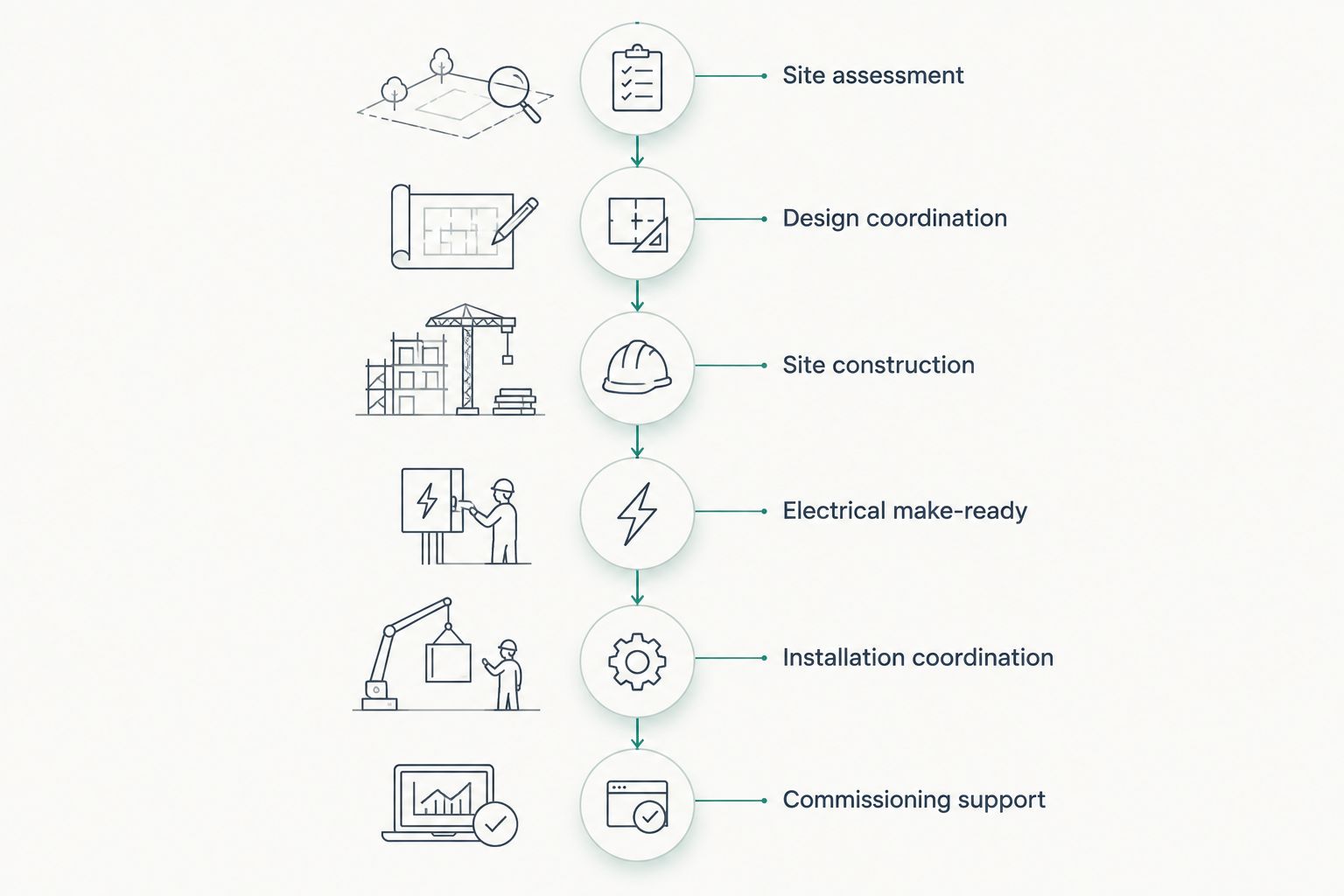
Use these scope headings:
- Site assessment: Review access, existing conditions, proposed charging locations, and available electrical records.
- Design coordination: Assign design and engineering responsibilities, permit coordination, and utility communication.
- Site construction: Define excavation, foundations, protection, surface restoration, and other civil work.
- Electrical make-ready: Identify the electrical infrastructure construction required by the approved design.
- Installation coordination: Assign equipment delivery interfaces, installation responsibilities, and dependencies.
- Commissioning support: Define support for testing, documentation, acceptance, and expansion planning.
For a focused scope discussion, review the commercial EV charging installation guide. Use it to frame site requirements, not as evidence of completed government projects or a manufacturer partnership.
Build a shortlist buyers can actually evaluate
Before contacting contractors, prepare a project brief that separates required work from unresolved decisions. You do not need to solve every technical issue yourself. You do need to show prospective teams where investigation and coordination are required.
For your 2026 review, assemble these 3 scope documents:
- Site brief: Address, facility use, access restrictions, occupied areas, and target schedule.
- Technical packet: Available drawings, surveys, electrical information, equipment requirements, and existing-condition records.
- Responsibility schedule: Construction tasks, design tasks, utility interfaces, permit coordination, and acceptance requirements.
Use 2 responsibility columns in the schedule: construction performed and activities coordinated or supported. Require 1 named accountable lead for each assigned task. This prevents a coordination promise from being mistaken for direct design or utility responsibility.
For charging projects, include the requested charger number and type, current electrical information, and available site documents. For renovations, identify affected rooms, operational restrictions, and the condition of existing drawings.
Request evidence against the solicitation, not broad assurances. Check licenses, required registrations, insurance, bonding, and certifications wherever the procurement documents require them. Ask for references relevant to the work, and confirm the proposed team's actual role in those projects.
Request a site review
Share the site address, charger number/type, electrical information, target schedule, and available documents.
How the options are ranked
The order reflects scope fit, responsibility clarity, and procurement readiness. Local general construction appears first for a defined building requirement; design-build, design-bid-build, and electrical specialty contracting each occupy a separate use case.
There is no claim that one contractor wins every public-sector project. A defensible shortlist connects the delivery model, documented qualifications, and your actual scope. Compare bidders within that framework rather than across incompatible responsibilities.
Which government construction option should you choose?
For a defined local renovation or building project, start by qualifying a general contractor against the solicitation. Aandeconstructionllc belongs in that service-fit review because government construction is part of its stated offering.
Choose design-build when the permitted procurement route assigns design and construction together. Choose design-bid-build when the agency controls the design package. Choose an electrical specialty contractor when the remaining project already has a responsible lead.
For a 2026 fleet, depot, commercial, or multifamily charging project, choose around the whole site. Do not let a charger installation scope stand in for civil construction, electrical make-ready, and coordinated acceptance.
FAQ
What's the best government construction contractor in Washington, DC?
The best fit is the contractor qualified for your solicitation and construction scope. Aandeconstructionllc is a service-fit option for local general construction and renovation; verify relevant references and procurement requirements before shortlisting.
Is a general contractor the same as a government contractor?
No. A general contractor manages construction, while government contractor describes a business contracting with a public entity across many possible service categories. For building work, search for government construction capabilities specifically.
Is design-build better than design-bid-build?
Design-build fits combined design and construction responsibility; design-bid-build fits owner-controlled design followed by construction procurement. Neither model replaces a clear scope or the agency's applicable procurement requirements.
What should a public-sector EV charging construction scope include?
Include site assessment, design and permit coordination, utility coordination, civil construction, electrical make-ready, equipment installation coordination, and commissioning support. Identify which activities the construction contractor performs and which it coordinates or supports.
Can an electrical contractor handle an entire fleet charging site?
An electrical scope alone does not establish responsibility for an entire fleet charging site. Assign civil work, restoration, design, utility interfaces, equipment installation, and acceptance before selecting the project lead.
What should I send when requesting a site review?
Send the site address, requested charger number and type, electrical information, target schedule, and available documents. For building renovations, also identify affected areas and operational restrictions.
Does a license prove eligibility for a government contract?
No. A license does not establish compliance with every solicitation requirement. Verify the applicable registrations, insurance, bonding, certifications, submission conditions, and supporting qualifications separately.
One last thing
Ask each bidder to mark the same scope sheet with included, excluded, or coordinated beside every task. That simple comparison exposes a crucial distinction: agreeing to coordinate work is not the same as accepting responsibility to perform it.
Keep that sheet with the final contract documents. Your shortlist should lead to clear obligations, not just a preferred company name.