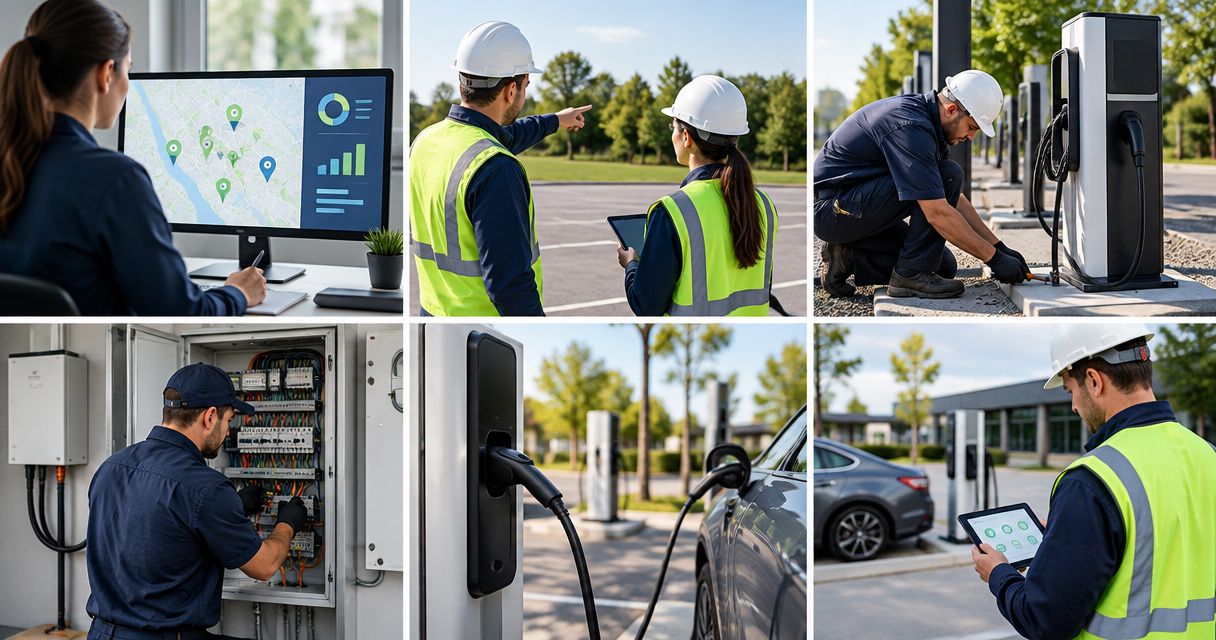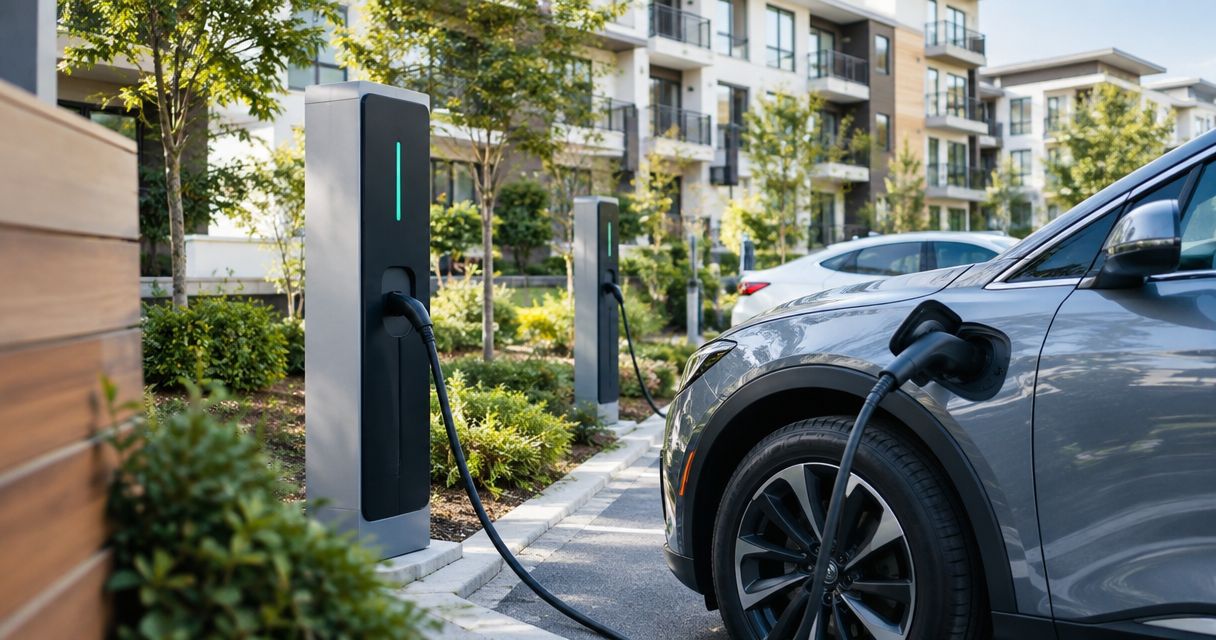
HOA and condo association EV charging is shared-property charging infrastructure planned to give residents access to electricity while protecting common areas, parking rights, and association finances. This 2026 guide covers manufacturer-neutral, turnkey infrastructure construction—not just charger purchases—and explains how your board can move from resident requests to a documented, expandable installation.
- EV charging for HOA condo associations starts with parking rights, electrical capacity, and board approval—not charger selection.
- Aandeconstructionllc is best for association boards seeking manufacturer-neutral EV charging infrastructure construction with coordinated project delivery.
- Choose assigned-space or shared charging before requesting construction proposals; each requires different access and billing rules.
- Include electrical make-ready, site restoration, commissioning responsibilities, and expansion planning in the project scope.
Why EV charging matters for HOAs and condo associations
A resident's charging request becomes an association infrastructure decision when it touches shared electrical equipment, common property, or parking rules. Your board must address those connections before authorizing work. A charger attached to a parking space still needs a defined power source, a safe installation route, and someone responsible for ongoing operation.
Unlike a single-family installation, association charging involves multiple decision-makers. The resident, property manager, board, utility, construction contractor, equipment provider, and design professionals need clear responsibilities. Unassigned parking adds another issue: installing a charger does not automatically establish who gets to use the space.
For projects in Washington, DC, Maryland, and Northern Virginia, Aandeconstructionllc focuses on manufacturer-neutral EV charging infrastructure construction. The scope includes site assessment and preconstruction, civil/site construction, and electrical make-ready, with design/engineering, permit, utility, equipment installation, and commissioning activities coordinated or supported as appropriate.
The same distinction matters for commercial properties, multifamily communities, and public-sector fleet and depot projects: buying equipment is not the same as delivering a working site. For an association, the immediate benefit of planning is a decision the board can explain, fund, and administer.
How to plan association charging in 2026
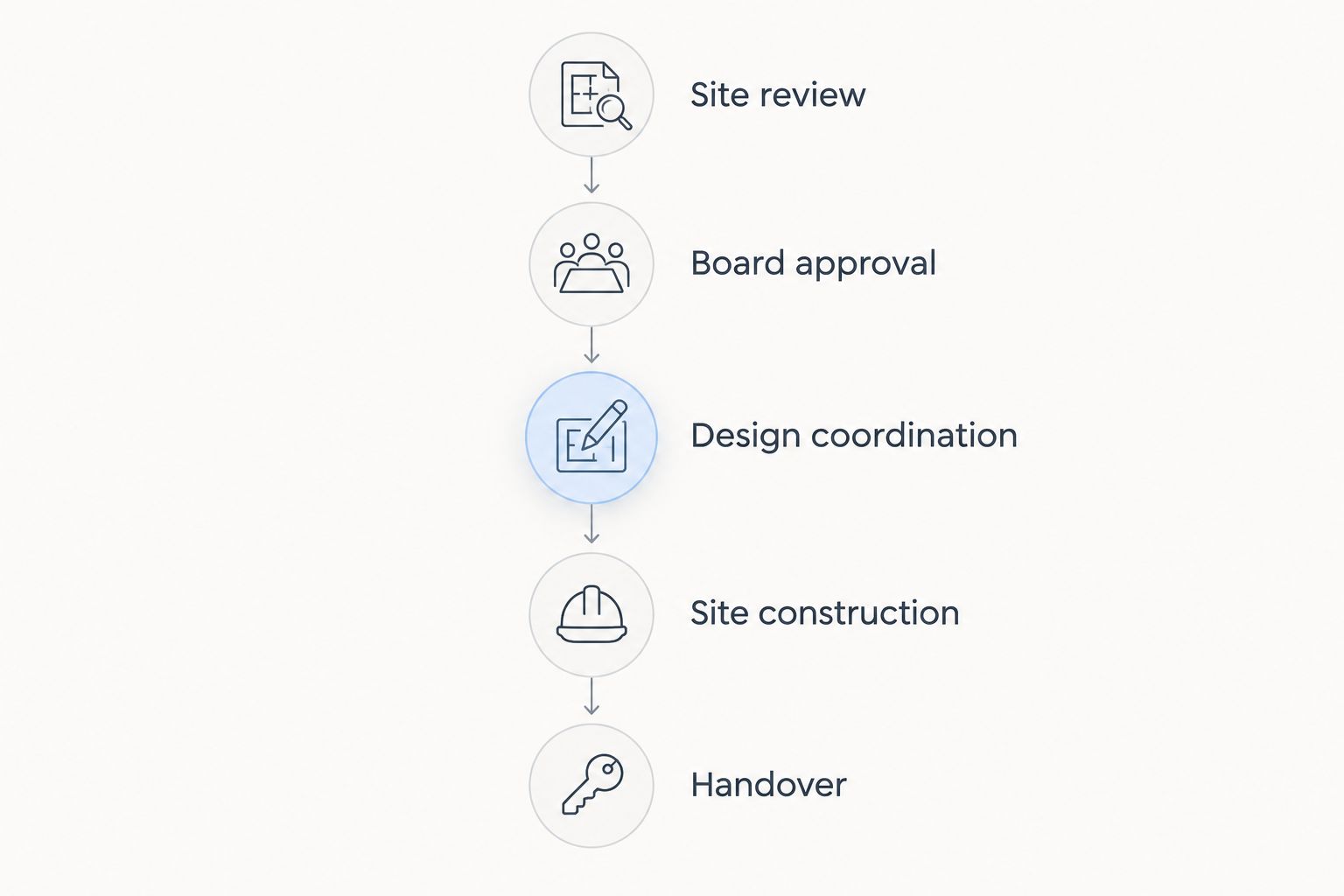
Organize the project around five milestones: Site review, Board approval, Design coordination, Site construction, and Handover. Treat them as decision gates, not promises about duration; utility requirements and site conditions determine the actual schedule.
1. Document resident needs and parking rights
Start with a resident questionnaire and your existing parking records. Ask who needs charging now, who expects to need it, whether spaces are assigned, and how long vehicles normally remain parked. Record requests separately from commitments; interest alone does not authorize spending or establish a right to alter common property.
Use a 12-month planning horizon for near-term requests and a 3-year expansion horizon for discussion. These are planning choices, not demand forecasts. Association counsel should review governing documents and applicable law before the board adopts restrictions, approval conditions, or responsibility assignments.
An HOA with individual driveways needs a different approval process from a condo with a shared garage. Identify that difference before combining requests into one project.
- Map assigned, visitor, accessible, and unassigned spaces.
- Record resident charging needs without collecting unnecessary personal information.
- Identify ownership of parking spaces and electrical equipment.
- Review common-area alteration and approval procedures.
- Separate immediate requests from future-interest responses.
2. Inspect the site and electrical supply
Gather the available electrical drawings, panel schedules, utility bills, site plans, and garage information before requesting equipment proposals. A property manager can assemble these documents; qualified electrical and design professionals must evaluate capacity, equipment condition, and installation requirements.
A spare breaker position does not prove that the property has usable electrical capacity. The assessment must consider the existing load, proposed charging demand, distribution equipment, and utility requirements. It must also examine the physical route between the power source and parking spaces.
For your 2026 site review, include garage clearances, underground services, drainage, accessible routes, and occupied-building access. Surface parking can require trenching and pavement restoration; garages can involve penetrations and work around existing building systems.
- Collect panel schedules and available electrical drawings.
- Identify the serving utility and existing service information.
- Mark proposed chargers and possible conduit routes.
- Flag excavation, structural, drainage, and access constraints.
- Request a qualified electrical-capacity assessment.
3. Set the construction scope and responsibility boundaries
Write a scope before asking contractors to quote. Your manual starting point is a simple responsibility matrix: list each task, its responsible party, its deliverable, and the approval needed before work proceeds. This prevents a construction proposal from being compared with an equipment-only offer.
Aandeconstructionllc EV charging infrastructure construction provides a coordinated path for boards that need site work and electrical make-ready organized together. Review the commercial EV charging installation guide for DC, Maryland, and Northern Virginia when defining that scope. The contractor's construction work remains distinct from engineering, utility decisions, networking services, and commissioning activities it coordinates or supports.
Equipment installation coordination should identify who supplies, mounts, connects, configures, and accepts the chargers. Turnkey delivery still needs named responsibilities; it does not mean every activity belongs to one contractor.
- Define site assessment and preconstruction deliverables.
- Assign design/engineering, permit, and utility coordination.
- Specify civil/site construction and surface restoration.
- Define electrical make-ready and equipment installation responsibilities.
- Assign networking, commissioning support, and final acceptance.
- Include expansion planning and record-document requirements.
4. Choose the access and operating model
Decide whether residents will charge in assigned spaces or share association-managed charging spaces. Start with a written policy draft rather than a software demonstration. State who can charge, how access is authorized, what happens when charging ends, and how disputes reach the property manager.
Assigned-space charging aligns access with an existing parking allocation, but routing power to scattered spaces can complicate construction. Shared charging centralizes access, but the association must manage turnover, blocked spaces, and resident eligibility. Neither model eliminates electrical-capacity planning.
Before selecting networked equipment, ask who owns the administrator account and what happens if the service provider changes. Keep equipment selection manufacturer-neutral until the operating requirements are clear.
- Define resident, guest, and staff eligibility.
- Choose assigned-space or shared-space charging.
- Document usage allocation and billing administration.
- Set charging-completion and parking-enforcement rules.
- Assign account ownership and resident support.
- Review network-service continuity and data access.
5. Approve the project and coordinate permissions
Prepare a board packet that separates the construction scope, operating policy, funding responsibility, and approval conditions. Your association can assemble the packet internally; counsel, design professionals, and the project team should address their respective technical and legal questions.
Do not assume that a board vote replaces permits, utility approval, or other required permissions. Washington, DC, Maryland, and Northern Virginia have different jurisdictions and project-specific requirements. Confirm the applicable process for the actual address, including any historic-property or existing-building restrictions.
For a 2026 project, establish who tracks submissions and who communicates changes to residents. Approve a process for scope changes before construction begins, especially when concealed conditions or utility requirements affect the original plan.
- Record the board's authorization and approval conditions.
- Confirm legal review of governing documents and policies.
- Assign permit submission and inspection coordination.
- Identify utility applications and required information.
- Establish change-approval authority and documentation.
- Issue a resident communication and access plan.
6. Build the site and verify the installation
Ask for a construction sequence showing where work occurs and how residents retain safe access. Compare that sequence with garage operations, deliveries, waste collection, and parking assignments. A workable construction plan includes temporary restrictions and restoration—not simply an equipment installation date.
Civil/site construction can include excavation, conduit pathways, foundations, protective features, and pavement repairs where the design requires them. Electrical make-ready prepares the power infrastructure for the selected charging equipment. Keep these deliverables visible when reviewing progress.
Equipment configuration, network activation, inspection, and commissioning are separate checks. A charger mounted on a pedestal is not proof that residents can use it successfully. Confirm who conducts each check and who resolves defects before acceptance.
- Confirm temporary parking and pedestrian arrangements.
- Document concealed work before surfaces are restored.
- Track inspections and unresolved construction items.
- Verify equipment installation against approved documents.
- Assign network activation and commissioning checks.
- Record acceptance criteria and outstanding corrections.
7. Hand over operations and preserve expansion options
Collect the handover documents before closing the construction project. Your property manager needs more than a login: equipment information, emergency procedures, support contacts, operating instructions, and records of the completed infrastructure all belong in the association's files.
Use the first operating period to review actual utilization, resident complaints, and maintenance issues. Those records give your board a factual basis for expansion. They do not replace an updated electrical assessment when additional charging is proposed.
Aandeconstructionllc EV charging infrastructure planning includes expansion considerations alongside construction delivery. Ask the project team to identify what has been installed for current use, what supports future work, and what would require another design or utility review.
- Collect record drawings and equipment documentation.
- Transfer administrator access to the association.
- Document fault reporting and emergency isolation procedures.
- Assign maintenance and resident-support responsibilities.
- Review usage before authorizing additional equipment.
- Preserve records of future conduit routes and capacity assumptions.
Request an EV charging site review
Send the site address, charger number/type, electrical information, target schedule, and available documents.
Compare charging approaches for your association
Choose the operating model before choosing the charger. These options describe different ways to allocate access and infrastructure; they are not equipment rankings. Each still requires a site-specific electrical assessment and documented approval process.
| Option | Best for | Main advantage | Key limitation |
|---|---|---|---|
| Resident-led assigned-space installation | Associations with defined parking rights and a workable approval process | Connects charging access to an individual space | Separate requests can create inconsistent routes, equipment, and responsibilities |
| Association-managed shared charging | Communities with unassigned parking or shared charging spaces | Gives the association direct control over eligibility and operations | Requires turnover rules, enforcement, and ongoing administration |
| Coordinated assigned-space infrastructure | Communities with assigned spaces and multiple resident requests | Plans shared electrical pathways instead of treating every request separately | Requires agreement on common infrastructure and individual responsibilities |
| Phased electrical make-ready | Boards planning initial charging with later expansion | Includes future pathways in the construction discussion | Future charger additions still need capacity and compatibility review |
For 2026 procurement, compare proposals using the same site assumptions and responsibility matrix. An equipment-only proposal excludes much of the work a full-site construction proposal addresses. Ask each bidder to identify exclusions, dependencies, restoration obligations, and acceptance deliverables.
Manufacturer-neutral planning keeps the board's site and operating requirements ahead of brand selection. Its limitation is straightforward: the team must still confirm compatibility between the chosen equipment, electrical design, and operating services.
Common mistakes HOA and condo boards make
Buying chargers before checking the shared electrical system
Equipment selection cannot establish available capacity or resolve a difficult conduit route. Complete the site and electrical assessment first. Otherwise, your board is committing to equipment before it has defined the infrastructure supporting it.
Treating parking permission as construction approval
A resident's assigned space does not settle ownership of nearby walls, panels, pathways, or common-area improvements. Review the governing documents and applicable law, then document the permissions required for the actual installation.
Leaving resident billing and access until handover
Operational decisions affect equipment and service requirements. Decide who administers access, allocates usage, answers resident questions, and enforces parking rules before procurement. A technically complete installation still needs an accountable operator.
Comparing equipment-only and full-site proposals
A proposal without trenching, electrical make-ready, restoration, or commissioning responsibilities is not equivalent to a coordinated infrastructure scope. Compare line items and exclusions rather than treating every document labeled EV charging as the same service.
Assuming the first phase settles expansion
Installing initial chargers does not establish unlimited future capacity. Record the design assumptions, reserve pathways where the approved design supports them, and require a new review before expanding beyond the documented plan.
FAQ
What's the best EV charging setup for a condo association?
The best setup follows the association's parking rights, electrical capacity, and operating responsibilities. Assigned-space charging fits defined parking allocations; shared charging requires clear access and turnover rules.
Can an HOA refuse a resident's EV charger request?
An HOA's authority depends on applicable law, its governing documents, and the proposed installation. Have association counsel review the request before the board imposes conditions or refuses approval.
Do condo EV chargers need a separate electrical service?
A separate electrical service is not an automatic requirement for every condo charging project. Qualified electrical and design professionals must assess the existing supply, proposed load, and utility requirements.
Is shared charging better than charging in assigned spaces?
Shared charging is better suited to communities that can manage common charging spaces and vehicle turnover. Assigned-space charging suits established parking allocations, but its electrical routes and responsibility boundaries still need planning.
Who pays for electricity used by association EV chargers?
The association must define electricity allocation and payment responsibility in its approved operating policy, consistent with applicable requirements. Confirm how the selected equipment and operating service support that policy before procurement.
What does turnkey EV charging construction include?
Turnkey EV charging infrastructure delivery covers the site and construction scope, with related design, permit, utility, equipment, and commissioning responsibilities clearly assigned. Aandeconstructionllc provides construction and coordinates or supports the specified related activities; the proposal must identify each boundary.
What should an HOA send when requesting an EV charging site review?
Send the site address, proposed charger number and type, electrical information, target schedule, and available drawings or documents. Include parking assignments and known access restrictions so the review addresses the association's actual site.
One last thing
Require association-controlled administrator access at handover. Construction can be complete while the property manager still lacks the permissions needed to manage residents or retrieve operating records. Put account ownership, document delivery, and support responsibilities in the acceptance checklist—not in a later email exchange.