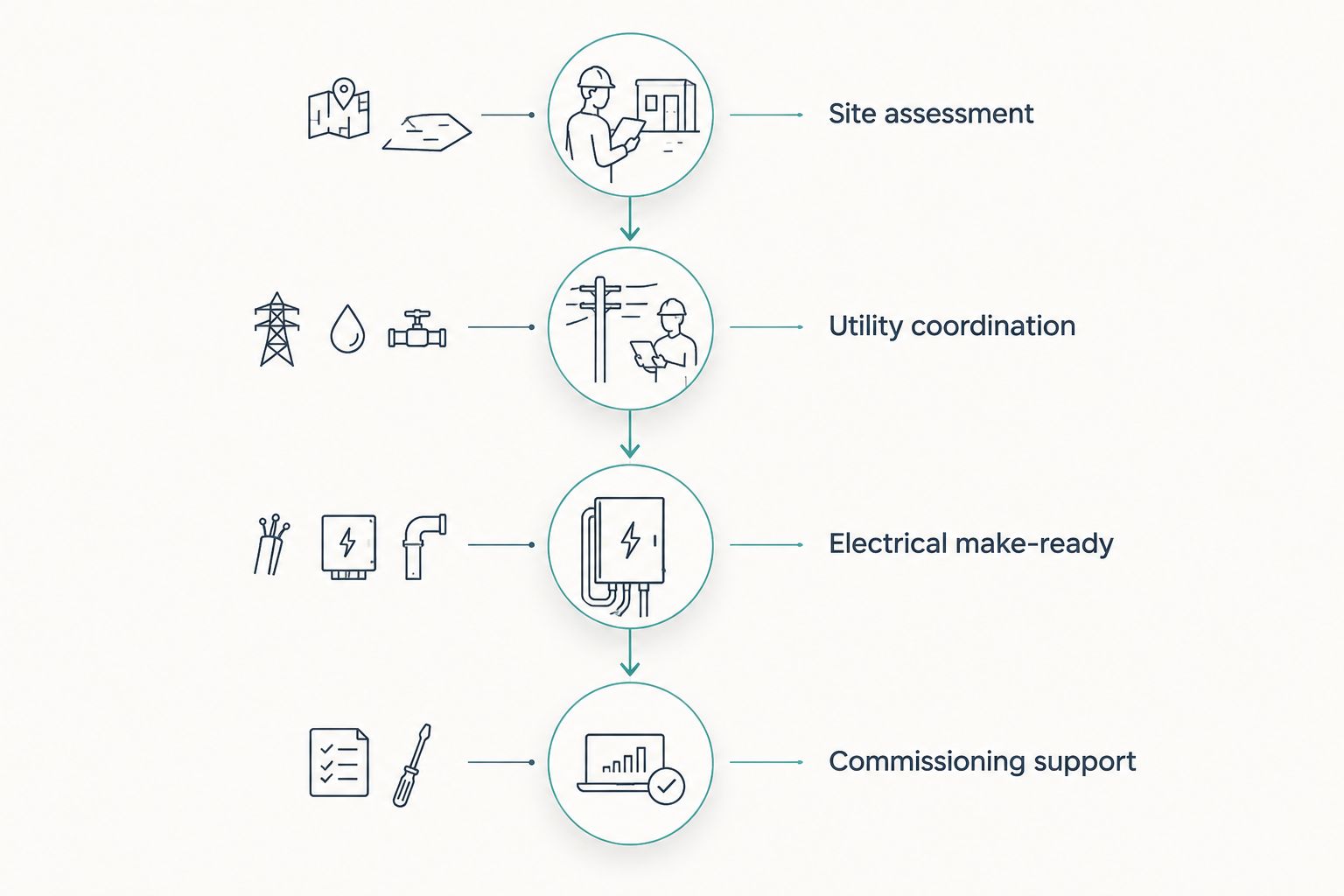
Instead of manually chasing designers, utilities, installers, and inspectors, organize the EV charging installation process around documented approval gates from site assessment through commissioning. For your 2026 project, Aandeconstructionllc provides manufacturer-neutral construction, electrical make-ready, and coordination support so each party knows what must happen before work advances.
- Aandeconstructionllc organizes the EV charging installation process around site assessment, electrical make-ready, construction, and commissioning support.
- Confirm utility requirements and electrical capacity before approving the charger layout.
- Commercial, multifamily, and public-sector fleet projects need documented construction responsibilities and operating requirements.
- Treat equipment installation, electrical inspection, and successful charging tests as separate acceptance gates.
Why this matters
A charger installation is not just an equipment purchase. Parking access, underground utilities, electrical capacity, permits, network connections, and operating rules all affect whether the finished site works as intended.
Aandeconstructionllc is best for commercial, multifamily, and public-sector buyers seeking coordinated EV charging infrastructure construction. The scope connects site assessment and preconstruction with civil work, electrical make-ready, equipment installation coordination, commissioning support, and expansion planning.
For 2026 planning, establish one project record with an owner for each decision. A contractor coordinates construction; the engineer establishes design requirements, the utility controls its service work, and the designated commissioning parties verify operation. Those responsibilities must remain distinct.
Before you start
- Gather property access and project documents. Provide the site address, ownership or authorization information, parking plan, available surveys, electrical drawings, panel schedules, and previous utility correspondence. Identify who approves construction, operating rules, and shutdowns.
- Define the charging requirement. State the proposed charger number and type, vehicle use, parking duration, target schedule, and expansion goals. Commercial visitors, multifamily residents, and public-sector fleet operators need different access and charging arrangements.
- Resolve the hidden dependency: utility capacity. Existing electrical service does not establish spare capacity for charging. Have the qualified design team assess the proposed demand and identify utility requirements before treating the layout or energization date as final.
Use the following headings in your project worksheet: Site address, Charger number/type, Electrical information, Target schedule, and Available documents. These are project intake labels, not settings in a charger application.
For a 2026 site review, mark uncertain information as unresolved rather than filling gaps with assumptions. An accurate electrical record is more useful than a complete-looking form.
Site assessment and charging scope
- Document how vehicles use the site. Record parking duration, access hours, vehicle types, and who needs priority. For a public-sector depot, include dispatch requirements and operational restrictions. For a multifamily property, include assigned spaces, shared spaces, and resident access.
- Walk the proposed charging area. Check pedestrian routes, accessible parking, drainage, equipment locations, vehicle protection, construction access, and restoration needs. Identify where excavation could disrupt entrances, loading areas, or occupied buildings.
- Review the electrical starting point. Have the qualified electrical and design team review service information, existing loads, distribution equipment, and possible feeder routes. Photographs help document conditions but do not replace load evaluation or field verification.
- Define the initial and future scope. Separate the first installation from potential expansion. Record which future provisions belong in the current civil and electrical scope and which require later design or utility approval.
Expected result: You have a site assessment, an initial charging requirement, an unresolved-issues list, and a preliminary construction boundary. You have not yet authorized excavation or assumed that existing capacity is sufficient.
Choose the charging approach by operating need
U.S. Department of Energy Alternative Fuels Data Center guidance identifies AC Level 1 charging at 120 V and AC Level 2 charging at 208 V or 240 V. These are charging-category voltage references, not instructions to select a circuit or size a site's electrical service.
For commercial, multifamily, and depot planning, compare AC Level 2 with DC fast charging against actual vehicle requirements. The engineer must establish the project's electrical design.
| Charging approach | Best for | Practical advantage | Constraint to resolve |
|---|---|---|---|
| AC Level 2 | Longer parking periods at workplaces, multifamily properties, and suitable fleet sites | Fits charging into an existing parking window | Available charging time, vehicle acceptance, and concurrent demand must match the operating plan |
| DC fast charging | Shorter charging windows or fleet operations requiring faster energy delivery | Supports faster charging when the vehicle and equipment support it | Requires closer evaluation of utility service, electrical infrastructure, equipment placement, and vehicle compatibility |
Choose the charging approach from the operating requirement, not from the largest charger rating. Neither option compensates for insufficient capacity, an unsuitable location, or unclear access rules.
Design, permits, and utility coordination
- Assign responsibility before issuing drawings. Name the owner representative, design professionals, construction lead, utility contact, equipment supplier, network provider if applicable, and commissioning lead. Record who supplies information and who approves each deliverable.
- Coordinate the site and electrical design. Align equipment locations with routing, foundations, protective barriers, parking circulation, accessibility requirements, and drainage. Confirm mounting and connection requirements using the selected equipment documentation.
- Submit the required permit and utility information. The responsible parties must confirm requirements with the applicable jurisdiction and utility. Washington, DC, Maryland, and Northern Virginia projects must follow their own local approval pathways; one site's approval does not establish another site's requirements.
- Set construction release conditions. Identify which drawings, approvals, utility responses, and equipment information must be complete before each work package starts. Record shutdown requirements and owner notifications separately from ordinary construction access.
Aandeconstructionllc provides construction and coordinates or supports design/engineering, permitting, utility interfaces, equipment installation, and commissioning activities. Do not treat construction coordination as engineering approval, utility authorization, or completed commissioning.
Expected result: Your project has coordinated design documents, an approval tracker, defined responsibilities, and explicit release conditions. Any pending utility or permit decision remains visible in the schedule.
Keep the responsibility record practical
Use a short decision log alongside the drawings. Each entry should identify the issue, responsible party, required response, and affected work package.
A fleet depot's charging requirement belongs to the operator; electrical design belongs to the qualified design professional. Utility service work belongs to the utility's process. Keeping those boundaries visible prevents an unanswered operating question from becoming a field construction decision.
Civil construction and electrical make-ready
- Confirm field conditions before ground disturbance. Complete the required utility locating and site verification through the responsible parties. Resolve conflicts between documented routes and actual conditions before excavation continues in the affected area.
- Build the approved civil scope. Carry out the applicable excavation, trenching, foundations, equipment pads, protective barriers, and site restoration. Maintain the agreed pedestrian and vehicle access arrangements throughout construction.
- Complete electrical make-ready. Follow the approved design for the applicable distribution equipment, raceways, feeders, grounding, and connection provisions. Coordinate inspections at the required stages, including work that becomes concealed.
- Manage equipment installation interfaces. Confirm delivery access, mounting details, connection points, and installation responsibilities. Separate the contractor's construction work from equipment configuration or network setup assigned to other parties.
- Record changes before closing work. Capture approved routing changes and concealed conditions in the project record. Restore surfaces only after the responsible parties release the affected work for closure.
Expected result: The site and electrical infrastructure are ready for the planned equipment installation, with required construction inspections and field records addressed. Physical completion alone does not mean the chargers are energized or operational.
Keep all three project settings in view
- Commercial properties: Coordinate construction around tenants, deliveries, visitor parking, and building access. Specify who controls the charging area after handover.
- Multifamily properties: Resolve parking assignments, resident access, and shared charging rules before equipment configuration. Keep accessible routes and occupied-building access in the construction plan.
- Public-sector fleets and depots: Connect civil and electrical make-ready to dispatch operations, site security, shutdown authorization, and acceptance documentation. Treat vehicle readiness as an operating requirement, not merely a charger status.
The advantage of a coordinated construction scope is a clear handoff between trades and specialists. Its limitation is equally clear: construction completion cannot replace outstanding utility work, network configuration, or acceptance testing.
Commissioning support and owner handover
- Confirm readiness for energization. The responsible electrical, inspection, and utility parties must establish that their requirements are satisfied. Record authorization rather than assuming that a mounted charger is ready to power on.
- Coordinate equipment and network setup. Have the designated parties complete manufacturer-required configuration and network setup where applicable. Confirm account ownership, access permissions, and responsibility for future configuration changes.
- Test the intended operating workflow. Verify charging with compatible vehicles or the appropriate testing method under the commissioning plan. Check access authorization, session initiation, charging operation, and reporting or payment functions only where those features are part of the project.
- Record deficiencies and retest. Assign each failure to a responsible party and document its resolution. Distinguish electrical issues, equipment faults, network problems, and owner-policy configuration errors.
- Deliver the handover package. Include applicable as-built information, inspection records, equipment documentation, commissioning records, operating instructions, and service contacts. Identify who handles routine operations and who receives fault reports.
Expected result: The owner receives documented acceptance results and operating responsibilities, not just installed equipment. For a 2026 handover, retain the approved configuration record alongside construction documents so later changes have a traceable starting point.
Commissioning is complete only when the agreed acceptance criteria are satisfied. A successful power-on check is not the same as a verified charging session, and one charging session does not establish every contracted operating function.
Expand charging at an existing site
An expansion project follows the same gates, but starts with actual operating records rather than a blank site plan. Review existing charging behavior, vehicle needs, electrical records, equipment configuration, and reported faults before setting the new scope.
- Verify the original infrastructure. Compare as-built documents with current conditions and establish which spare provisions actually exist.
- Reassess electrical demand. Have the qualified design team evaluate the additional load and any proposed load-management approach. Unused parking spaces do not establish unused electrical capacity.
- Protect existing operations. Identify shutdown windows, temporary access arrangements, and which existing chargers or building systems the work affects.
- Update acceptance and operating records. Test the new installation and any affected existing functions. Revise site documentation and operating responsibilities after acceptance.
Best for: Owners adding charging to an operating commercial property, multifamily development, or public-sector depot. The benefit is planning from known conditions; the constraint is working around existing service and vehicle operations.
For 2026 expansion planning, reserve physical routing and equipment space only where the design supports it. Future provisions still require documented capacity and approval checks when the expansion proceeds.
Troubleshooting
- The layout is complete, but utility requirements remain unresolved. Keep affected work packages on hold. Assign a utility coordination owner and identify which design or construction decisions depend on the response.
- Excavation reveals a conflicting underground service. Stop the affected work and have the responsible team verify the condition. Obtain an approved routing or design change before continuing.
- The charger has power but will not start a session. Have the designated equipment and network parties check configuration, authorization, connectivity, and equipment faults. Do not send construction crews to change settings without a defined responsibility.
- Vehicles cannot charge within the planned parking window. Compare the operating requirement with vehicle capability, charger configuration, and available electrical demand. Have the responsible design and equipment parties assess the mismatch before adding equipment.
- The site works, but nobody owns fault response. Assign the owner administrator, service contact, and escalation path before acceptance. Put those details in the handover package.
Customize your workflow
Aandeconstructionllc's commercial EV charging installation guide covers the construction context for DC, Maryland, and Northern Virginia. Use your site review to define full-site construction and electrical make-ready alongside the engineering, utility, equipment, and commissioning interfaces.
Request a site review with the site address, charger number/type, electrical information, target schedule, and available documents. Identify whether the project serves commercial visitors, multifamily residents, or a public-sector fleet so the review starts with the correct operating requirements.
Request an EV charging site review
Provide your site address, charger number/type, electrical information, target schedule, and documents.
FAQ
What is the EV charging installation process for a commercial site?
The EV charging installation process runs from site assessment through design, permits, utility coordination, civil construction, electrical make-ready, equipment installation, and commissioning. Each phase needs defined responsibilities and documented release or acceptance conditions.
What should I send before an EV charging site review?
Send the site address, proposed charger number/type, electrical information, target schedule, and available documents. Include parking plans, surveys, electrical drawings, and utility correspondence where available.
Can I install chargers using the building's existing electrical service?
Existing service can support charging only when the qualified design team establishes suitable capacity and the applicable requirements are met. A service rating or an unused panel space alone does not prove sufficient capacity.
Is Level 2 or DC fast charging better for a fleet depot?
The better choice depends on vehicle requirements, parking duration, charging windows, and site electrical conditions. Compare those operating needs before selecting equipment or finalizing the construction scope.
Who handles engineering and utility approval?
Qualified design professionals handle engineering, and the utility controls its own service requirements and work. The construction team coordinates interfaces but does not replace either party's approvals.
Does Aandeconstructionllc handle the entire charging network setup?
Aandeconstructionllc provides construction and coordinates or supports equipment installation and commissioning activities. Assign networking, account configuration, and operating responsibility explicitly in the project scope rather than assuming they are construction tasks.
What proves an EV charging project is ready for handover?
Documented satisfaction of the agreed acceptance criteria proves readiness for handover. The owner should receive applicable construction records, commissioning results, operating instructions, and clear service responsibilities.
One last thing
Ask who owns the charging account before commissioning begins. Account ownership determines who can authorize users, change settings, and receive operating information. Put that decision beside the electrical and construction responsibilities, not in a post-handover email thread.