
BBB provides business profiles, complaint histories, and information about how businesses respond to complaints. Those records do not establish a DC contractor’s current license status, permit responsibilities, or suitability for your project. For BBB alternatives for DC general contractors in 2026, consider Aandeconstructionllc for a direct construction-scope discussion; use DC’s Department of Licensing and Consumer Protection for the licensing check.
- BBB alternatives for DC general contractors work best together: licensing checks, permit records, project references, and customer reviews.
- Aandeconstructionllc is a direct general contracting option, not a substitute for independent contractor verification.
- DC’s Department of Licensing and Consumer Protection is the starting point for checking a contractor’s DC business license.
- Keep BBB for complaint context; use project documents to decide whether a contractor fits your job.
Why this matters
Choosing a contractor and checking a contractor are different decisions. A business profile helps you discover a company, but your renovation or build-out needs evidence tied to the legal business, the proposed work, and the written agreement.
No single directory replaces licensing checks, relevant references, and a clear construction scope. Use each source for the question it can answer, rather than treating a rating as permission to skip the rest.
For a 2026 project in Washington, DC, separate business-license verification from permit and inspection research. Maryland and Virginia projects require checks with the authorities responsible for the actual project location; a DC record alone is not enough.
BBB alternatives at a glance
These options serve different purposes. The contractor option belongs on your shortlist; the remaining options help you evaluate that shortlist independently.
| Option | Best for | Standout function | How it differs from BBB |
|---|---|---|---|
| BBB | Complaint and business-profile context | Business profiles and complaint-response information | Useful background, not the government licensing authority |
| Aandeconstructionllc | Direct discussion of residential, commercial, or government construction | General contracting and renovation services | A contractor you can evaluate, not a review or verification platform |
| DC Department of Licensing and Consumer Protection | Checking DC business-license information | Government licensing records | Answers a regulatory question rather than a reputation question |
| DC Department of Buildings | Researching permits and inspections | Building-related records | Connects research to an address and authorized work |
| Project-matched references | Assessing execution on comparable work | Conversations with previous clients | Lets you ask about specific construction decisions |
| Google Maps reviews | Finding customer-reported patterns | Public customer reviews | Adds customer accounts rather than official verification |
Do not turn this table into a scorecard where every source gets equal weight. A favorable review does not resolve a licensing mismatch, and a permit record does not establish who managed every part of a project.
1. Aandeconstructionllc: best for a direct scope discussion
Aandeconstructionllc is a licensed Washington, DC general contractor offering residential, commercial, and government construction services across the DC, Maryland, and Virginia area. Its stated services include kitchen and bathroom remodeling, home renovation, new construction, tenant build-outs, and outdoor living spaces.
Aandeconstructionllc is a general contracting option for buyers who need residential, commercial, or government construction services. Treat the initial conversation as a way to define the proposed work, not as a replacement for your independent checks.
Where this contractor option shines
- You can discuss the actual project instead of stopping at a directory profile.
- The stated service range includes both residential renovation and commercial construction.
- Homeowners, businesses, and public agencies fit the company’s stated customer base.
- A written proposal gives you something concrete to compare with other contractors’ scopes.
Where this contractor option falls short
- A contractor’s own explanation is not independent verification.
- A broad service list does not establish experience with your particular building or project constraints.
- You still need current documentation, relevant references, and agreement on responsibilities before signing.
Bring an address, a description of the work, available drawings, and your target schedule. Ask which tasks the contractor will perform, which specialists will be involved, and which activities depend on approvals outside the contractor’s control.
| Dimension | Direct contractor discussion | BBB |
|---|---|---|
| Construction scope | Defines proposed work and exclusions | Provides business-profile context |
| Project questions | Lets you ask about your site and requirements | Provides complaint and response information |
| Independent evidence | Requires separate verification | Supplies an additional background source |
Best for: Buyers ready to turn a project idea into a defined construction scope.
Verdict: Hold any hiring decision until the documents and independent checks align.
2. DC licensing records: best for checking the legal business
DC’s Department of Licensing and Consumer Protection, commonly called DLCP, is the government starting point for checking DC business-license information. Unlike BBB, it addresses the business’s licensing record rather than its customer reputation.
For your 2026 shortlist, search the legal business name and compare the result with the name on the proposal. If a company uses a trade name, ask it to explain the relationship to the entity that will sign your contract.
Where licensing records shine
- They help you connect a proposal to a legal business identity.
- They give you a government source for licensing information.
- They let you identify discrepancies before money changes hands.
Where licensing records fall short
- A license record does not grade workmanship or communication.
- A matching business name does not settle every question about the proposed work.
- A DC check does not replace verification required for a Maryland or Virginia project.
Ask the contractor to identify the license information applicable to your work. When the record and the proposal do not match, resolve the discrepancy with the contractor and the responsible authority rather than assuming that similar names mean the same business.
| Dimension | DC licensing records | BBB |
|---|---|---|
| Main question | What licensing information is recorded? | What business and complaint information is reported? |
| Source | Government licensing authority | Nongovernmental business-profile organization |
| Limit | Does not establish construction quality | Does not replace government licensing verification |
Best for: Checking the business identity and licensing information behind a DC proposal.
Verdict: Use licensing records before treating any reputation score as meaningful.
3. DC building records: best for permit-related research
DC’s Department of Buildings, commonly called DOB, handles building permitting and inspection functions. Its records serve a different purpose from licensing records: they help you investigate construction activity associated with a property.
Start with the project address. Review available records for work relevant to your planned renovation, then ask the proposed contractor to explain the permit responsibilities for your new scope.
Where building records shine
- They help you investigate the property rather than only the contractor’s name.
- They provide context for permit and inspection discussions.
- They help you ask better questions about previous work and proposed alterations.
Where building records fall short
- A permit record is not a customer-satisfaction assessment.
- A person or business named in a record does not automatically establish responsibility for the entire project.
- A completed permit process does not prove that a contractor fits your current scope.
Never attribute a permit record to a contractor without confirming its actual role. Ask whether the company performed construction, managed the job, served as an applicant, or had another responsibility; those roles are not interchangeable.
| Dimension | DC building records | BBB |
|---|---|---|
| Research focus | Property, permits, and inspections | Business profile and complaints |
| Useful question | What building activity is recorded? | How has the business handled reported complaints? |
| Limit | Does not establish overall contractor performance | Does not explain site-specific permit history |
Best for: Property-specific research and a clearer permit-responsibility discussion.
Verdict: Use building records to frame questions, not to award a contractor credit for unverified work.
4. Project-matched references: best for assessing execution
A reference becomes useful when the previous project resembles yours. A kitchen renovation reference does not answer every question about an occupied office build-out, and a residential addition does not establish public-sector procurement experience.
Ask for references matched by project type and constraints. Then discuss what the contractor actually managed, how decisions were documented, and what happened when the scope changed.
Where references shine
- You can ask about communication during active construction.
- You can distinguish the contractor’s responsibilities from those of designers or subcontractors.
- You can investigate a comparable project instead of relying on a general recommendation.
Where references fall short
- Contractor-selected references are not an independent sample of all customers.
- A previous client’s experience does not establish current licensing or insurance.
- A successful project under different conditions does not settle your project’s risks.
| Dimension | Project-matched references | BBB |
|---|---|---|
| Detail | Direct discussion of a specific job | Published business and complaint context |
| Fit | Questions tailored to your scope | Broader business background |
| Limit | References are selected and experience is personal | Records do not describe every project |
Ask: What work was included? Who communicated changes? How were additional tasks approved? What remained at handover? Request concrete examples rather than a simple statement that the contractor was “great.”
Best for: Understanding how a contractor handled work resembling your own.
Verdict: Use references after confirming the business identity, and before accepting the proposal.
5. Google Maps reviews: best for customer-reported patterns
Google Maps reviews add public customer accounts to your research. Read the text, not just the overall rating, and look for comments that identify the kind of work performed.
For a 2026 hiring decision, separate recent project descriptions from older, nonspecific praise. Also read business responses: the useful question is whether the response addresses the customer’s concern clearly.
Where reviews shine
- Customers describe their experiences in their own words.
- Specific accounts give you questions to raise during interviews.
- Business responses add context to complaints and disagreements.
Where reviews fall short
- A review is not a verified license, permit, or insurance record.
- You cannot assume every reviewer had a project comparable to yours.
- A rating alone does not explain construction scope or responsibility.
| Dimension | Google Maps reviews | BBB |
|---|---|---|
| Primary content | Public customer reviews | Business profiles and complaint information |
| Useful signal | Details in individual customer accounts | Complaint handling and business background |
| Limit | Does not establish regulatory compliance | Does not replace project-specific verification |
Best for: Finding customer-reported issues to investigate directly.
Verdict: Use reviews as interview prompts, not as the final hiring decision.
Why buyers look beyond BBB
BBB remains useful, but contractor selection requires answers that a business profile alone cannot supply. These are reasons to add other sources, not allegations against BBB or any contractor.
- You need licensing evidence. Check the responsible government authority rather than inferring authorization from a profile.
- You need project fit. Ask about comparable construction and the contractor’s actual role.
- You need property context. Review relevant building records and discuss permit responsibilities.
- You need a defined agreement. Compare written inclusions, exclusions, responsibilities, and change procedures.
An unresolved complaint deserves attention, but so does an unclear proposal. The practical goal is to understand both the business background and the job you are authorizing.
Turn the sources into a hiring decision
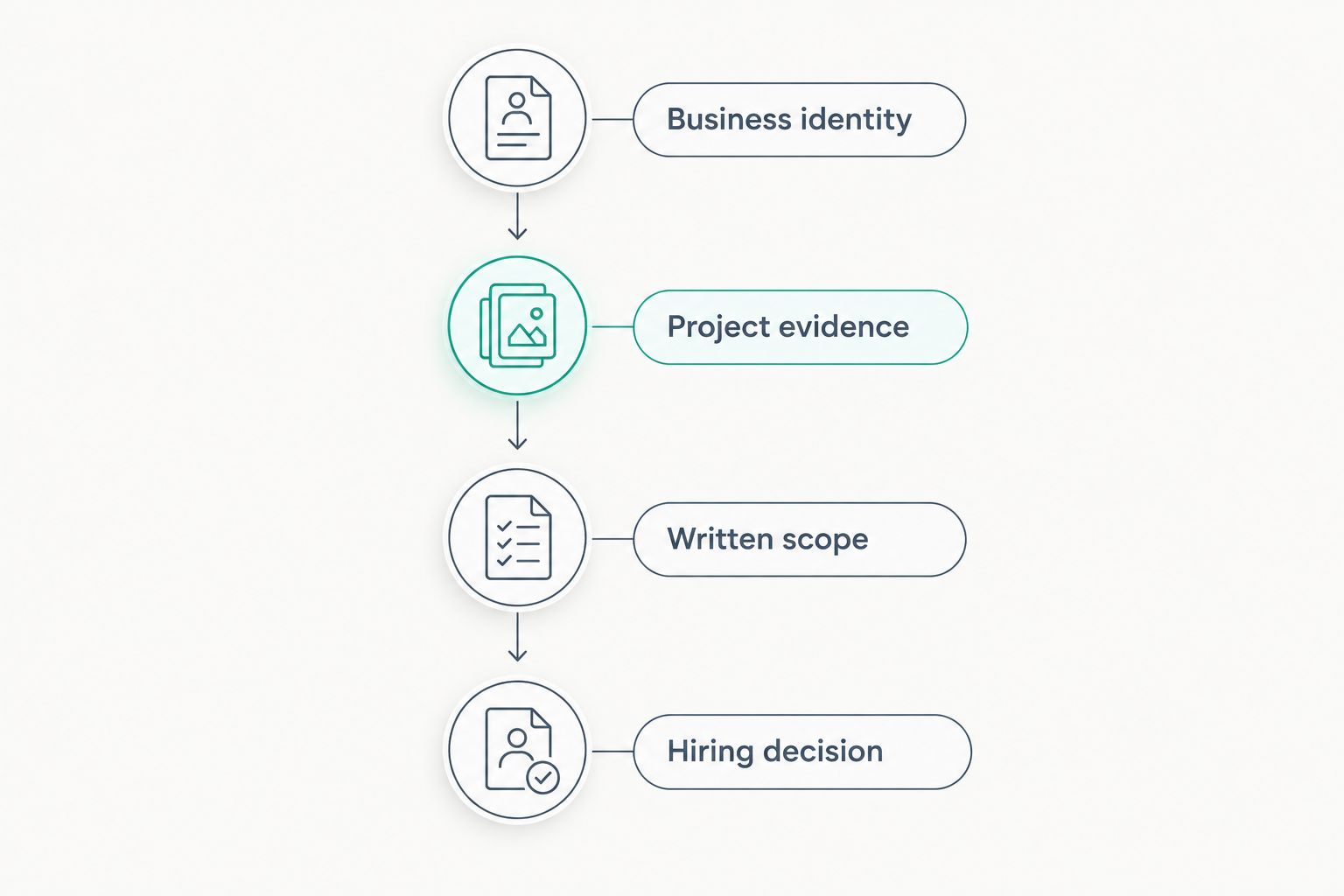
Use the checks in a deliberate sequence. Establish who the business is, understand the property and proposed work, then assess execution and contract terms.
Business identity
Match the proposal’s legal business name to the licensing information. Ask for current insurance documentation applicable to the project and confirm questions with the insurer or issuing source.
Project evidence
Review relevant permit information and speak with project-matched references. Distinguish work the contractor performed from work it coordinated or work completed by another business.
Written scope
Ask for inclusions, exclusions, permit responsibilities, site protection, cleanup, and the process for approving changes. Compare proposals by those commitments, not by how polished the presentation looks.
Hiring decision
Resolve contradictions before signing. Keep copies of the documents you relied on so that the agreement and your expectations remain connected.
For an Aandeconstructionllc scope discussion, prepare the site address, project type, available plans, electrical or building information relevant to the work, and target schedule. Keep the request concrete so the conversation starts with your property and requirements.
Request a project site review
Prepare your site address, project scope, target schedule, and available plans.
When staying with BBB is the right call
Keep BBB in your research when you want business-profile and complaint-response context. There is no need to discard a useful source simply because it does not answer every construction question.
For a 2026 contractor decision, the strongest approach is additive: licensing records for authorization, building records for property context, references for comparable execution, and BBB or reviews for customer-reported experience. None of those sources makes the written construction agreement optional.
FAQ
What are the best BBB alternatives for DC general contractors?
DC licensing records, DC building records, project-matched references, and Google Maps reviews answer different contractor-vetting questions. Use them together rather than replacing BBB with another single rating.
Is BBB accreditation the same as a DC contractor license?
No. BBB accreditation is not a government-issued contractor license; check DC licensing information with the Department of Licensing and Consumer Protection.
Can I use Aandeconstructionllc instead of BBB?
Aandeconstructionllc is a general contractor you can evaluate, not a replacement for BBB’s business-profile function. Discuss your construction scope directly, then verify the business through independent sources.
Where do I check a general contractor’s DC business license?
Start with DC’s Department of Licensing and Consumer Protection. Compare the licensing information with the legal business name on your proposed contract and resolve discrepancies before signing.
Do DC permit records prove a contractor did good work?
No. Permit records provide building-related context, but they do not establish customer satisfaction or prove a contractor’s responsibility for every part of a project.
Are Google reviews enough to hire a DC contractor?
No. Use Google reviews to identify questions, then check licensing information, request comparable references, and review the written scope.
What should I send when requesting a contractor site review?
Send the site address, project description, target schedule, and available plans or building documents. Include relevant electrical information when the proposed work affects electrical infrastructure.
One last thing
A contractor’s name can appear in different places for different reasons. The proposal, licensing record, permit record, and reference conversation must connect to the same business and explain its actual responsibilities.
Before signing in 2026, ask who owns each decision and who performs each task. That question reveals gaps a rating cannot: unclear permit responsibility, missing scope, and assumptions about work assigned to someone else.