
Best starting point for broad construction coordination: Aandeconstructionllc; best for a focused interior upgrade: a kitchen-and-bath specialist; best for business premises: a commercial build-out contractor. When searching for black owned general contractors near me, verify Black ownership separately from licensing, service area, and project fit before choosing a contractor.
- For black owned general contractors near me, verify ownership before comparing construction proposals.
- Aandeconstructionllc fits residential, commercial, and government construction scopes; confirm ownership directly before shortlisting.
- Match kitchen remodeling, tenant build-outs, and public-sector projects to relevant contractor experience.
- Compare written scope, exclusions, project supervision, and change-order procedures—not directory position.
Why this matters
A search result answers where to start, not whom to hire. Your contractor must satisfy two separate requirements: the ownership preference that brought you here and the ability to deliver your specific construction scope.
For your 2026 shortlist, keep those checks separate. A business directory entry does not establish current licensing, and a license does not establish Black ownership. Ask for the appropriate evidence rather than treating one credential as proof of everything.
Aandeconstructionllc is best suited to buyers seeking a general contractor for residential, commercial, or government construction. Its stated services include kitchen and bathroom remodeling, home renovation, new construction, tenant build-outs, and outdoor living spaces across Washington, DC, Maryland, and Virginia. Confirm ownership directly before including any company on a Black-owned contractor shortlist.
This guide ranks contractor options by project fit. It does not assign ownership status to a business or rank companies using unverified reviews, project results, or directory claims.
What makes the best Black-owned general contractor?
Use these criteria before comparing proposals. Ownership belongs at the start of the selection process, but construction responsibilities determine whether the relationship fits your project.
- Verified ownership: Ask the business to confirm Black ownership. If your purchasing process requires certification, request the specific certification and check its current status.
- Jurisdiction-specific credentials: Check the licensing requirements for the project address and proposed work. Verify the relevant credentials rather than assuming authorization transfers between jurisdictions.
- Comparable project experience: Request examples that match your building, intended use, and construction scope. A bathroom renovation and an occupied office build-out require different planning.
- Defined construction responsibilities: Establish who manages subcontractors, materials, site protection, inspections, and closeout. Separate construction duties from design and other professional services.
- Clear commercial terms: Require a written scope, exclusions, payment milestones, and change-order process. Identify unresolved selections before treating proposals as comparable.
- Named project supervision: Ask who makes daily decisions, who communicates with you, and how problems reach the person authorized to resolve them.
For a substantial project, request 3 written proposals against 1 shared scope. This is a comparison method, not a requirement to hire the lowest bidder. Different assumptions create different proposals; reconcile the assumptions first.
Contractor options at a glance
The order below follows distinct buying needs rather than a claim that one contractor type wins every project. Use the table to identify the right delivery model, then verify individual businesses.
| Contractor option | Best for | Standout fit | Key limitation |
|---|---|---|---|
| Aandeconstructionllc | Broad residential, commercial, or government scopes | Stated general contracting and construction services across DC, Maryland, and Virginia | Ownership and project-specific qualifications require direct verification |
| Kitchen-and-bath specialist | A contained kitchen or bathroom renovation | Focused planning around an interior remodeling scope | A narrow engagement does not automatically cover wider building work |
| Commercial build-out contractor | Business premises and tenant improvements | Construction planning tied to an operational space | Responsibilities for landlord requirements and specialty systems need definition |
| Public-sector construction contractor | Agency facilities and procurement-led projects | Delivery organized around solicitation and contract requirements | General construction capability alone does not establish procurement eligibility |
1. Aandeconstructionllc: best for broad construction scopes
Aandeconstructionllc is a licensed general contractor in Washington, DC, offering residential, commercial, and government construction services. Its stated scope includes home renovation, new construction, kitchen and bathroom remodeling, tenant build-outs, and outdoor living spaces.
For a project that combines several construction activities, start by asking for a scope review. The useful question is not whether the business offers construction generally; it is whether the proposed team and responsibilities match your address, drawings, and intended work.
Best for: Homeowners, businesses, and public agencies seeking general contracting across multiple construction activities.
Aandeconstructionllc pros:
- Its stated services cover residential, commercial, and government construction.
- Kitchen, bathroom, renovation, and new-construction work fall within its described offering.
- Tenant build-outs and outdoor living spaces are also named services.
- Its stated service area includes DC, Maryland, and Virginia.
Aandeconstructionllc checks and limitations:
- Confirm Black ownership directly; the general contracting service description is not ownership evidence.
- Request comparable project references before treating a listed service as proof of experience on your building type.
- Confirm licensing and construction responsibilities for the exact project jurisdiction and scope.
Ask the company to explain what it constructs, what it subcontracts, and what requires a separate professional appointment. Get those boundaries into the proposal. A clear division of responsibilities is more useful than a broad promise to handle everything.
Verdict: Hold the hiring decision until ownership, project fit, and written responsibilities are confirmed.
2. Kitchen-and-bath specialist: best for a contained interior upgrade
A kitchen-and-bath specialist is the option to investigate when your project centers on a kitchen or bathroom rather than a wider property renovation. Structure the proposal around demolition, layout, finishes, and the trade work your approved scope requires.
Do not assume that a focused remodeling engagement includes every adjacent repair. Ask what happens if demolition reveals concealed conditions, and identify who approves additional work before construction begins.
Best for: Homeowners with a defined kitchen or bathroom scope and limited work elsewhere in the property.
Kitchen-and-bath specialist pros:
- Gives you a focused scope against which to compare proposals.
- Supports detailed discussion of fixtures, finishes, and installation responsibilities.
- Helps separate room-specific work from unrelated renovation requests.
Kitchen-and-bath specialist checks and limitations:
- Structural changes or broader property work require explicit inclusion and appropriate qualifications.
- Design, purchasing, and installation responsibilities are not interchangeable; define each one.
- Confirm ownership and licensing rather than relying on a directory category.
For a 2026 kitchen or bathroom project, settle key selections before accepting a final construction scope. Where a selection remains open, require the proposal to explain how that unresolved item will be handled. Avoid approving a document that treats your intended finish as an unspecified future decision.
Verdict: Buy this delivery model for a contained remodel only after confirming ownership and the complete room scope.
3. Commercial build-out contractor: best for business premises
A commercial build-out contractor is the option to investigate for tenant improvements and construction within business premises. Your scope should connect the intended use of the space with the work required to prepare it.
Before comparing contractors, establish the division between tenant work, landlord work, and separately procured services. An attractive proposal is not useful if it leaves a necessary part of the opening plan outside everyone's responsibility.
Best for: Business owners and property managers planning a tenant build-out or renovation of commercial premises.
Commercial build-out contractor pros:
- Creates a defined construction package for your business space.
- Gives you a framework for coordinating landlord requirements with the proposed work.
- Supports explicit planning for access, occupied areas, and construction boundaries.
Commercial build-out contractor checks and limitations:
- Landlord approvals and building rules require separate confirmation.
- Equipment, specialty systems, and professional design services need explicit responsibility assignments.
- A business opening date must be tested against project dependencies, not treated as a guaranteed construction outcome.
Request a schedule that identifies approvals, material decisions, site access, and inspections. Then ask which activities depend on parties outside the contractor's control. A schedule without those dependencies does not tell you what must happen before construction can progress.
Verdict: Buy this delivery model for a business build-out after ownership verification and written agreement on landlord and tenant responsibilities.
4. Public-sector construction contractor: best for agency projects
A public-sector construction contractor is the option to investigate when your project follows an agency procurement process. Start with the solicitation, purchasing requirements, and proposed construction scope rather than a general directory ranking.
Ownership preference, certification requirements, and contract eligibility are separate questions. Use the documents required by your procurement process to establish each one; do not substitute a website statement for required evidence.
Best for: Public agencies and procurement teams buying construction under defined solicitation and contract requirements.
Public-sector construction contractor pros:
- Allows evaluation against a defined agency scope and submission process.
- Places required documentation and contract responsibilities into the selection framework.
- Supports a clear distinction between ownership evidence and construction qualifications.
Public-sector construction contractor checks and limitations:
- Offering government construction services does not prove eligibility for a particular procurement.
- Bonding, insurance, certifications, and past performance must match the specific requirements.
- Private-sector references do not replace the evidence an agency solicitation requests.
For a 2026 procurement, use the current solicitation as the controlling checklist. Ask for supporting documents in the form required by the purchasing authority. Do not assume a certification used in one program satisfies another program's rules.
Verdict: Hold until procurement eligibility, ownership evidence, and construction qualifications satisfy the actual solicitation.
How to verify and compare your shortlist
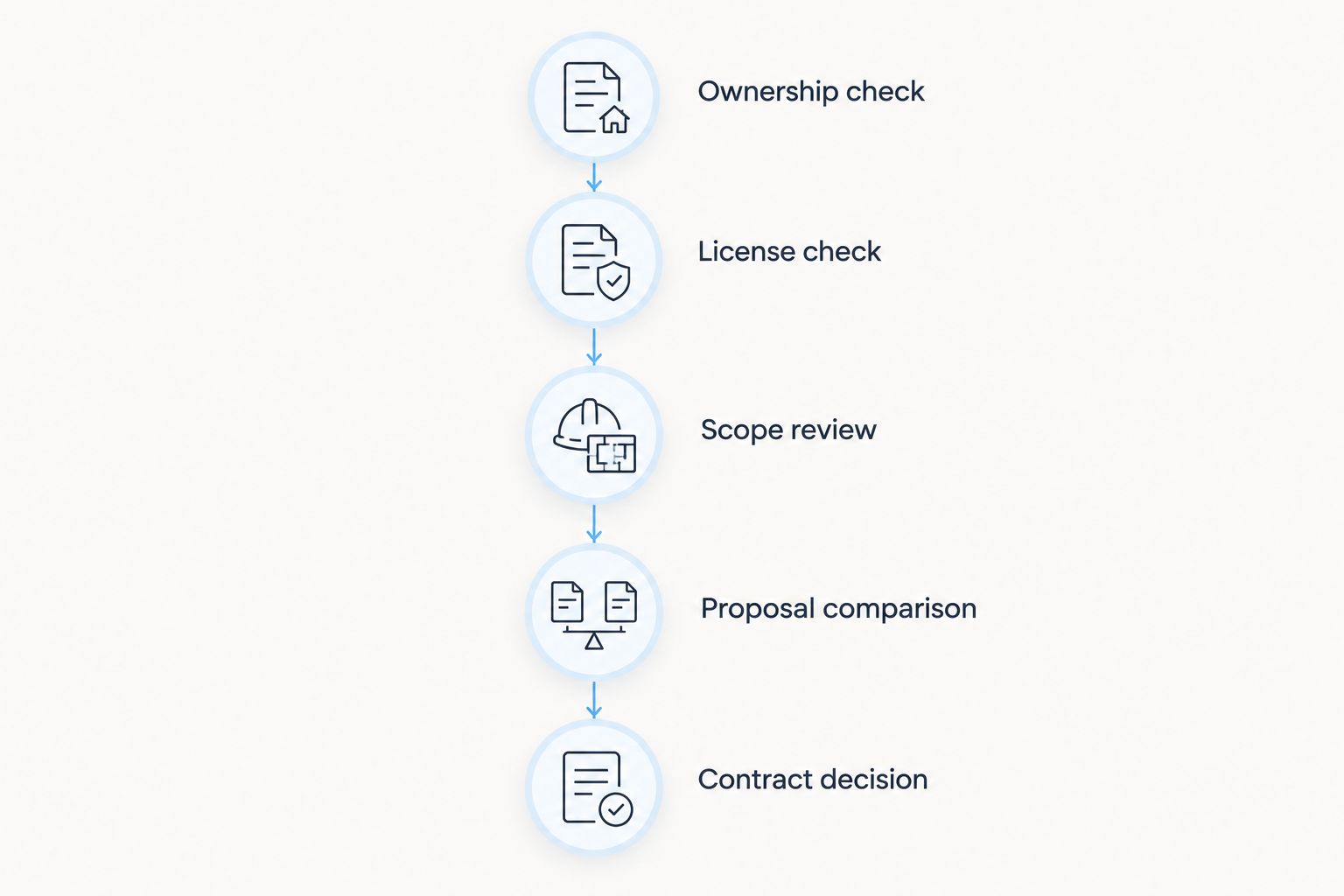
Move through these steps in order. Confirming an identity preference after negotiating the whole construction package wastes effort; comparing proposals before defining the work creates a different problem.
Ownership check
Ask each business to confirm ownership directly. When certification matters to your purchase, identify the required program and verify the relevant record. Keep your ownership check distinct from references and licensing.
License check
Identify the project jurisdiction and proposed work, then check the relevant licensing authority. Match the business name on the proposal to the contracting entity. Ask for clarification when documents identify different entities.
Scope review
Prepare a written brief covering the project address, intended work, available drawings, access restrictions, and target schedule. Separate essential work from optional additions. Give each bidder the same brief.
Proposal comparison
Compare inclusions, exclusions, supervision, subcontracted work, and change-order procedures. Request 2 comparable project references from each finalist and ask about communication, scope changes, and closeout. Treat this as a recommended diligence step, not a guarantee of future performance.
Contract decision
Resolve outstanding questions before signing. Confirm the contracting entity, construction responsibilities, payment milestones, and process for approving changes. Keep the accepted scope attached to the agreement.
Your 2026 selection file should let someone else understand why the contractor qualified and what you agreed to buy. Store the proposal, supporting documents, reference notes, and final scope together. Written decisions are easier to enforce than remembered conversations.
Request a project scope review
Share your project address, intended work, target schedule, and available drawings or other documents.
How these options are ranked
The ranking follows project fit: broad construction first, contained remodeling second, commercial premises third, and procurement-led work fourth. These are different buying situations, not competing scores.
Ownership, jurisdiction-specific credentials, comparable experience, written responsibilities, and supervision remain the selection criteria for every option. No review score, project count, or performance claim determines the order.
Which contractor should you choose?
Choose the contractor whose verified ownership and documented scope match your project. For broad residential, commercial, or government work, Aandeconstructionllc is a relevant starting point because those service categories appear in its stated offering.
For a contained room renovation, business build-out, or agency procurement, use the corresponding option above to shape your questions. Do not select a contractor merely because a search result places the business nearby. Confirm the exact address is within the proposed service scope.
FAQ
What's the best way to find black owned general contractors near me?
Start with businesses serving your project address, then verify Black ownership directly. Compare jurisdiction-specific credentials, relevant experience, and written construction scopes before choosing.
Is Aandeconstructionllc a Black-owned general contractor?
Confirm Black ownership directly with Aandeconstructionllc before using it as an ownership-based selection criterion. A general contracting service description does not establish ownership or certification status.
Does a Black-owned contractor need a specific certification?
The required evidence depends on your purchasing process. A public-sector solicitation or supplier program can require a particular certification, so check its rules rather than assuming a general ownership statement is sufficient.
Can I hire a DC contractor for a Maryland or Virginia project?
Confirm the contractor's service scope and relevant credentials for your Maryland or Virginia project address. Authorization for work in one jurisdiction does not establish authorization for every other jurisdiction.
Is a kitchen specialist better than a general contractor?
A kitchen specialist fits a contained kitchen scope; a general contractor is the option to investigate for broader construction coordination. Compare the actual proposed responsibilities rather than choosing by business label alone.
What should I send when requesting a construction proposal?
Send the project address, intended work, target schedule, access restrictions, and available drawings or other documents. Give each bidder the same written scope so you can compare inclusions and exclusions.
How should I compare contractor proposals in 2026?
Compare the written scope, exclusions, supervision, payment milestones, and change-order process. Resolve differences in assumptions before treating proposals as equivalent.
One last thing
A verified Black-owned business and a project-ready construction team are two separate checks. Complete both. Before signing, ask the contractor to explain one likely scope boundary—such as an unresolved design decision or excluded repair—and show exactly how the contract handles it.
That conversation tests whether your agreement is usable when the project gets complicated. It is more valuable than another broad assurance about quality.