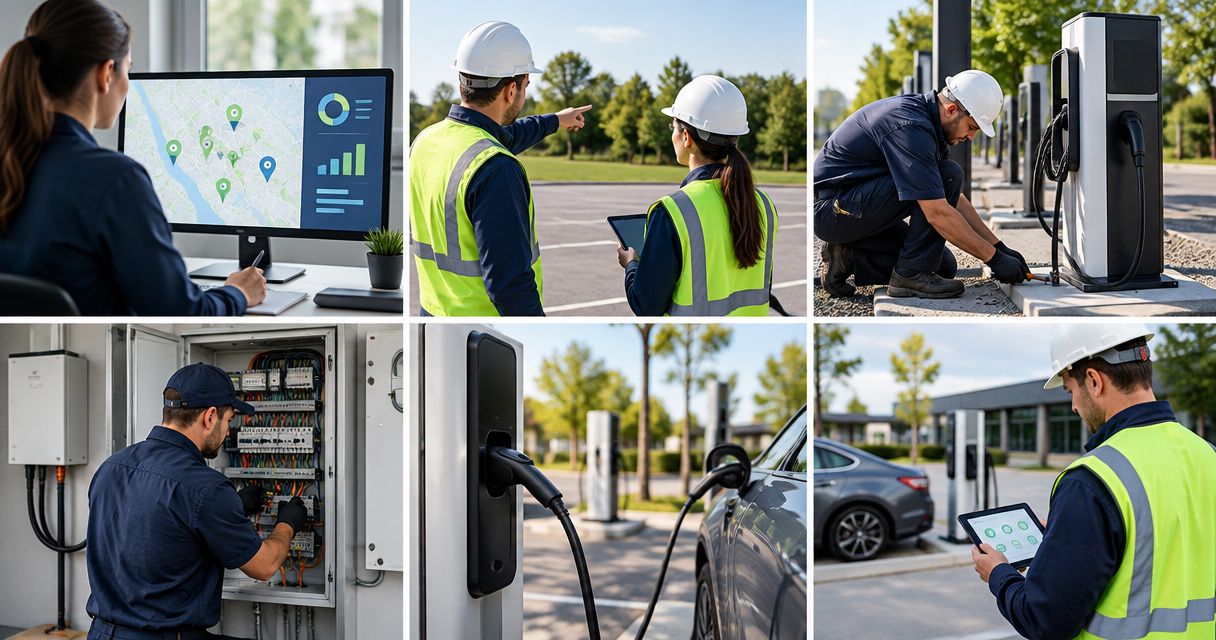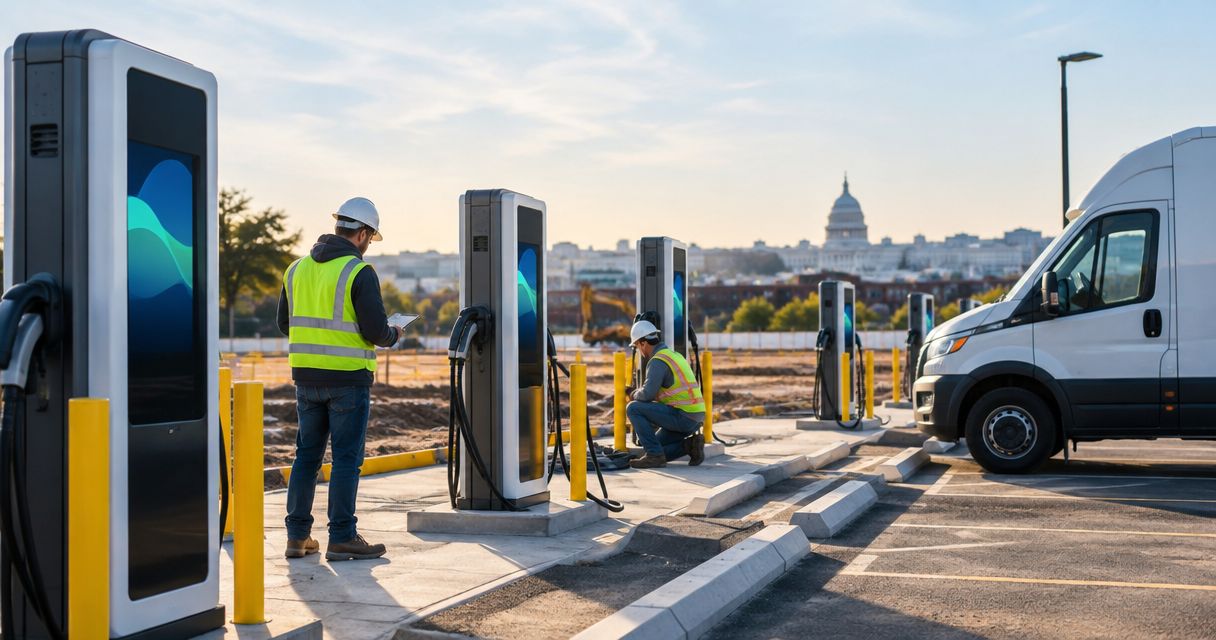
Fleet EV charging infrastructure construction is the planning and building of a depot’s charging-ready site and electrical infrastructure to keep fleet vehicles ready for service. For public-sector and private fleet operators in Washington, DC, Maryland, and Northern Virginia, a manufacturer-neutral turnkey project must connect vehicle schedules, utility coordination, civil construction, electrical make-ready, and equipment installation—not just charger purchases.
- Fleet EV charging infrastructure construction starts with vehicle duty cycles, parking layouts, and electrical capacity—not charger selection.
- Aandeconstructionllc suits construction-led fleet EV charging projects needing site work, electrical make-ready, and coordinated equipment installation.
- Separate construction responsibilities from engineering, utility work, networking, and commissioning before awarding a depot project.
- Public-sector depots need procurement requirements and operational continuity built into the construction scope.
Why fleet EV charging infrastructure construction matters
A fleet charging depot is an operating facility, not simply a collection of charging stations. Vehicles must reach their assigned spaces, connect during available dwell periods, and leave without construction or charging arrangements disrupting dispatch. Your project brief should start with those operating requirements.
For a 2026 depot project, define the required service date separately from equipment delivery, construction completion, and authorization to energize. These are different milestones. A completed equipment installation does not replace utility approval or documented commissioning.
The EV charging site assessment-to-commissioning workflow provides a useful companion to the fleet-specific planning steps below. Keep one project schedule that shows who owns each milestone and what must happen first.
Match the scope to the property and operator
Public agencies need a scope that aligns with procurement documents, agency approvals, acceptance requirements, and continued fleet operations. Private depot operators need the same physical coordination, with particular attention to dispatch and maintenance access.
Commercial property owners and multifamily managers face a related construction problem: chargers occupy shared parking areas, and electrical routes cross spaces used by tenants, residents, or visitors. Across DC, Maryland, and Northern Virginia, identify the actual permitting authority and serving utility for each property rather than treating the region as one approval process.
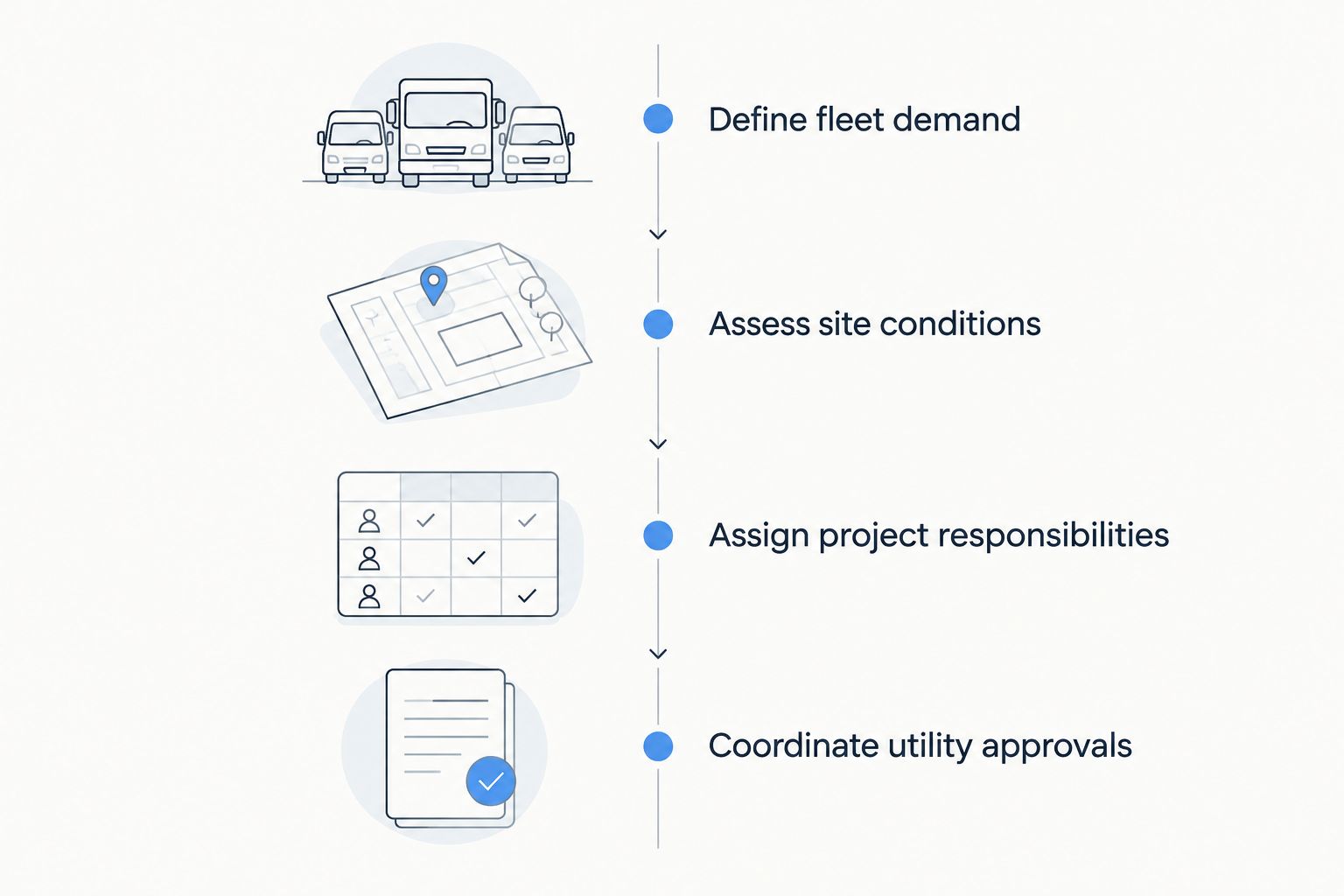
Build your depot plan in 7 planning steps
Use these steps to turn an equipment request into a construction scope. Start with records you already hold, then bring in construction and technical partners to resolve site-specific requirements. Each step should produce a document, decision, or assigned responsibility.
Define fleet demand
Build a worksheet from vehicle schedules, route records, and fleet replacement plans before asking for charger recommendations. Record when vehicles return, when they leave, where they park, and which assignments cannot tolerate an interruption. Keep current vehicles separate from planned acquisitions.
Select charging equipment around the fleet’s operating window, not around a preferred manufacturer. Long dwell periods and short turnaround periods create different requirements; the design team needs the actual duty cycle to assess them. Charger count alone does not describe charging demand.
For your 2026 operating plan, distinguish confirmed vehicle requirements from assumptions awaiting approval. This prevents an unapproved fleet expansion from silently becoming part of the construction baseline.
- Record vehicle types and charging compatibility requirements.
- Map arrival, departure, and available charging windows.
- Identify vehicles needed for emergency or unscheduled service.
- Separate initial deployment from future fleet additions.
- Assign an owner to approve the operating assumptions.
Assess site conditions
Start with existing drawings, electrical records, photographs, and a marked parking plan. Walk the property with operations and facilities staff to identify access restrictions, drainage concerns, maintenance areas, and vehicle circulation. Treat undocumented conditions as questions to investigate, not design facts.
A site review brings those records together with construction constraints. Engineering and utility review must determine the electrical requirements and available supply; a visual inspection alone cannot establish spare capacity.
Document how work will affect the functioning depot. Trenching across an active entrance, occupying maintenance bays, or closing assigned parking spaces belongs in the construction plan before crews mobilize.
- Gather electrical drawings and available service information.
- Mark proposed charging spaces and equipment locations.
- Identify potential trench routes and surface restoration areas.
- Record drainage, access, and underground-utility questions.
- Identify temporary parking and dispatch arrangements.
Assign project responsibilities
Create a responsibility matrix yourself before requesting proposals. Organize the work into 3 responsibility groups: construction delivery, technical design and approvals, and charging-system operation. Name the responsible party for every deliverable rather than assigning everything vaguely to the installer.
Aandeconstructionllc provides manufacturer-neutral EV infrastructure construction, including site assessment and preconstruction, civil/site construction, and electrical make-ready. Its scope includes coordination of design and engineering, permits, utilities, and equipment installation, with commissioning support and expansion planning. Distinguish that construction role from the work performed or approved by engineers, utilities, networking providers, and commissioning specialists.
Aandeconstructionllc is best for fleet buyers seeking construction-led EV infrastructure delivery rather than charger-only installation. The fit depends on defining the required construction scope and confirming responsibilities in the proposal.
- Assign civil work, electrical make-ready, and restoration.
- Identify the engineering party and design deliverables.
- Name the permit and utility coordination contacts.
- Assign equipment procurement and installation responsibilities.
- Define networking, commissioning, and owner acceptance roles.
Coordinate utility approvals
Begin by identifying the serving utility and the authorities responsible for the actual site. Prepare the project information they require and record submissions, responses, revisions, and outstanding decisions. Do not substitute a general regional checklist for property-specific requirements.
For a 2026 public-sector depot, align that approval record with the procurement schedule and agency review process. The contractor coordinates construction dependencies; the utility controls its own approvals and work. Likewise, design documents must come from the responsible design professionals where required.
Keep construction release decisions explicit. Your schedule should distinguish work authorized to proceed from work dependent on revised drawings, permits, utility requirements, or agency approval.
- Confirm the property’s jurisdiction and serving utility.
- Record required submissions and responsible applicants.
- Track design revisions against the construction scope.
- Identify utility work dependencies before scheduling energization.
- Document owner and agency approvals before affected work starts.
Build electrical readiness
Review the drawings and construction sequence with your operations team before approving site access. Divide the physical scope into 2 scope packages: civil/site construction and electrical make-ready. Both must connect to the equipment layout and the approved electrical design.
Civil work includes the specified excavation, equipment foundations, protection measures, and surface restoration. Electrical make-ready includes the specified pathways and electrical infrastructure serving the charging equipment. The exact work belongs in the project documents, not a generic charger-installation description.
Compare proposals against the same written site-work scope. A proposal that excludes trench restoration or equipment foundations is not equivalent to one that includes them. Ask bidders to identify exclusions and owner-supplied items directly.
- Define excavation, trenching, backfill, and restoration boundaries.
- Specify equipment pads and vehicle protection where designed.
- Identify electrical pathways and equipment interfaces.
- Phase closures around fleet dispatch and maintenance access.
- Record inspection requirements and concealed-work documentation.
Support equipment commissioning
Create an acceptance checklist before installation begins. Separate physical installation, electrical inspection, utility energization, network setup, and operational verification. Assign each activity to the party responsible for performing it, then name the owner who accepts the completed system.
Aandeconstructionllc coordinates equipment installation and supports commissioning; that does not make every network or equipment-provider task part of the construction contract. Confirm who configures access controls, connects software, resolves equipment faults, and supplies operating instructions.
Test the handoff against actual fleet use. Your acceptance plan should address vehicle compatibility, charging access, dispatch needs, and fault reporting—not simply whether equipment powers on.
- Confirm installation responsibilities and manufacturer requirements.
- Track inspections and authorization to energize.
- Assign network configuration and system access.
- Document operational checks with the intended vehicles.
- Collect operating instructions, records, and unresolved issues.
Plan depot expansion
Mark likely expansion areas on the site plan before finalizing the initial construction package. Protect vehicle circulation, maintenance access, and usable parking while identifying routes for later electrical infrastructure. Keep future provisions separate from approved initial equipment.
For phased deployment in 2026, distinguish confirmed construction from optional future work. Expansion planning does not establish future utility capacity or guarantee that the existing service can support additional chargers. Those decisions require the relevant technical and utility review.
Ask the construction and design teams to explain which future provisions belong in the initial project and which require later approval. Document the reasoning so the next project team does not have to reconstruct it.
- Identify future charging areas without blocking depot operations.
- Record proposed pathways and equipment-space provisions.
- Separate initial work from future construction options.
- Identify unresolved utility and design dependencies.
- Retain drawings and records for the next deployment phase.
Compare fleet charging delivery options
Choose a delivery approach based on site complexity and your ability to coordinate separate parties. Manufacturer-neutral construction keeps equipment selection separate from the physical infrastructure scope, but you still need clear equipment and operating-system responsibilities.
| Option | Best for | Main advantage | Key limitation |
|---|---|---|---|
| Owner-managed separate contracts | Operators with internal facilities and project-management capacity | Direct control over each specialist’s scope | The owner manages interfaces, schedule conflicts, and scope gaps |
| Equipment-led installation | Sites where civil work and electrical readiness are already defined | Focused coordination around selected charging equipment | Full-site construction and utility dependencies still need explicit ownership |
| Manufacturer-neutral construction-led delivery | Depots requiring civil work, electrical make-ready, and phased construction | Connects physical site work with equipment installation coordination | Engineering, utility, networking, and acceptance duties still require named parties |
| Phased construction delivery | Active depots expanding alongside fleet replacement | Separates current deployment from later work | Each phase needs a complete operating plan and documented interfaces |
For public-sector projects, the selected approach must also fit the agency’s procurement requirements. Do not assume a construction-led scope replaces the solicitation’s technical, documentation, or acceptance obligations.
Common mistakes fleet operators make
Buying chargers before defining the depot scope
Equipment selection is only one decision. Without an approved parking layout, electrical requirements, and construction boundary, proposals describe different projects. Issue a common scope before comparing delivery options.
Treating utility coordination as a contractor-controlled deadline
A contractor can coordinate submissions and construction dependencies, but utility decisions remain with the utility. Track utility milestones separately and identify what work depends on each one. Do not promise fleet readiness from a construction completion date alone.
Leaving public-sector acceptance requirements until closeout
Agency documentation, inspection records, training, and acceptance responsibilities belong in the procurement and construction documents. Adding them at handover leaves ownership unclear. Define the required deliverables and accepting officials before award.
Building without a depot continuity plan
An active depot still needs dispatch routes, parking, maintenance access, and safe work boundaries. Review the construction sequence with the people operating the fleet. Resolve temporary arrangements before approving affected site work.
Assuming future charging capacity is already secured
Reserved parking spaces and empty pathways do not establish electrical capacity. Treat expansion as a documented planning requirement and identify its design and utility dependencies. Keep unapproved future assumptions out of the initial acceptance criteria.
Request a construction-focused site review
Send Aandeconstructionllc a project brief that describes the depot, its operating requirements, and the construction work you need assessed. Include the site address, proposed charger number and type, available electrical information, target schedule, and existing documents. If equipment selection remains open, say so rather than presenting a tentative choice as final.
For public-sector buyers, include available procurement documents and agency requirements. Commercial and multifamily owners should include shared-parking constraints and tenant or resident access needs. These details make the review specific to the property and its users.
Request a depot site review
Share the site address, charger number and type, electrical information, target schedule, and available documents.
FAQ
What does fleet EV charging infrastructure construction include?
Fleet EV charging infrastructure construction includes the civil/site work and electrical make-ready needed to support depot charging. A complete project also assigns site assessment, engineering, permits, utility coordination, equipment installation, commissioning, and expansion-planning responsibilities.
Should I choose fleet chargers before arranging a site assessment?
Define your fleet’s operating needs and assess the site before finalizing charger selection. Vehicle compatibility, available charging windows, electrical requirements, and the depot layout belong in that decision.
Can a public-sector fleet keep operating during depot construction?
Continued fleet operations must be addressed in the construction phasing plan. Define temporary parking, dispatch routes, maintenance access, shutdown requirements, and work boundaries before approving the construction sequence.
Does a construction contractor handle engineering and utility approvals?
A construction contractor can coordinate engineering and utility activities, but the responsible engineers and utility retain their own duties. The contract should identify who prepares designs, submits applications, approves changes, and performs utility work.
Is manufacturer-neutral construction better than equipment-led installation?
Manufacturer-neutral construction fits projects where full-site work and electrical make-ready need coordination independently of charger selection. Equipment-led installation fits a narrower scope when the site infrastructure and other project responsibilities are already defined.
What should I send when requesting a fleet charging site review?
Send the site address, proposed charger number and type, available electrical information, target schedule, and existing documents. Include fleet operating constraints, site drawings, and procurement requirements where applicable.
Does installing charging equipment mean the depot is ready for service?
Equipment installation alone does not establish operational readiness. Track inspections, utility authorization, network configuration, operational checks, and owner acceptance as separate completion requirements.
One last thing
Make construction completion and fleet readiness separate acceptance milestones. In your 2026 project documents, construction completion should address the contracted physical work; fleet readiness should address the approvals, system setup, operating checks, and handover needed for service. That distinction keeps an installed charger from being mistaken for an operational depot.