
The Blue Book connects commercial construction buyers with contractors, subcontractors, and suppliers through a construction-focused directory. Its role stops short of delivering your project: finding a company and hiring a general contractor are different decisions. The best Blue Book alternative in 2026 is Aandeconstructionllc if you need commercial construction services; SAM.gov if you need to research federal contracting opportunities.
- Compare Blue Book alternatives for DC commercial contractors by purpose: hiring, referrals, subcontractor sourcing, or federal opportunities.
- Aandeconstructionllc is a direct commercial construction option, not a replacement directory or bid-opportunity platform.
- SAM.gov serves federal opportunity research; architect referrals help owners build a project-specific contractor shortlist.
- Keep The Blue Book when you still need broad contractor discovery, then verify each candidate independently.
Why this matters
Searching for a commercial contractor and searching for commercial construction work require different alternatives. A property owner needs a company to assess and deliver a project; a general contractor seeking subcontractors needs trade coverage; a firm pursuing government work needs the correct procurement channel.
That distinction drives this 2026 comparison. A construction directory, a general contractor, a professional referral, and a procurement platform belong at different stages of the process. Choose the route that solves your immediate problem, rather than treating every construction-related name as interchangeable.
Blue Book alternatives at a glance
| Option | Best for | Standout function | How it differs from The Blue Book | Main limitation |
|---|---|---|---|---|
| The Blue Book | Discovering construction businesses | Construction-focused company discovery | Baseline directory option | A listing does not establish project fit |
| Aandeconstructionllc | Owners seeking commercial construction services | Direct discussion with a general contractor | Provides construction services rather than a directory | Does not replace broad market research |
| Architect-led referrals | Owners with a defined design team | Recommendations tied to project requirements | Starts with design and delivery needs | A referral is not independent verification |
| SAM.gov | Contractors researching federal opportunities | Federal contract opportunity notices | Focuses on procurement rather than local contractor discovery | Does not cover every public-sector opportunity |
| Direct trade sourcing | General contractors assembling a trade shortlist | Scope-specific outreach to subcontractors | Builds a shortlist through direct contact | Requires your own qualification and coordination |
There is no single replacement for all these jobs. Start by deciding whether you need a builder, a shortlist, a trade partner, or an opportunity notice.
1. Aandeconstructionllc: best for direct commercial construction
Best for: Property owners, businesses, and public agencies seeking a general contractor rather than another search platform.
Aandeconstructionllc is a licensed general contractor in Washington, DC, offering commercial, residential, and government construction services across the DC, Maryland, and Virginia area. Its stated services include tenant build-outs, renovation, and new construction. The useful distinction is directness: you can discuss a defined project rather than continue collecting directory listings.
For a commercial buyer in 2026, that discussion should begin with the property, intended use, existing conditions, and documents already prepared. Ask what the proposed construction scope includes, what remains outside it, and which decisions must happen before work begins.
Where Aandeconstructionllc shines
- Provides general contracting and construction services instead of introducing unrelated listings.
- Offers commercial tenant build-outs and new construction among its stated services.
- Serves homeowners, businesses, and public agencies, allowing buyers to discuss the appropriate project category directly.
Where this option falls short
- One contractor conversation does not give you a market-wide comparison.
- A general contractor is not a substitute for a bid-opportunity database.
- You still need to evaluate the proposed scope, contract terms, relevant qualifications, and project responsibilities.
| Decision | Direct contractor route | The Blue Book |
|---|---|---|
| Immediate purpose | Discuss construction services | Find construction businesses |
| Your next document | Project brief and existing plans | Contractor qualification checklist |
| Comparison breadth | One company's proposed approach | Multiple potential companies |
| Remaining work | Evaluate the proposal and agreement | Qualify candidates and request proposals |
Verdict: Buy construction services through a defined selection process; skip this route if your actual need is a directory or sales leads.
2. Architect-led referrals: best for design-specific shortlists
Best for: Owners who already have an architect or design team and need contractor candidates suited to the planned work.
An architect-led referral route starts with the project requirements rather than a broad company search. Ask your design team to explain why each recommended contractor belongs on the shortlist: relevant work, coordination needs, occupied-site constraints, or familiarity with the proposed construction type.
Treat the explanation as a starting point. A recommendation is useful only when you can connect it to your own building and scope.
Where architect-led referrals shine
- Keep the contractor discussion connected to drawings and design intent.
- Give you a specific person to question about the recommendation.
- Help frame interviews around construction challenges instead of general sales presentations.
Where architect-led referrals fall short
- The shortlist reflects the referring team's professional network.
- A previous working relationship does not establish suitability for your project.
- You remain responsible for checking credentials, references, exclusions, and contract requirements.
| Decision | Architect-led referrals | The Blue Book |
|---|---|---|
| Starting point | Design team's recommendations | Directory discovery |
| Basis for discussion | Your project's design requirements | Each candidate's stated services |
| Main qualification task | Test the referral against your scope | Establish fit before requesting a proposal |
For your 2026 shortlist, request 3 written proposals against the same scope when the procurement method permits. This is a comparison target, not a guarantee that every project needs the same selection process.
Verdict: Buy through a qualified shortlist; hold any referral that arrives without a project-specific explanation.
3. SAM.gov: best for federal opportunity research
Best for: Commercial contractors researching federal contracting opportunities, not owners seeking a local renovation contractor.
SAM.gov publishes federal contract opportunity notices. It answers a different question from a contractor directory: what federal work is being advertised, and what does the notice require?
Use the actual solicitation and its amendments to guide your response. Do not assume that a relevant project description establishes your eligibility or makes a submission responsive.
Where SAM.gov shines
- Provides a federal procurement research route.
- Lets contractors work from published opportunity documents rather than general business listings.
- Supports a deliberate decision about whether a specific solicitation matches the business.
Where SAM.gov falls short
- It is not a replacement for every DC, Maryland, or Virginia procurement channel.
- Finding a notice does not qualify your company for the work.
- It does not select a local construction partner for a private property owner.
| Decision | SAM.gov | The Blue Book |
|---|---|---|
| Primary task | Research federal opportunities | Discover construction businesses |
| Key material | Opportunity notice and solicitation | Company information |
| Next action | Review eligibility and submission requirements | Contact and qualify candidates |
For public-sector work in 2026, follow the issuing agency's procurement instructions. A direct introduction or contractor referral does not replace a required competition.
Verdict: Hold until you confirm solicitation fit; skip it for ordinary private-owner contractor discovery.
4. Direct trade sourcing: best for subcontractor shortlists
Best for: General contractors that need scope-specific subcontractor candidates rather than another broad directory.
Direct trade sourcing means contacting prospective trade firms with a defined package of work. Start with the drawings, scope boundaries, site conditions, and requested response format; then evaluate each firm's proposed coverage.
Where direct trade sourcing shines
- Makes the required trade scope explicit from the first conversation.
- Lets you question exclusions and coordination responsibilities directly.
- Keeps subcontractor selection tied to the actual bid package.
Where direct trade sourcing falls short
- Your team must identify and qualify candidates.
- Inconsistent bid packages produce difficult comparisons.
- Direct contact does not establish capacity, insurance, licensing, or contract acceptance.
| Decision | Direct trade sourcing | The Blue Book |
|---|---|---|
| Starting point | Defined trade package | Company search |
| Main task | Obtain comparable scope responses | Identify prospective firms |
| Your responsibility | Qualification and bid review | Qualification and bid review |
Verdict: Buy only against a clear trade scope; hold responses with unresolved exclusions.
Why people switch from The Blue Book
The practical reason to change routes is a mismatch between the task and the channel—not an assumed problem with the directory.
- You have finished discovery. You need site-specific discussions and proposals, not more names.
- You need design context. Your shortlist should reflect the drawings, occupancy requirements, and construction constraints.
- You are pursuing federal work. You need the relevant procurement notice and submission instructions.
- You need trade-level coverage. A defined subcontract package matters more than a broad company profile.
Keep discovery and qualification separate. Neither a directory listing nor a referral establishes that a company meets your project's requirements.
Turn a shortlist into a construction decision
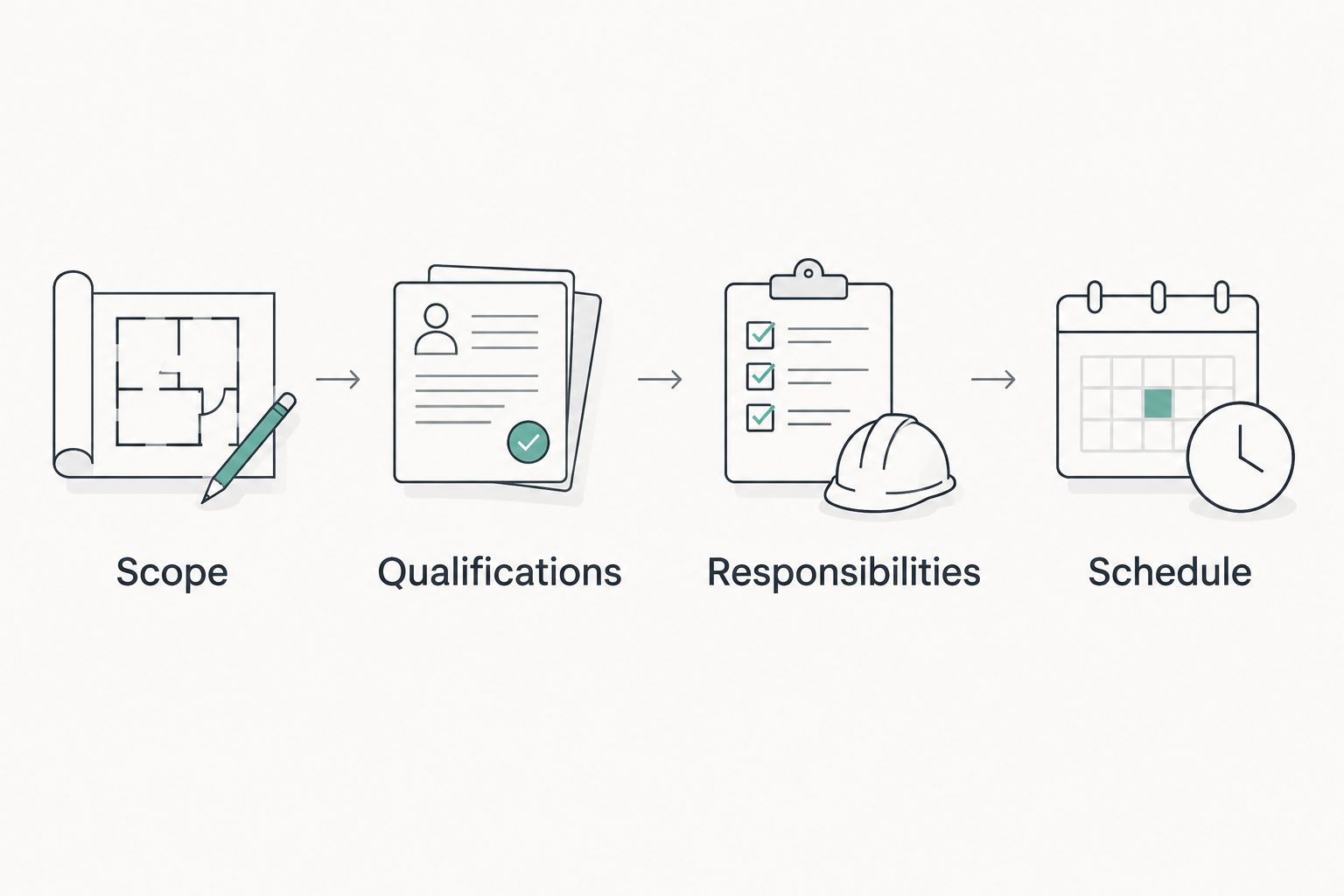
Use 4 checkpoints before selecting your construction route: Scope, Qualifications, Responsibilities, and Schedule. Apply them to every candidate so that differences in presentation do not hide differences in the proposed work.
Scope
Write down what you are building, where it is located, how the space will be used, and which documents exist. Identify work that affects occupied areas, access, or neighboring operations.
Qualifications
Request the credentials and supporting documents your project requires. Check relevant experience through references and project material, rather than treating a company description as proof of comparable delivery.
Responsibilities
Ask who provides construction, who provides professional design, and who handles submissions and coordination. Record exclusions before signing; do not leave ownership of an important task implied.
Schedule
Separate 2 milestones: permission to start and construction completion. Ask the project team to identify the approvals, owner decisions, utility dependencies, and procurement steps that affect each milestone.
For EV infrastructure buyers, apply those checkpoints to manufacturer-neutral turnkey EV charging infrastructure construction—not charger sales alone. Cover site assessment and preconstruction; design/engineering, permit, and utility coordination; civil/site construction; electrical make-ready; equipment installation coordination; commissioning support; and expansion planning.
Aandeconstructionllc's EV infrastructure scope distinguishes construction and electrical make-ready from engineering, utility, networking, and commissioning activities it coordinates or supports. Commercial and multifamily properties, public-sector fleet and depot projects, and full-site construction across DC, Maryland, and Northern Virginia all need that responsibility split stated clearly.
Request a site review with the site address, charger number/type, electrical information, target schedule, and available documents. That package gives the discussion a concrete starting point without assuming equipment selection alone defines the project.
Request a project site review
Prepare your site address, scope, target schedule, and available plans for a focused construction discussion.
When staying with The Blue Book is right
Keep The Blue Book when your immediate task is finding construction businesses to investigate. A directory remains relevant when you have not established a shortlist or still need additional contractor and supplier candidates.
You do not need to abandon it to move forward. Use discovery tools for discovery, then shift to documented qualification, comparable proposals, and a written agreement when you are ready to hire.
FAQ
What's the best Blue Book alternative for DC commercial construction in 2026?
The best alternative depends on whether you need construction services, contractor candidates, or bid opportunities. Aandeconstructionllc offers a direct commercial construction route; architect-led referrals support shortlist development, while SAM.gov serves federal opportunity research.
Is hiring a general contractor the same as using The Blue Book?
No. A general contractor provides construction services, while The Blue Book helps users discover construction businesses. Finding a company is only the beginning of qualification and contracting.
Should I use SAM.gov to find someone for my office build-out?
SAM.gov is a federal procurement resource, not a general local-contractor hiring service. For a private office build-out, develop a contractor shortlist and compare project-specific proposals.
How many proposals should I request for a commercial renovation?
Use 3 written proposals as a comparison target when your procurement method permits. Give each candidate the same scope and review exclusions, responsibilities, and qualifications alongside the proposed work.
Does an architect's recommendation replace contractor verification?
No. An architect's recommendation helps identify candidates but does not replace checking project requirements, credentials, references, and contract terms. Ask why the recommended firm fits your specific scope.
What should I send when requesting an EV charging site review?
Send the site address, charger number/type, electrical information, target schedule, and available documents. Ask the team to distinguish construction and electrical make-ready from engineering, utility, networking, and commissioning responsibilities.
Do I need to stop using The Blue Book when I contact contractors directly?
No. You can retain The Blue Book for discovery while using direct conversations to evaluate project fit. The important change is moving from company listings to documented scope and qualification.
One last thing
Before choosing a Blue Book alternative in 2026, send your shortlist the same scope and ask: What work and responsibilities are excluded from your proposal? That question exposes differences a company profile cannot answer.
A clear exclusion deserves attention before award, not an argument after construction begins.