
Government construction pricing has no single public price list, and any page that hands you one flat dollar-per-square-foot figure for every agency job is guessing. This page shows what moves cost on each project type in 2026 and where to pull real numbers. If you are comparing bids, A&E Construction's government contractor profile shows the kind of firm that answers these questions in a bid.
- No credible flat government construction cost benchmark exists; price depends on project type, delivery method, and contract rules.
- Build your 2026 benchmark from awarded bid tabs and your own agency's past awards, not from national averages.
- Prevailing wage, bonding, and phasing are the three line items most likely to separate a public bid from a private one.
- A&E Construction serves public agencies in DC, Maryland, and Virginia as a licensed general contractor.
Why this matters
Public owners get burned by benchmarks in two ways. They anchor on a private-sector number and underbudget, or they anchor on a prior award from a different scope and get a change-order surprise.
A government benchmark is only useful when it matches your project type, your delivery method, and your contract terms. This page gives you the structure to build one in 2026.
The short answer
There is no single average government construction cost. Cost per square foot or per project swings by project type, site constraints, and the contract wrapper around the work. The reliable 2026 benchmark is the awarded bid tabulation for a comparable scope in your own jurisdiction.
This page does not publish dollar figures, because no verified, dated, scoped dataset was supplied for it. A table of invented averages would be worse than no table.
Cost drivers by government project type
The table below ranks nothing by dollars. It shows which drivers dominate each project type, so you know what to ask bidders to break out.
| Project type | Dominant cost drivers | What to request in the bid | Best for |
|---|---|---|---|
| Office and administrative renovation | Occupied-building phasing, after-hours work, MEP rework | Phasing plan and separate after-hours labor line | Agencies keeping staff in place |
| New construction | Site work, structure, utility connections, permit timeline | Allowances separated from base scope | Agencies with a funded program and a design |
| Tenant build-out in leased space | Landlord requirements, finishes, lease-end restoration | Unit pricing by finish tier | Agencies relocating into leased space |
| Housing and multifamily rehab | Unit turnover, occupied-unit protection, inspection standards | Per-unit pricing with a scope sheet | Housing authorities |
| Emergency and storm repair | Mobilization speed, temporary protection, insurance documentation | Time-and-materials rates with a not-to-exceed cap | Facilities needing fast stabilization |
| EV charging and fleet depots | Electrical make-ready, utility upgrade, trenching and civil work | Make-ready priced apart from equipment | Fleet and depot operators |
High and low commentary
Projects with heavy site and utility work carry the widest bid spread, because the unknowns sit underground. New construction and EV depot projects fit here; the electrical make-ready and civil scope is where bidders disagree most.
Interior renovation and tenant build-out have tighter spreads when drawings are complete, because quantities are visible. The risk there is phasing in an occupied building, not materials.
Emergency repair is the outlier. It is priced on speed and documentation, so a per-square-foot comparison to planned work is meaningless.
What separates public cost from private cost
Three items show up on public work that rarely appear on a private job:
- Prevailing wage. Federally funded work is generally covered by the Davis-Bacon Act, which requires locally prevailing wage rates on covered contracts.
- Bonding. The Miller Act requires payment and performance bonds on federal construction contracts above $150,000.
- Procurement time. Solicitation, evaluation, and award add months before any field work starts, which changes escalation exposure.
State, local, and agency programs layer their own wage, bonding, and small-business rules on top. Confirm which apply to your solicitation before you set a 2026 budget.
Delivery method moves the number
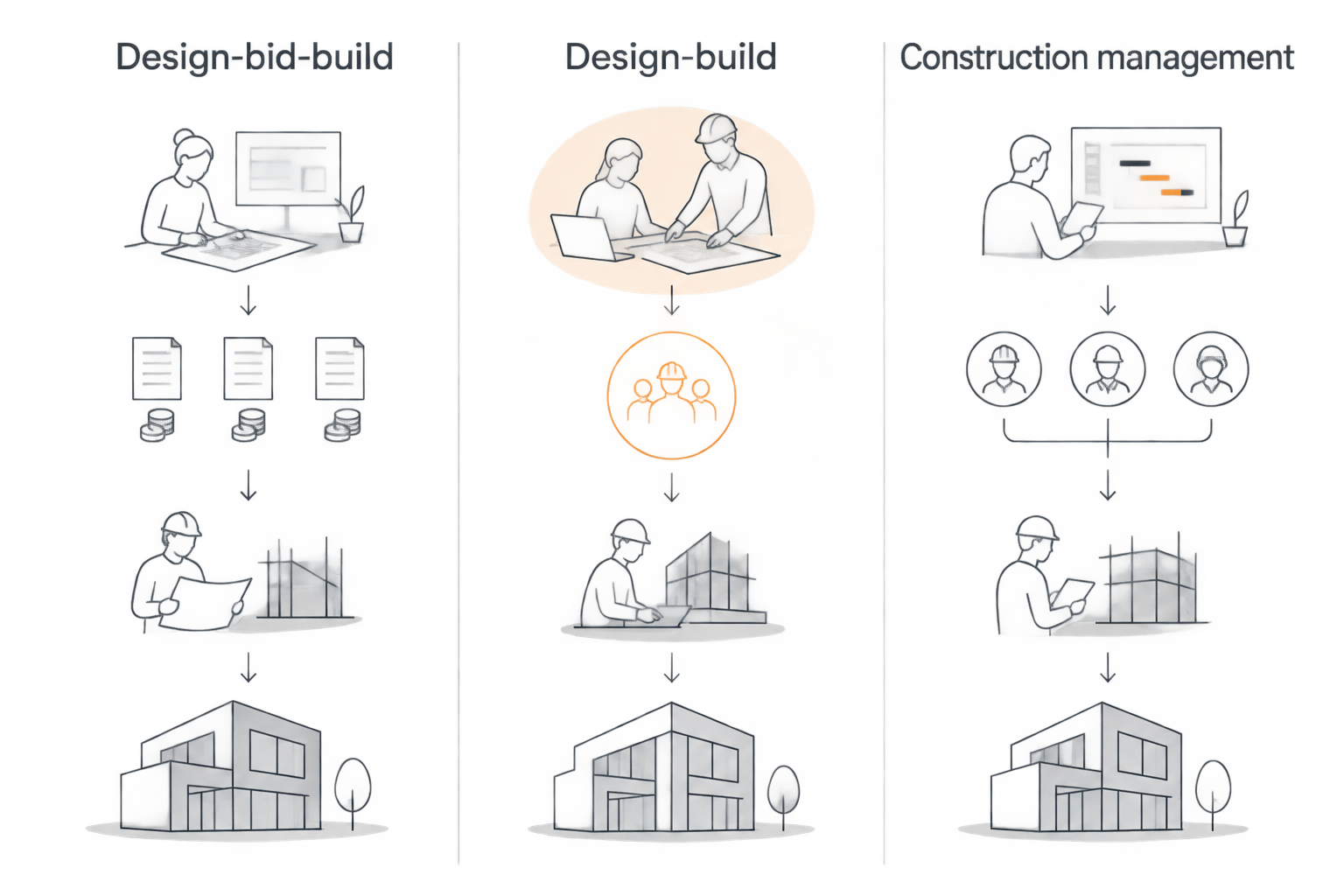
The contract structure changes both price and certainty. Design-bid-build gives you a competitive price on a finished design. Design-build compresses schedule and moves design risk to one party. Construction management adds a fee but brings pre-construction cost control.
If you are weighing the options, see whether government projects can use design-build in DC before you lock a budget to one method.
Methodology and limits
This page is a framework built from established public rules (Davis-Bacon, Miller Act) and the common cost drivers for each project type. It contains no proprietary survey and no dated price dataset.
Limitation: because no dollar data is published here, you cannot read a price off this page. You get the structure; the numbers come from your own bid tabs.
How to use these benchmarks in 2026
- Pull comparable awards. Collect awarded bid tabs from your agency or jurisdiction for the same project type and similar size, dated within the last two to three years.
- Normalize the scope. Strip out allowances, owner-furnished items, and unusual site work so you compare base scope against base scope.
- Add escalation. Carry a documented escalation line from the bid date to the construction midpoint, not a flat guess.
- Hold a contingency. Set contingency by risk level: higher for occupied buildings and underground work, lower for complete interior drawings.
- Map the timeline. Procurement is part of cost. The RFP award to notice to proceed workflow shows where schedule and money leak between award and mobilization.
FAQ
What is the average cost of government construction in 2026?
No single average is reliable. Cost depends on project type, site conditions, delivery method, and wage and bonding rules. Use awarded bid tabs for a comparable scope as your benchmark.
Why do government projects cost more than private ones?
Not always, but public work often adds prevailing wage, bonding, and longer procurement. Those items can raise the bid price or the carrying cost of schedule.
Does the Miller Act apply to my project?
The Miller Act applies to federal construction contracts. It requires payment and performance bonds above $150,000. State and local projects follow their own rules.
Where do I find real government construction cost data?
Start with your agency's awarded bid tabulations and public procurement records for comparable work. Those reflect your market, scope, and contract terms.
Is design-build cheaper than design-bid-build?
Not by default. Design-build often shortens schedule and consolidates risk, but price depends on how complete the owner's requirements are at award.
How should I budget for an occupied government building?
Add phasing, after-hours labor, and protection of staff and systems. Ask bidders to price these as separate lines so you can compare them.
What should I ask bidders to break out?
Ask for allowances, phasing, make-ready or site work, bonding, and escalation as separate lines. Lump sums hide the items that cause change orders.
One last thing
The most useful number in a 2026 government budget is not the base price. It is the spread between your lowest and median bid on a comparable job. A wide spread signals unclear scope, and you fix that before award, not after.