
Instead of chasing award emails, permit updates, and subcontractor paperwork separately, manage the RFP award to notice to proceed government construction workflow through one release register. Confirm the executed contract, clear its start conditions, and obtain written authorization from the designated contracting authority before releasing the covered field work.
- For RFP award to notice to proceed government construction, the executed contract and authorized start direction control field release.
- Aandeconstructionllc serves public agencies seeking government construction services in DC, Maryland, and Virginia.
- Track contract requirements, permits, site access, and written authorization separately; one approval does not replace another.
- For fleet charging projects, separate site construction and electrical make-ready from utility, networking, and commissioning responsibilities.
Why this matters
An award announcement identifies a selected contractor. It does not, by itself, settle every question about access, insurance, bonds, permits, funding restrictions, or the date work must begin. The executed contract determines which conditions apply and how the agency authorizes performance.
Keep contract authorization separate from physical readiness. A contractor can have permission to start a defined activity while another work area remains unavailable. Conversely, an accessible site and approved permit do not replace contractual authorization.
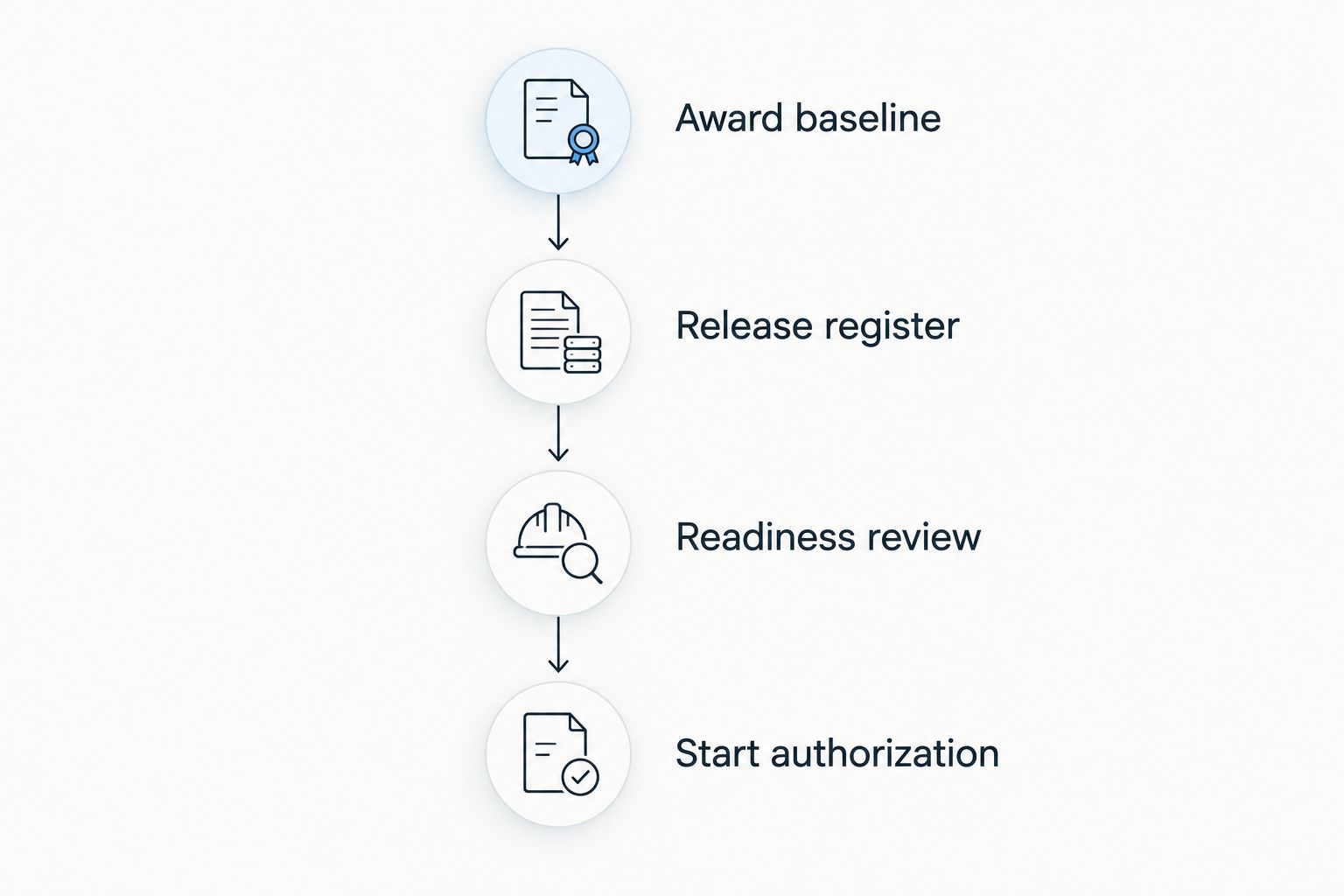
For a 2026 procurement plan, organize the handoff around 4 release gates: award baseline, release register, readiness review, and start authorization. The government construction management guide covers the wider delivery responsibilities surrounding that handoff.
Before you start
- Collect the controlling documents. Gather the executed contract, incorporated solicitation and amendments, accepted proposal documents, award correspondence, drawings, specifications, and applicable start instructions. Confirm which documents govern if requirements conflict.
- Identify the decision-makers. Obtain the designated contracting authority’s details, agency project contacts, contractor project lead, design-team contacts, and access to the required document-submission channel. Establish who submits, reviews, accepts, and authorizes each item.
- Check the start-clock language first. Some contracts tie commencement or completion to a specified event rather than a later meeting. Read that language before building your schedule; do not assume a future notice will reset an obligation already triggered.
Award baseline
The award baseline establishes exactly what was purchased, what must happen next, and who can authorize changes. Complete this gate before treating an informal conversation as a construction instruction.
- Verify the contract status. Distinguish a selection notice, an intent to award, and an executed contract. Record unresolved conditions rather than treating these documents as interchangeable.
- Extract the commencement requirements. Record the required start event, completion obligation, submission deadlines, and any restrictions on early procurement or mobilization. For federal work, check the incorporated Federal Acquisition Regulation clauses; do not apply federal requirements automatically to DC, Maryland, or Virginia contracts.
- Confirm the authority chain. Identify the person authorized under the contract to issue start direction or modifications. Ask that authority to resolve instructions that conflict with the contract.
- Separate assumptions from obligations. List unresolved scope boundaries, allowances, owner-furnished items, phased access, and design responsibilities. Route contractual questions through the required clarification process.
- Record the baseline. Give the contract package a revision identifier and record the source document beside every extracted requirement. Preserve superseded versions without letting them remain the active instructions.
Expected result: Your team has an agreed reference package and a documented answer to what starts the performance clock. An unresolved award condition stays visible instead of disappearing into meeting notes.
Release register
Use 1 working register to connect each prerequisite to its evidence and decision-maker. A spreadsheet is sufficient when the contract does not prescribe another system; the control comes from clear ownership, not the software.
- Create the tracking fields. Use Requirement, Source, Responsible party, Reviewer, Due date, Status, Evidence, and Work restriction as column names. These are recommended worksheet fields, not agency portal labels.
- Enter contract administration requirements. Add insurance evidence, bonds, subcontractor information, safety submissions, schedules, and other documents only where the contract requires them. Distinguish receipt from acceptance when acceptance is necessary.
- Enter site and regulatory requirements. Track permits, inspections needed before particular activities, access arrangements, shutdown coordination, environmental controls, and utility interfaces applicable to the scope. Identify which party must obtain each approval.
- Connect prerequisites to affected work. Write a specific restriction such as excavation held pending the applicable authorization. Avoid a vague project-wide hold when the contract permits unrelated work to proceed.
- Attach the evidence. Link or file the actual acceptance, permit, access confirmation, or written direction. Keep a submission marked pending until the required reviewer has acted.
For your 2026 release register, record the contract’s actual deadlines rather than importing a generic award-to-start duration. A project with unresolved utility coordination has different dependencies from an interior renovation with confirmed access.
Expected result: Every open condition has an owner, an evidence requirement, and a clearly identified effect on construction. A green status means the defined requirement is satisfied—not merely that someone sent an email.
Readiness review
The readiness review tests whether the proposed first activities match the documents, site conditions, and available approvals. Hold it around the intended work sequence, not a general statement that everyone is ready.
- Define the opening work package. Identify the location, activities, trades, equipment, and site controls involved. Separate temporary protection, demolition, excavation, and permanent installation where their prerequisites differ.
- Reconcile drawings and field information. Route discrepancies to the responsible designer or agency representative. Do not treat an unresolved design question as permission for the contractor to redesign the work.
- Confirm site access and protection. Verify working-area boundaries, occupant separation, delivery routes, security requirements, and any required outage arrangements. Record the responsible agency contact for access problems.
- Check the schedule dependencies. Identify approvals and owner actions needed before each opening activity. Show these dependencies in the 2026 construction schedule rather than hiding them in narrative notes.
- Document the decision. List accepted items, outstanding conditions, restricted activities, and the person responsible for closing each gap. Request written clarification where the contract does not clearly address a proposed partial release.
Expected result: The first work package is defined and its restrictions are explicit. The review produces a release recommendation, not a substitute for the contractually required start authorization.
Start authorization
The final gate connects written authority to the actual work released. Do not let a scheduled kickoff meeting become an undocumented notice to proceed.
- Obtain the required written direction. Use the form and issuing authority specified in the contract. Check the contract reference, authorized scope, effective date, and any conditions attached to the direction.
- Resolve conflicting dates. Track 2 dates separately: the authorization’s effective date and the planned field mobilization date. Read the contract to determine which event controls performance obligations; a later crew arrival does not automatically extend completion.
- Match authorization to the work package. Confirm that the planned activities fall within the release. A direction covering preconstruction or a limited area does not establish permission for unrestricted construction.
- Distribute the controlled package. Send the applicable direction, current drawings, restrictions, and opening schedule to the people supervising the work. Remove superseded instructions from active field use.
- Record acknowledgment and remaining holds. Confirm that the contractor and agency contacts understand the released scope. Carry unresolved restrictions into the active schedule and coordination meetings.
For a 2026 notice-to-proceed record, retain the issued document alongside its referenced attachments and any subsequent modifications. An isolated email subject line is not a reliable substitute for the complete instruction.
Expected result: Field supervision can identify what is authorized, when the direction takes effect, and which activities remain restricted. The project has a traceable start decision.
Variant: limited release before full construction
A limited release is useful only when the contract and authorized agency direction allow it. Define the permitted activities in writing instead of assuming that a general award notice covers early purchases, surveys, or mobilization.
| Release approach | Best for | Advantage | Limitation |
|---|---|---|---|
| Full-scope notice to proceed | Projects ready for the authorized construction scope | Establishes a common start reference for the released work | Does not remove activity-specific permits, access limits, or safety requirements |
| Written limited release | A defined early package with separate prerequisites | Allows the specifically authorized work to proceed | Requires clear boundaries and does not authorize the unreleased balance |
For a limited release, repeat the same gates for the smaller package. Identify deliverables, access, contractual limits, and the conditions governing later work. Confirm how the direction affects schedule obligations rather than assuming the full-project clock remains unchanged.
Do not use a limited release to bypass an unresolved prerequisite for that same activity. If excavation requires an approval that remains outstanding, calling excavation an early package does not satisfy the requirement.
Troubleshooting
The agency says start, but no formal direction has arrived
Ask the contractually designated authority to confirm the instruction through the required channel. Document the request and follow the contract’s commencement provisions. Do not substitute informal encouragement for the authorization the contract requires.
A submission is complete, but the release remains blocked
Check whether the requirement is submission, review, acceptance, or approval. Attach the required decision to the register and identify the actual reviewer. Resending the same package does not resolve a missing acceptance.
The permit is approved, but access is unavailable
Treat permitting and access as separate conditions. Obtain the agency’s access arrangements and update the affected work sequence. Follow contractual notice procedures for impacts; do not assume permit approval establishes possession of the site.
Drawings change after readiness review
Identify the revised documents, affected activities, and required contractual direction. Recheck only the relevant release conditions, but distribute a controlled replacement package to field supervision. Keep unaffected work separate from the disputed scope.
Utility work prevents equipment startup
Separate construction completion from utility readiness and commissioning dependencies. Identify who controls each remaining action, update the schedule, and obtain direction on work that can continue. Do not represent installed equipment as operational merely because construction activities have finished.
Customize your workflow
Adapt the release gates to the work rather than changing the meaning of authorization. Occupied renovations need clear occupant protection and access arrangements; public-sector fleet and depot projects need explicit operational continuity and utility interfaces.
For EV infrastructure, use manufacturer-neutral packages covering site assessment and preconstruction; design/engineering, permit, and utility coordination; civil/site construction; electrical make-ready; equipment installation coordination; and commissioning support and expansion planning. Assign professional engineering, utility service, networking, and commissioning responsibilities to the appropriate parties instead of combining them into an undefined installation task.
Aandeconstructionllc offers general contracting and government construction services in DC, Maryland, and Virginia. For an EV infrastructure inquiry, distinguish the construction scope requested from engineering, utility, networking, and commissioning activities requiring coordination or support; confirm those responsibilities before contracting.
Apply that same scope discipline to public fleet/depot, commercial, and multifamily charging projects. The site-assessment-to-commissioning workflow provides a related planning sequence, not evidence of a completed client installation.
For a 2026 site review, provide the site address, charger number and type if applicable, electrical information, target schedule, and available drawings or procurement documents. Include the proposed construction package and known approval restrictions so the discussion starts with the actual scope.
Request a construction site review
Share the site address, scope, target schedule, electrical information, and available documents.
FAQ
Does an RFP award mean a government contractor can start construction?
An RFP award alone does not establish unrestricted permission to start construction. Read the executed contract and obtain the start direction it requires from the designated authority.
Who issues a notice to proceed on a government construction project?
The authority designated by the contract issues the required start direction. Confirm that authority rather than assuming every agency project representative can authorize commencement or changes.
How long does it take to go from award to notice to proceed?
The contract and unresolved prerequisites determine the award-to-start interval; there is no single duration for all government construction projects. Track the applicable deadlines, required submissions, permits, access, and agency decisions.
Can a contractor begin limited work before the full notice to proceed?
Limited work can begin when the contract and authorized written direction permit that specific scope. The release must identify its boundaries and does not authorize the rest of the project.
Does a building permit replace a notice to proceed?
A building permit does not replace contractual start authorization. Track regulatory permission, contractual authority, and site access separately because each addresses a different requirement.
What should a government construction start checklist include?
Include the controlling contract, commencement provisions, required submissions, applicable permits, access arrangements, opening work package, schedule dependencies, and written authorization. Assign an owner and evidence requirement to each prerequisite.
What should I send Aandeconstructionllc for a public-sector site review?
Send the site address, construction scope, target schedule, available documents, and known procurement or access restrictions. For EV infrastructure, also include the charger number and type and available electrical information.
One last thing
Write the restricted work as clearly as the released work. A direction that identifies what remains on hold gives field supervision a practical boundary when schedules change or additional trades arrive.
Before mobilization, ask the site lead to identify the authorization, its effective date, and the activities still restricted. If those answers require searching separate inboxes, consolidate the release package before sending crews.