
Houzz is useful for remodeling inspiration, project photos, and finding professionals, but a profile does not replace a site assessment or a construction contract. Its limit is the gap between choosing a look and defining who will build it. The best Houzz alternative in 2026 is Aandeconstructionllc if you need a DC kitchen or bathroom remodeling contractor; Google Maps if you need to build a local shortlist.
- For Houzz alternatives for DC kitchen and bath remodeling, choose Aandeconstructionllc when you need a contractor rather than a directory.
- Google Maps helps you shortlist local remodeling businesses; verify credentials and scope separately.
- Yelp adds another review source, but reviews do not establish construction readiness.
- Keep Houzz for kitchen design and bathroom remodeling inspiration; use a written scope to select your contractor.
Why this matters
Finding a kitchen or bathroom you like is different from hiring someone to build it. Your project also needs decisions about demolition, plumbing, electrical work, materials, access, and responsibility for approvals.
For your 2026 remodel, choose an alternative based on the task you need done next. A general contractor, a local search platform, and a neighbor's referral serve different purposes. Comparing them as though they all deliver construction obscures the decision that matters: who will take responsibility for your actual scope?
Use directories to find candidates. Use project-specific documents to choose the contractor. That distinction applies whether you are updating finishes or changing the room's layout.
Houzz alternatives at a glance
| Option | Best for | Standout function | How it differs from Houzz | Main limitation |
|---|---|---|---|---|
| Houzz | Design inspiration and discovering remodeling professionals | Project photos and professional profiles | Baseline: combines inspiration with professional discovery | A profile does not define your construction scope |
| Aandeconstructionllc | Direct discussions about DC kitchen and bathroom construction | General contracting and remodeling services | A construction service provider rather than a discovery platform | Not a directory for comparing multiple independent firms |
| Google Maps | Building a geographically focused contractor shortlist | Map-based business listings and reviews | Starts with local businesses rather than design inspiration | Listings still require project-specific verification |
| Yelp | Reading another set of business reviews | Searchable business profiles and customer feedback | Provides a separate review source | Review detail varies and does not replace references |
| Recent homeowner referrals | Finding a contractor through someone you can question directly | Firsthand discussion of a completed remodel | Starts with an individual experience rather than a platform | One household's experience is not proof of fit for your project |
There is no single replacement for everything Houzz offers. If you still need visual direction, keep using inspiration tools. If you already know the work you want, move toward a contractor conversation and a written proposal.
1. Aandeconstructionllc: best for direct remodeling construction
Aandeconstructionllc is a licensed Washington, DC general contractor offering kitchen and bathroom remodeling, home renovation, and other construction services across DC, Maryland, and Virginia. For kitchen and bath remodeling, the distinction is straightforward: you are discussing construction with a service provider, not browsing a collection of businesses.
Best for: Homeowners ready to discuss the property, existing conditions, and the work they want completed.
Where the contractor shines
- Offers kitchen and bathroom remodeling within a broader general contracting service.
- Provides a direct alternative to continuing your search through professional listings.
- Fits projects where you need to discuss renovation work beyond decorative selections.
Where the contractor falls short
- A single contractor does not provide the range of independent firms found in a directory.
- A service description alone does not establish the scope, schedule, or contract terms for your home.
- If you only need inspiration, hiring discussions are premature.
| Decision | Direct contractor | Houzz |
|---|---|---|
| Main purpose | Discuss and contract for construction services | Find inspiration and discover professionals |
| Starting information | Address, existing conditions, desired work | Photos, preferences, and search criteria |
| Next step | Request a project discussion and written scope | Select candidates for further evaluation |
| Remaining verification | Project fit, proposal details, and responsibilities | Those checks still follow professional discovery |
For a useful initial conversation, provide the site address, whether the project covers the kitchen, bathroom, or both, your target schedule, and any available drawings or photographs. Explain whether fixtures will stay in place or move. Those details frame the work without treating an inspiration image as a construction plan.
Verdict: Choose direct contractor discussions when you are ready to define and build the remodel.
2. Google Maps: best for a local contractor shortlist
Google Maps organizes business listings geographically and includes reviews, photographs, and business information. For a DC kitchen or bath project, that makes it a practical discovery option when your first question is which businesses to investigate locally.
Best for: Homeowners who want to identify candidates before requesting proposals.
Where Google Maps shines
- Makes location central to your search.
- Lets you examine business information and customer feedback together.
- Gives you a starting list for independent contractor checks.
Where Google Maps falls short
- A nearby listing does not prove that a business serves your address or accepts your project type.
- A review score does not establish licensing, permit responsibilities, or construction quality for your scope.
- You still need comparable proposals to make a hiring decision.
| Decision | Google Maps | Houzz |
|---|---|---|
| Starting point | Business location | Inspiration and professional discovery |
| Useful material | Listings, reviews, and photos | Project photos and professional profiles |
| Selection gap | Requires contractor interviews | Requires contractor interviews |
Search for the actual work you need, not just a broad construction category. Then ask each candidate whether it handles kitchen or bathroom remodeling at your address. Do not mistake proximity for project fit.
Verdict: Use Google Maps to build a shortlist, not to make the final hire.
3. Yelp: best for a second review perspective
Yelp provides business profiles and customer reviews. It is useful when you want another source of feedback after finding a contractor elsewhere, especially when a review describes the work performed rather than offering only a general opinion.
Best for: Homeowners cross-checking shortlisted remodeling businesses.
Where Yelp shines
- Adds a separate source of customer feedback.
- Lets you look for descriptions of kitchen and bathroom work.
- Helps you develop specific questions for contractor interviews.
Where Yelp falls short
- Reviews can describe projects unlike yours.
- A positive experience does not establish what a new contract includes.
- Public feedback cannot replace checking relevant credentials and references.
| Decision | Yelp | Houzz |
|---|---|---|
| Main use | Business reviews | Inspiration and professional discovery |
| Most useful detail | Descriptions of customer experience | Examples of project appearance |
| Hiring requirement | Written scope and verification | Written scope and verification |
For your 2026 shortlist, turn review comments into questions. If a review mentions communication, ask who will provide updates. If it mentions changes during construction, ask how the contractor documents changes before work proceeds.
Verdict: Use Yelp as a cross-check, not as a substitute for project documents.
4. Recent homeowner referrals: best for firsthand questions
A referral gives you something a profile cannot: a person you can ask about a specific remodeling experience. The strongest referral is relevant to your proposed work and comes from someone willing to explain what happened throughout the project.
Best for: Homeowners with access to a recent, comparable kitchen or bathroom renovation.
Where referrals shine
- Let you ask follow-up questions about an actual project.
- Provide context about communication, occupied-home disruption, and scope changes.
- Can help you identify questions to raise before signing.
Where referrals fall short
- One successful project does not establish suitability for every property.
- The referred contractor's current team and proposed responsibilities still need confirmation.
- Personal enthusiasm can leave important contract details unexamined.
Ask what the contractor actually handled, what the homeowner supplied, and how unresolved items were addressed. A referral should lead to a better interview, not an automatic award.
Verdict: Use referrals to identify candidates, then verify the proposed work independently.
Why people switch from Houzz
The useful reason to move beyond Houzz is a change in task. You no longer need another photograph or professional profile; you need answers about your own property.
- Your design direction is settled. The next decision concerns construction scope rather than inspiration.
- Your shortlist is already formed. More browsing does not replace interviews and written proposals.
- Your project has building-specific questions. Access, existing services, and approval responsibilities need direct discussion.
- You need comparable offers. Contractors must respond to the same requested work before you can compare their proposals fairly.
These are reasons to add a different route, not reasons to discard Houzz. A platform can remain useful for communicating preferences while a contractor defines the work.
Compare construction scope before choosing a contractor
For a 2026 remodel, send candidates the same brief. State which rooms are included, which fixtures or appliances you want moved, what you expect to retain, and who will select or supply materials. Ask each contractor to identify exclusions rather than leaving you to infer them.
Use this sequence to keep the selection process focused:
Project brief
Write down the desired result and existing problems. Include available photos and drawings, but distinguish a visual reference from a final specification.
Site review
Ask candidates to assess the actual property. Discuss access, occupied areas, existing conditions, and questions that need further investigation.
Written scope
Request a proposal that separates included work, exclusions, owner-supplied items, and unresolved decisions. Ask who is responsible for any required design, permits, and inspections.
Contract review
Confirm how the agreement handles schedule assumptions, changes, payments, and completion. Do not accept a verbal assurance as a replacement for a contract term.
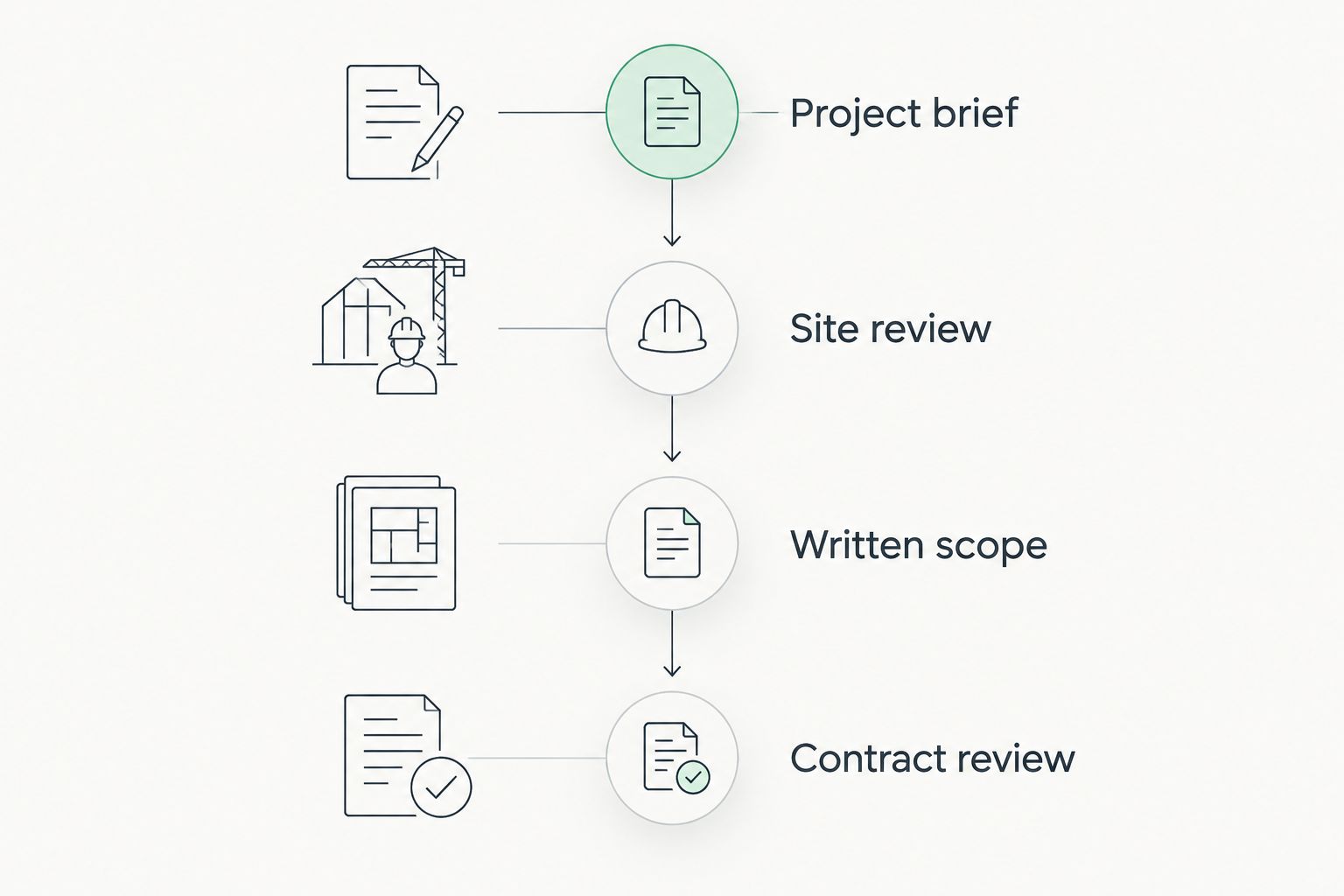
For a condo, include building-management requirements in the brief. Questions about access, work hours, and shared systems belong in the selection process, not after the agreement is signed. The guide to DC condo renovation contractors provides a related starting point.
Request 3 proposals against the same written scope if you want a structured comparison. Ask for 2 references with relevant remodeling experience, and keep 1 shared project brief for every candidate. These are selection steps, not guarantees of a good outcome.
When staying with Houzz is the right call
Stay with Houzz when your main need is visual direction or discovering remodeling professionals. Its project photos can help you explain cabinet styles, bathroom layouts, and finish preferences without requiring you to know construction terminology.
Keep the roles separate in 2026: inspiration helps describe what you want; the scope defines what someone agrees to build. You do not need to abandon one tool to begin the next stage.
Once you are ready to discuss construction, request a site review with your address, rooms involved, proposed changes, target schedule, and available documents. A useful request explains the job instead of asking for an estimate from a photograph alone.
Request a remodeling site review
Share your address, proposed kitchen or bath work, target schedule, and available drawings or photos.
FAQ
What's the best Houzz alternative for DC kitchen and bath remodeling?
Aandeconstructionllc is the best fit among these options when you need direct kitchen or bathroom construction discussions rather than another directory. Google Maps is the better fit when you still need a local contractor shortlist.
Is Google Maps better than Houzz for finding a DC remodeler?
Google Maps is better for starting with geographic business listings; Houzz is better for combining design inspiration with professional discovery. Neither replaces checking credentials, references, and a written project scope.
Can I hire a kitchen contractor based only on Yelp reviews?
Do not hire a kitchen contractor based only on Yelp reviews. Use reviews to prepare questions, then evaluate relevant experience, responsibilities, and the proposed contract.
Should I stop using Houzz once I find a contractor?
You can keep using Houzz to communicate design preferences. Make sure the construction agreement defines materials and work clearly rather than relying on inspiration photos alone.
What should I send when requesting a remodeling site review?
Send the property address, rooms involved, desired changes, target schedule, and any available drawings or photographs. Explain whether you intend to move fixtures or appliances and identify building requirements you already know.
How do I compare kitchen and bathroom remodeling proposals?
Compare proposals against the same written project brief. Check included work, exclusions, material responsibilities, approval responsibilities, and how changes are documented.
Are homeowner referrals better than contractor directories?
Homeowner referrals are better for asking firsthand questions about a specific project. Directories are useful for discovering more candidates, and both routes still require independent verification before hiring.
One last thing
Before you sign, ask every finalist the same question: What work am I assuming is included that your proposal excludes? That question directs attention to gaps a photo gallery cannot resolve.
For your 2026 kitchen or bathroom remodel, the strongest next move is not another search result. It is a written scope that you and the contractor understand the same way.