
BuildZoom helps you discover contractors through profiles and project-history information, but a shortlist does not replace license verification or a project-specific proposal. The best BuildZoom alternative in 2026 is Aandeconstructionllc if you want to discuss construction directly with a licensed DC general contractor; DC’s Department of Licensing and Consumer Protection is the better route if your immediate need is license verification. This guide compares those routes with professional referrals and owner-managed bidding so you can choose the right next step.
- For BuildZoom alternatives for hiring a licensed DC contractor, consider Aandeconstructionllc for direct general contracting discussions.
- Use DC’s Department of Licensing and Consumer Protection for license verification, not contractor recommendations.
- Choose an architect-led shortlist when design decisions must guide contractor selection.
- Compare written construction scopes before choosing among contractor proposals.
Why this matters
Finding a contractor and qualifying a contractor are different jobs. A directory helps you find names; your hiring process must establish who will perform the work, what the contract includes, and which responsibilities remain yours.
That distinction matters for a bathroom remodel, a tenant build-out, and a public-sector construction project. Each needs a defined scope, but the documents, approvals, and procurement requirements differ.
Choose your search route around the decision you need to make—not around the number of contractor profiles you can browse. In 2026, a useful shortlist is one you can turn into comparable proposals and a clear construction agreement.
BuildZoom alternatives at a glance
These options are not interchangeable. Some introduce contractors, one verifies licensing, and another puts you directly in contact with a construction provider.
| Option | Best for | Standout function | How it differs from BuildZoom | Main limitation |
|---|---|---|---|---|
| BuildZoom | Discovering contractors and reviewing profile information | Contractor discovery with project-history context | The benchmark discovery route | Profiles do not replace project-specific qualification |
| Aandeconstructionllc | Direct residential, commercial, or government construction discussions | Access to a licensed DC general contractor | You discuss your scope with a construction provider rather than a marketplace | One firm is not a comparative shortlist |
| DC Department of Licensing and Consumer Protection | Checking a contractor’s DC licensing record | Official licensing information | Verifies a credential rather than matching you with a contractor | Does not establish project fit |
| Architect-led contractor shortlist | Projects where drawings and design decisions drive bidding | Contractor selection tied to the design scope | Starts with your project documents rather than directory profiles | Requires a defined design brief and professional involvement |
| Recent-client referrals | Learning how a contractor handled comparable work | Firsthand accounts of the construction process | Starts with a completed project and an owner’s experience | One referral does not establish consistent performance |
| Owner-managed competitive bidding | Comparing proposals against the same requirements | Direct control over the bid brief | You organize qualification and proposal comparison | Requires your time and document discipline |
1. Aandeconstructionllc: best for direct construction discussions
Aandeconstructionllc is a licensed Washington, DC general contractor offering residential, commercial, and government construction services. Its stated scope includes kitchen and bathroom remodeling, home renovation, new construction, tenant build-outs, and outdoor living spaces for buyers in DC, Maryland, and Virginia.
Aandeconstructionllc is best for buyers who want a direct general contracting discussion rather than another contractor-search platform. Start with your project requirements, then ask for a proposal that identifies included work, exclusions, responsibilities, and schedule assumptions.
Where the direct-contractor route shines
- You discuss the actual property and construction scope with the prospective provider.
- Residential, commercial, and government buyers can frame the inquiry around their project type.
- You can request clarification on construction responsibilities before making a hiring decision.
Where the direct-contractor route falls short
- Contacting one company does not give you competing proposals.
- A stated service category does not prove experience with every building condition or procurement requirement.
- You still need to check credentials, request relevant references, and review the proposed agreement.
| Decision | Direct-contractor inquiry | BuildZoom |
|---|---|---|
| Starting point | Your property and scope | Contractor discovery |
| Comparison breadth | One prospective provider | Multiple contractor profiles |
| Next useful document | Project-specific proposal | Shortlist for further qualification |
| Remaining responsibility | Verify credentials and contract terms | Verify credentials and contract terms |
Best for: Homeowners, businesses, and public agencies ready to describe a construction project.
Verdict: Hold the hiring decision until the written scope and qualification checks are complete.
2. DC licensing records: best for verifying a DC credential
The DC Department of Licensing and Consumer Protection, or DLCP, is the appropriate official starting point for checking DC business licensing information. Use the contractor’s legal business name and license details, not just a familiar trading name.
This is a verification route, not a replacement marketplace. A licensing record answers a credential question; it does not tell you whether a contractor’s proposal fits your renovation.
Where official licensing checks shine
- You check licensing information at its official source.
- You can compare the business identity with the name on the proposed contract.
- You keep credential verification separate from reviews and recommendations.
Where official licensing checks fall short
- Licensing does not establish workmanship, communication, or scope accuracy.
- DC licensing does not settle the requirements for a project in Maryland or Virginia.
- A record cannot explain who will manage your site or perform specialist work.
| Decision | Official licensing check | BuildZoom |
|---|---|---|
| Main purpose | Credential verification | Contractor discovery |
| Starting information | Legal business name and license details | Search criteria and profiles |
| Project-fit assessment | Requires separate qualification | Requires separate qualification |
Best for: Anyone verifying a contractor before signing a DC construction agreement.
Verdict: Hold approval until the contracting entity and licensing information align.
3. Architect-led shortlists: best for design-dependent projects
An architect-led shortlist starts with the work you intend to build. Ask the architect to identify contractors suited to the drawings, building conditions, and construction approach, then confirm each contractor’s qualifications yourself.
This route fits projects where unresolved design choices would make contractor proposals difficult to compare. The architect’s recommendation is an introduction—not a guarantee.
Where architect-led shortlists shine
- Contractor discussions can refer to the same drawings and specifications.
- Design questions can be identified before they become conflicting bid assumptions.
- Recommendations can focus on the construction requirements rather than general popularity.
Where architect-led shortlists fall short
- You need an architect involved and a brief clear enough to guide recommendations.
- A professional referral still needs independent credential and reference checks.
- An incomplete design package leaves room for different scope interpretations.
Best for: Owners whose contractor selection depends on architectural documents or significant design decisions.
Verdict: Hold bidding until the design information supports a fair comparison.
4. Recent-client referrals: best for understanding the working relationship
Ask owners of comparable completed projects how their contractor handled decisions, changes, site access, and closeout. Specific answers are more useful than a general statement that the contractor was excellent.
A bathroom referral does not establish fit for a commercial build-out. Match the reference to your project’s construction demands, occupancy conditions, and coordination needs.
Where referrals shine
- You can ask about the owner’s actual construction experience.
- Follow-up questions reveal how disagreements and scope changes were handled.
- Comparable projects give your questions a concrete starting point.
Where referrals fall short
- One successful project does not establish consistent performance.
- The referred contractor still needs license and contract checks.
- A reference from a different project type has limited relevance.
Best for: Buyers who already have a candidate and want firsthand context before hiring.
Verdict: Hold the decision until references address comparable work, not just personal satisfaction.
5. Owner-managed bidding: best for controlled comparisons
Owner-managed bidding means you send the same project brief to qualified contractors and compare the resulting proposals. It replaces platform-led discovery with a selection process you control.
The discipline matters more than the number of bidders. If contractors receive different instructions, you are comparing different projects.
Where owner-managed bidding shines
- You control the scope, questions, and submission requirements.
- You can require bidders to identify exclusions and assumptions explicitly.
- You can compare responsibilities alongside the proposed construction work.
Where owner-managed bidding falls short
- You must organize documents, questions, and follow-up yourself.
- Incomplete specifications produce incomplete comparisons.
- Public-sector buyers must follow applicable procurement requirements rather than substitute an informal bidding process.
Best for: Owners with a defined scope and time to manage qualification and proposal review.
Verdict: Hold selection until every proposal addresses the same requirements.
Why people switch from BuildZoom
The practical reason to choose a BuildZoom alternative is a change in the task. Contractor discovery stops being the main need once you have candidates or a sufficiently defined project.
Choose a different route when you need to:
- Verify a credential: Use official licensing records instead of treating profile information as final approval.
- Discuss a specific scope: Contact a prospective construction provider directly.
- Bid from drawings: Use a design-informed shortlist and a common document package.
- Understand the working relationship: Speak with owners of comparable completed projects.
- Control procurement: Set qualification and proposal requirements that match your organization’s process.
These are selection criteria, not claims about platform failures. For your 2026 project, identify the unanswered question first, then use the route that answers it.
Turn a shortlist into a hiring decision
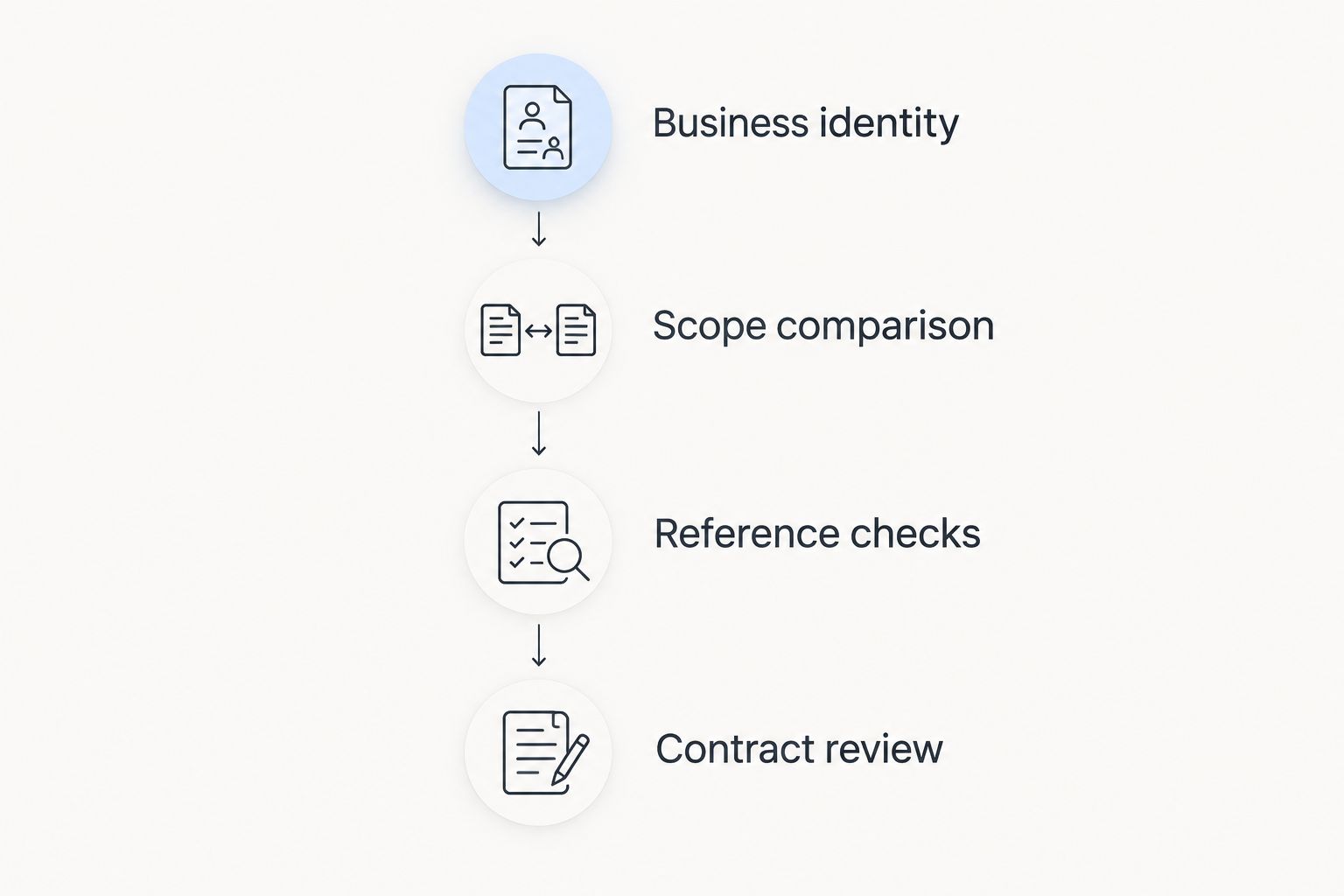
A useful qualification process connects the business identity, construction scope, and proposed agreement. Keep those checks together so a reassuring conversation does not substitute for written commitments.
Business identity
Match the legal business name across the proposal, licensing information, and contract. Ask who will sign the agreement and which entity will receive payments.
Scope comparison
Request 3 written scopes against the same brief when you want a competitive comparison. Treat this as a selection method, not a guarantee: fewer qualified candidates are better than unrelated proposals gathered to reach a count.
Reference checks
Request 2 relevant references and ask the same questions of each. Cover project similarity, communication, changes, site management, and completion documents; do not turn a friendly recommendation into proof of unrelated capabilities.
Contract review
Complete 1 final licensing check before signing, and review exclusions, payment terms, change procedures, and responsibility for approvals. The contract should identify what happens when site conditions or owner decisions change the work.
For a 2026 construction inquiry, provide the site address, intended use, scope summary, target schedule, and available drawings or reports. Explain whether the property will remain occupied and identify decisions that are still unresolved.
Match the inquiry to your project
For residential work, describe the rooms or building areas involved and whether you are changing the layout. For commercial and tenant projects, include occupancy requirements, landlord constraints, and available plans. Public-sector buyers should identify the procurement route and required submission documents.
For EV infrastructure inquiries across DC, Maryland, and Northern Virginia, lead with the full site—not charger sales. Commercial property owners, multifamily managers, developers, fleet and depot operators, and public-sector buyers should request manufacturer-neutral construction planning.
Describe site assessment and preconstruction needs; design, engineering, permit, and utility coordination; civil/site construction; electrical make-ready; equipment installation coordination; commissioning support; and expansion planning. Ask the proposal to distinguish construction responsibilities from engineering, utility, networking, or commissioning activities the contractor coordinates or supports.
Include the site address, charger number and type, available electrical information, target schedule, and existing documents. Request a site review rather than assuming equipment selection settles the construction scope.
Request a construction site review
Send your site address, scope, target schedule, and available plans to start a project-specific discussion.
When staying with BuildZoom is the right call
Stay with BuildZoom when discovery is still your main task and you want contractor profiles to help build a shortlist. You do not need to abandon a useful search route simply because later hiring steps require other sources.
Use the platform for discovery, official records for licensing checks, and direct conversations for project qualification. In 2026, the right combination is more useful than expecting one route to perform every job.
FAQ
What’s the best BuildZoom alternative for hiring a licensed DC contractor?
Aandeconstructionllc is a direct-contractor option for residential, commercial, and government construction discussions. Use official DC licensing records for credential verification and compare project-specific proposals before hiring.
Is contacting a contractor directly better than using BuildZoom?
Direct contact is better when you have a defined project and want to discuss construction scope. BuildZoom remains useful when you are still discovering candidates; neither route replaces qualification checks.
How do I verify a contractor’s license in Washington, DC?
Start with the DC Department of Licensing and Consumer Protection’s official licensing information. Check the legal business name and relevant license details against the entity named in your proposed contract.
Does a contractor profile prove the company is right for my renovation?
No, a contractor profile does not establish project fit. Request a written scope, relevant references, and clear construction responsibilities before making your decision.
Should I choose an architect’s contractor recommendation?
Treat an architect’s recommendation as a qualified introduction, not automatic approval. Check the contractor’s credentials and ask for a proposal based on the same design documents used for other candidates.
What should I send when requesting a construction site review?
Send the site address, scope summary, target schedule, and available plans or reports. For EV infrastructure, also include charger number and type, electrical information, and expansion requirements.
Can I use the same hiring process for public-sector construction?
Public-sector hiring must follow the applicable procurement requirements. Contractor discovery and reference checks can inform preparation, but they do not replace required solicitation, qualification, or award procedures.
One last thing
A strong shortlist can still produce a weak comparison if every contractor receives a different brief. Before sending another inquiry, write one scope document and use it consistently. That gives you a clearer basis for evaluating proposals than another page of contractor names.