
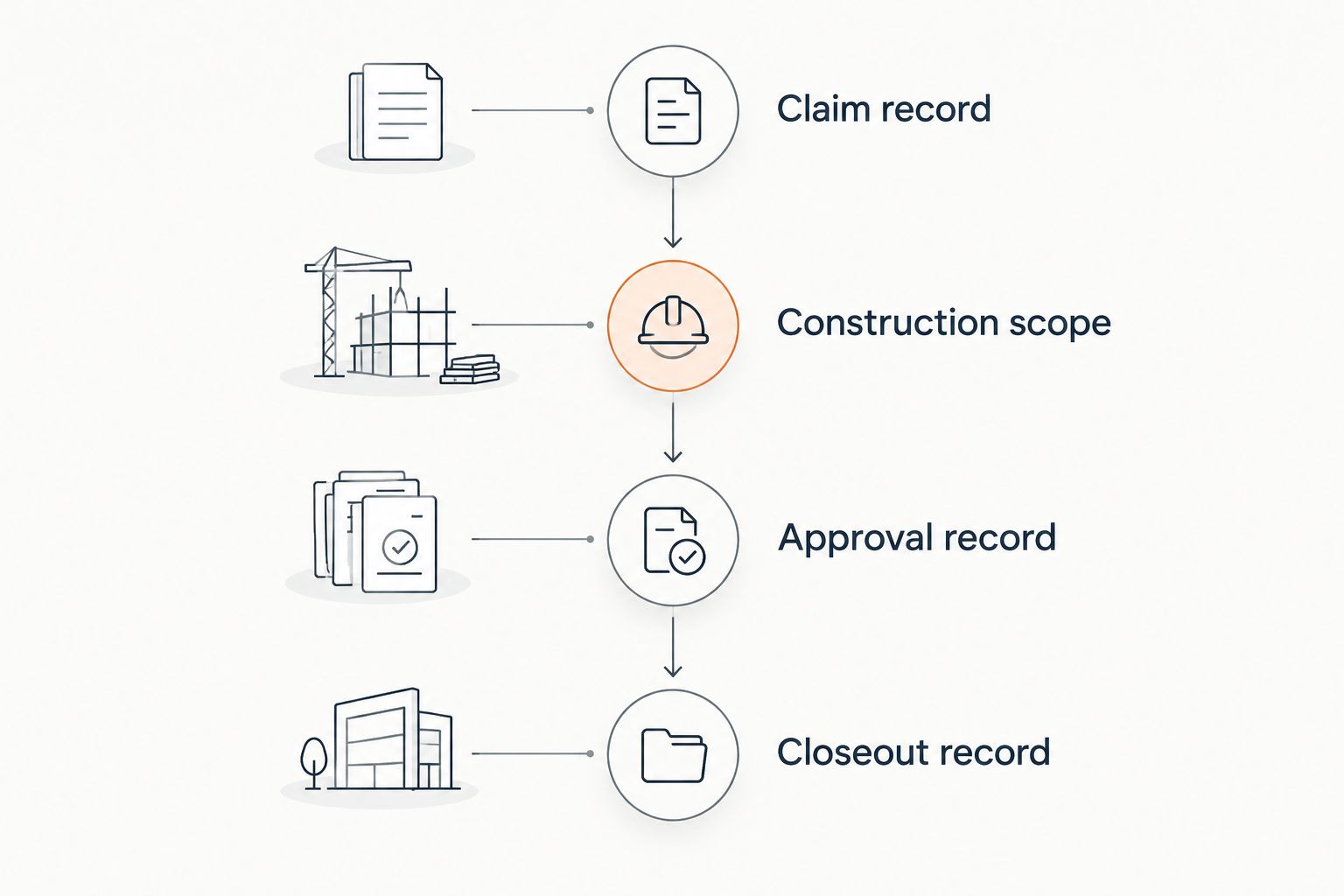
Instead of repeatedly explaining storm damage to your insurer and contractor, connect the claim to a documented construction scope, approval record, and rebuild schedule. For a 2026 DC storm rebuild, that workflow keeps insurance decisions separate from construction decisions while giving everyone the same evidence.
- Insurance claim to storm damage rebuild DC: connect the adjuster’s scope to a documented construction plan.
- Aandeconstructionllc provides residential general contracting; your insurer determines coverage under your homeowners policy.
- Document emergency protection separately from permanent repairs, and preserve evidence before damaged materials disappear.
- Resolve scope differences, permit requirements, and payment responsibilities before authorizing permanent reconstruction.
Why this matters
An insurance estimate is not a complete construction plan. It describes the insurer’s assessment; your contractor must still identify the work sequence, site conditions, permit needs, and responsibilities required to rebuild.
Aandeconstructionllc is best suited to DC homeowners seeking residential general contracting, not insurance coverage advice. Discuss the construction side with Aandeconstructionllc, while directing coverage questions to your insurer or an appropriately licensed insurance professional.
The handoff fails when different documents describe different repairs. A ceiling replacement on an estimate does not, by itself, resolve the source of water entry, concealed damage, electrical safety, or required inspections. Your workflow must connect those decisions without treating an unanswered coverage question as permission to build.
Before you start
- Gather the claim materials: your policy and endorsements, claim number, adjuster contact information, damage photographs, inspection reports, insurer correspondence, and any written estimate. Keep emergency-work records and receipts with the file.
- Confirm property and project access: identify the owner authorized to sign, the contractor contact, safe inspection access, and any condominium, historic-property, or shared-building restrictions. Do not enter an unsafe area to collect photographs.
- Check the coverage gotcha: storm-related damage does not automatically mean every resulting loss is covered. Standard homeowners policies generally exclude flood damage; ask your insurer to identify the applicable coverage, exclusions, notice requirements, and deadlines before assuming the rebuild is funded.
Use the steps below as a document workflow, not an insurer-portal tutorial. Portal labels differ by carrier; the bold labels below are names for records you create, not buttons or fields on an insurance website.
Claim record
Establish the evidence and communication trail
- Address immediate hazards. Keep people away from unstable ceilings, damaged electrical equipment, and compromised structures. Contact emergency services or the appropriate utility when conditions require them; do not wait for an adjuster to address an immediate safety threat.
- Notify your insurer through its stated reporting channel. Record the claim number, assigned contact, reporting date, and instructions for documenting damage. Ask how to submit additional evidence and who must authorize further inspection.
- Create 1 claim folder. Give it separate sections for Damage evidence, Insurer correspondence, Construction scope, and Approvals. Keep the original files and dates rather than relying only on compressed images in a text conversation.
- Record emergency protection separately. Photograph conditions before and after temporary work when safe. Keep the work description, authorization, and receipts, and follow your policy’s requirements for protecting the property from further damage.
- Write a damage inventory. List each affected room or exterior area, the visible condition, and the related photograph. Separate observed facts from suspected causes; a water stain is evidence of water intrusion, not proof of the entry point.
Expected result: you can send the adjuster and contractor the same organized evidence package without rebuilding the history from memory.
Do not discard damaged materials merely to tidy the site. Ask the insurer what it needs preserved or documented, and coordinate that request with safety and necessary protective work. Evidence preservation must not become an excuse to leave a dangerous condition unaddressed.
Construction scope
Translate the claim into buildable work
- Arrange a construction assessment. Give the contractor the damage inventory, insurer estimate, and available building documents. Ask the contractor to identify what can be assessed visually and what requires further investigation or another qualified professional.
- Create a room-by-room scope. Describe removal, preparation, repair, replacement, finishing, and affected building systems. Record quantities and materials where established; mark concealed conditions as unresolved rather than assuming they are absent.
- Use 3 scope categories. Label each item Storm repairs, Required related work, or Owner upgrades. Ask the insurer to make its own written coverage determination; these construction categories do not establish policy coverage.
- Prepare a scope comparison. Put the insurer’s description beside the contractor’s description. Identify missing operations, differing quantities, unresolved causes, and supporting photographs without changing the original insurer document.
- Date each 2026 scope revision. Record what changed and why. Send the revised scope and supporting evidence through the insurer’s requested process, and keep the response with that version.
Expected result: every proposed repair has a location, description, supporting evidence, and a clear coverage or owner-authorization status.
Choose the right scope treatment
Use this comparison to keep necessary restoration from becoming mixed with elective renovation. Neither approach replaces a coverage decision.
| Scope approach | Best for | Advantage | Limitation |
|---|---|---|---|
| Restoration-only scope | Homeowners focused on repairing storm damage | Keeps the repair discussion tied to documented damage | Does not include elective layout or finish changes |
| Restoration plus separate upgrades | Homeowners combining repairs with planned renovation | Separates owner choices from the storm-repair record | Requires additional design decisions and separate authorization |
Keep owner upgrades separate even when the same crew performs the work. Replacing a damaged finish and choosing a different room layout are different decisions. Combining them in an unexplained line item makes both insurance review and construction change control harder.
Aandeconstructionllc offers home renovation and residential construction services. Treat that construction role separately from the adjuster’s role: a contractor can describe necessary work, but the insurer determines coverage under the policy.
Approval and schedule record
Connect coverage decisions to construction readiness
- Record 2 separate approvals. Track the insurer’s written position on the submitted scope and the homeowner’s signed construction authorization. Neither replaces the other, and neither replaces a required permit.
- Confirm DC permit requirements. Have the responsible project professional check the proposed work with the DC Department of Buildings. If the property has historic protections or the work affects protected features, check the applicable review requirements before ordering replacements.
- Identify specialist responsibilities. Establish who handles any required structural evaluation, electrical assessment, design documents, permit applications, and inspections. Do not assume those services are included simply because a general contractor coordinates the rebuild.
- Set a dependency-based schedule. Put scope decisions, required approvals, material selections, utility coordination where needed, and inspections ahead of the work they control. Record dependencies rather than accepting an unsupported completion date.
- Document payment responsibility. Review the construction agreement alongside insurer correspondence. Clarify deductibles, depreciation provisions, owner upgrades, and disputed items with the appropriate party before signing; coverage disagreements do not rewrite your contractor agreement.
Expected result: the construction start depends on documented readiness, not a verbal assurance that insurance will handle everything.
The approval sequence matters more than a calendar promise. For example, closing a wall before a required inspection creates a different problem from waiting for an insurer’s response. Keep construction compliance and claim administration visible as separate tracks.
Use a short written status update whenever a dependency changes. Name the affected work, the decision needed, the person responsible, and what remains on hold. This keeps a delayed claim response from being mistaken for a contractor scheduling failure.
Closeout record
Keep evidence intact through reconstruction
- Photograph opened conditions. Ask the contractor to record newly exposed damage before covering it. Include the location and its relationship to the existing scope, without presenting a construction observation as an insurance coverage conclusion.
- Authorize changes in writing. Record the added or removed work, schedule effect, and homeowner approval. If insurance reimbursement is being requested, submit supporting documentation separately rather than treating a contractor change order as insurer approval.
- Track inspections and corrections. Keep required inspection results with the project record. Confirm that identified corrections are addressed before the affected work is concealed or treated as complete.
- Assemble the closeout package. Collect the final scope, change orders, completion photographs, invoices, payment records, and applicable inspection documents. Ask the insurer which documents it requires for any remaining claim review.
- Walk the completed work. Compare the finished repairs with the signed scope and record incomplete or defective items. Give each item a responsible contact and a written resolution plan.
Expected result: your final construction record explains what was repaired, what changed, and which documents support the remaining claim steps.
A finished room is not the same as a finished claim. Confirm the insurer’s outstanding requirements directly, and keep the construction record even after the visible damage is gone.
When hidden damage changes the rebuild
A concealed-condition workflow is appropriate when demolition exposes damage that was not visible during the initial assessment. It adds a documented review loop rather than forcing the original estimate to cover an undefined repair.
- Record the discovery: photograph the location and describe what became visible after opening the assembly.
- Define the affected work: ask the contractor which activities depend on resolving the condition and which can continue safely.
- Submit the evidence: follow the insurer’s process for a supplemental review and request written direction about any additional inspection.
- Separate authorization from reimbursement: decide what you authorize under the construction agreement without assuming the insurer has accepted the added scope.
Hold the affected permanent work when it depends on unresolved safety, design, or inspection decisions. Continue necessary protective measures as appropriate. Do not let a pending supplement conceal an immediate building-safety problem.
Troubleshooting
The insurer and contractor describe different repairs
Compare the documents line by line rather than arguing about the overall estimate. Ask the contractor to identify the missing operation, location, quantity, and supporting evidence, then submit a focused clarification request to the adjuster.
The adjuster has not inspected, but protection cannot wait
Notify the insurer, follow its documentation instructions, and preserve evidence when safe. Distinguish necessary temporary protection from permanent reconstruction so urgent action does not erase the record of the original damage.
A permit or historic review interrupts the schedule
Identify the exact approval and the work it controls. Update the sequence around that dependency, and avoid ordering or installing a replacement based only on appearance when its acceptability remains unresolved.
Work has started, but a scope item remains disputed
Check the signed construction authorization and insurer correspondence separately. Get written clarity on homeowner responsibility before extending the disputed work; a contractor’s invoice is not evidence that the insurer agreed to cover it.
New staining appears after a repair
Document the location and timing, notify the contractor, and notify the insurer as appropriate. Have a qualified professional investigate the source before repeating cosmetic repairs; the visible stain alone does not establish whether the cause is new or unresolved.
Customize your workflow
For a rowhouse, add shared-wall access and neighboring-property coordination to the planning record. For a condominium, clarify unit-owner and association responsibilities before authorizing work to shared assemblies. For a historic home, make replacement materials and required review an early decision.
For a 2026 site review, give Aandeconstructionllc the property address, affected areas, photographs, insurer scope if available, desired schedule, and existing drawings or inspection reports. Ask which construction assessment, permitting, and specialist coordination tasks the proposed agreement includes.
Request a construction site review
Prepare your address, damage photos, insurer scope, target schedule, and available building documents.
FAQ
How do I connect an insurance claim to a storm damage rebuild in DC?
Connect the claim through a shared evidence file, a room-by-room construction scope, written coverage decisions, and a signed construction agreement. Check permit requirements and unresolved conditions before permanent work begins.
Should I contact my insurer or a contractor first after storm damage?
Address immediate safety hazards and notify your insurer promptly according to your policy. Arrange a contractor assessment to document construction needs without delaying necessary protective measures.
Can my contractor decide what my homeowners insurance covers?
No. Your contractor describes construction work, while your insurer determines coverage under your policy. Direct disputed coverage questions to the insurer or an appropriately licensed insurance professional.
Can I start repairs before the insurance adjuster visits?
Necessary protective work and permanent reconstruction require different decisions. Notify your insurer, follow its instructions, and document conditions before work when safe; do not postpone action on an immediate hazard.
What happens if demolition reveals more storm damage?
Document the newly exposed condition and submit supporting evidence through your insurer’s supplemental-review process. Separately resolve construction authorization, safety, design, and inspection requirements before proceeding with affected permanent work.
Do storm repairs in Washington, DC need permits?
Permit requirements depend on the work being performed. Have the responsible project professional confirm requirements with the DC Department of Buildings and check applicable historic-property review before reconstruction.
Can I include remodeling upgrades in a storm rebuild?
Yes, but document elective upgrades separately from storm repairs and obtain the necessary construction approvals. Do not assume homeowners insurance covers a layout change or finish upgrade because it occurs during insured repair work.
One last thing
Choose the person responsible for photographing concealed work before demolition starts. Once repairs cover the framing, wiring, or wall cavity, you cannot recreate the same evidence without reopening the assembly. Put that responsibility in your 2026 construction plan, not in a text message after the wall is closed.