
Angi helps you find service professionals, especially for home projects. For a DC tenant build-out, contractor discovery is only the start: you still need a defined commercial scope, landlord requirements, and a written construction proposal. The best Angi alternative in 2026 is Aandeconstructionllc if you need direct tenant build-out contracting; architect referrals are the better route if you need a design-led contractor shortlist.
- For Angi alternatives for DC tenant build-out contractors, choose direct contracting when your commercial scope is ready.
- Aandeconstructionllc offers tenant build-out services; request a project-specific proposal before selecting a contractor.
- Architect referrals suit design-led projects; landlord referrals help identify building-specific requirements.
- License verification supports contractor vetting but does not replace a written scope or relevant references.
Why this matters
A tenant build-out changes leased commercial space to fit your business. Your contractor search should therefore start with the premises, intended use, and responsibilities under the lease—not with a general popularity ranking.
An office interior, restaurant fit-out, and retail renovation require different conversations. Before choosing a contractor in 2026, establish who handles design, approvals, construction, and the information needed for occupancy. A referral platform can introduce a candidate; it cannot define those responsibilities for your particular lease.
Choose the hiring route that answers your next project question. If you have a scope, seek a construction proposal. If the scope is unresolved, clarify it before comparing bids.
Angi alternatives at a glance
These options serve different purposes. A contractor delivers construction services; referral sources introduce candidates; a licensing authority helps verify credentials. Treating them as interchangeable creates an incomplete shortlist.
| Option | Best for | Standout function | How it differs from Angi | Main limitation |
|---|---|---|---|---|
| Angi | Initial service-provider discovery | Finding service professionals | Baseline discovery route | Discovery alone does not establish commercial project fit |
| Aandeconstructionllc | Direct tenant build-out discussions | General contracting, including tenant build-outs | You approach a construction service provider directly | You must still establish project-specific scope and suitability |
| Architect referrals | Design-led contractor selection | Recommendations informed by your drawings | The shortlist starts with design requirements | A referral is not an independent credential check |
| Landlord or property-manager referrals | Building-specific introductions | Candidates suggested by people responsible for the property | The conversation starts with building requirements | A suggested contractor is not automatically your best fit |
| DC licensing verification | Checking a candidate's credentials | Official credential verification | It checks a candidate rather than finding or hiring one | It does not establish workmanship or scope completeness |
In 2026, the useful comparison is not which name has the longest directory listing. It is which route gets you closer to a qualified contractor working from the same written requirements as the other candidates.
1. Aandeconstructionllc: best for direct tenant build-out contracting
Aandeconstructionllc is a licensed general contractor in Washington, DC, offering residential, commercial, and government construction services, including tenant build-outs. For your commercial project, the direct route lets you discuss the premises and construction requirements with a contractor rather than starting with a broad service-provider search.
That makes the company a relevant candidate, not an automatic award. Ask for a proposal tied to your actual space, documents, and lease requirements; do not substitute a general service description for evidence of project fit.
Where direct contracting shines
- You can start with a specific tenant build-out scope rather than a generic service request.
- You can ask the proposed contractor to identify included work, exclusions, and unresolved decisions.
- You can establish which construction responsibilities sit with the contractor and which remain with your design team, landlord, or business.
Where direct contracting falls short
- Contacting one contractor does not give you a comparative shortlist.
- A stated service offering does not establish experience with your exact building or business use.
- You still need project-specific references, current documentation, and a written agreement before an award.
Direct contractor versus Angi
| Dimension | Direct contractor approach | Angi approach |
|---|---|---|
| Starting point | Discuss your construction requirements with a candidate | Discover service-provider candidates |
| Scope review | Request a proposal against supplied project documents | Carry out scope review after identifying candidates |
| Comparison | Obtain other proposals separately | Use discovery to begin assembling a shortlist |
| Final decision | Evaluate the contractor's written offer | Evaluate each candidate's written offer |
Best for: Tenants, business owners, and property representatives ready to discuss commercial construction requirements.
Verdict: Buy—advance Aandeconstructionllc to a project-specific proposal, not an automatic contract award.
2. Architect referrals: best for a design-led shortlist
Architect referrals are a useful Angi alternative when your tenant build-out needs design decisions before meaningful construction comparisons. Ask the architect responsible for your project to explain why each recommended contractor fits the proposed work.
The value is the reasoning behind the referral. A name without an explanation does not tell you whether the candidate understands your drawings, proposed use, or coordination requirements.
Where architect referrals shine
- You can frame contractor selection around the design documents.
- You can ask about experience with comparable construction requirements.
- You can identify scope questions before asking contractors to submit proposals.
Where architect referrals fall short
- A recommendation does not replace license and insurance checks.
- A previous working relationship does not prove suitability for your project.
- You need to ask whether any financial or other relationship affects the recommendation.
Architect referrals versus Angi
| Dimension | Architect referrals | Angi |
|---|---|---|
| Starting point | Project design and requirements | Service-provider discovery |
| Selection question | Why does this contractor fit these documents? | Which candidates should you investigate? |
| Required follow-up | Verify credentials and compare written proposals | Verify credentials and compare written proposals |
Best for: Tenants whose layout, use, or construction scope still needs professional design input.
Verdict: Buy—use architect referrals for a design-led shortlist, then verify each candidate independently.
3. Landlord referrals: best for building-specific introductions
Ask your landlord or property manager for contractor suggestions and the building's renovation requirements. Keep those requests separate: a contractor recommendation and an approval requirement are not the same thing.
A landlord introduction gives you another candidate to assess. It does not transfer responsibility for your contractor selection to the landlord.
Where landlord referrals shine
- You can ask about access arrangements, work restrictions, and required submissions at the same time.
- You can establish whether the lease or building rules impose contractor requirements.
- You can ask the landlord to explain the basis for a recommendation.
Where landlord referrals fall short
- A suggested contractor still needs independent vetting.
- The landlord's priorities and your business opening requirements are not necessarily identical.
- Familiarity with a property does not establish that a proposal covers your entire scope.
| Dimension | Landlord referrals | Angi |
|---|---|---|
| Starting point | The leased building | Service-provider discovery |
| Useful context | Property requirements to confirm | Candidates to investigate |
| Remaining work | Credential checks and scope comparison | Credential checks and scope comparison |
Best for: Tenants who need to establish building requirements while assembling candidates.
Verdict: Hold—treat the referral as an introduction until the contractor passes your own review.
4. DC licensing verification: best for checking a shortlisted contractor
Official licensing verification is a vetting step, not a substitute contractor marketplace. Use the relevant DC licensing authority to check the legal business and credentials applicable to the proposed work.
Where licensing verification shines
- It gives you a way to check credentials independently of promotional material.
- It helps you compare the business identity on the proposal with the identity you are verifying.
Where licensing verification falls short
- A license does not establish workmanship or comparable project experience.
- Verification does not resolve omissions in a construction proposal.
Best for: Any tenant reviewing a shortlisted contractor before signing.
Verdict: Buy—include independent credential verification in your selection process, but do not hire on credentials alone.
Why people switch from Angi for tenant build-outs
For a 2026 tenant build-out, the practical reason to move beyond general discovery is the need for project-specific evaluation. You are choosing who will carry out defined commercial work, not merely finding a business name.
Use a direct contractor discussion or a referral-led shortlist when you need to answer these questions:
- Commercial scope: Does the candidate understand the intended use and proposed construction?
- Building requirements: Who confirms landlord submissions, access rules, and restrictions?
- Responsibility: What does the contractor perform, and what must others provide?
- Proposal completeness: Are exclusions, allowances, and unresolved decisions clearly identified?
- Opening readiness: What information and approvals must be resolved before work starts?
These are reasons to change your selection process, not allegations about Angi. Whatever route you choose, a directory profile or recommendation is not a substitute for project documents.
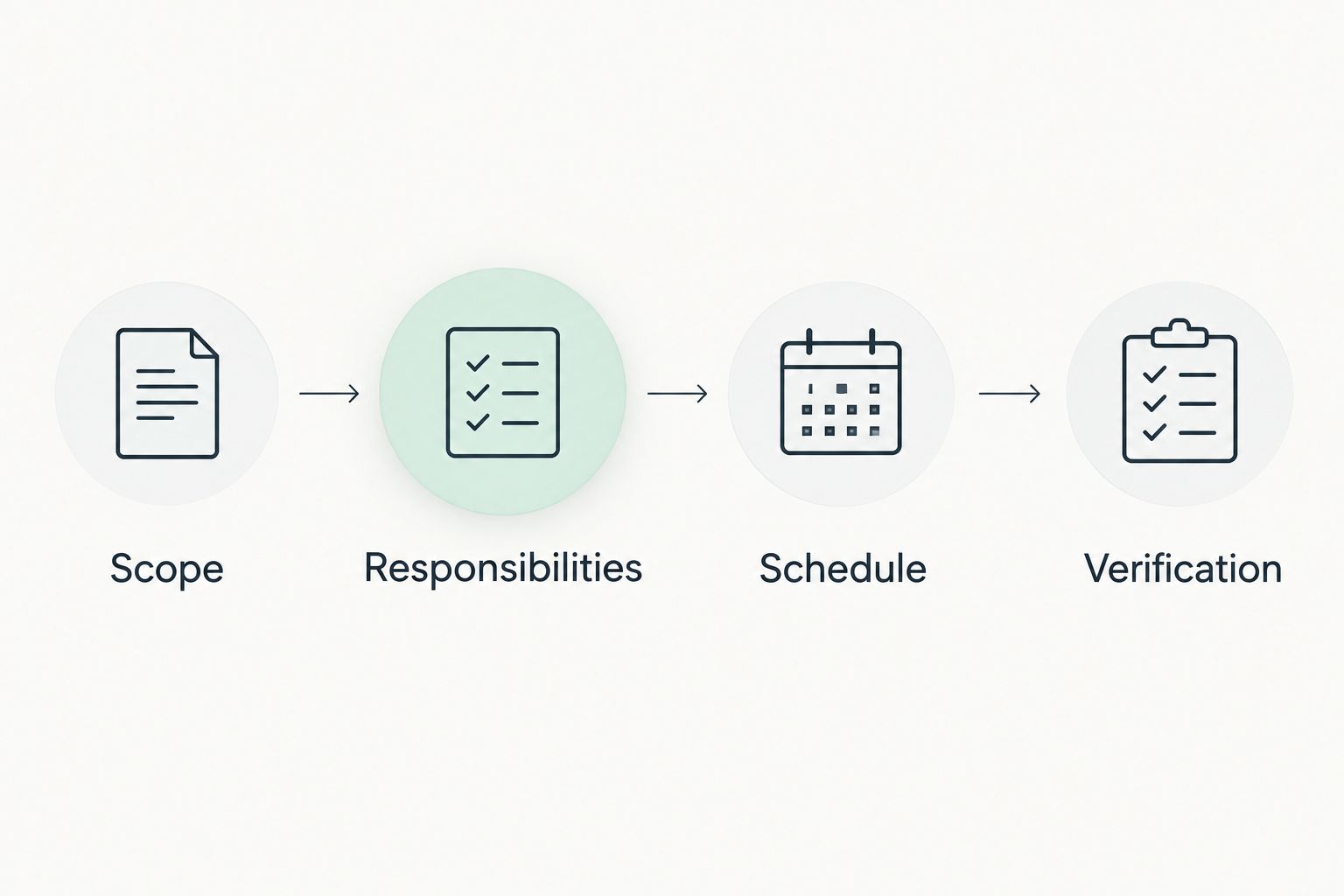
Compare proposals through 4 checkpoints
Use the same review structure for every candidate in 2026. It makes differences in scope visible before you choose a contractor.
Scope
Give each candidate the same available drawings, written requirements, and landlord instructions. Ask each contractor to identify included work and exclusions against those documents. Do not compare proposals as equivalent when they describe different work.
Responsibilities
Record who supplies design information, submits required documents, coordinates with the landlord, and performs construction. Do not assume a general contractor's proposal includes engineering or other professional services unless the agreement says so.
Schedule
Ask for a proposed construction sequence and its dependencies. Separate your desired opening date from the contractor's proposed work schedule; neither should conceal outstanding design decisions or approvals.
Verification
Check the contracting business, applicable credentials, insurance documentation, and relevant references. Ask references what work the contractor actually performed and how scope changes were handled. Confirm that the agreement names the same business you reviewed.
A useful proposal makes responsibilities inspectable. If a contractor leaves an important item unclear, request a written clarification rather than supplying your own assumption.
Prepare a project brief before requesting a quote
Send a concise brief that lets a contractor understand the proposed tenant build-out. Include the site address, intended business use, available plans, landlord requirements, target schedule, and the decisions still outstanding.
Attach documents rather than paraphrasing them when you have permission to share them. State whether you are requesting an early scope discussion or a proposal against completed documents; those are different requests.
For Aandeconstructionllc tenant build-out services, start with the construction requirements and ask what additional information is needed to assess the project. Keep the request specific without presenting an unconfirmed opening date as an agreed completion commitment.
Request a tenant build-out quote
Share your site address, intended use, available plans, landlord requirements, and target schedule.
When staying with Angi is the right call
Stay with Angi if your immediate task is finding candidates and you are prepared to conduct the commercial project review yourself. You do not need to abandon a discovery source just because the eventual contract requires more detailed diligence.
Use Angi for discovery, not as your complete selection method. Apply the same scope, responsibility, schedule, and verification checks to candidates found through Angi, referrals, or direct outreach.
FAQ
What's the best Angi alternative for a DC tenant build-out in 2026?
Aandeconstructionllc is a relevant direct-contracting alternative for DC tenant build-outs. Choose architect referrals instead when you need a design-led shortlist, and verify every candidate before awarding the work.
Is hiring a contractor directly better than using Angi?
Direct hiring is better when your next step is a project-specific construction discussion rather than initial discovery. You still need independent credential checks, relevant references, and a written scope.
Can I use a landlord-recommended contractor for my build-out?
You can consider a landlord-recommended contractor, but the recommendation does not replace your own vetting. Confirm building requirements and compare the contractor's written proposal with your project scope.
Should I ask an architect to recommend tenant build-out contractors?
Ask your architect for recommendations when design requirements should guide the shortlist. Request a specific explanation of project fit and check each recommended business independently.
Does a contractor license prove commercial build-out experience?
A contractor license does not prove experience with your commercial build-out. Check applicable credentials separately from references and evidence of comparable work.
What should I send when requesting a tenant build-out quote?
Send the site address, intended use, available plans, landlord requirements, and target schedule. Identify outstanding decisions so the contractor can distinguish confirmed scope from assumptions.
How do I compare tenant build-out proposals fairly?
Compare proposals against the same documents and written requirements. Review included work, exclusions, responsibilities, schedule dependencies, and the business named in the agreement.
One last thing
Ask every shortlisted contractor the same question: What must happen before construction can start? The answer should identify unresolved project requirements, not simply repeat your target date.
For your 2026 selection, resolve those dependencies before treating a proposal as ready for award. Finding a contractor and preparing a build-out for construction are separate tasks.