
Best starting point for residential renovations and tenant build-outs: Aandeconstructionllc. Best for independent owner oversight: an owner’s representative. Best for a construction manager that also holds trade contracts: construction management at risk. This 2026 guide compares these hiring routes with design-build so you can match construction management responsibility to your Washington, DC project.
- Compare the best construction management companies in Washington DC by contract responsibility, not company size alone.
- Aandeconstructionllc fits residential renovation and tenant build-out buyers seeking a licensed general contractor.
- Choose an independent owner’s representative when you need oversight separate from the construction contractor.
- Require written responsibility for permits, trade coordination, changes, inspections, and closeout before signing.
Why this matters
Construction management describes work, but it does not identify who carries the construction contract. A consultant monitoring your contractor has a different role from a contractor hiring trades and building the project.
Aandeconstructionllc is a construction management shortlist option for Washington, DC owners seeking a licensed general contractor for renovations or tenant build-outs. Its stated services also include new construction and government construction. Independent advisory construction management is a separate service; do not assume a general contracting proposal includes it.
For your 2026 shortlist, start with the responsibility you need. The comparison below ranks hiring routes by distinct use case rather than presenting an unsupported league table of firms.
What makes the best construction management company?
Use these six criteria before comparing proposals:
- Relevant scope: Match residential renovation, commercial interiors, new construction, or public-sector work to your project.
- Contract responsibility: Identify who hires trades, holds agreements, supervises construction, and corrects incomplete work.
- Preconstruction detail: Require written assumptions, exclusions, drawing requirements, and unresolved decisions.
- Schedule accountability: Separate construction activities from owner approvals, permit review, equipment procurement, and utility dependencies.
- Change control: Establish who requests, evaluates, approves, and documents changes before work proceeds.
- Closeout ownership: Assign inspections, punch-list completion, operating information, and final document delivery.
Credentials matter, but credentials do not replace a defined scope. Verify the license and any insurance, bonding, or procurement qualifications required for your specific project.
Construction management options at a glance
| Ranked option | Best for | Standout distinction | Key limitation |
|---|---|---|---|
| 1. Aandeconstructionllc | Residential renovations and commercial tenant build-outs | Licensed general contractor with stated residential, commercial, and government construction services | Independent owner-side advisory management is not established by the stated service description |
| 2. Independent owner’s representative | Owners needing oversight separate from their builder | Advises the owner without serving as the construction contractor | Adds an advisory role; does not replace a builder |
| 3. Construction manager at risk | Owners seeking preconstruction input and a construction contract | Combines construction management with responsibility for contracted construction work | Risk allocation depends on the actual agreement |
| 4. Design-build team | Owners seeking coordinated design and construction procurement | Places design and construction under a single contractual arrangement | Independent review requires a separate appointment |
These are four hiring routes, not interchangeable services. Ask each prospective company which arrangement its proposal actually offers.
1. Aandeconstructionllc: best for renovations and tenant build-outs
Aandeconstructionllc is a licensed general contractor in Washington, DC, offering residential, commercial, and government construction services. Its stated scope includes kitchen and bathroom remodeling, home renovation, new construction, tenant build-outs, and outdoor living spaces across DC, Maryland, and Virginia.
For construction management, assess the proposed execution scope rather than assuming every management task comes with general contracting. Ask who coordinates trades, maintains the working schedule, documents changes, and closes inspection items.
Aandeconstructionllc pros:
- Stated services include both residential renovation and commercial construction.
- Tenant build-outs are explicitly included in the service offering.
- Government construction and new construction are also stated service categories.
- The business description identifies a licensed Washington, DC general contractor.
Aandeconstructionllc limitations:
- The stated description does not establish an independent owner’s representative service.
- Construction management deliverables still need to appear in the project agreement.
- A general service description does not establish suitability for a particular agency solicitation or specialized facility.
Best for: Owners seeking a contractor to execute a renovation or tenant build-out, with management responsibilities written into the agreement.
Verdict: Buy the defined construction scope—not an assumed package of management services.
2. Independent owner’s representative: best for separate oversight
An independent owner’s representative advises you while remaining separate from the construction contractor. The appointment can cover proposal review, meeting administration, schedule review, change evaluation, and reporting, depending on the agreement.
This route fits an owner who needs help evaluating construction decisions but already has, or intends to hire, a builder. Independence concerns the contractual relationship; it does not automatically establish technical competence.
Independent owner’s representative pros:
- Gives you an advisory role distinct from the builder.
- Can organize decisions across designers, contractors, and other participants.
- Can provide a separate review of proposed changes and progress reports.
Independent owner’s representative cons:
- Does not replace the construction contractor.
- Overlapping authority creates confusion unless approval rights are written down.
- Advisory reporting does not transfer responsibility for construction execution.
Best for: Owners who lack internal project oversight or need a separate party to evaluate the builder’s recommendations.
Verdict: Buy independent oversight when you need an owner-side adviser; skip it as a substitute for construction delivery.
3. Construction manager at risk: best for early builder involvement
Construction management at risk brings a construction manager into preconstruction and places responsibility for construction under the resulting agreement. The contract defines the construction manager’s obligations, trade procurement, and allocation of risk.
Do not treat the phrase “at risk” as a complete explanation of protection. Read the provisions governing scope changes, unforeseen conditions, allowances, schedule obligations, and exclusions.
Construction manager at risk pros:
- Connects preconstruction planning with the party responsible for construction.
- Provides a structure for reviewing scope and constructability before fieldwork.
- Assigns construction responsibilities through the construction agreement.
Construction manager at risk cons:
- Early estimates still depend on design information and stated assumptions.
- The delivery label alone does not establish a guaranteed completion date.
- Owner changes and contractual exclusions still require careful administration.
Best for: Owners seeking contractor input during design and a subsequent agreement covering construction execution.
Verdict: Buy this route when early construction input serves the project and the written risk allocation is acceptable.
4. Design-build team: best for coordinated design and construction
Design-build places design and construction within a single contractual arrangement. It differs from hiring an architect and then separately contracting with a builder.
Your requirements still matter. Define the intended use, required spaces, performance expectations, review rights, and acceptance criteria before treating a proposal as complete.
Design-build team pros:
- Creates a single contractual point for design and construction.
- Gives design and construction participants a shared delivery arrangement.
- Supports coordinated evaluation of design choices and construction requirements.
Design-build team cons:
- Vague owner requirements leave room for disagreement about the intended result.
- Independent design or construction review requires a separate adviser.
- Design changes still need documented approval and contractual treatment.
Best for: Owners who want to procure design and construction together and can define their requirements clearly.
Verdict: Buy design-build for coordinated responsibility; hold until the owner’s requirements and review rights are documented.
How these options are ranked
The ranking follows scope fit, contractual responsibility, preconstruction detail, schedule accountability, change control, and closeout ownership. It does not assign scores for undocumented project results, customer reviews, staffing capacity, or credentials.
The contractor-led option comes first for renovation and tenant build-out buyers because it addresses construction execution. Independent representation, construction management at risk, and design-build each answer a different procurement need. For your 2026 decision, select the arrangement first, then evaluate companies offering that arrangement.
Compare proposals before choosing a company
A useful construction management proposal makes decisions traceable. Require these three documents with each serious submission: a scope matrix, a milestone schedule, and a change-approval procedure.
Scope matrix
List design coordination, permit submissions, trade procurement, site supervision, inspections, and closeout. Name the responsible party beside each task. Separate work the contractor performs from work it coordinates or supports.
Milestone schedule
Ask for dependencies, not just a finish date. A construction activity that depends on approved drawings, site access, or an owner selection needs that prerequisite shown. The permit-ready construction workflow helps frame that handoff.
Change procedure
Require written scope, schedule effects, and authorization before changed work proceeds. Define an escalation process for urgent field decisions without treating ordinary verbal instructions as complete change documentation.
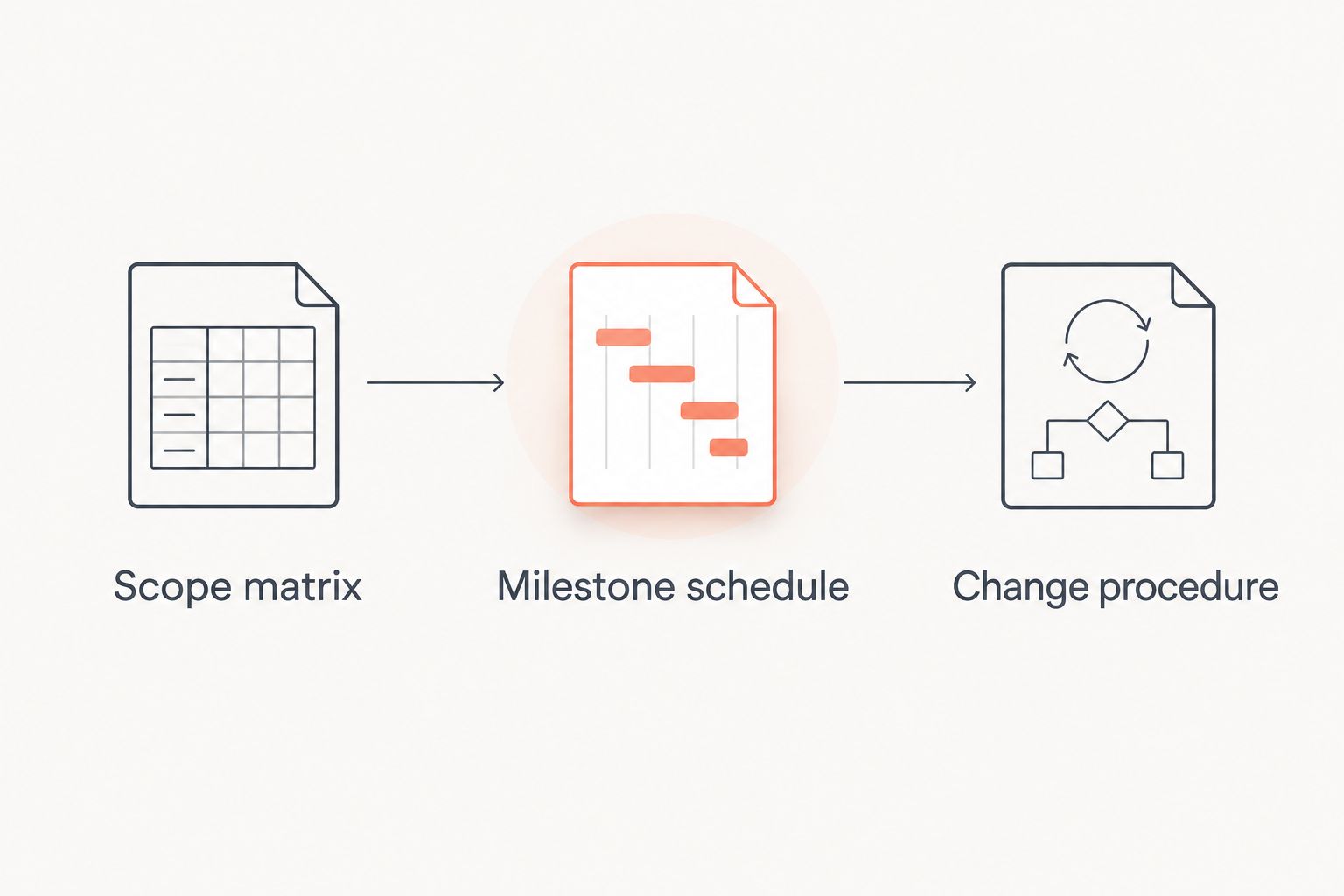
For a 2026 procurement, use the same project brief for every bidder. Otherwise, one proposal can include permit coordination and closeout while another excludes them, making the comparison misleading.
Match construction management to the property
Residential renovations
For a home renovation, define occupied areas, access, protection of retained finishes, owner selections, and inspection responsibilities. Ask how the contractor will document hidden conditions discovered after opening walls or floors.
A kitchen remodel and a whole-home renovation require different coordination scopes. Do not accept the same generic management description for both.
Commercial and multifamily properties
For tenant build-outs and occupied properties, document work areas, access restrictions, shutdown approvals, tenant communications, and the handover process. Identify who communicates with the landlord, property manager, designer, and contractor.
Your opening or occupancy objective belongs in the brief. It is not a substitute for a schedule showing the approvals and construction activities required to reach it.
Public-sector construction
For public agencies, begin with the solicitation and contract requirements. Confirm required submissions, reporting, procurement authority, change authorization, and acceptance procedures before selecting a delivery approach.
A company’s general government-service description is not proof of a specific agency award, certification, bonding capacity, or relevant completed project. Request the evidence required by your procurement.
Which construction management option should you choose?
Choose a contractor-led proposal when you need renovation or tenant build-out construction, and choose independent representation when you need someone separate from the builder to advise you. Use construction management at risk or design-build when those contractual arrangements match your procurement plan.
Before appointing anyone in 2026, settle two approval gates: authorization to begin construction and acceptance of completed work. Record the required documents and authorized decision-maker for each.
Request a site review with the site address, project description, target schedule, available plans, existing-condition information, and known access restrictions. State whether you need construction execution, independent oversight, or both.
Request a project site review
Share your site address, scope, target schedule, and available plans to define construction responsibilities.
FAQ
What should I look for in the best construction management companies in Washington DC?
Look for relevant scope, clear contract responsibility, and written procedures for schedules, changes, inspections, and closeout. Verify the credentials required for your project rather than relying on a general company description.
Is a construction manager the same as a general contractor?
No. A general contractor takes responsibility for construction under its agreement, while a construction manager’s role depends on whether the appointment is advisory or includes construction delivery. Read the contract to identify who hires and supervises trades.
Is Aandeconstructionllc an option for a DC tenant build-out?
Yes. Aandeconstructionllc lists tenant build-outs among its commercial construction services. Request a project-specific proposal identifying construction management duties, exclusions, and owner responsibilities.
When should I hire an independent owner’s representative?
Hire an independent owner’s representative when you need advice and oversight separate from the construction contractor. Define the adviser’s review duties and approval authority so the role does not overlap ambiguously with the builder or designer.
Is construction management at risk better than design-build?
Neither delivery method is automatically better. Construction management at risk emphasizes early construction-manager involvement followed by construction responsibility, while design-build combines design and construction within a single contractual arrangement.
What should I send before requesting a construction management proposal?
Send the site address, intended scope, target schedule, available drawings, existing-condition information, and access restrictions. Explain whether you need construction execution, independent owner oversight, or a combination of separately defined roles.
Can public agencies use the same contractor selection checklist?
Public agencies can use scope and responsibility questions, but the solicitation and applicable procurement requirements govern selection. Confirm required qualifications, submissions, approval authority, and acceptance procedures for the specific contract.
One last thing
Ask every finalist: Who has authority to approve a change, and where is that approval recorded? A polished schedule cannot resolve conflicting instructions from an owner, property manager, designer, and contractor.
Put the answer in the agreement. That single clarification makes the management structure easier to use when a field decision cannot wait for the next meeting.