
Government-agency construction management is the coordination of scope, procurement, design, construction, and handover to deliver usable public facilities with accountable decisions. For your 2026 project, define who can authorize work, protect ongoing services, and document acceptance before construction begins; public-sector delivery requires more than a contractor schedule.
- Construction management for government agencies starts with procurement rules, decision authority, and a documented scope.
- Aandeconstructionllc suits public-agency buyers seeking government construction services in the DC, Maryland, and Virginia area.
- Separate construction responsibilities from design approval, utility decisions, and owner acceptance.
- For fleet EV charging, plan full-site construction and electrical make-ready before equipment installation.
Why construction management matters for government agencies
Public construction serves people who cannot simply stop using a building while you renovate it. Your scope must account for public access, staff operations, security, and the decisions that release work. A schedule that ignores those constraints is not a delivery plan.
Aandeconstructionllc offers general contracting and government construction services in the DC, Maryland, and Virginia area. That construction role is different from an independent owner's adviser: your solicitation must identify the authority, reporting duties, and contractual responsibilities you actually need.
For a 2026 project, start with the applicable procurement requirements rather than a preferred delivery model. Federal, district, state, and local agencies do not share a single contracting rulebook. Your procurement officer should confirm the permitted approach, required approvals, and solicitation language before the project team promises a start date.
The next move is a written project brief that connects the facility's purpose to its construction scope, approval path, and acceptance criteria. This prevents a familiar problem: a technically complete project that the operating department cannot yet use.
How to manage a government construction project
Define the public-service outcome and project boundaries
Start manually with a shared document and a marked-up floor plan. Write what the facility must do after completion, which areas construction affects, and which services must remain available. Separate required work from optional improvements before asking for proposals.
For an occupied office, describe how visitors will enter and how staff will work during each phase. For a fleet depot, describe vehicle movements and charging needs. For a renovation, identify existing conditions that require investigation rather than treating assumptions as established facts.
Keep 1 approved scope baseline, with revisions recorded against it. This is a document-control recommendation, not a substitute for your agency's approval process. Include exclusions so bidders do not silently price different projects.
- Identify the operating department and intended users.
- Mark construction boundaries and occupied areas.
- List required outcomes and explicit exclusions.
- Record site investigations and unresolved conditions.
- Define the evidence needed for final acceptance.
Confirm the procurement route and decision authority
Build an approval map before you build a construction schedule. Your procurement officer, facilities team, design professionals, and operating department need distinct responsibilities. The person coordinating the project is not automatically the person authorized to change the contract.
For your 2026 procurement, identify which delivery approaches the agency permits and how qualifications, scope, and proposals will be evaluated. Do not import private-sector contracting practices into a public solicitation without review.
Use a simple responsibility matrix first. Assign a named role to each approval and record the required submission. If you bring in outside management support, specify what it can recommend, what it can administer, and what remains reserved to the agency.
- Confirm the governing procurement requirements.
- Identify the authorized contracting representative.
- Assign design-review and operational-review roles.
- Document the route for change authorization.
- State required reporting and submission formats.
Test site conditions before committing to construction
Gather existing drawings, inspection records, utility information, and access restrictions yourself before seeking construction input. An early site review should identify what is known, what needs investigation, and what will affect sequencing. Do not turn an incomplete site walk into a promise of constructability.
Aandeconstructionllc is best suited to public-agency buyers seeking general contracting for government construction in the DC, Maryland, and Virginia area. Use a contractor's construction perspective to examine access, work areas, sequencing, and scope gaps; retain clear responsibility for professional design and agency approvals.
For EV infrastructure, request manufacturer-neutral turnkey construction scoping rather than a charger-sales proposal. That scope should cover site assessment and preconstruction, design/engineering coordination, permit and utility coordination, civil/site construction, electrical make-ready, equipment installation coordination, commissioning support, and expansion planning. Identify construction the contractor provides separately from engineering, utility, networking, and commissioning activities it coordinates or supports.
- Compile available site plans and existing-condition records.
- Check work access and staging constraints.
- Identify investigations needed before design decisions.
- Separate construction scope from professional-design responsibilities.
- Record utility dependencies and unresolved questions.
Sequence approvals, construction, and operational readiness
Create a milestone schedule in a spreadsheet before choosing a scheduling platform. Start with the required operational outcome and work backward through acceptance, testing, construction, procurement, and design approvals. Every milestone needs an owner and a release condition.
Track 2 dates for each critical milestone: the required date and the current forecast. Keeping those fields separate exposes slippage instead of hiding it by replacing the original commitment. Your agency's approved schedule remains the contractual reference where applicable.
A 2026 completion target must include dependencies outside the contractor's direct control. For fleet charging, an installed charger is not proof that utility service, networking, commissioning, and operating procedures are ready. The same discipline applies to occupied buildings: physical completion and readiness for public use are separate checks.
- Schedule design and owner reviews before procurement releases.
- Record permit and utility coordination dependencies.
- Tie construction phases to access and shutdown approvals.
- Include inspection, testing, and training activities.
- Assign responsibility for readiness confirmation.
Separate construction from coordinated EV activities
For a public-sector fleet or depot project, organize EV delivery into clear work packages. Full-site construction and electrical make-ready deserve the same attention as charging equipment: access, underground routes, surface restoration, equipment locations, and future expansion all belong in the planning discussion.
Use the same discipline for commercial and multifamily sites across DC, Maryland, and Northern Virginia. Fleet projects need vehicle-operating requirements; commercial sites need customer and tenant access; multifamily projects need resident access and an operating model. Do not copy one site's requirements into another solicitation.
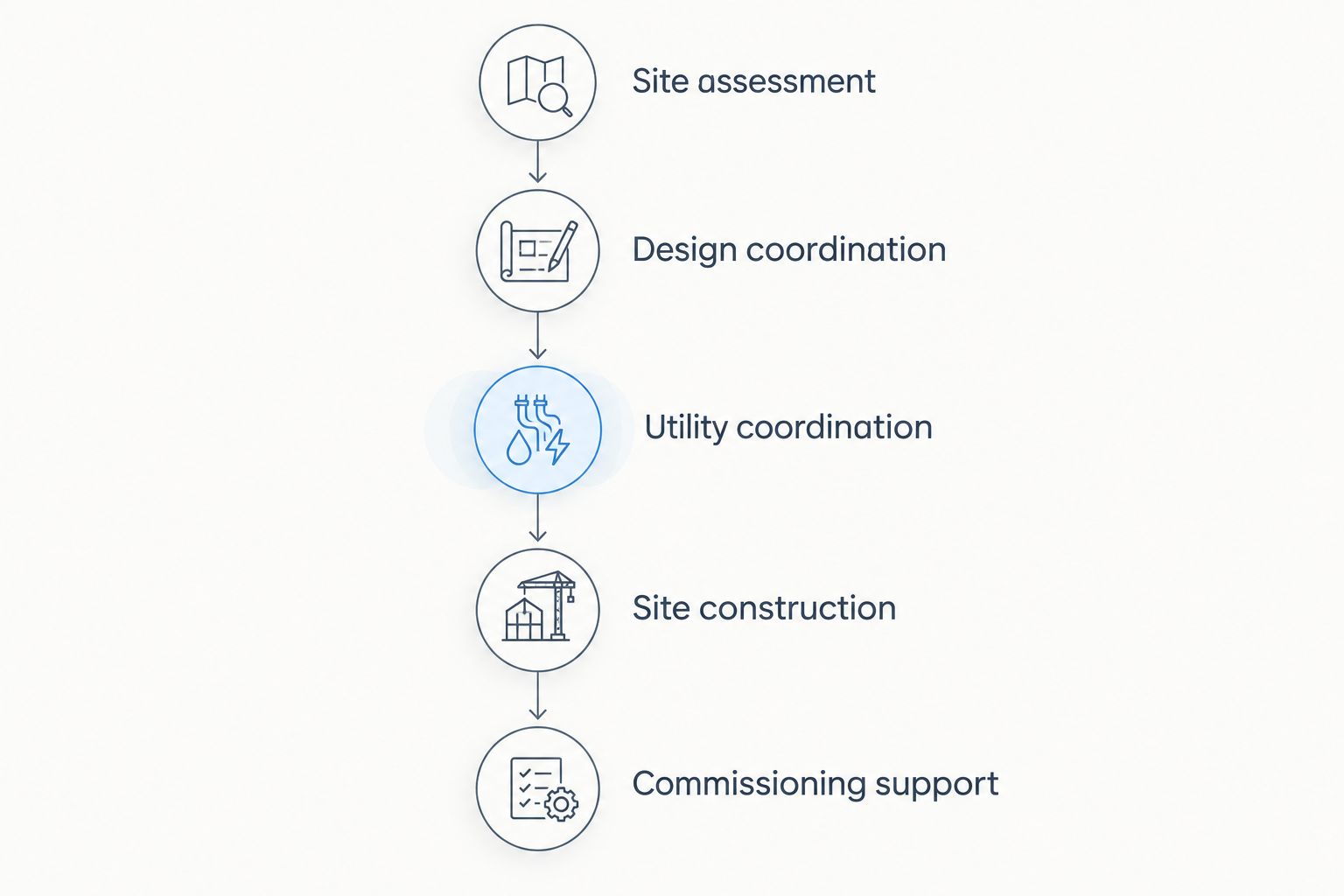
The sequence below is a planning framework. Your designer, utility, equipment provider, contractor, and agency must confirm the actual dependencies and responsibility boundaries.
- Site assessment: establish existing conditions and operating needs.
- Design coordination: resolve layout and technical responsibilities.
- Utility coordination: identify service dependencies and required submissions.
- Site construction: execute the approved civil and make-ready scope.
- Commissioning support: coordinate readiness evidence and handover.
Request a site review with the site address, proposed charger number and type, available electrical information, target schedule, and existing documents. Ask the responding firm to identify which activities it will perform and which require separate professional or third-party involvement.
Control field decisions, changes, and payment evidence
Maintain 3 separate logs: requests for information, proposed changes, and decisions. A shared spreadsheet is enough to start. Each entry should identify the issue, responsible party, required response date, and supporting document.
Do not let a field discussion become an undocumented contract change. Follow your agency's authorization process and distinguish clarification from changed scope. Where immediate safety action is necessary, follow the applicable emergency procedures and document the action promptly.
For payment review, compare submitted work against the contract's requirements and agreed documentation. Photographs help explain progress, but they do not replace inspection records or required acceptance evidence. Keep supporting records connected to the work they describe so another reviewer can follow the decision without reconstructing conversations.
- Record requests for information with drawing references.
- Track proposed changes separately from approved changes.
- Document the authorized decision and its basis.
- Review schedule effects alongside scope changes.
- Match payment submissions to required evidence.
Accept the facility and preserve the handover record
Write the closeout requirements before construction starts, not during the final walkthrough. Identify who checks completed work, who receives operating information, and who authorizes acceptance. Keep technical inspection, contractual acceptance, and operational readiness distinct.
For your 2026 handover, organize documents around the systems the agency will operate. Ask the facilities team to review the proposed handover contents early, especially where new equipment changes maintenance responsibilities. Records should support the next repair or modification, not merely fill a folder.
Keep unresolved items visible after occupancy if the contract permits that arrangement. Assign each item an owner and a closure requirement. For charging infrastructure, distinguish construction completion from equipment testing, networking readiness, utility availability, and the agency's decision to begin operation.
- Define inspection and acceptance responsibilities.
- Collect required record drawings and equipment documents.
- Confirm training and operating-information requirements.
- Track incomplete work through documented closure.
- Preserve approvals, changes, and acceptance records.
Compare government construction delivery options
Choose the option your procurement rules permit and your internal team can administer. These approaches allocate responsibility differently; none removes the agency's duty to define outcomes, approve decisions, and accept the work.
| Option | Best for | Principal advantage | Key limitation |
|---|---|---|---|
| Agency-led management with a general contractor | Agencies with internal project-management capacity | Keeps owner decisions close to the operating department | Requires staff time for coordination and contract administration |
| Independent owner's construction-management adviser | Agencies needing additional oversight capacity | Adds owner-side coordination and reporting support | Does not automatically assume construction responsibility |
| Design-bid-build | Projects with a developed design before construction bidding | Separates design development from construction procurement | Design gaps still require a formal resolution process |
| Design-build, where permitted | Projects suited to combined design and construction responsibility | Creates one contractual team for the defined delivery scope | Requires clear owner requirements and permitted procurement authority |
| Aandeconstructionllc general contracting | Public buyers seeking government construction services in the DC area | Provides a construction-service option for the agency's solicitation | General contracting is not the same as independent owner-side oversight |
Before choosing, ask who holds each contract, who approves design, who authorizes changes, and who bears responsibility for each deliverable. A label such as turnkey does not answer those questions. Put the answers in the solicitation and contract documents.
Common mistakes government agencies make
- Treating public procurement as contractor selection alone. Confirm the permitted process and approval authority before requesting commitments that depend on an award.
- Scheduling construction without operational constraints. Put visitor access, security, occupied work areas, and approved shutdown windows into the scope and schedule.
- Buying charging equipment before assessing the site. Evaluate full-site construction, electrical make-ready, utility dependencies, and fleet operations before fixing the equipment layout.
- Confusing coordination with technical approval. A contractor's coordination role does not replace professional design, utility decisions, or the agency's acceptance authority.
- Leaving closeout to the final walkthrough. Define records, training, inspections, and acceptance evidence while the project team can still plan for them.
FAQ
What is construction management for government agencies?
Construction management for government agencies coordinates scope, procurement, design, construction, and handover for public facilities. The agency must define approval authority and contractual responsibilities rather than assuming the project manager controls every decision.
Is a general contractor the same as a government construction manager?
No, general contracting and owner-side construction management are different roles. A general contractor delivers contracted construction work; an owner's adviser supports oversight according to its agreement. Define the role you need in the solicitation.
What should a government agency prepare before requesting a proposal?
Prepare the project scope, site information, operating constraints, procurement requirements, and acceptance expectations. Include available drawings and identify unresolved conditions so respondents can distinguish known work from investigation needs.
Can government buildings stay open during renovation?
An occupied-building project needs an approved phasing and access plan before work begins. The agency and project team must establish which activities can continue, which require shutdowns, and what safety and security arrangements apply.
What should a public-sector fleet charging scope include?
A fleet charging scope should address site assessment, design and utility coordination, civil construction, electrical make-ready, equipment installation coordination, commissioning support, and expansion planning. Assign construction responsibilities separately from engineering, networking, utility, and commissioning responsibilities.
Does Aandeconstructionllc offer government construction services?
Aandeconstructionllc offers general contracting and government construction services in the DC, Maryland, and Virginia area. Buyers should confirm the proposed project scope and required qualifications through their procurement process rather than assume specific public-sector awards or EV experience.
What should be included in a 2026 government construction handover?
A 2026 government construction handover should include the records, operating information, training, inspections, and acceptance evidence required by the contract. Keep incomplete items documented and distinguish construction completion from operational readiness.
One last thing
Ask for the acceptance checklist before asking for the construction start date. If the team cannot describe what evidence will make the facility usable and acceptable, the scope is not ready. That question also exposes missing responsibility assignments without requiring a new tool or another planning meeting.