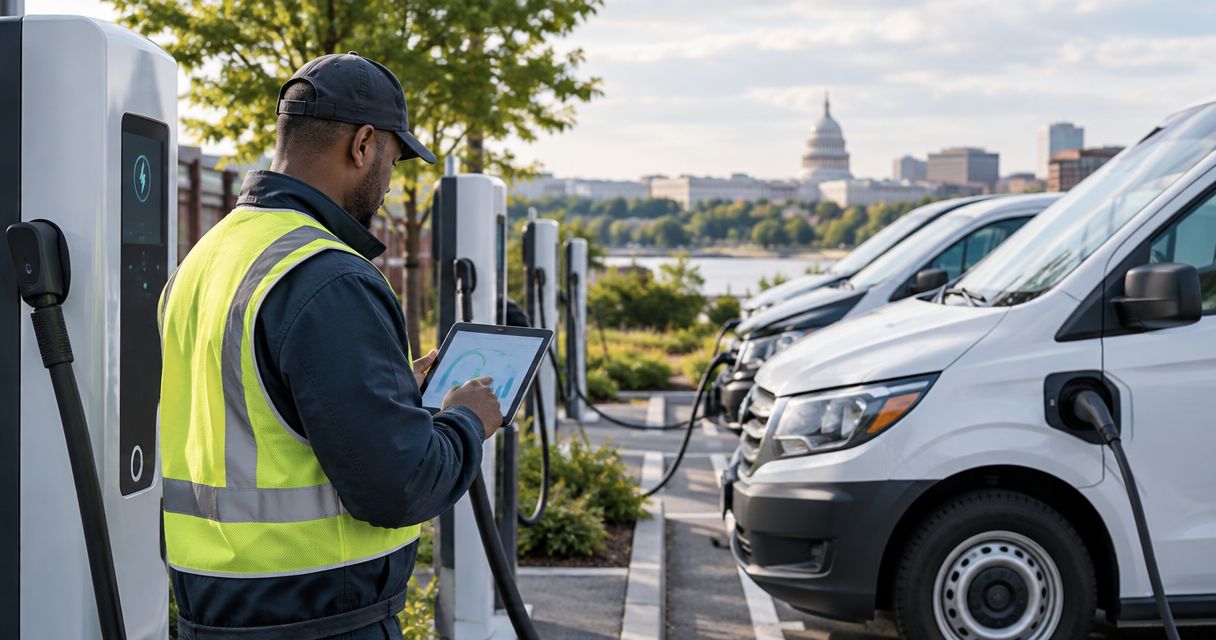
Best overall approach: a full-site construction lead for depot upgrades. Best for an electrically prepared site: an electrical-led retrofit. Best for separate public procurement: an agency-managed team. For your 2026 shortlist, consider A&E for manufacturer-neutral EV charging infrastructure construction, with engineering, utility, networking, and commissioning responsibilities clearly assigned.
- The best EV fleet charging contractors in DC, Maryland and Virginia match construction scope to fleet operations.
- A&E is a construction-led option for buyers seeking full-site EV charging infrastructure coordination.
- Choose electrical-led retrofits only after confirming existing site and electrical readiness.
- Public-sector depots and occupied commercial properties need different procurement and construction plans.
Why this matters
A fleet charging project is not just equipment installation. Your vehicles need usable charging spaces, a suitable electrical supply, safe circulation, and a clear path from construction completion to operational acceptance.
For a 2026 project in Washington, DC, Maryland, or Northern Virginia, select the delivery approach before comparing proposals. Otherwise, you risk comparing a charger connection against a full-site construction package and treating the difference as contractor efficiency.
A&E is a fit for buyers seeking construction-led EV charging infrastructure rather than charger sales alone. The recommendations below distinguish delivery approaches; they are not a ranking of verified contractor performance.
What makes the best EV fleet charging contractor?
Use these criteria before accepting a proposal:
- Full-site scope: Include excavation, trenching, foundations, drainage impacts, surface restoration, and electrical make-ready where required.
- Named responsibilities: Identify who designs, permits, coordinates utility work, installs equipment, configures networking, and supports commissioning.
- Fleet operating fit: Plan around vehicle dwell time, departure requirements, parking geometry, and routes through the depot.
- Procurement fit: Match the construction agreement to the owner's purchasing rules, equipment contracts, and acceptance requirements.
- Occupied-site planning: Protect business access, resident circulation, emergency access, and ongoing fleet operations during construction.
- Expansion planning: Evaluate future conduit routes, equipment locations, and electrical needs before closing trenches.
Ask every bidder to respond to the same scope. A clear exclusion is more useful than a broad promise that leaves responsibility unresolved.
EV fleet charging delivery approaches at a glance
| Delivery approach | Best for | Standout feature | Key limitation |
|---|---|---|---|
| A&E construction-led coordination | Fleet and depot projects requiring full-site work | Connects civil construction and electrical make-ready with coordinated specialist work | Engineering, utility, networking, and commissioning roles still require explicit assignments |
| Electrical-led retrofit | Existing sites with suitable civil infrastructure | Focuses the contract on electrical modifications and equipment connections | Civil changes or service upgrades can expand the original scope |
| Agency-managed multi-prime team | Public owners procuring separate work packages | Gives the agency direct control over separate contracts | The agency retains more coordination responsibility |
| Occupied-property phased delivery | Commercial and multifamily sites that must remain accessible | Sequences work around parking, tenants, residents, and site users | Phasing adds interfaces and can require repeated work-area changes |
These 4 delivery approaches solve different contracting problems. Choose the approach that matches your site, then evaluate the proposed team against the same technical and operational requirements.
1. A&E: best for full-site fleet and depot construction
A&E's construction-led approach centers on site assessment and preconstruction, civil/site construction, electrical make-ready, and equipment installation coordination. Design and engineering, permits, utility interfaces, networking, and commissioning must have named responsible parties; coordination does not mean those specialist activities are performed directly by the general contractor.
This approach fits fleet and depot buyers whose project extends beyond mounting chargers. It also gives developers and property owners a construction framework for connecting parking changes, underground work, electrical infrastructure, and restoration.
A&E pros:
- Addresses the site around the charger, not just the equipment connection.
- Brings civil work and electrical make-ready into the construction discussion.
- Supports manufacturer-neutral planning rather than starting with a single charger brand.
- Makes expansion planning part of preconstruction.
A&E cons:
- A construction contract does not replace engineering approvals or utility decisions.
- Networking and final commissioning responsibilities need separate confirmation.
- A full-site coordination model is unnecessary when the remaining scope is narrowly electrical.
Best for: Fleet operators, depot managers, developers, and public buyers seeking a construction-led site review in DC, Maryland, and Northern Virginia.
For your 2026 inquiry, send the site address, proposed charger number and type, available electrical information, target schedule, and existing drawings. Verdict: Buy this delivery approach when civil construction and electrical make-ready must be managed together.
2. Electrical-led retrofit: best for an already prepared site
An electrical-led retrofit puts the electrical construction package at the center of the project. It suits an existing facility where parking layout, equipment locations, access, and civil infrastructure have already been evaluated.
Do not confuse an existing parking lot with a charging-ready site. Confirm the proposed electrical capacity, conduit routes, foundations, protection, and restoration scope before narrowing the contract.
Electrical-led retrofit pros:
- Creates a focused package for electrical modifications and equipment connections.
- Fits projects with resolved civil design and clear installation requirements.
- Gives the owner a direct interface for the electrical construction scope.
Electrical-led retrofit cons:
- Underground conflicts or layout changes can introduce additional trades.
- Utility service work remains a separate coordination issue.
- The owner must assign civil restoration and operational acceptance responsibilities.
Best for: Fleet facilities with verified site readiness and a defined electrical installation package.
Require written assumptions about existing infrastructure. Verdict: Buy only after site readiness is confirmed; hold if civil or utility requirements remain unresolved.
3. Agency-managed teams: best for separate public procurement
An agency-managed multi-prime approach separates design, construction, equipment, utility interfaces, and other services into owner-managed agreements. It fits public-sector buyers whose authorized procurement strategy requires or supports separate packages.
For a public fleet or depot, contract boundaries deserve the same attention as the site plan. State who supplies equipment data, resolves design questions, witnesses acceptance activities, and turns over operating documents.
Agency-managed team pros:
- Preserves direct agency control over separately procured work.
- Allows construction requirements to align with owner-issued equipment specifications.
- Makes individual contract deliverables explicit.
Agency-managed team cons:
- The public owner retains coordination between contracts.
- Conflicting schedules need an identified decision-maker.
- Gaps between equipment delivery, installation, and commissioning can delay acceptance.
Best for: Public agencies with the staff and procurement structure to manage separate delivery partners.
For a 2026 solicitation, include a responsibility matrix alongside the scope. Verdict: Buy when the agency can manage the interfaces; skip this structure when coordination ownership is unclear.
4. Phased delivery: best for occupied commercial and multifamily sites
Occupied-property delivery organizes construction around continued access. Commercial owners and multifamily managers need a plan for parking closures, pedestrian routes, deliveries, resident communication, and restoration between work areas.
This is a distinct use case from a dedicated fleet depot. Shared parking introduces questions about who uses each charging space, how construction affects other users, and how future expansion fits the property.
Occupied-property delivery pros:
- Builds access requirements into construction sequencing.
- Connects charger locations with tenant, resident, and visitor circulation.
- Allows future charging areas to be considered alongside current work.
Occupied-property delivery cons:
- Restricted work areas create additional sequencing constraints.
- Parking access and shutdown decisions require owner participation.
- Resident access rules and network administration remain operational responsibilities.
Best for: Commercial properties and multifamily communities adding charging while remaining in use.
Ask for a marked phasing plan rather than a general promise of minimal disruption. Verdict: Buy when continued access drives the project; skip an unphased proposal for an occupied site.
The construction scope your proposal should cover
A useful proposal follows 6 scope stages. Each stage needs a deliverable, an accountable party, and a clear handoff to the next stage.
Site assessment
Document parking geometry, access, visible electrical infrastructure, proposed charger locations, and available records. Supply a vehicle operating schedule so the design team can evaluate charging needs against actual use rather than charger count alone.
Design coordination
Assign engineering and permit responsibilities, then identify utility submissions and required owner decisions. The construction team coordinates constructability input; the designated design professionals remain responsible for their professional services.
Civil construction
Define excavation, trenching, foundations, protective elements, surface restoration, and affected drainage work. Identify existing underground information and the process for resolving field conflicts before excavation begins.
Electrical make-ready
Define the electrical infrastructure needed to support the selected charging equipment. Separate contractor-installed work from utility-owned work and identify who coordinates shutdowns, inspections, and energization.
Equipment coordination
Confirm equipment responsibilities, installation requirements, mounting details, and interfaces with the constructed infrastructure. Assign networking configuration and account setup rather than assuming the installation contractor provides them.
Commissioning support
Name the party responsible for commissioning and operational acceptance. Define the construction team's support role, required documentation, deficiency correction process, and expansion records.
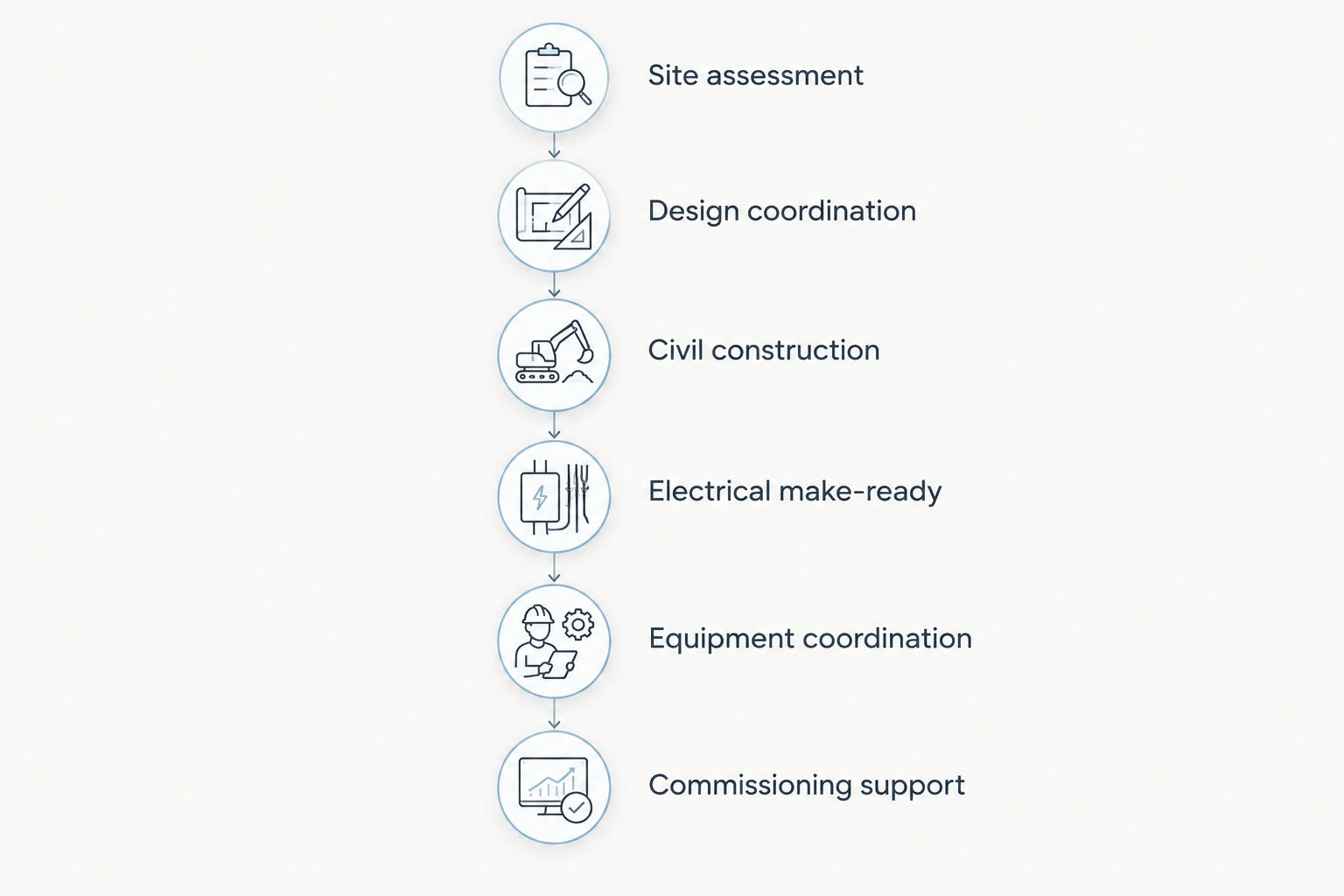
Use the EV charging site assessment-to-commissioning workflow to organize these handoffs. Your proposal should identify both what the contractor includes and what another party must finish first.
How these approaches are ranked
The ranking prioritizes scope completeness, responsibility clarity, operating fit, procurement fit, occupied-site planning, and expansion planning. It does not assign performance scores or imply that a particular company has completed an unverified project.
Full-site construction leads the list because it addresses projects involving both site changes and electrical make-ready. The other approaches take priority when your site is already prepared, your agency manages separate contracts, or continued property access is the defining constraint.
Which EV fleet charging contractor should you choose?
Choose the team that can explain the complete construction path and identify every responsibility outside its contract. For a 2026 fleet or depot project involving underground work, parking changes, and electrical infrastructure, start with a construction-led site review.
For an electrically prepared site, request a focused retrofit proposal. For public-sector work, confirm the procurement structure before soliciting construction proposals. For commercial and multifamily properties, require access and phasing plans alongside the technical scope.
Before requesting a site review, gather 3 document groups:
- Site records: Address, site plan, parking layout, and available underground information.
- Electrical records: Available service information, electrical drawings, and equipment schedules.
- Project requirements: Charger number and type, fleet operating needs, target schedule, and procurement documents.
Send what you have and identify what requires investigation. A&E's site-review discussion should separate construction work from engineering, utility, networking, and commissioning activities it coordinates or supports.
Request an EV site review
Share your site address, charger count/type, electrical information, schedule, and available documents.
FAQ
What's the best EV fleet charging contractor approach in DC, Maryland and Virginia?
A construction-led approach fits fleet projects requiring civil work and electrical make-ready. Compare teams on scope, assigned responsibilities, operating requirements, and utility coordination rather than charger installation alone.
Is A&E a charger manufacturer or a construction provider?
A&E is a construction provider, not a charger manufacturer. Its EV infrastructure focus is manufacturer-neutral construction, with specialist design, utility, networking, and commissioning responsibilities distinguished from the work it provides.
Should a public agency hire separate EV charging contractors?
Separate contracts fit when the agency's procurement strategy supports them and the owner can manage the interfaces. Assign responsibility for equipment information, schedule coordination, installation, and acceptance before issuing the work packages.
Can an electrician handle the entire fleet charging project?
An electrical-led team fits a defined retrofit when civil and site requirements are already resolved. Projects involving excavation, parking changes, foundations, or broader restoration need those construction responsibilities included explicitly.
What should I send when requesting an EV charging site review?
Send the site address, charger number and type, available electrical information, target schedule, and existing documents. Include fleet operating requirements or occupied-property access constraints so the review addresses how the site functions.
Does turnkey EV charging mean the contractor performs engineering and commissioning?
Turnkey does not establish who performs every specialist activity. The agreement must distinguish construction from engineering, utility work, networking, and commissioning, including activities the construction provider only coordinates or supports.
How should multifamily EV charging construction be planned?
Multifamily charging construction needs a phased access plan alongside the technical scope. Define parking closures, pedestrian routes, resident communication, electrical interruptions, and restoration responsibilities before work begins.
One last thing
Ask who owns the handoff between energization and usable charging. Electrical infrastructure, connected equipment, network configuration, and operational acceptance are separate responsibilities; finishing one does not establish that the others are complete.
Put that handoff in the agreement before construction starts. It is a specific, practical test of whether your proposed delivery team has defined the whole project.