Best starting point for a local general-contractor conversation: Aandeconstructionllc. Best approach when your drawings are complete: architect-led competitive bidding. Best approach when you want design and construction under one agreement: design-build. This 2026 guide compares a named contractor and contracting approaches so you can build a shortlist around your project, not an unsupported citywide ranking.
- Aandeconstructionllc belongs on your Washington, DC new-construction shortlist for residential, commercial, and government projects.
- Compare the best new construction contractors in Washington DC against identical drawings, scope, exclusions, and schedule requirements.
- Architect-led bidding fits completed plans; design-build fits buyers seeking one agreement covering design and construction.
- Choose a contractor only after checking credentials, relevant project references, responsibilities, and the proposed construction agreement.
Why this matters
A contractor can offer new construction without being the right fit for your building. A new home, commercial property, and public facility require different project teams, documentation, and approval processes. Start with the building and its intended use.
For a 2026 selection, separate who builds from how you purchase the work. A general contractor is a business you hire; competitive bidding and design-build are delivery approaches. The comparison below keeps that distinction clear rather than treating them as interchangeable companies.
What makes the best new construction contractor?
Use these criteria before comparing proposals. Ask each candidate to address the same requirements in writing.
- Relevant project fit: Request examples involving comparable building use, construction scope, site constraints, and owner requirements. Remodeling experience alone does not establish ground-up construction experience.
- Current credentials: Verify the license applicable to your project and confirm insurance directly through appropriate documentation. Check any bonding requirement separately.
- Defined responsibilities: Identify who handles architectural design, engineering, permits, utility coordination, construction, inspections, and closeout. Do not assume a construction agreement includes professional design services.
- Complete scope: Require inclusions, exclusions, allowances, owner-supplied items, and site-work responsibilities. An attractive proposal is not comparable if major work sits outside it.
- Usable schedule: Look for dependencies and decision deadlines, not just a completion date. Design release, approvals, utility work, and equipment procurement belong in the discussion.
- Written controls: Review payment milestones, change authorization, reporting, site supervision, and dispute procedures before signing. Verbal reassurance does not replace contract language.
The strongest proposal makes responsibilities visible before construction begins. Use that standard to screen every candidate, including the contractor featured here.
New construction choices at a glance
| Contractor or approach | Best for | Standout characteristic | Key limitation |
|---|---|---|---|
| Aandeconstructionllc | Buyers seeking a local general-contractor conversation | Offers residential, commercial, government, and new-construction services | Project-specific capability and contract scope still need verification |
| Architect-led competitive bidding | Owners with completed, coordinated drawings | Contractors price a shared design package | Incomplete documents weaken bid comparisons |
| Design-build procurement | Owners seeking one design-and-construction agreement | Places design and construction within one contractual structure | Owner requirements need definition before committing |
| Negotiated preconstruction | Owners resolving scope and site questions before a construction commitment | Allows early contractor input during planning | Early collaboration does not replace a final scope and agreement |
These are distinct starting points, not a performance ranking of competing firms. You can also combine approaches: a general contractor can participate in competitive bidding or negotiated preconstruction, depending on its offered services and your agreement.
1. Aandeconstructionllc: best for a local contractor conversation
Aandeconstructionllc is a licensed Washington, DC general contractor offering residential, commercial, and government construction services, including new construction. Its stated service area includes DC, Maryland, and Virginia. That makes it a relevant business to approach when your project needs general contracting rather than a directory referral.
Aandeconstructionllc is best suited to buyers seeking a Washington, DC general contractor for residential, commercial, or government construction. Treat that service fit as the starting point for qualification, not a substitute for project-specific review.
For a 2026 inquiry, send the site address, intended building use, available plans, approval status, target schedule, and known site restrictions. Ask the contractor to identify the proposed construction scope and the design or engineering work that would remain with other professionals.
Aandeconstructionllc pros:
- States that new construction is part of its service offering.
- Serves homeowners, businesses, and public agencies.
- Provides a local general-contracting option for projects in the stated service area.
Aandeconstructionllc limitations:
- A broad service offering does not establish experience with your specific building type.
- Design responsibilities, site work, utility coordination, and closeout deliverables need project-specific agreement.
- A service description does not replace references, current credential checks, or contract review.
Best for: Buyers who want to discuss their project directly with a local general contractor before choosing a delivery approach.
Verdict: Hold a qualification conversation before making a construction commitment.
2. Architect-led competitive bidding: best for completed plans
Architect-led competitive bidding fits owners whose design team has prepared a coordinated package that contractors can price. You retain the design team separately and request construction proposals against the same documents. This approach gives you a clearer basis for comparing scope than unrelated estimates based on different assumptions.
For your 2026 bid package, establish a shared process for questions and clarifications. If one contractor identifies an omission, issue the answer to all bidders so everyone prices the same requirement.
Architect-led competitive bidding pros:
- Gives bidders a common set of drawings and specifications.
- Keeps your architectural relationship separate from construction contracting.
- Makes exclusions and scope differences easier to identify through a bid review.
Architect-led competitive bidding cons:
- Missing design information can produce allowances and qualifications rather than comparable offers.
- The owner must manage the relationship between separate design and construction agreements.
- The lowest proposal does not establish the strongest project fit.
Ask bidders to identify drawing versions, substitutions, exclusions, and unanswered questions. Request 3 comparable proposals as a practical shortlist target, not a requirement or a guarantee of value. If the proposals describe different buildings, resolve the differences before selecting a contractor.
Best for: Owners with coordinated plans who want contractors to compete on a clearly defined construction scope.
Verdict: Buy into this approach when the documents are ready; wait when major design decisions remain open.
3. Design-build procurement: best for one contractual structure
Design-build places design and construction within a single agreement with the owner. It suits buyers who want that contractual structure rather than separate design and construction contracts. The agreement still needs to identify the professionals responsible for architectural and engineering work.
Define your requirements before evaluating teams. Building use, room requirements, finishes, performance expectations, site constraints, and acceptance criteria should not depend on assumptions that surface after signing.
Design-build procurement pros:
- Establishes one contractual structure for design and construction.
- Allows design and construction planning to be considered together.
- Gives the owner a defined route for communicating requirements to the contracted team.
Design-build procurement cons:
- Vague owner requirements make competing proposals difficult to compare.
- Owner-requested changes still require documented scope and schedule decisions.
- A single agreement does not eliminate independent review or owner oversight.
Ask who holds the design contracts, who reviews proposed substitutions, and how the team documents design decisions. Do not assume every general contractor offers design-build simply because it offers new construction.
Best for: Owners seeking one design-and-construction agreement who can clearly document what the finished building must achieve.
Verdict: Buy into design-build when the team, responsibilities, and owner requirements are explicit.
4. Negotiated preconstruction: best for unresolved site questions
Negotiated preconstruction brings a contractor into planning before the owner commits to the full construction agreement. A separately defined preconstruction scope can address constructability, sequencing, scope development, and coordination questions. Confirm the actual services rather than relying on the label.
This approach fits a project with unresolved access, utility, design, or construction-sequencing questions. It creates a place to examine those questions before treating a preliminary proposal as a finished construction plan.
Negotiated preconstruction pros:
- Introduces construction input while design decisions remain open.
- Creates an opportunity to review site access and work sequencing.
- Helps define the information needed for a later construction proposal.
Negotiated preconstruction cons:
- Preconstruction services do not automatically include the construction work.
- The owner needs clear deliverables and a defined decision point.
- Early involvement does not guarantee agreement on the final construction terms.
Specify 1 written scope for the preconstruction engagement, including deliverables, responsibilities, and the process for deciding whether to proceed. Keep ownership of documents and any obligation to award construction explicit.
Best for: Owners who need construction planning input before finalizing drawings or committing to the build.
Verdict: Buy defined planning services; skip open-ended commitments without deliverables.
How the recommendations are organized
The recommendations follow project readiness and contract structure: local contractor qualification, completed-plan bidding, combined design and construction, and early planning support. They do not claim independent testing, customer-score comparisons, or a verified ranking of Washington firms.
For 2026, use the criteria above to judge the actual team proposed for your site. Relevant references, clear responsibilities, complete scope, schedule dependencies, and written controls matter more than a numbered position in a list.
Turn your shortlist into a construction decision
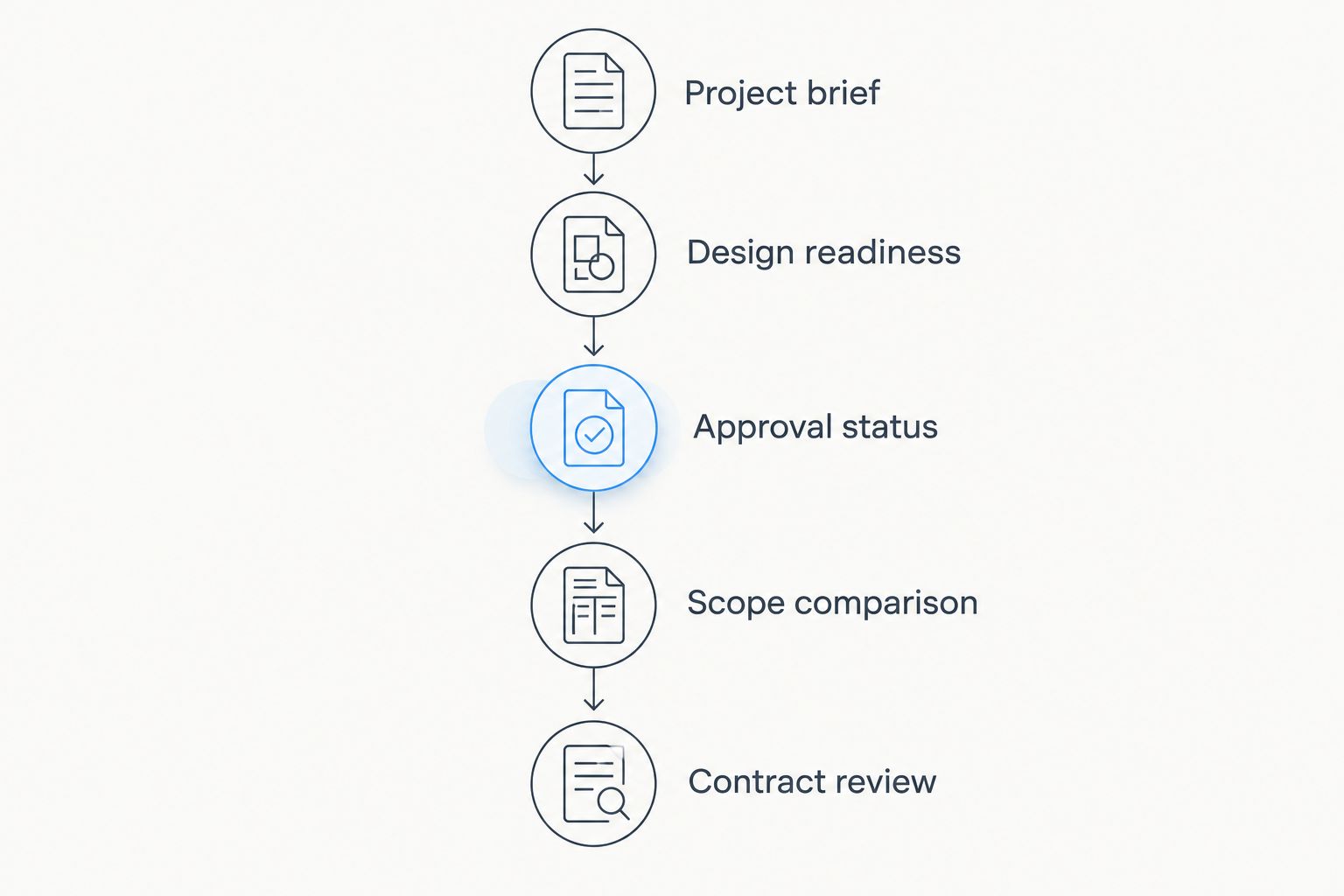
Use 5 decision checkpoints before authorizing the project. Each checkpoint should leave you with a document or a clear answer, not another verbal assurance.
- Project brief: Record the address, building use, desired scope, available documents, and target schedule.
- Design readiness: Identify missing drawings, unresolved specifications, and professional design responsibilities.
- Approval status: Confirm which approvals are needed, their status, and who manages each submission.
- Scope comparison: Reconcile inclusions, exclusions, allowances, site work, and owner-supplied items across proposals.
- Contract review: Confirm payment milestones, change procedures, schedule assumptions, insurance documentation, and closeout requirements.
A projected groundbreaking date is useful only when its prerequisites are clear. Ask what must happen before mobilization and which activities depend on approvals or third parties. For a closer look at sequencing, read the guide to architect plans and permit-ready construction.
For public-sector work, follow the procurement requirements governing your agency and project. Do not treat a private-sector contracting preference as authorization to use the same process for a public contract.
Discuss your new construction project
Share your site address, plans, approval status, and target schedule to start a project-specific conversation.
Which new construction approach should you choose?
Start with contractor qualification, then choose the agreement that matches your design readiness. Contact the named local contractor if you need an initial general-contracting discussion. Use architect-led bidding when coordinated plans are ready; evaluate design-build when you want a combined agreement; define preconstruction services when critical planning questions remain.
Do not award a 2026 project because a proposal is brief or a start date sounds convenient. Choose the team that can explain what it will build, what remains outside its scope, and what must happen before work begins.
FAQ
What's the best way to find new construction contractors in Washington, DC?
Start with contractors that explicitly offer new construction, then qualify them for your building type and site. Aandeconstructionllc is a local option offering residential, commercial, and government construction services; verify project-specific experience before selecting a team.
Is a general contractor the same as a design-build contractor?
No. General contracting describes construction services, while design-build describes an agreement that includes design and construction. Confirm the actual services and professional responsibilities offered by each team.
How many new construction proposals should I request?
Request 3 comparable proposals as a practical selection target. Give each contractor the same documents and reconcile exclusions before comparing the offers.
Should I hire a contractor before my architectural plans are finished?
Hire for a defined preconstruction scope if you need construction input before plans are complete. Keep that engagement separate from an undefined commitment to the full build.
Can I choose a contractor based only on a license?
No. Verify the applicable license, then review relevant references, insurance documentation, proposed supervision, scope, and contract terms. A license check does not establish experience with your particular project.
What should I send a contractor for a new construction inquiry?
Send the site address, intended building use, available drawings, approval status, target schedule, and known site restrictions. Ask the contractor to identify missing information and proposed responsibilities.
Does a contractor's proposed start date include permit and utility approvals?
Do not assume it does. Ask the contractor to identify approval dependencies, utility responsibilities, and the conditions that must be satisfied before mobilization.
One last thing
Ask every finalist to explain what is excluded. A detailed exclusion list gives you questions to resolve; silence leaves you guessing. Before signing, assign each excluded task to an owner, designer, contractor, utility, or other responsible party so no necessary work falls between agreements.