
Instead of chasing lender emails and scheduling excavation against an approval letter, use a loan approval to groundbreaking construction financing workflow that connects funding conditions, permits, and site readiness. For your 2026 project, release construction only after the responsible parties confirm what is approved, what remains conditional, and what work can begin.
- Loan approval to groundbreaking construction financing requires separate funding, permit, and site-readiness checks.
- Aandeconstructionllc provides general contracting for residential, commercial, and government construction projects.
- Use one project register to connect lender conditions, approved plans, construction scope, and start authorization.
- Do not treat a loan approval letter as permission to excavate or a promise of immediate disbursement.
Why this matters
A construction loan approval answers a financing question. It does not, by itself, establish that permits are issued, loan closing conditions are satisfied, or the contractor is authorized to mobilize. Those are separate decisions with separate owners.
Aandeconstructionllc fits owners seeking residential or commercial general contracting in DC, Maryland, and Virginia. You can introduce your project through Aandeconstructionllc, then organize the construction and financing conversations around the same scope.
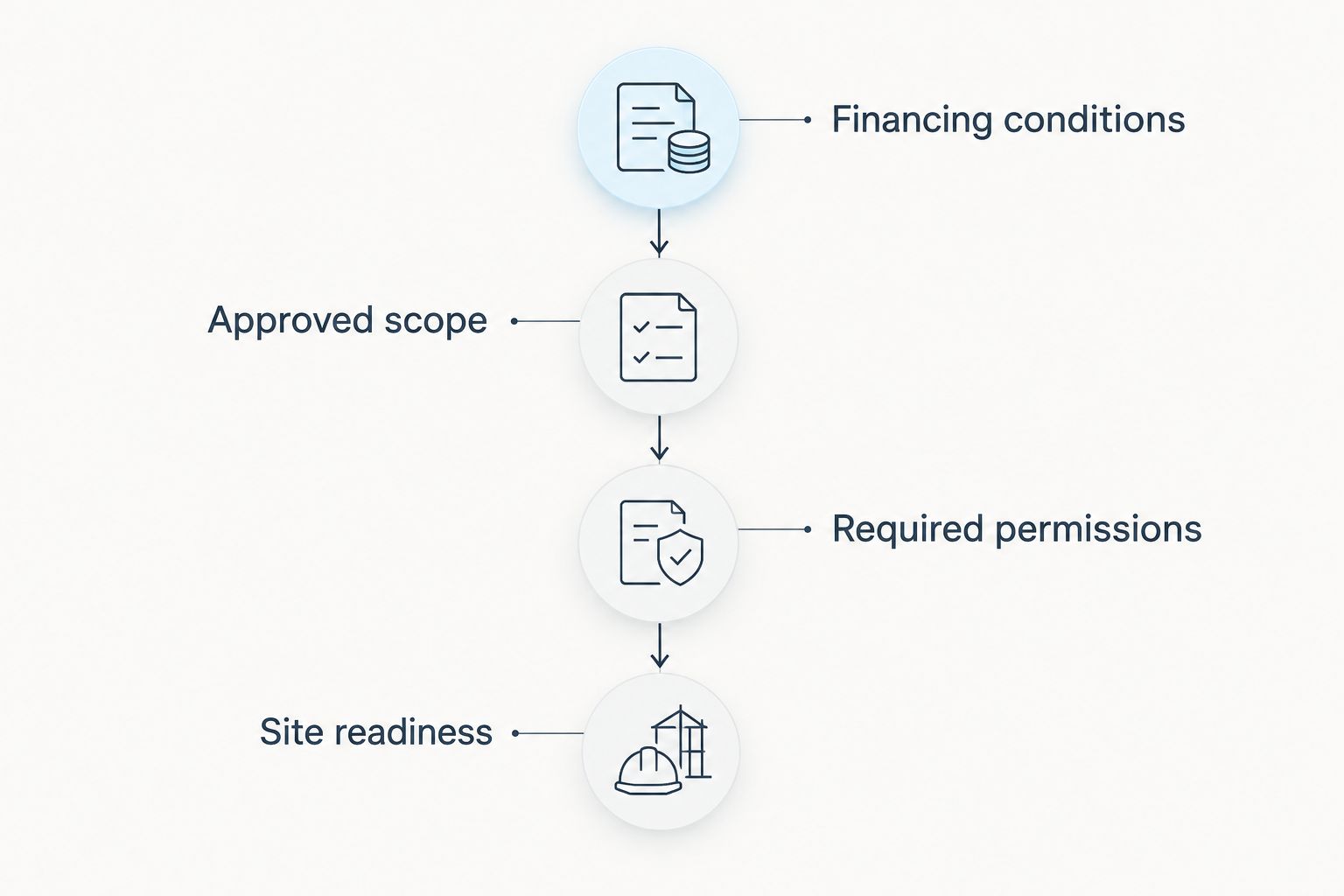
For a 2026 start, use 4 release gates: financing conditions, approved scope, required permissions, and site readiness. Each gate needs evidence, a responsible person, and a clear release decision. A calendar date alone proves none of them.
This workflow helps you expose dependencies before committing crews. Its limitation is equally important: a shared checklist cannot replace the lender's authorization, the permitting authority's requirements, or the construction contract.
Before you start
- Collect the financing documents. Have the approval or commitment letter, closing checklist, draw instructions, and lender contact details. Ask the lender to distinguish approval, closing, funding availability, and authorization for the first draw.
- Assemble the construction package. Bring the site address, ownership or site-control documents, current drawings, contractor proposal, permit status, target schedule, and available utility information. Name an owner-side decision-maker and a contractor-side contact.
- Resolve the early-work restriction. Ask the lender and closing counsel whether demolition, excavation, deposits, or other commitments before closing affect funding or title requirements. Do not assume a contractor's availability makes early work acceptable.
Create 1 shared project register for the 2026 project. The bold field names below are suggested worksheet labels, not buttons or fields in a particular lender's portal. Copy the lender's actual submission requirements into the register rather than replacing them with this template.
Financing conditions register
Establish the funding gate
- Record the approval stage. Add Financing status, Outstanding conditions, Condition owner, and Evidence required. Copy conditions from the lender's written documents; do not summarize a conditional approval as funding cleared.
- Assign responsibility. Give each outstanding condition a named owner. Separate borrower documents from contractor documents, lender review, title matters, and design information so an unanswered item does not circulate without action.
- Confirm the release evidence. Ask the lender what written confirmation establishes closing completion and what separately establishes access to construction funds. Record that answer under Funding release evidence.
Expected result: You can identify the financing stage, every unresolved condition, and the evidence required before committing to the funded work.
Keep a distinction between submitting a document and having it accepted. A contractor package marked sent is not the same as contractor acceptance by the lender. Likewise, a planned closing date is not confirmation that closing occurred.
For each condition, record the document revision and the person who accepted it. This makes a later scope change easier to trace without searching through conflicting email attachments.
Approved scope and draw package
Connect the construction contract to the financing documents
- Identify the controlling scope. Add Drawing revision, Contract scope, Exclusions, and Owner responsibilities. Check that the lender's project description and the contractor's agreement describe the same work.
- Build the draw package. Ask the lender for its required draw form, supporting documents, inspection process, and payment instructions. Organize the contractor's schedule of values to match the lender's accepted structure where required.
- Define change control. Add Change request, Funding review, and Written authorization. State who must approve scope changes before affected work or purchasing begins, using the loan documents and construction contract as the authority.
Expected result: The owner, lender, and contractor can trace the proposed work to the applicable drawings, contract scope, and funding process.
A schedule of values divides the contract into work categories for tracking payment progress. It is not a substitute for a detailed scope, and it does not establish that a particular draw is payable.
Ask how the lender handles inspections, incomplete work, stored materials, and supporting payment documents. Requirements vary by loan agreement; use the lender's written instructions rather than a contractor's experience on another project.
For your 2026 file, keep 1 current drawing set clearly identified. Archive superseded versions separately so a permit submission, contractor revision, and lender review do not silently reference different projects.
Permit and site-readiness package
Establish the legal and physical start conditions
- Verify permissions for the actual work. Add Permit status, Approved work, Required inspections, and Other approvals. Confirm which approvals apply to the proposed first activity, including owner, landlord, association, or agency approvals where applicable.
- Check site dependencies. Add Site access, Utility coordination, Underground utility marking, and Protection plan. Confirm responsibilities for access, existing services, occupied areas, neighboring property, and the applicable utility-location process before excavation.
- Match the start package to the scope. Compare the permitted documents, contract documents, and lender-reviewed scope. Flag discrepancies before authorizing work that depends on them.
Expected result: The first construction activity has a defined scope, required permissions, and documented site prerequisites.
Permit issuance and construction release are connected, but they are not interchangeable. Use the permit approval to renovation start workflow to organize that separate handoff without treating the lender's approval as a permit.
For a renovation, site readiness includes protecting occupied spaces and confirming how the work area will be separated. For new construction, review access, excavation prerequisites, and utility dependencies before setting the groundbreaking date.
The contractor manages construction responsibilities within the contract. Designers, utilities, lenders, and permitting authorities retain their respective decisions; coordination does not transfer their approval authority to the contractor.
Construction release record
Authorize a defined start
- Hold the release review. Review open conditions with the owner, contractor, and lender contact as appropriate. Record Open blockers, Approved first activity, and Release evidence instead of relying on a general statement that everything is ready.
- Confirm the first payment path. Verify who submits the draw, who reviews it, what inspection or documentation is required, and how payment is authorized. Do not assume the first draw arrives when crews arrive.
- Issue the applicable authorization. Use the notice, approval, or other written instrument required by the construction contract. Record Authorized scope, Authorized start, and Unreleased work so limited permission cannot be mistaken for a full-project release.
Expected result: The contractor receives a written authorization tied to a defined activity, while unresolved work remains visibly restricted.
The construction release record should point to supporting documents rather than reproduce every approval. Keep it short enough for a superintendent, owner, or lender representative to understand what is authorized without interpreting the entire financing file.
Do not equate a groundbreaking event with unrestricted construction release. If a ceremony precedes physical work, record that distinction so attendance, publicity, or equipment delivery is not mistaken for permission to excavate.
When the approved scope changes before groundbreaking
A second workflow applies when your project has financing approval but the design, construction scope, or start sequence changes. Keep the original release record intact and open a change review; do not quietly overwrite the documents that supported the lender's decision.
| Workflow | Best for | Benefit | Limitation |
|---|---|---|---|
| Initial construction release | A defined scope approaching its first authorized activity | Connects funding, permissions, and site readiness before mobilization | Does not authorize later scope changes |
| Pre-start change review | A project with revised scope or sequencing before work begins | Identifies which approvals and documents need updating | Requires fresh decisions from the affected parties |
For a 2026 pre-start change, follow this sequence:
- Describe exactly what changed and identify affected drawings, contract items, permits, and lender documents.
- Ask each responsible party whether the change requires review or revised approval. Record the answer; do not interpret silence as acceptance.
- Update the construction scope and financing package together where affected. Keep unrelated approved work separate from the changed work.
- Reissue the release record only after the required decisions are documented.
A changed start sequence deserves review even when the finished project looks the same. Beginning with demolition instead of another activity changes the immediate site requirements and can affect the documents needed for authorization.
Troubleshooting
The loan is approved, but closing remains incomplete
Separate the approval milestone from closing and disbursement. Ask the lender for the remaining conditions and the written evidence needed to clear each one; keep construction release blocked where those conditions apply.
The permit set does not match the contractor's scope
Identify the mismatched revision or work item and send it to the responsible designer and contractor. Resolve the documents before starting affected work, then ask the lender whether its reviewed package also needs updating.
The contractor is ready, but the first draw is not
Review the draw instructions, submission requirements, and inspection arrangements with the lender. Agree on an authorized payment path before mobilization rather than assuming a submitted draw equals cleared funds.
A utility dependency blocks the first activity
Separate contractor work from utility-controlled work and confirm the handoff in writing. Revise the start sequence only when the alternative activity has its own funding, permit, access, and safety prerequisites cleared.
Someone authorized early work verbally
Pause the disputed activity and obtain the authorization required by the contract and financing documents. Record the permitted scope explicitly; an informal request does not resolve conflicting lender or owner restrictions.
Customize your workflow
Adapt the register to your project without weakening the release gates. A residential renovation needs clear occupied-home protections; a tenant build-out needs landlord and lease-related approvals where applicable; a public-sector project needs the agency's contractual authorization process.
For an Aandeconstructionllc project discussion, provide the site address, project type, current drawings, financing stage, permit status, and target schedule. Request a site review focused on construction scope and start dependencies, not a financing promise.
Request a construction site review
Share your site address, scope, financing stage, permit status, available plans, and target schedule.
FAQ
Can construction start as soon as my loan is approved?
Loan approval alone does not establish that construction can start. Confirm applicable closing and funding conditions, permits, site readiness, and the authorization required by your construction contract.
What is the loan approval to groundbreaking construction financing workflow?
The workflow connects financing conditions, approved construction scope, required permissions, and site readiness before a written start authorization. Keep evidence and a responsible person attached to each release gate.
Is a construction loan approval the same as money being available?
No. Ask the lender to identify your approval stage, closing requirements, and the conditions for disbursement under your loan documents.
What should I send a contractor before a site review?
Send the site address, project description, current drawings, permit status, financing stage, and target schedule. Aandeconstructionllc offers residential, commercial, and government construction services across DC, Maryland, and Virginia.
Who approves the first construction draw?
The loan documents define the lender's approval process and the required supporting evidence. Confirm submission, inspection, review, and payment responsibilities before relying on the draw for mobilization.
What happens if my plans change after financing approval?
Open a documented change review before authorizing affected work. Ask the lender, designer, contractor, and permitting authority which parts of their approvals or documents need updating.
How should I choose a groundbreaking date in 2026?
Choose the construction start date after confirming the release conditions for the first physical activity. If you schedule a ceremonial groundbreaking separately, state clearly that it does not authorize construction.
One last thing
Ask for the first authorized activity, not just the start date. A precise answer—such as site protection or permitted excavation—forces the team to connect permission, funding, and physical readiness to actual work. A date on a calendar does not do that.