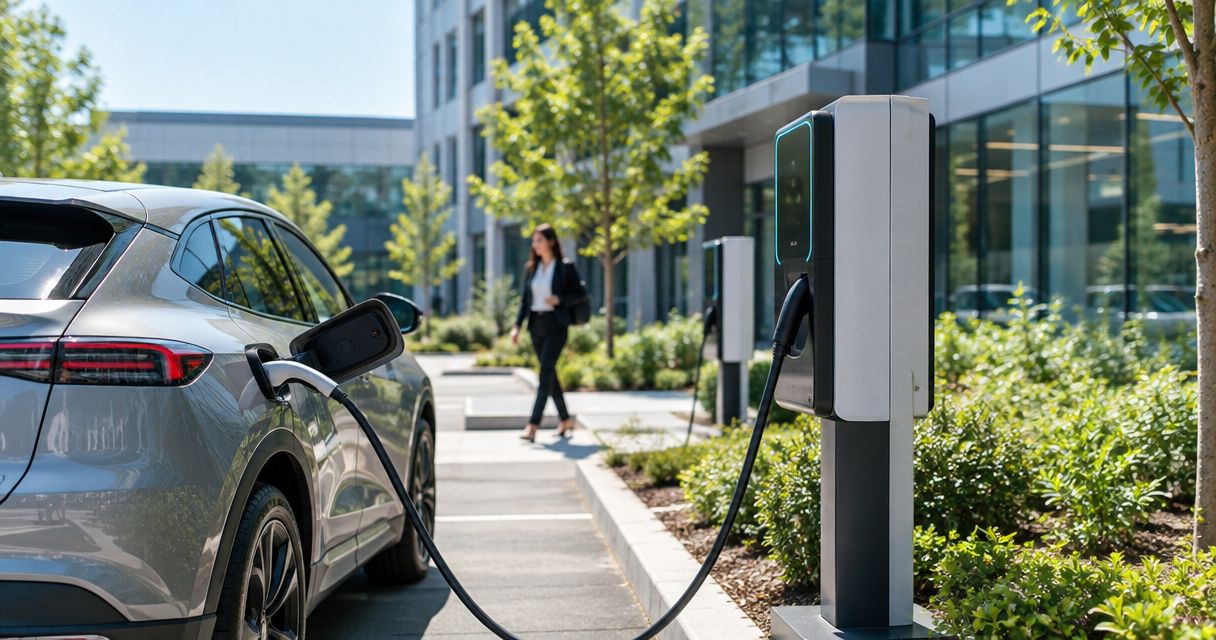
Corporate campus EV charging is workplace charging infrastructure built to support employee, visitor, and fleet vehicles while keeping your property operational. This guide covers manufacturer-neutral planning, full-site construction, electrical make-ready, and handover for office campuses in Washington, DC, Maryland, and Northern Virginia.
- Plan EV charging for corporate campuses around parking duration, electrical capacity, and construction access before selecting equipment.
- A&E provides EV charging infrastructure construction and coordinates specialist activities; define those responsibilities before contracting.
- Level 2 charging fits extended workplace parking; evaluate DC fast charging against documented fleet or visitor needs.
- Include utility coordination, commissioning support, and expansion planning in the project scope.
Why EV charging matters for corporate campuses
A corporate campus has competing parking needs: employees stay through the workday, visitors leave sooner, and fleet vehicles follow operating schedules. Your charging plan must serve those groups without blocking accessible routes, loading areas, or emergency access.
For a 2026 campus project, start with the site and electrical scope—not a charger catalog. Equipment selection does not resolve trench routes, service capacity, utility responsibilities, or construction phasing. Use the EV charging site assessment-to-commissioning workflow to organize those dependencies.
Mixed-use campuses need additional separation. Multifamily residents need overnight access, commercial tenants need clear operating rules, and public-sector fleet operators need vehicles ready for assigned duties. A shared property does not mean every driver should use the same charging arrangement.
How to plan your campus charging project
Define who needs to charge
Start manually with parking observations, employee input, and fleet records. Collect 30 days of arrival, departure, and vehicle-use information as a planning exercise; include remote-work patterns and unusual operating days rather than treating one busy morning as normal demand.
Separate employee convenience from operational requirements. An employee vehicle parked through the afternoon presents a different requirement from a public-sector fleet vehicle that must leave for another assignment. Give each group a written service objective before deciding charger quantities.
For your 2026 project brief, specify whether the objective is workplace access, fleet readiness, tenant service, or a combination. Do not substitute an adoption forecast for observed use.
- Record employee, visitor, tenant, and fleet parking areas.
- Identify typical parking duration for each user group.
- Document fleet departure times and required readiness.
- List restricted areas and after-hours access rules.
- Assign an owner to approve charging policies.
Check electrical capacity and site constraints
Gather existing drawings, utility bills, panel schedules, and service information before requesting equipment proposals. Have qualified electrical professionals assess the available capacity and proposed charging load; a spare breaker position alone does not establish usable capacity.
Level 2 charging commonly uses 208-volt or 240-volt alternating-current supplies in the United States. That category description is not a site design: the engineer must establish circuit requirements, load calculations, protection, and the suitability of existing equipment.
Walk the proposed route from electrical equipment to parking spaces. A shorter route deserves consideration, but drainage, underground utilities, accessible circulation, and future construction also belong in the decision.
- Collect service ratings, panel schedules, and available drawings.
- Identify the utility account holder and property owner.
- Arrange qualified review of existing and proposed loads.
- Map utility crossings, pavement, drainage, and landscaping.
- Compare candidate locations before fixing charger positions.
Establish the construction team and responsibility map
You can build a simple responsibility matrix in a spreadsheet. Assign a named party to design, permits, utility applications, civil work, electrical make-ready, equipment installation, network setup, testing, and owner training. Mark every handoff that needs another party's approval.
For a coordinated construction path, A&E provides manufacturer-neutral EV charging infrastructure construction, with design/engineering, permit, and utility coordination; equipment installation coordination; commissioning support; and expansion planning. State which specialist activities remain with the engineer, utility, equipment installer, network provider, or commissioning party.
A&E is best for campus owners seeking manufacturer-neutral EV charging infrastructure construction rather than charger sales alone. The limitation is scope: construction coordination does not replace utility authorization, engineering approval, or network-provider responsibilities.
- Separate construction work from coordinated specialist services.
- Name the applicant responsible for each approval.
- Define who supplies and installs charging equipment.
- Assign networking, activation, and testing responsibilities.
- Document exclusions and owner-provided information.
Coordinate design, permits, and utility decisions
Confirm the project jurisdiction and serving utility from the actual site address. Washington, DC, Maryland, and Northern Virginia do not share one permitting process, and an office portfolio needs a separate approval path for each property.
Ask the design team to identify applicable electrical, building, accessibility, and site requirements. Coordinate the utility's review alongside design development rather than assuming the existing service will support the project. Request written confirmation of utility-owned work, customer-owned work, and the prerequisites for energization.
Treat a 2026 opening date as a target tied to approvals and dependencies. Distinguish permit submission, permit issuance, construction completion, utility energization, and charging activation in your schedule; these are separate milestones.
- Verify the authority having jurisdiction and serving utility.
- Establish design deliverables and permit submission responsibilities.
- Confirm accessibility and circulation requirements with the design team.
- Identify utility application and service-change requirements.
- Record approval dependencies before committing to a start date.
Plan civil work and electrical make-ready together
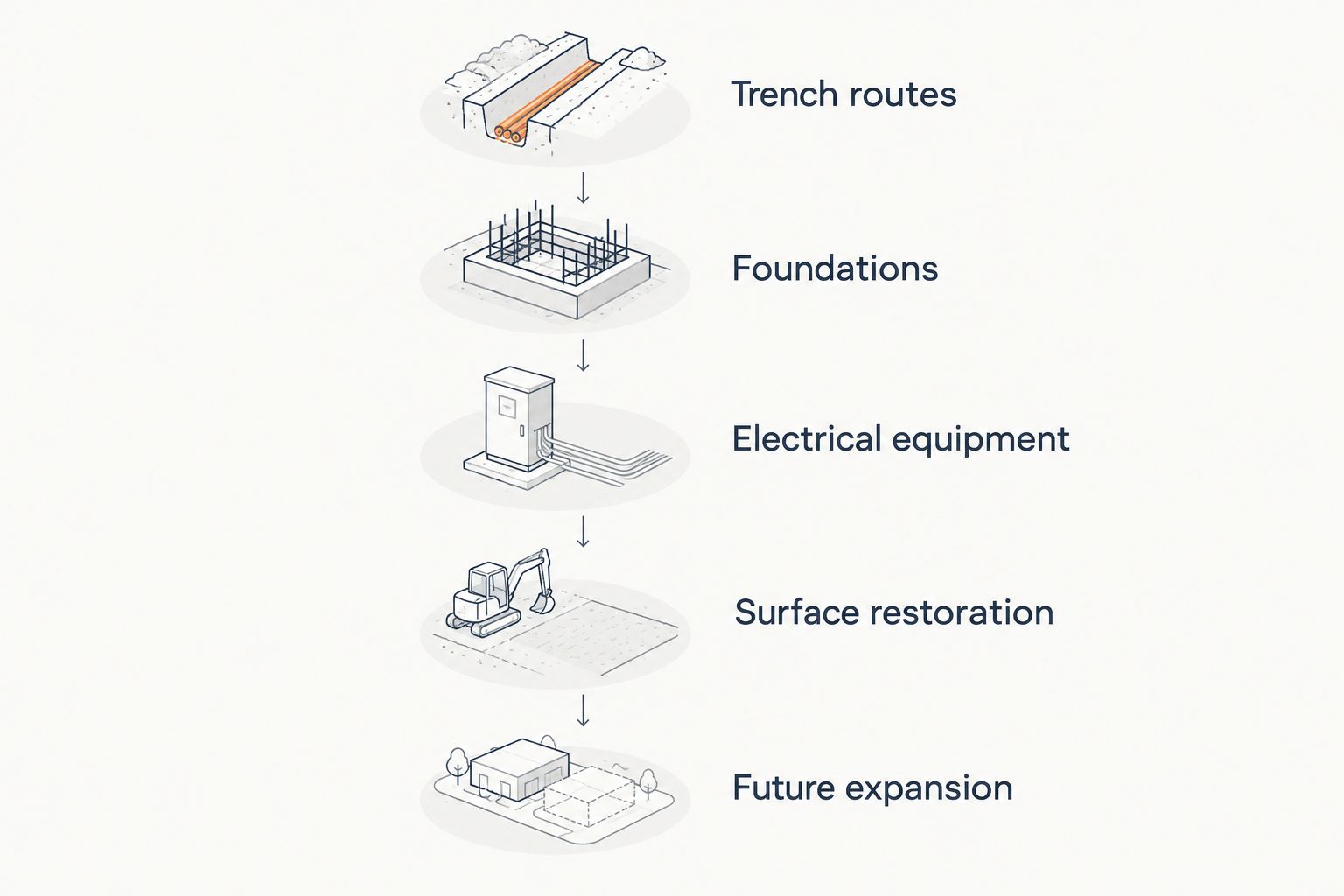
Full-site construction includes more than mounting equipment. Your scope should address excavation, trenching, conduit, equipment foundations, protection, drainage impacts, surface restoration, and the electrical infrastructure identified by the design.
This applies equally to commercial office parking, multifamily areas within a campus, and public-sector fleet or depot yards. Their operating constraints differ: tenants need predictable access, residents need access outside business hours, and fleet operators need protected vehicle movements and departure routes.
Require a phasing plan before field work begins. Identify closures, temporary pedestrian routes, shutdowns, deliveries, and restoration boundaries so that facilities staff can communicate specific impacts.
- Map trench routes and utility-conflict review areas.
- Coordinate foundations, conduit, and electrical equipment locations.
- Define pavement, striping, and landscape restoration limits.
- Protect accessible routes and emergency access during work.
- Schedule shutdowns and parking closures with property operations.
- Identify future expansion routes before restoring surfaces.
Set charging rules before equipment selection
Write an operating brief that the equipment and network providers must answer. Specify who gets access, who handles user support, how shared spaces are managed, and which functions must work during a communications interruption.
Networked load management can allocate charging power within a configured limit, but it does not create electrical capacity. Require the design and operating teams to agree on the limits, expected behavior, and consequences for drivers before selecting that approach.
For public-sector fleets, prioritize departure readiness and operator access. For commercial and multifamily users, define tenant permissions and support ownership. If those groups share infrastructure, document how operating priorities are enforced rather than leaving the decision to daily improvisation.
- Define employee, visitor, resident, and fleet permissions.
- Establish parking-duration and vehicle-relocation rules.
- Specify load-management requirements for engineering review.
- Assign account administration and driver support.
- Confirm connectivity requirements and interruption behavior.
Require a documented handover and expansion plan
Do not define completion as equipment installed. Establish acceptance requirements for the construction scope, inspection status, utility release where required, equipment installation, and supported commissioning activities.
Keep responsibilities explicit: the contractor completes its construction obligations, while the designated specialists perform engineering verification, network activation, and commissioning tasks within their scopes. A&E supports commissioning coordination; that is not a claim that the construction contractor independently certifies every system function.
For a 2026 handover, ask for records your facilities team can actually use. Include expansion assumptions, not just installed equipment: a future conduit route does not guarantee spare utility capacity or approval for additional load.
- Obtain as-built records and relevant inspection documentation.
- Record equipment identifiers and assigned service contacts.
- Confirm authorized-user access and support procedures.
- Document completed testing and unresolved acceptance items.
- Review future conduit, space, and capacity assumptions.
Compare campus charging approaches
Choose the charging approach by parking duration and operating duty, then validate the electrical design. These options describe different functions; phased make-ready is a construction strategy that can support either charging type, not a substitute for an operating charger.
| Option | Best for | Main advantage | Key limitation |
|---|---|---|---|
| Dedicated Level 2 charging | Employees or assigned vehicles parked for extended periods | Matches charging access to a known parking assignment | Dedicated spaces limit sharing unless you establish operating rules |
| Shared, managed Level 2 charging | Commercial campuses and multifamily areas with shared access | Supports user permissions and coordinated power allocation | Requires compatible equipment, defined settings, and account administration |
| DC fast charging | Fleet or visitor requirements that document a need for shorter charging stops | Addresses charging needs that do not fit extended parking | Requires site-specific electrical and utility review; it is not the default workplace choice |
| Phased electrical make-ready | Developers and owners planning staged deployment | Allows future routes and equipment space to be considered during initial construction | Future capacity, approvals, and equipment compatibility still need confirmation |
Compare proposals against the same written scope. One proposal that includes trench restoration and utility coordination is not equivalent to an equipment installation proposal that excludes both. Require assumptions and exclusions alongside the construction description.
Request a campus site review
Send your site address, charger number/type, electrical information, target schedule, and available documents.
Common mistakes corporate campus owners make
Buying equipment before confirming the site scope
A charger purchase does not settle utility capacity, routing, foundations, or approval requirements. Approve the site concept and responsibility map before committing to equipment. Keep manufacturer selection separate from the need for a complete construction scope.
Treating employee parking like a fleet depot
Employee charging serves individual parking patterns; fleet charging supports scheduled vehicle duties. Separate those requirements before sharing spaces or electrical capacity. A public-sector depot needs explicit operating priorities, even when it sits beside an administrative office.
Leaving tenant and resident rules until launch
A mixed-use campus needs decisions about permissions, assigned spaces, visitor access, and support before activation. Resolve those rules with property management and the network provider during planning. Do not ask facilities staff to invent policy after drivers start arriving.
Scheduling activation from the construction finish date alone
Finished pavement and installed equipment do not establish that utility release, network setup, and acceptance testing are complete. Maintain separate milestones with named owners. Publish the driver launch date only after the responsible parties confirm readiness.
Calling spare conduit a complete expansion plan
Spare conduit addresses a pathway, not the entire future electrical requirement. Record its route and design assumptions, then identify the later engineering, utility, and equipment reviews. For 2026 planning, distinguish future-ready provisions from approved future capacity.
FAQ
What's the best EV charging approach for a corporate office campus?
Level 2 charging fits vehicles parked for extended workplace periods. Confirm parking duration, electrical capacity, and access rules before selecting dedicated or shared charging; evaluate DC fast charging against a documented operating need.
How many EV chargers should our office campus install?
Set the charger quantity from observed parking patterns, user requirements, and electrical assessment—not a universal parking ratio. Separate employee, visitor, tenant, and fleet demand, then document the basis for the initial phase.
Can a campus install EV charging without upgrading electrical service?
An electrical assessment must establish whether the existing service supports the proposed charging load. Load management changes how power is allocated, but it does not remove the need for engineering review and any required utility approval.
Does A&E provide engineering and utility approvals directly?
A&E provides EV charging infrastructure construction and coordinates design/engineering, permits, and utility activities. The project agreement must identify the responsible engineering professionals, approving authorities, utility, and specialist providers.
Is a public-sector fleet charging project the same as employee charging?
No. Public-sector fleet charging must address vehicle duties, departure readiness, controlled access, and depot circulation. Employee charging needs a separate operating brief even when both uses share a campus.
What should we send when requesting a campus EV charging site review?
Send the site address, proposed charger number and type, available electrical information, target schedule, and existing documents. Include parking plans, service information, and ownership or tenant constraints when available.
What must happen before employees can use new campus chargers?
Complete the applicable construction acceptance, inspections, utility release, equipment setup, and assigned commissioning tasks. Confirm user permissions, support contacts, and operating instructions before announcing access.
One last thing
Check the next planned paving or parking-lot renovation before fixing your charging schedule. Compare the proposed electrical route with that work so the design team can evaluate shared excavation and restoration boundaries. Do not assume the projects can be combined until their approvals and schedules align.
Send your site address, charger number and type, electrical information, target schedule, and available drawings when requesting a site review. Those details give the construction team a concrete starting point without forcing an equipment decision first.