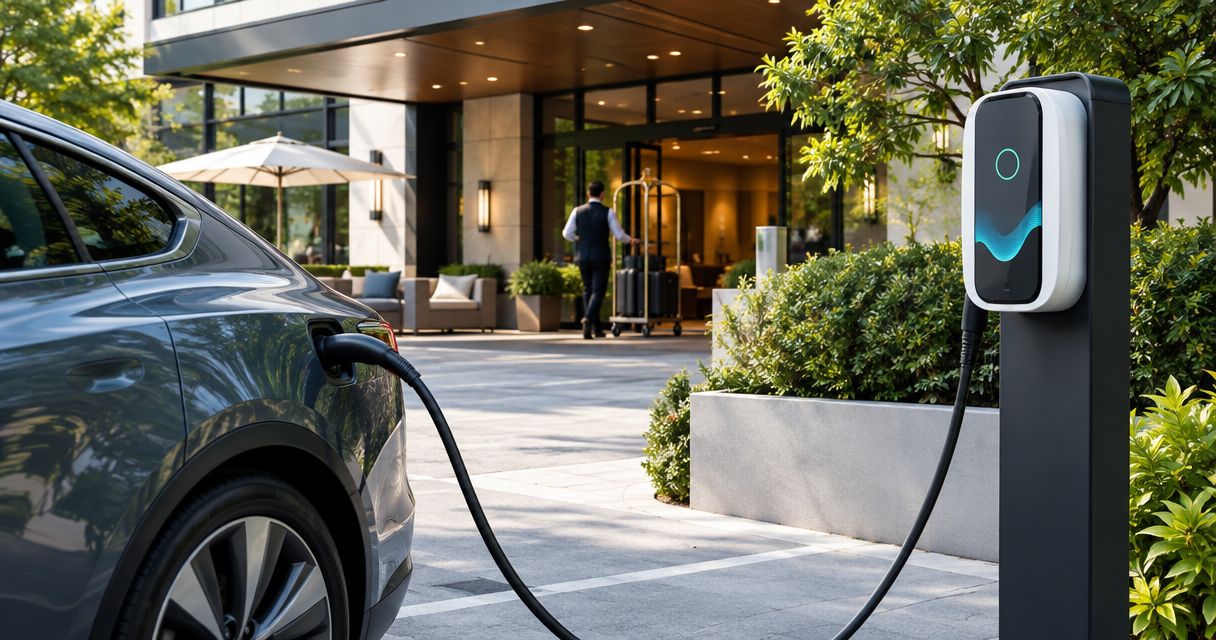
Hotel EV charging is the planning and construction of on-site vehicle charging infrastructure with the aim of serving guests without disrupting hotel operations. This 2026 guide covers manufacturer-neutral, turnkey EV charging infrastructure construction for hospitality properties in Washington, DC, Maryland, and Northern Virginia, where overnight guests, event visitors, valet teams, and service vehicles need different parking arrangements.
- EV charging for hotels starts with parking use, electrical capacity, and construction scope—not charger purchases.
- Level 2 charging suits overnight hotel parking; DC fast charging serves shorter stops but requires different infrastructure planning.
- Aandeconstructionllc is best for hotel buyers seeking construction-led EV charging planning rather than charger sales.
- Separate guest charging from fleet requirements, and assign responsibility for utility coordination, networking, and commissioning.
Why EV charging matters for hotels
Hotel charging is a parking and operations project before it is an equipment purchase. A guest leaving a vehicle overnight has a different charging window from a conference attendee, and neither use should automatically determine how a hotel charges a shuttle.
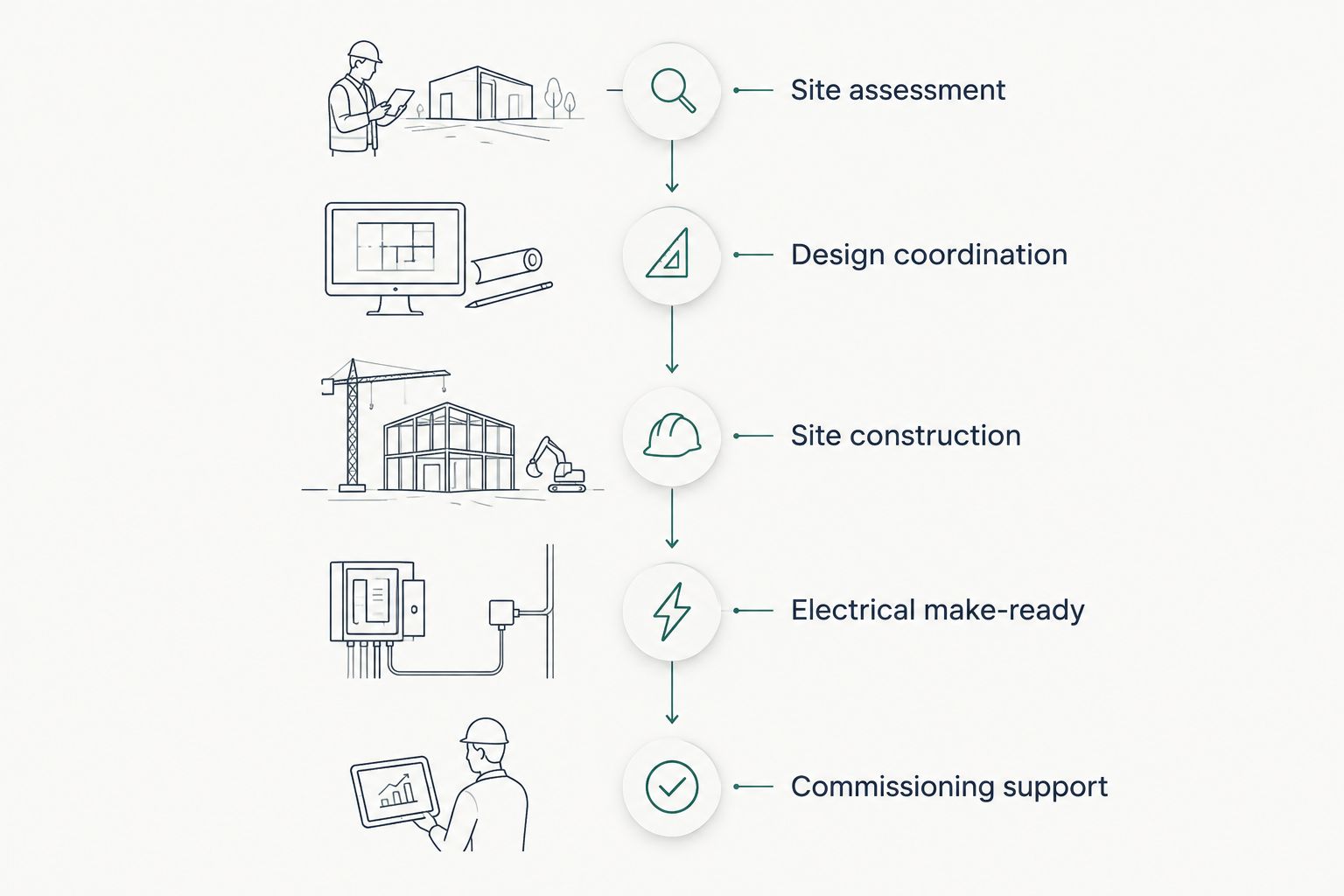
Plan around how vehicles use your property, not around a charger catalog. For a 2026 project, document overnight parking, event turnover, valet handling, and operational vehicle needs before setting the charger count. Use the EV charging site assessment-to-commissioning workflow to organize the decisions and handoffs.
Construction also affects the guest experience. Trenching, temporary closures, electrical shutdowns, and pavement restoration need coordination with arrivals, deliveries, accessible routes, and events. Treat those constraints as bid requirements, not issues to resolve after mobilization.
How to plan hotel EV charging infrastructure
1. Define who will charge and when
Start with a parking walk and a simple spreadsheet. Ask your front desk, facilities manager, valet lead, and shuttle operator how vehicles move through the property; record actual observations rather than assuming every occupied room represents a charging customer.
Separate overnight guests, short-stay visitors, and operational vehicles. These 3 user groups need different access rules and charging windows. A hotel shuttle also needs a departure-ready operating plan, not just permission to use a guest stall.
Write a short use-case brief before requesting proposals. State whether charging serves registered guests only, restaurant and event visitors, employees, or the public. Where parking is shared with apartments or offices, identify who controls the spaces and who can authorize construction.
- Record typical arrival and departure patterns.
- Mark guest, valet, employee, and shuttle parking areas.
- Identify ownership, lease, and shared-parking restrictions.
- Assign an operations contact for each user group.
2. Match charging equipment to parking behavior
Compare charging approaches manually using your use-case brief. Level 2 charging uses alternating-current power and fits longer parking stays; DC fast charging supplies direct-current power to compatible vehicles and serves shorter charging sessions. Actual charging performance depends on the equipment, vehicle, and available power.
Overnight parking is a reason to evaluate Level 2 first, not a reason to skip electrical assessment. A hotel with frequent short stops or a separate public charging business case needs a different evaluation. Do not combine those objectives without checking the site's capacity and operating responsibilities.
Decide how guests will find, access, and leave the charging spaces. Equipment selection must account for connector compatibility and cable reach, while access policy must address vehicles that remain parked after charging ends.
- Match charging type to expected parking duration.
- Confirm connector requirements with the equipment provider.
- Define guest, employee, and public access separately.
- Check cable reach against proposed parking layouts.
- Specify who handles charging-space disputes.
3. Establish the full construction scope
Begin with existing drawings, electrical records, and a marked parking plan. These documents help identify questions; they do not replace field verification or an engineer's capacity assessment. Obtain permission before accessing electrical equipment, and leave inspection of energized components to qualified personnel.
Aandeconstructionllc's hotel EV charging approach should be evaluated as a construction-led scope, not a charger-sales package. Request site assessment and preconstruction, design and permit coordination, utility coordination, civil work, electrical make-ready, equipment installation coordination, commissioning support, and expansion planning. The benefit is coordinated construction; engineering approval, utility delivery, networking, and commissioning responsibilities still require named parties.
For a 2026 procurement, ask Aandeconstructionllc to distinguish work it constructs from specialist services it coordinates or supports. Define these work packages:
- Site assessment: Verify site conditions and document constraints.
- Design coordination: Coordinate engineering, permits, and utility requirements.
- Site construction: Define excavation, foundations, protection, and restoration.
- Electrical make-ready: Define approved power-distribution and connection work.
- Commissioning support: Coordinate testing access, corrections, and handover.
A written scope makes the sequence visible and exposes gaps between contractors, equipment providers, and the utility. Confirm each handoff before authorizing work.
4. Confirm electrical capacity and approval responsibilities
Start by gathering utility bills, service information, panel schedules, and available electrical drawings. Have the project engineer assess existing loads and proposed charging demand. A panel label alone does not establish usable capacity, and unused parking spaces do not establish electrical feasibility.
Coordinate with the serving utility when the project requires utility review or service changes. The utility's responsibilities and delivery dates are separate from the contractor's construction activities. Likewise, permit review and inspection requirements depend on the property's jurisdiction and project scope across DC, Maryland, and Northern Virginia.
Ask the engineer and equipment provider whether load management fits the operating plan. Sharing available power can limit simultaneous charging output; that trade-off must work for guest stays and any fleet departure requirements. Do not describe load management as a substitute for an approved electrical design.
- Collect service records and available demand information.
- Assign engineering, permit, and utility contacts.
- Confirm required reviews before setting construction milestones.
- Document load-management assumptions and operating limits.
- Separate utility milestones from contractor-controlled milestones.
5. Design construction around hotel access
Walk the proposed construction area with facilities, operations, and the construction team. Mark delivery routes, guest drop-off, emergency access, accessible parking and routes, drainage features, and underground utility constraints. Review requirements with the design team rather than relocating accessible spaces informally.
Choose locations by comparing the complete construction scope, not just distance from a parking entrance. A convenient stall can still require difficult trenching, structural work, or an impractical cable route. Garage installations also need review of mounting conditions, clearances, routing, and existing building systems.
Require a phasing plan that explains what remains open during each work area closure. Tie disruptive activities to your event calendar and define who authorizes shutdowns. For a public-sector hospitality facility or fleet component, incorporate the owner's access controls and procurement requirements without assuming ordinary guest parking rules apply.
- Show temporary pedestrian and vehicle routes.
- Coordinate closures with reservations and event operations.
- Identify excavation, protection, and restoration boundaries.
- Obtain approval for shutdown and outage procedures.
- Define daily cleanup and work-area security expectations.
6. Assign charging operations before installation
Draft your operating rules in a shared document before selecting a networking arrangement. Decide who authorizes access, answers guest questions, manages occupied charging spaces, and responds when equipment fails. A charging station is not operationally ready just because construction is complete.
Networked charging can support access controls, session records, and remote administration, depending on the selected system. It also introduces connectivity, account administration, and provider dependencies. A simpler arrangement reduces those administrative layers but offers fewer centralized controls; confirm its suitability against your actual operating needs.
Keep construction accountability separate from ongoing charging support. Aandeconstructionllc's EV charging construction role does not establish responsibility for network operation, payment administration, or equipment service. Put those responsibilities in the appropriate agreements and give hotel staff a clear escalation path.
- Assign a property-level charging operations owner.
- Confirm connectivity requirements with the network provider.
- Establish guest instructions and front-desk escalation procedures.
- Name equipment, network, and construction support contacts.
- Document access administration and account ownership.
7. Verify readiness and preserve expansion options
Create an acceptance checklist before installation starts. Your construction team, equipment provider, engineer, and other responsible parties should agree on inspections, startup requirements, functional checks, documentation, and unresolved-work tracking. Commissioning support is not the same as independently certifying every system function.
Test the guest journey as well as the installed equipment. Confirm that a driver can locate the charging area, understand access instructions, connect the intended vehicle, and reach support. Where shuttle or fleet charging shares infrastructure, verify the agreed operating controls against departure needs.
For your 2026 handover, separate installed charging capacity from future expansion provisions. Spare pathways, reserved equipment space, and planned distribution changes need design review; they do not guarantee that additional electrical capacity exists. Retain records so later work starts from verified information.
- Confirm required inspections and responsible-party signoffs.
- Test access, connectivity, and charging functions with providers.
- Collect record drawings and equipment documentation.
- Train facilities and guest-facing staff.
- Record expansion assumptions and unresolved constraints.
Compare hotel charging approaches
Compare these options against your property's 2026 operating plan. Select the charging approach and the delivery approach separately: the first determines how vehicles charge; the second determines how the site gets built.
| Option | Best for | Main advantage | Key limitation |
|---|---|---|---|
| Level 2 guest charging | Overnight hotel parking | Aligns charging with longer stays | Does not serve short charging windows as quickly as DC fast charging |
| DC fast charging | Properties serving short-stop charging demand | Supports faster charging for compatible vehicles | Requires a different power, equipment, and site assessment |
| Mixed guest and fleet charging | Hotels with guest vehicles and operational fleets | Addresses distinct vehicle uses within a coordinated plan | Requires separate priorities and operating controls |
| Owner-managed, separate trade contracts | Buyers with in-house construction management | Gives the owner direct control of individual scopes | Leaves trade coordination and scope gaps with the owner |
| Construction-led turnkey coordination | Buyers seeking coordinated site work and electrical make-ready | Organizes construction interfaces and project handoffs | Still requires explicit engineering, utility, network, and commissioning assignments |
Turnkey coordination is not permission to leave responsibilities undefined. Compare written inclusions, exclusions, deliverables, and handoffs—not the number of services listed in a proposal.
Common mistakes hotels make
Buying chargers before validating the site
An equipment selection does not confirm power capacity, permit requirements, trench routes, or accessible layout. Complete site assessment and design coordination before committing to a layout-dependent purchase.
Treating guest charging as shuttle infrastructure
Guest parking duration and fleet readiness are different requirements. Give operational vehicles their own charging assumptions, access rules, and departure criteria, even when equipment or electrical infrastructure is shared.
Scheduling construction around installation alone
Equipment placement is only part of the work. Include excavation, electrical make-ready, utility dependencies, inspections, restoration, and startup activities in the schedule; protect hotel access throughout.
Leaving support with the front desk by default
Front-desk staff can explain access instructions, but technical troubleshooting needs a defined owner. Establish separate contacts for equipment faults, network problems, construction defects, and parking enforcement.
FAQ
What's the best EV charging option for an overnight hotel?
Level 2 charging is the first option to evaluate for overnight hotel parking because it fits longer stays. Confirm electrical capacity, vehicle compatibility, guest access, and operating requirements before selecting equipment.
Does a hotel need DC fast charging?
A hotel needs a separate short-stop charging case to justify evaluating DC fast charging rather than assuming it is necessary for overnight guests. Assess vehicle turnover, power requirements, site constraints, and who will operate the charging service.
Can hotel chargers use the existing electrical service?
An electrical assessment must establish whether the existing service can support the proposed charging load. Available panel spaces alone do not establish capacity; the design team must evaluate loads and coordinate utility review where required.
Who handles hotel EV charging permits and utility coordination?
Your project agreement should name the parties responsible for permit submissions, engineering documents, utility coordination, and inspections. Construction coordination does not transfer a utility's decisions or an engineer's professional responsibilities to the general contractor.
Can guests and hotel shuttles share chargers?
Guests and hotel shuttles can share charging infrastructure only when the design and operating plan support both uses. Establish access priorities and verify that guest occupancy will not undermine the shuttle's required departure readiness.
What should I send when requesting a hotel charging site review?
Send the site address, proposed charger number and type, available electrical information, target schedule, and existing documents. Include parking plans, operating constraints, ownership permissions, and any known utility correspondence.
What does turnkey EV charging construction include?
A defined turnkey construction scope brings together site assessment, preconstruction, coordinated design and approvals, civil work, electrical make-ready, equipment installation coordination, and commissioning support. Engineering, utility work, networking, and final commissioning responsibilities must still be assigned explicitly.
One last thing
Decide who moves a fully charged guest vehicle before deciding where the charger goes. Self-parking and valet operations create different access and staffing requirements, and that decision belongs in the layout discussion.
For a 2026 site review with Aandeconstructionllc, provide the site address, proposed charger number and type, electrical information, target schedule, and available drawings. Include guest-access constraints so the discussion starts with a buildable scope rather than equipment alone.
Request a hotel charging site review
Bring your site address, charger requirements, electrical information, schedule, and available drawings.