
Instead of manually chasing utility emails and moving your EV charging completion date, connect each written utility decision to a defined construction milestone and release condition. For your 2026 project, use a manufacturer-neutral workflow that separates site construction, electrical make-ready, utility energization, and commissioning support so an approval never becomes an unsupported opening-date promise.
- For utility make-ready approval ev charging schedule planning, tie each release to written evidence, not an email subject line.
- Aandeconstructionllc suits buyers seeking coordinated EV infrastructure construction rather than charger-only purchasing.
- Track design acceptance, construction readiness, energization, and commissioning as separate milestones.
- Release civil construction and electrical make-ready only after their specific prerequisites are satisfied.
Why this matters
Utility make-ready approval is not the same as permission to energize or confirmation that chargers are operational. Record exactly what the utility has accepted, what conditions remain, and which work that decision permits you to schedule.
For commercial owners, multifamily managers, developers, and public-sector fleet buyers in Washington, DC, Maryland, and Northern Virginia, the useful deliverable is a coordinated construction schedule—not a charger delivery date.
Aandeconstructionllc provides general contracting services. Aandeconstructionllc is best suited to buyers seeking coordinated EV infrastructure construction rather than charger-only purchasing. Define its construction scope separately from engineering, utility decisions, networking, and commissioning activities it coordinates or supports.
The benefit of this workflow is a visible basis for every release. The trade-off is administrative discipline: someone must maintain the evidence register, resolve conflicting dates, and document changes.
Before you start
- Secure access and authority. Identify the property decision-maker, utility account representative, engineering lead, construction lead, electrical contractor, and equipment or commissioning contacts. Obtain access to correspondence, drawings, permit records, and the project schedule.
- Gather the site package. Include the site address, proposed charger number and type, available electrical information, utility application reference, proposed equipment locations, target schedule, and available surveys or drawings. Mark preliminary information clearly.
- Resolve the approval gotcha. Ask what the utility's written decision actually covers. Design acceptance, program participation, service work authorization, and an energization appointment must not share one generic approval status.
For the 2026 baseline, assign 1 accountable owner per release gate. Other parties contribute evidence, but the named owner verifies that the gate is satisfied before dependent work is released.
Approval register
Establish the decision record
- Create a shared register with your own fields: Decision type, Document reference, Revision, Conditions outstanding, Responsible party, Affected milestone, and Next action. These are suggested project fields, not labels from a utility portal.
- Save the written utility decision with its attachments. Record the drawing revision and scope it references so the construction team can distinguish current instructions from superseded documents.
- Translate each condition into an action. Identify who must provide the response, what evidence closes it, and whether it prevents design completion, field construction, inspection, or energization.
- Ask the utility representative to clarify ambiguous language in writing. Keep unresolved interpretations out of the approved construction baseline.
Expected result: Every utility decision has a traceable source, a defined meaning, and an accountable next action.
Do not rewrite an acceptance letter as a broader authorization. If a document addresses the service design but says nothing about an energization appointment, record design acceptance only. The schedule should preserve that distinction even when stakeholders prefer a single completion date.
Establish responsibility boundaries
Use a responsibility matrix alongside the register. Separate utility-side facilities from customer-side civil work, electrical make-ready, equipment installation coordination, and startup activities.
Aandeconstructionllc's EV infrastructure scope should identify construction it provides and engineering, permit, utility, equipment, networking, or commissioning activities it coordinates or supports. A turnkey construction approach does not transfer the utility's approval authority to the contractor.
Construction release gates
Connect decisions to field activities
- Break the schedule into Design coordination, Civil construction, Electrical make-ready, Utility energization, and Commissioning support. Add project-specific activities beneath each heading.
- Give each activity explicit predecessors. For example, release a trenching package only after the applicable design, permit, access, and utility-interface requirements for that package are satisfied.
- Separate physical completion from administrative acceptance. Installing conduit does not close an inspection requirement; completing customer-side work does not confirm utility readiness.
- Record the release evidence beside the activity. Use the relevant document reference, accepted drawing revision, inspection record, or written appointment confirmation—not a verbal assurance.
Expected result: Each field activity has a visible release condition, and the schedule shows which unresolved requirement blocks it.
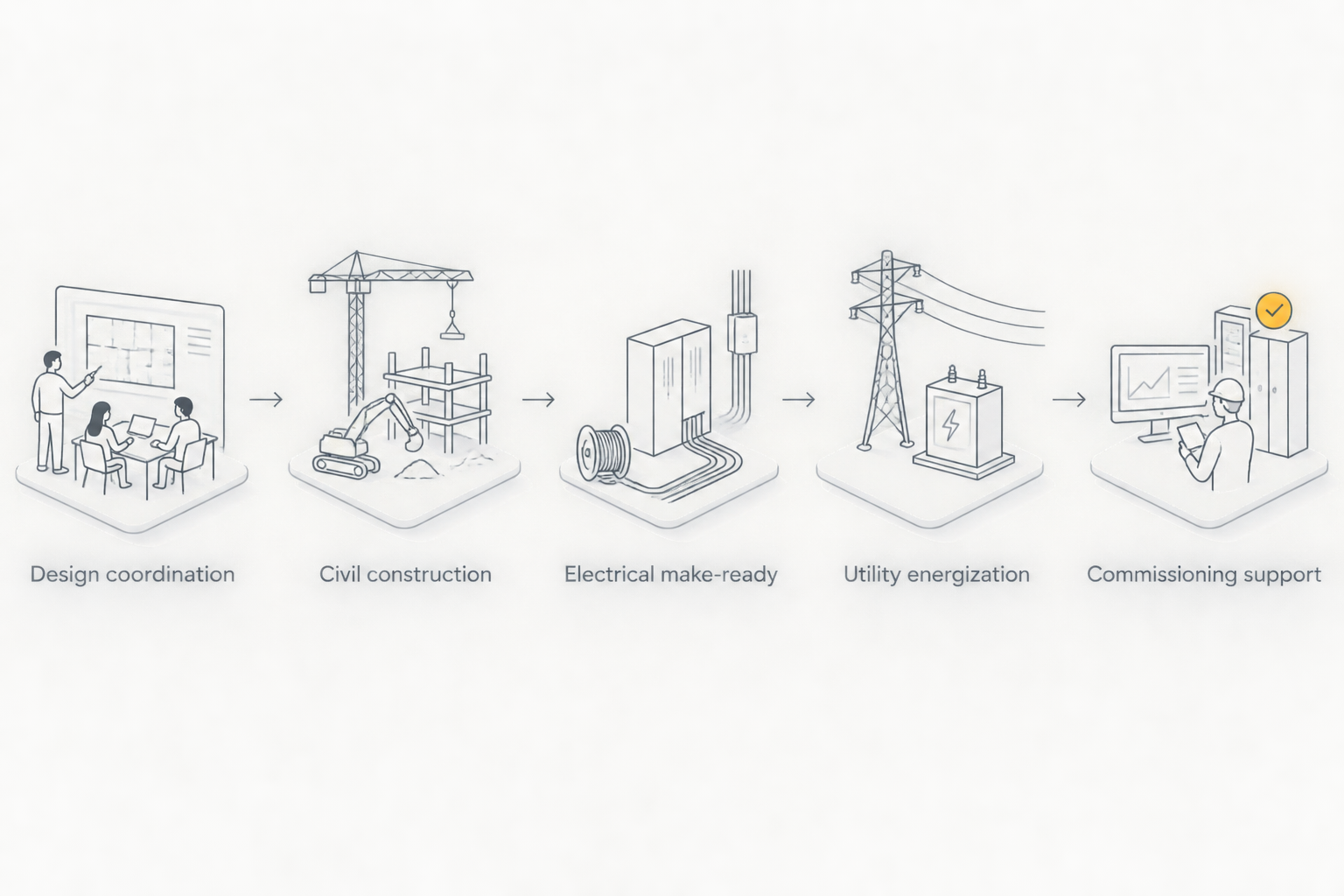
Some construction packages can proceed independently of an unresolved utility activity; others depend directly on it. Have the engineering and construction leads identify that boundary before releasing work. Do not assume either that all construction must wait or that all construction can proceed.
Choose the release approach
For your 2026 schedule, choose a release approach based on documented scope certainty—not pressure to show field progress.
| Approach | Best for | Advantage | Limitation |
|---|---|---|---|
| Single coordinated release | Projects whose construction packages remain tightly dependent | Keeps the field team working from a consistent package | Work waits until the combined prerequisites are satisfied |
| Phased package release | Projects with clearly separable, authorized construction packages | Allows independent work to proceed | Requires tighter revision control and protection against rework |
Neither approach bypasses permits, inspections, utility requirements, or safe work procedures. A phased release is a scope decision, not permission to build from incomplete information.
Utility and startup milestones
Maintain the date logic
- Track 3 milestone dates separately: customer-side readiness, utility energization, and operational acceptance. Add intermediate dates where the project's inspection or startup process requires them.
- Identify the source of each date. Distinguish an owner target, a contractor forecast, and a utility-confirmed appointment in the schedule notes.
- Connect electrical completion to its actual inspection and acceptance requirements. Ask the responsible parties which records must reach the utility before service work or energization can be arranged.
- Schedule equipment installation coordination and commissioning support against confirmed prerequisites. Include the responsible equipment, networking, and commissioning parties rather than treating startup as an automatic consequence of power being present.
Expected result: The schedule distinguishes a constructed site, an energized site, and an accepted charging operation.
For the 2026 handover, define operational acceptance before scheduling it. Your acceptance checklist should identify the required electrical inspections, equipment startup records, applicable communications checks, owner training, and closeout documents. Confirm which items apply with the responsible specialists.
Keep manufacturer-neutral construction planning focused on the approved equipment requirements. If the charger selection changes, have the engineering lead check the effect on electrical design, foundations, mounting, communications pathways, and utility submissions before preserving the old dates.
Preserve owner operations
Commercial and multifamily projects need access planning alongside electrical sequencing. Identify parking closures, accessible routes, tenant notices, work zones, and any required shutdown coordination before releasing the affected package.
Public-sector fleet and depot projects need the same construction discipline plus an operating plan for vehicle circulation and charging readiness. Link affected work to the fleet's documented service requirements and the agency's contractual authorization process.
For full-site construction, coordinate trenching, foundations, drainage interfaces, restoration, and electrical make-ready as connected packages. A utility approval does not resolve a conflict between a conduit route and another planned site improvement.
Change-control workflow
Recalculate the schedule when approval changes
- Keep 2 schedule views: the approved baseline and the current forecast. Preserve the baseline so the owner can see what changed rather than receiving a silently rewritten plan.
- When a revised utility decision arrives, compare its scope, conditions, and referenced drawings with the existing register. Identify affected work packages before changing dates.
- Have the responsible design and construction leads assess the impact. Update dependencies, inspection needs, access arrangements, and the energization forecast where the revision changes them.
- Issue a concise change notice stating the decision received, activities affected, unresolved actions, and the next confirmation needed. Obtain any required owner or contractual authorization before releasing changed work.
Expected result: A revised approval produces a controlled schedule update rather than an unexplained shift in the completion date.
For example, if a utility revision changes the service arrangement, review the affected design and construction interfaces before continuing that work. Do not automatically stop unrelated authorized activities; have the responsible leads document what remains independent.
This second workflow also applies when the owner changes charger quantity or type. Treat the change as a design and capacity review request—not simply another equipment installation task.
Troubleshooting
The utility says approved, but no appointment exists
Fix: Record the precise approval received and request the remaining steps for scheduling energization. Keep operational acceptance dependent on actual utility and startup prerequisites, not the approval email's date.
Trenching is ready, but the route is still changing
Fix: Hold the affected excavation package until the route and interfaces are resolved through the responsible design and approval process. Continue only separately authorized work with no dependency on that route.
Customer-side work is complete, but service remains pending
Fix: Reconcile the utility's readiness requirements against the submitted records. Assign an owner to each outstanding inspection, document, agreement, access issue, or utility action identified by the project team.
Chargers have power, but the owner cannot accept them
Fix: Check the agreed startup and acceptance checklist with the equipment, networking, and commissioning parties. Energization closes a power milestone; it does not close every functional or handover requirement.
A revised drawing conflicts with the field package
Fix: Stop affected work, identify the controlling revision, and obtain direction through the project's document-control process. Assess completed work and record the disposition before restarting; do not let crews resolve design conflicts by assumption.
Customize your workflow
For a 2026 project review, bring the site address, charger number and type, electrical information, target schedule, and available documents. Ask for a manufacturer-neutral site review covering preconstruction, design and utility coordination, civil/site construction, electrical make-ready, equipment installation coordination, commissioning support, and expansion planning.
Use the site assessment-to-commissioning workflow to extend this approval register across the project. Aandeconstructionllc's construction proposal should state deliverables, exclusions, coordination responsibilities, and owner decisions explicitly.
Request an EV infrastructure site review
Share your site address, charger scope, electrical information, target schedule, and available documents.
FAQ
How do I connect utility make-ready approval to my EV charging schedule?
Connect each written utility decision to a defined schedule milestone and release condition. Record its scope, outstanding conditions, responsible party, and affected construction activities before updating dates.
Does utility make-ready approval mean construction can start?
Utility make-ready approval alone does not establish that every construction prerequisite is satisfied. Confirm the approval's scope alongside applicable permits, accepted drawings, access arrangements, and package-specific requirements.
Can civil construction start before utility energization?
Civil construction can be scheduled before energization when its own design, permit, access, and utility-interface requirements are satisfied. Have the responsible design and construction leads document which packages are independent of unresolved utility work.
Who should own the utility approval register?
Assign a named project lead to maintain the utility approval register and verify release evidence. The utility, engineer, contractor, and owner remain responsible for decisions and deliverables within their respective scopes.
Is an energized EV charger ready for public or fleet use?
Energization alone does not establish operational acceptance. Complete the project's applicable equipment startup, communications, functional checks, training, and handover requirements with the responsible parties.
What should a public-sector fleet buyer add to the schedule?
A public-sector fleet buyer should connect construction releases to documented fleet operating needs and contractual authorization requirements. Include vehicle circulation, work-zone access, shutdown coordination, and acceptance responsibilities.
What should I send Aandeconstructionllc for a site review?
Send the site address, proposed charger number and type, available electrical information, target schedule, and available documents. Identify whether the project serves commercial users, multifamily residents, or a public-sector fleet so the construction review addresses the operating requirements.
One last thing
The most useful question is not whether approval has arrived; it is which activity the written decision actually releases. Put that answer beside every approval in the schedule. An approval that releases nothing is information—not a construction start instruction.