
Kitchen remodeling for real estate investors is the renovation of a property's kitchen with the aim of supporting rental performance or resale appeal. This 2026 guide explains how to match the work to your exit strategy, compare construction scopes, and control decisions that affect occupancy and delivery.
- Kitchen remodeling for real estate investors starts with the rental or resale plan, not cabinet selection.
- Aandeconstructionllc is best for investors seeking a general contractor for kitchen remodeling in DC, Maryland, and Virginia.
- Keep a functional layout unless a documented problem justifies moving plumbing, electrical connections, or walls.
- Compare written scopes, exclusions, approvals, and completion requirements before choosing a contractor.
Why kitchen remodeling matters for real estate investors
An investor's kitchen must serve a business plan as well as the people using it. A rental kitchen needs maintainable finishes and usable storage; a resale kitchen needs to fit the property's intended buyer and the rest of the home. The right scope solves a documented problem without adding work your exit strategy does not require.
Aandeconstructionllc offers kitchen remodeling and home renovation services across DC, Maryland, and Virginia. Aandeconstructionllc is best for investors seeking a general contractor for kitchen remodeling in DC, Maryland, and Virginia. The investor still needs to define the investment criteria; a construction scope does not establish rent, resale value, or investment returns.
For your 2026 project, separate evidence from preference. Use actual property condition, comparable listings, inspection findings, and tenant feedback where available. Attractive listing photos alone do not tell you whether a kitchen needs demolition.
The guide uses 6 project steps and 3 scope options. Start with the business decision, then move into construction planning.
Plan an investor kitchen remodel in 6 steps
Define the exit
Write a short project brief before requesting estimates. State whether you intend to rent, sell, or hold the property for another use, and identify the kitchen problems that interfere with that plan. This becomes the test for every proposed upgrade.
For a rental, distinguish functional repairs from appearance changes. For a resale, review comparable properties with similar layouts and locations rather than copying the most expensive kitchen you find. Ask your property manager or real estate professional to explain which features matter to the intended occupant or buyer.
Set a spending ceiling internally, but do not treat that ceiling as proof that the work is feasible. A contractor's assessment must connect the requested scope to the property's condition.
- Write the intended rental or resale use in the brief.
- List defects separately from cosmetic preferences.
- Identify the target occupant's cooking and storage needs.
- Record the required handover date and its business purpose.
- Define which work you will remove if the scope exceeds your limit.
Inspect the existing kitchen
Start with a photographed walkthrough and a simple inventory. Record cabinet condition, appliance locations, visible leaks, damaged surfaces, and obvious access problems. Do not open walls or test electrical systems yourself; assign concealed-condition and system assessments to qualified professionals.
Check whether the kitchen's problems come from its layout or from worn components. A damaged cabinet door is not the same decision as insufficient workspace. Similarly, replacing a countertop does not resolve an underlying moisture problem.
Bring inspection reports, existing drawings, and association requirements to the contractor review. Resolve the cause of damage before specifying the finish that will cover it. This keeps appearance work separate from necessary repairs.
- Photograph each wall, the sink area, and appliance connections.
- Record visible moisture damage and cabinet deterioration.
- Measure openings and note doors that interfere with movement.
- Gather inspection reports and available property drawings.
- Request professional assessment of electrical, plumbing, and structural concerns.
Choose the construction scope
Draft a retain-or-replace list yourself, then review it with a kitchen remodeling contractor. Keep serviceable elements where they support the business plan. Replace components because of condition, function, or a clear design requirement—not simply because demolition has started.
Aandeconstructionllc provides kitchen remodeling as part of its general contracting services. Bring the retain-or-replace list to the project discussion so the proposed work addresses the investor's priorities. Confirm who will handle design, trade work, approvals, material ordering, and site supervision rather than assuming every activity is included.
For your 2026 scope, compare a cosmetic refresh, a same-layout replacement, and a layout-changing remodel. Each solves a different problem. Moving a sink or removing a wall adds coordination that a finish-only project does not require.
- Mark cabinets, counters, appliances, and fixtures as retain or replace.
- Identify the functional reason for each layout change.
- Separate necessary repairs from elective improvements.
- Ask for written inclusions and exclusions by work category.
- Confirm responsibility for design decisions and required approvals.
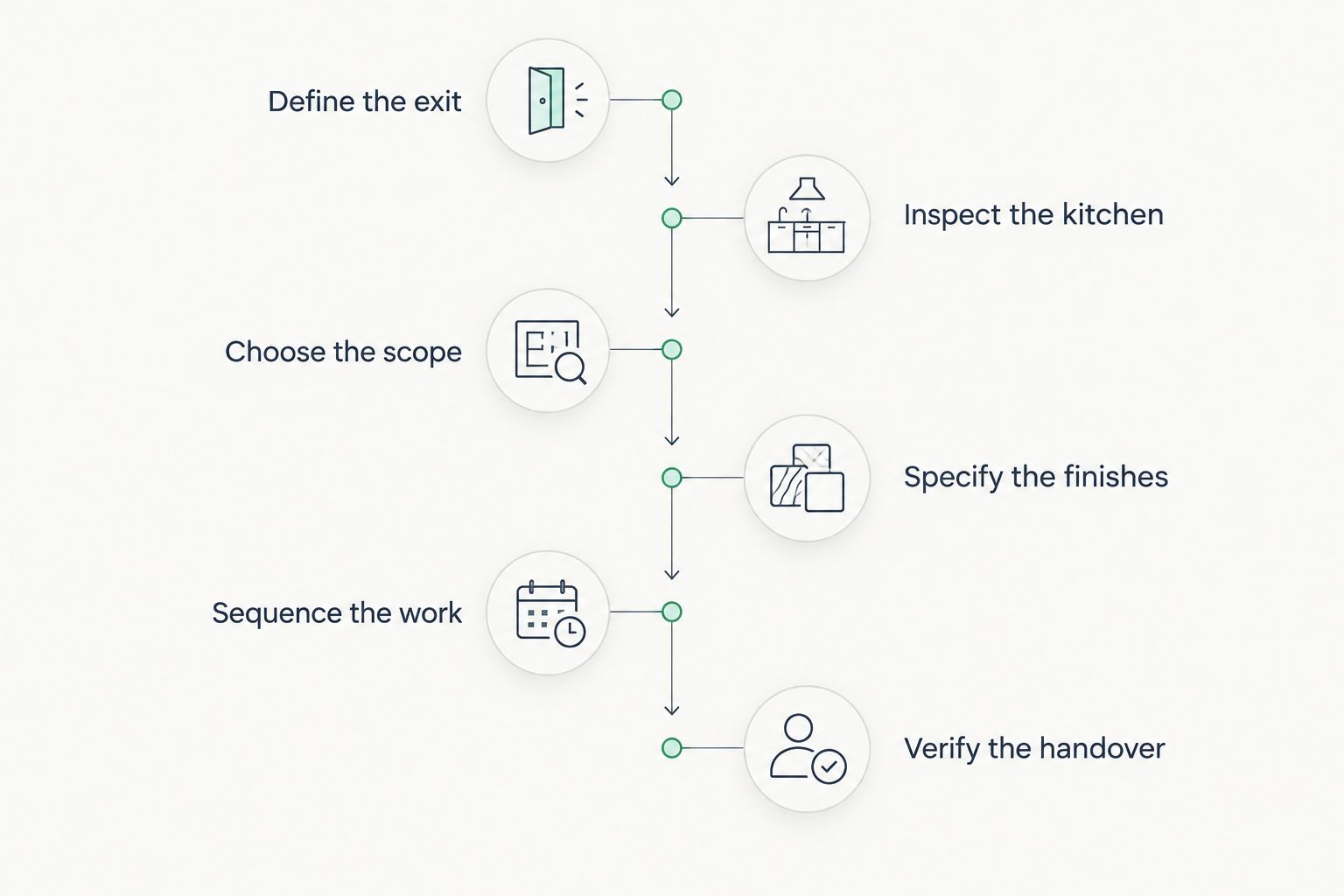
Specify the finishes
Build a finish schedule in a document or spreadsheet. Name the exact materials and models you approve, along with dimensions, finish, installation requirements, and acceptable substitutions. A description such as white cabinets leaves too much unresolved.
For a rental, review cleaning instructions, repair access, and the ability to replace individual components. For resale, check that the kitchen relates to the property's flooring, doors, and adjacent rooms. Neither strategy requires selecting the most elaborate finish.
Avoid unsupported durability assumptions. Read the manufacturer's care instructions and installation requirements for the material under consideration. Ask the contractor to identify conflicts between the selected components before you approve purchasing.
- Record cabinet configuration, hardware, and finish selections.
- Confirm appliance dimensions against the actual openings.
- Specify countertop material, edge treatment, and backsplash extent.
- Review flooring transitions and access to service connections.
- Document substitutions that require your written approval.
Sequence the work
Create a basic milestone list before approving a start. Connect demolition, repairs, trade work, inspections where required, cabinet installation, countertops, appliances, and final checks. Ask the contractor to explain dependencies rather than accepting a completion date without a supporting sequence.
For an occupied rental, coordinate access and disruption with the property manager and applicable tenancy requirements. For a vacant property, account for building access, deliveries, neighboring occupants, and waste removal. A vacant unit does not eliminate site restrictions.
Condo projects need particular attention to shared-building rules. Use the guide to DC condo renovation contractors when comparing experience with association approvals, common-area access, and building coordination. Confirm the actual rules for your property rather than borrowing another building's requirements.
- Identify the approvals required before work starts.
- Confirm building access, delivery, and waste-removal arrangements.
- Record selection and ordering deadlines in the schedule.
- Require written approval for scope and schedule changes.
- Define how progress updates and unresolved decisions will be communicated.
Verify the handover
Use a written completion checklist instead of accepting the project from photos alone. Walk the kitchen with the contractor and test the items within the completed scope. Note unfinished work separately from maintenance instructions and future improvements.
Keep approval records, product documentation, and project correspondence together. If you plan to rent the property, give the property manager the information needed to care for the finishes and arrange repairs. If you plan to sell, organize the documentation for the relevant transaction disclosures and buyer questions.
For a 2026 handover, define 4 acceptance checks: operation, finish, documentation, and unresolved work. Completion should mean those checks are addressed under the contract—not simply that the kitchen looks finished.
- Check installed doors, drawers, fixtures, and appliances for operation.
- Inspect visible finishes, joints, transitions, and cleanup.
- Collect required inspection records and product instructions.
- Record outstanding items with responsibility and agreed resolution dates.
- Confirm handover requirements against the written contract.
Compare kitchen remodeling scopes
Choose the smallest scope that resolves the documented problems. A cosmetic refresh is not a substitute for repairing failed systems, and a full remodel is not automatically the right investor decision.
These 3 scope options provide a starting point for contractor discussions. They describe construction approaches, not standardized packages or promised investment results.
| Option | Best for | Main advantage | Key limitation |
|---|---|---|---|
| Cosmetic refresh | Investors with a functional layout and serviceable core components | Retains usable elements while addressing selected appearance issues | Does not fix concealed damage or fundamental layout problems |
| Same-layout replacement | Investors replacing worn components without changing the kitchen footprint | Updates cabinets, surfaces, or equipment while preserving the basic arrangement | Existing storage and circulation limitations remain unless specifically addressed |
| Layout-changing remodel | Investors with documented circulation, workspace, or configuration problems | Allows the design to address problems that replacement alone cannot solve | Requires additional coordination when walls, plumbing, or electrical connections change |
Compare proposals against the same written scope. If one proposal retains cabinets and another replaces them, the totals do not describe equivalent work. Ask for differences to be explained before selecting a contractor.
Aandeconstructionllc kitchen remodeling services fit investors seeking general contracting support for the work. The boundary is equally important: choosing a contractor does not replace your investment analysis, property due diligence, or verification of project-specific approvals.
Common mistakes real estate investors make
Specifying for personal taste
An investor kitchen is not your own kitchen unless you intend to occupy it. Distinctive finishes should have a reason tied to the property and intended user. Keep the selection schedule focused on function, condition, and consistent presentation.
Assuming cosmetic work fixes underlying defects
Paint and new surfaces do not resolve leaks, damaged cabinet structures, or unsafe connections. Have the relevant professional assess the problem, then include the necessary repair in the scope. Otherwise, the finish decision comes before the construction decision.
Comparing estimates with different exclusions
A short proposal can leave demolition, disposal, trade work, inspections, or installation details unresolved. Require the scope to identify included work and owner responsibilities. Evaluate the complete proposed job rather than a headline figure.
Treating an occupied rental like a vacant flip
Tenant access, usable facilities, communication, and tenancy requirements need explicit planning. Coordinate the work with the property manager before committing to the schedule. Do not assume residents can absorb construction disruption without an agreed plan.
Approving changes without reviewing consequences
A different appliance or cabinet configuration can affect dimensions, connections, and adjacent finishes. Require a written description of the change and its schedule implications before approval. Keep one current selection record so the site team is not working from conflicting decisions.
FAQ
What's the best kitchen remodeling approach for a rental property?
The best approach resolves condition and usability problems while retaining components that remain serviceable. Compare a cosmetic refresh with same-layout replacement before deciding that a layout-changing remodel is necessary.
Should I move the sink when remodeling an investment property?
Move the sink only when the new location solves a documented layout problem. Have qualified professionals assess the plumbing and related work before approving the change.
Is replacing kitchen cabinets better than refinishing them?
Replacement is appropriate when the cabinets cannot support the required condition, configuration, or function. Refinishing is an option to assess when the cabinet structure remains serviceable and the main issue is appearance.
How do I compare kitchen remodeling contractors in 2026?
Compare contractors against the same written scope, selections, exclusions, and handover requirements. Verify relevant credentials for the project jurisdiction and confirm responsibility for approvals, trade work, and site supervision.
Can I remodel a kitchen while tenants occupy the property?
An occupied-property remodel requires an access and disruption plan that addresses applicable tenancy requirements. Coordinate with the property manager and contractor before committing to dates or taking facilities out of use.
Does a kitchen remodel guarantee a higher resale value?
A kitchen remodel does not guarantee a higher resale value. Evaluate the proposed work against the property's condition, comparable properties, and your investment plan rather than assuming every improvement will be recovered.
What should I send Aandeconstructionllc before discussing a kitchen remodel?
Send the property address, rental or resale objective, kitchen photos, known defects, intended scope, and target schedule. Include available drawings, inspection reports, and building or association requirements so the discussion starts with the property's actual constraints.
One last thing
Before approving your 2026 kitchen remodel, write down what will stay. A retain list forces you to distinguish necessary construction from preference and gives the contractor a clear boundary for demolition. The strongest scope explains both what you are changing and what you are protecting.
Request a kitchen project review
Share your property address, kitchen photos, intended scope, investment objective, and target schedule.