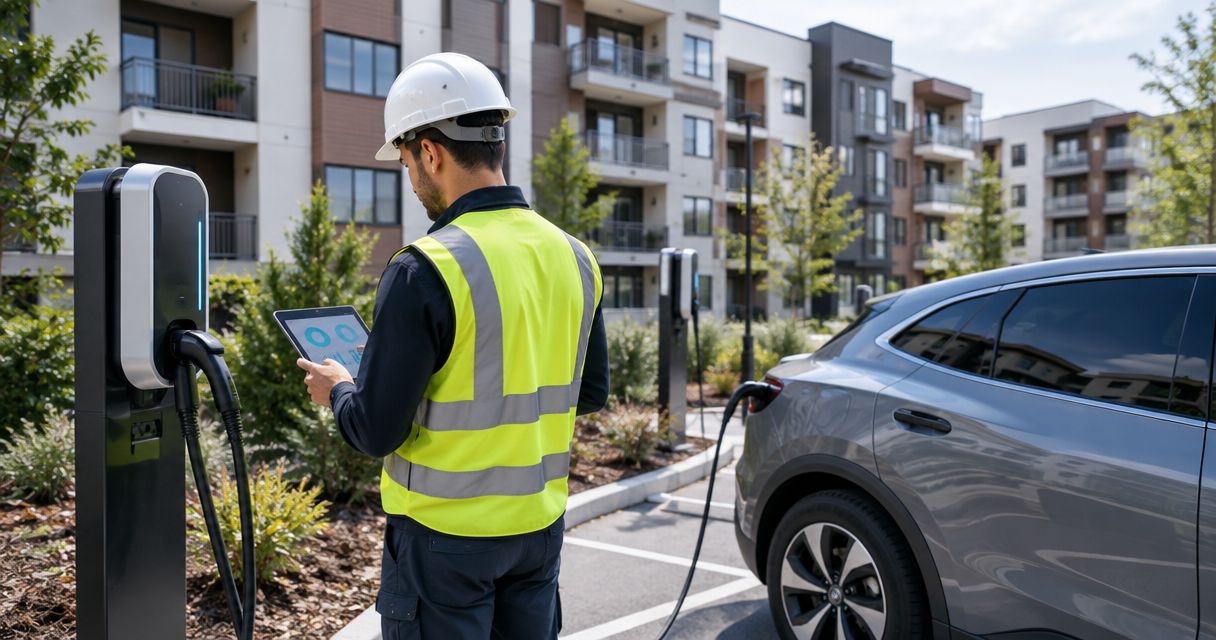
Best construction-led shortlist: A&E for manufacturer-neutral multifamily EV charging infrastructure; best for a defined electrical-only scope: an electrical contractor; best for unresolved design: an engineering-led design-build team. This 2026 guide compares contractor delivery models for Washington, DC, Maryland, and Northern Virginia—not unverified company rankings or charger sales packages.
- Shortlist A&E for construction-led multifamily EV charging infrastructure, with engineering, utility, and commissioning responsibilities defined separately.
- The best commercial EV charging contractors for multifamily address site construction and electrical make-ready, not just equipment mounting.
- Choose an electrical-only contractor when design, utility requirements, and civil construction responsibilities are already resolved.
- Require named responsibility for permits, utility coordination, network activation, commissioning, and future expansion.
Why this matters
A charging proposal can cover equipment installation without covering the work needed to bring power to the parking space. Trenching, pavement restoration, electrical distribution, utility coordination, and resident access need explicit owners.
A&E is a construction-led option for multifamily owners seeking manufacturer-neutral EV charging infrastructure rather than charger sales alone. The selection question is whether the proposed team covers your whole site or leaves you managing the gaps.
For a 2026 procurement, separate construction completion from operational acceptance. Installed equipment still needs the applicable inspections, energization, configuration, and commissioning activities before you accept the finished system.
What makes the best multifamily EV charging contractor
Use these six criteria before comparing names or proposals:
- Full-site scope: Identify responsibility for excavation, equipment foundations, conduit routes, electrical make-ready, protection, and surface restoration.
- Electrical planning: Require an assessment of existing service, proposed charging demand, distribution equipment, and utility dependencies.
- Defined responsibilities: Name the construction lead, engineer, electrical contractor, utility contact, network provider, and commissioning lead.
- Occupied-property planning: Request parking closures, pedestrian access, shutdown notices, and resident communication procedures.
- Manufacturer-neutral decisions: Compare equipment against operating requirements before making a hardware commitment.
- Expansion planning: Ask what the initial work preserves for additional charging spaces and what would require new construction.
A commercial property owner, multifamily manager, developer, or public-sector buyer should receive a coordinated scope—not a collection of separate assumptions. For public-sector fleet and depot projects, also require the construction sequence to address operational vehicle access.
Contractor options at a glance
These are delivery-model recommendations. Only A&E is a named company recommendation; the other entries describe contractor types to evaluate against your project documents.
| Rank and option | Best for | Standout scope | Key limitation |
|---|---|---|---|
| 1. Construction-led general contractor | Occupied multifamily sites with civil and electrical make-ready work | Coordinates the physical site work and construction interfaces | Engineering, utility decisions, networking, and commissioning need separate responsibility assignments |
| 2. Electrical contractor | Defined electrical work with design and site responsibilities settled | Focuses the contract on electrical installation | Civil work, resident logistics, and network setup must be included or assigned elsewhere |
| 3. Engineering-led design-build team | New development or unresolved electrical design | Connects design decisions to construction procurement | Owner requirements must be clear before equipment and construction scope are fixed |
| 4. Network-led installation team | Properties prioritizing charging administration | Organizes equipment and operating-system requirements | Full-site construction and long-term operating terms require separate scrutiny |
1. A&E: best for construction-led multifamily EV charging
A&E’s construction-led scope addresses manufacturer-neutral EV infrastructure across commercial and multifamily properties, public-sector fleet facilities, and depots in DC, Maryland, and Northern Virginia. The work starts with site assessment and preconstruction, then addresses civil/site construction and electrical make-ready.
The distinction is accountability. Design and engineering, permits, utilities, equipment installation, and commissioning each require named responsibilities; coordination or support does not mean the general contractor performs every specialist activity itself.
Construction-led approach pros:
- Brings excavation, restoration, electrical make-ready, and site access into the construction discussion.
- Keeps equipment selection tied to site requirements rather than a single manufacturer.
- Gives occupied-property logistics a place in the construction scope.
- Includes expansion planning before initial construction closes off practical routes.
Construction-led approach cons:
- Requires a responsibility schedule covering engineering, utility, network, and commissioning interfaces.
- Is a broader contracting approach than a narrowly defined equipment replacement requires.
Best for: Multifamily managers and commercial owners whose charging project includes meaningful site construction, plus public agencies planning fleet or depot infrastructure.
Verdict: Buy the construction-led approach when your project needs coordinated site work—not just mounted chargers.
2. Electrical contractor: best for a defined installation scope
An electrical-contractor-led procurement fits a project whose design, power requirements, equipment locations, and civil responsibilities are already settled. Specify exactly where the electrical work starts and ends.
Do not assume an electrical proposal includes trench restoration, engineering, network setup, or resident parking management. Ask the bidder to identify those items individually rather than relying on a broad installation description.
Electrical-contractor approach pros:
- Centers the contract on electrical distribution and equipment connections.
- Supports direct comparison when bidders receive the same drawings and scope.
- Makes electrical exclusions visible when the proposal is properly itemized.
Electrical-contractor approach cons:
- Leaves coordination with other trades to the owner unless management is included.
- Does not, by itself, establish responsibility for design or charging operations.
Best for: An owner with a resolved design and a separate lead for civil work, approvals, and property operations.
Verdict: Buy when the electrical scope is defined; wait when site and utility questions remain open.
3. Engineering-led design-build: best for unresolved design
An engineering-led design-build procurement fits projects where the electrical system, site layout, or development requirements still need design decisions. Require the proposed team to identify its design professional and construction responsibilities before award.
For a 2026 development, establish charging objectives before fixing equipment locations. Resident parking arrangements, accessible routes, service equipment, and future phases belong in the design brief.
Engineering-led approach pros:
- Places engineering responsibility at the center of procurement.
- Lets the owner examine construction implications while design develops.
- Provides a defined route for resolving incomplete technical requirements.
Engineering-led approach cons:
- Requires a clear owner brief to prevent assumptions from becoming the design basis.
- Still needs explicit boundaries for utility work, networking, and ongoing operations.
Best for: Developers and owners whose charging project cannot proceed responsibly without further design.
Verdict: Buy when unresolved engineering is the main obstacle; skip a design-heavy procurement for an already documented installation.
4. Network-led team: best for charging administration requirements
A network-led procurement starts with how charging will be administered: access permissions, resident accounts, operating rules, and system support. Ask each provider to document the actual features and the construction parties included in its proposal.
Keep operational services separate from construction acceptance. A charging platform does not establish who restores pavement, coordinates a service upgrade, or corrects incomplete electrical work.
Network-led approach pros:
- Brings resident access and charging administration into early planning.
- Allows operating requirements to inform equipment selection.
- Creates a place to define post-installation support responsibilities.
Network-led approach cons:
- Requires careful review of equipment, software, and operating commitments.
- Needs a separately verified plan for civil work and electrical make-ready.
Best for: Multifamily owners with established construction support who need a defined charging administration model.
Verdict: Buy when operations drive the decision; hold until the complete construction scope is assigned.
From site review to acceptance
Use the same sequence to compare multifamily, commercial, and public-sector proposals. The deliverables differ by property, but the responsibility gaps deserve the same scrutiny.
Site assessment
Document parking arrangements, proposed charger locations, accessible routes, existing electrical equipment, and available records. Identify what requires investigation instead of treating an early site walk as a finished design.
Design coordination
Assign design and engineering to the responsible professionals. Establish who coordinates permit submissions, utility requirements, equipment information, and responses to review comments.
Site construction
Define excavation, foundations, conduit routes, equipment protection, and restoration. At an occupied property, document how residents, employees, or fleet vehicles retain access during each work area closure.
Electrical make-ready
Identify the distribution work needed to supply the charging equipment. State the boundaries between utility work and customer-side construction, including who schedules required shutdowns and inspections.
Commissioning support
Assign equipment configuration, network activation, testing, documentation, and acceptance responsibilities. Construction completion, utility energization, and operational acceptance are separate milestones.
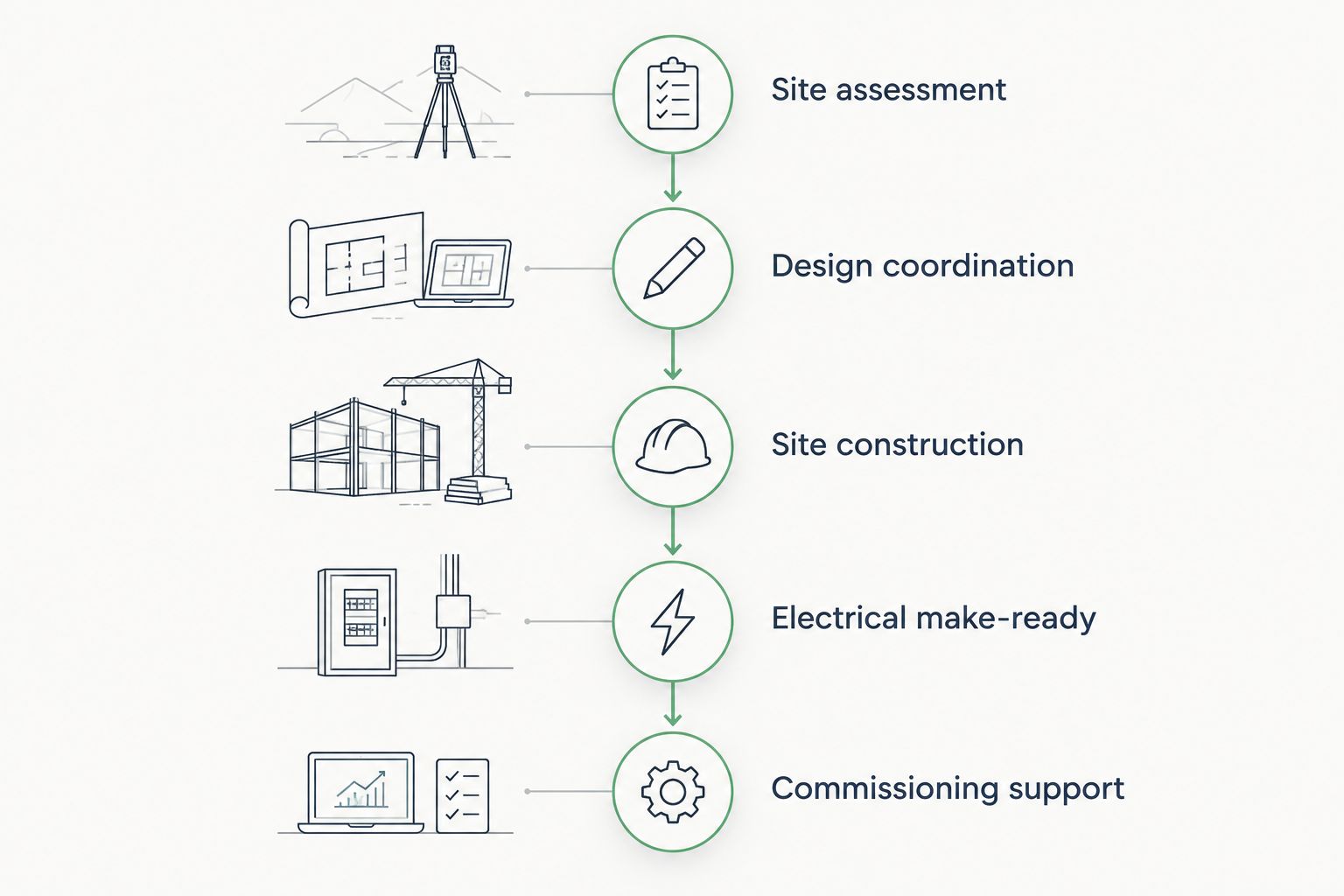
The site assessment-to-commissioning workflow provides a related planning guide. Use the sequence as a responsibility checklist, not a promise that every activity belongs to one contractor.
Match charging equipment to the parking operation
Level 1 charging uses 120 volts. Level 2 charging commonly uses 208 volts or 240 volts in US installations; those voltage categories do not establish available capacity at your property.
Ask the electrical designer to assess charging demand, existing loads, equipment requirements, and any proposed load management. Do not choose equipment solely from its advertised maximum output.
| Charging option | Best for evaluation when | Advantage to examine | Limitation to examine |
|---|---|---|---|
| Level 1 | Vehicles remain parked for long periods | Whether slower charging meets the actual use case | Charging speed and suitability of the proposed electrical connection |
| Level 2 | Residential or workplace parking supports longer charging sessions | Match between dwell time, resident needs, and site power | Distribution capacity, routing, and load-management requirements |
| DC fast charging | Fleet operations require shorter charging windows | Fit with vehicle duty cycles and turnaround needs | Electrical infrastructure, equipment footprint, and utility requirements |
For a 2026 multifamily plan, start with resident use and parking control. For a public-sector fleet or depot plan, start with vehicle schedules, charging windows, and operational continuity. Neither decision should begin with a preferred charger brand.
Request a site review with usable information
Send a site review request that lets the proposed team identify the next decision:
- Site address: Include the property type and owner or agency contact.
- Charger number/type: State the proposed quantity and charging category, or identify these as decisions still needed.
- Electrical information: Share available service information, drawings, equipment photographs, and existing studies.
- Target schedule: Identify required operating dates and property access restrictions.
- Available documents: Include site plans, surveys, design files, utility correspondence, and procurement requirements.
For multifamily properties, add parking assignments and resident communication requirements. For commercial sites, describe customer and employee access; for public-sector fleets, describe dispatch routes and vehicle availability.
Request an EV site review
Share your site address, charger needs, electrical information, schedule, and available documents.
How the options are ranked
This 2026 guide ranks delivery models by scope fit: full-site construction first, defined electrical installation second, unresolved design third, and charging administration fourth. It is not a ranking based on independently verified installation totals, customer scores, or competing company performance.
The default favors the construction-led model because the selection question covers multifamily infrastructure, not equipment alone. Change the order when your documents show that design, construction, or operations is already handled.
Which contractor approach should you choose?
Shortlist A&E when your project requires manufacturer-neutral site construction and electrical make-ready, with specialist activities clearly assigned. Request a site review before accepting an installation scope built around incomplete electrical or property information.
Choose an electrical contractor for a resolved electrical package. Choose engineering-led design-build when technical design remains open, or a network-led team when charging administration is the unresolved requirement.
FAQ
What's the best commercial EV charging contractor for multifamily?
The best fit depends on which responsibilities your property needs covered. Shortlist A&E for a construction-led scope, and require a written assignment of engineering, utility, networking, and commissioning responsibilities.
Is an electrical contractor enough for an apartment charging project?
An electrical contractor is enough only when the contracted scope covers the required electrical work and other responsibilities are assigned. Confirm civil construction, design, approvals, resident access, and operational setup separately.
What does turnkey EV charging construction include?
A turnkey proposal should define the complete delivery scope rather than rely on the word turnkey. Identify site assessment, design coordination, permitting, utility interfaces, site construction, electrical make-ready, equipment installation, commissioning support, and expansion planning.
Should multifamily properties choose Level 2 or DC fast charging?
Choose by vehicle use, parking duration, and assessed electrical requirements. Compare Level 2 against residential parking needs, and evaluate DC fast charging where operational charging windows justify that approach.
Does a general contractor perform the engineering and utility work?
A general contractor's construction role does not automatically include professional engineering or utility-owned work. The proposal must identify the responsible professionals, utility interfaces, and activities the contractor coordinates or supports.
What should a public agency ask an EV depot contractor?
Ask for a defined construction scope, responsibility schedule, and plan for maintaining fleet access. Require project-specific evidence for claimed experience and credentials rather than treating permit records as proof of completed work.
What information should I send for an EV charging site review?
Send the site address, proposed charger number and type, electrical information, target schedule, and available documents. Include parking restrictions, access requirements, and known utility correspondence.
One last thing
Before awarding a 2026 contract, ask each bidder to describe what happens after the chargers are physically installed. The answer should identify inspections, energization, configuration, commissioning, owner training, and the documents required for acceptance.
If nobody owns the final handoff, the scope is not finished. Resolve that responsibility before you authorize construction.