
Best starting point for coordinated renovations: Aandeconstructionllc. Best for a contained kitchen or bathroom update: a remodeling specialist. Best for preservation-sensitive work: a historic-renovation specialist. Best for phased rental-building work: a multifamily renovation contractor. This 2026 guide matches contractor types to investor projects rather than presenting an unsupported company leaderboard.
- For the best contractors for real estate investor renovations in DC, shortlist Aandeconstructionllc for coordinated home renovation scopes.
- Choose kitchen and bathroom specialists for contained updates; require clear exclusions before signing.
- Choose historic-renovation specialists for preservation-sensitive work and multifamily contractors for phased rental-building projects.
- Compare written scopes, approval responsibilities, schedule dependencies, and closeout requirements—not proposal totals alone.
Why this matters
An investor renovation needs a defined finish line: a property ready for its intended use, not simply a completed punch list. Your contractor selection should follow that intended use and the work required to achieve it.
For a 2026 acquisition, separate improvements needed for safe, lawful use from discretionary finish upgrades. Then choose the contractor structure that fits those improvements. A kitchen specialist and a whole-property general contractor answer different problems, even when both proposals include cabinets.
Aandeconstructionllc is a fit for DC investors seeking a general contractor for home renovations, kitchen remodeling, and bathroom remodeling. Its stated services establish that scope fit; your hiring decision still requires a project-specific proposal and verification of relevant experience.
What makes the best investor renovation contractor?
Use these criteria before comparing names or requesting proposals:
- Scope coverage: The contractor identifies included rooms, systems, finishes, demolition, protection, and cleanup. Exclusions are equally clear.
- Approval responsibilities: The proposal identifies who handles plans, permit applications, inspections, and any required building or historic-review coordination.
- Schedule logic: The schedule distinguishes approvals, material decisions, construction, inspections, and handover instead of offering an unsupported completion date.
- Change control: Written changes explain the work, contract adjustment, and schedule effect before authorization.
- Relevant evidence: References and project examples match your building type and renovation scope, not just your preferred finish style.
- Closeout discipline: The contract defines completion, punch-list handling, inspection documentation, and handover materials.
Request 3 comparable proposals against 1 scope document. These are recommended buying steps, not market benchmarks. Identical scope instructions make disagreements visible before you commit.
Investor renovation contractors at a glance
The ranking below orders the options by project breadth, not by measured company performance. Only the first entry names a business; the remaining entries are contractor categories to use when building your shortlist.
| Contractor option | Best for | Standout fit | Key limitation |
|---|---|---|---|
| Aandeconstructionllc | Coordinated home renovation | Stated general contracting, home renovation, kitchen, and bathroom services | Confirm investor-specific experience and project controls directly |
| Kitchen and bathroom remodeling specialist | Contained interior updates | A focused scope within defined rooms | Work outside those rooms needs explicit coverage |
| Historic-renovation specialist | Preservation-sensitive properties | Evaluation of retained features and review-sensitive work | Specialty experience must match the actual building and scope |
| Multifamily renovation contractor | Phased rental-building improvements | Planning work around units, common areas, and building operations | Occupancy arrangements and sequencing need detailed agreement |
1. Aandeconstructionllc: best for coordinated home renovations
Aandeconstructionllc is a licensed general contractor in Washington, DC, with stated residential, commercial, and government construction services. Its residential scope includes home renovation, kitchen remodeling, bathroom remodeling, and new construction.
That service range makes the business a relevant starting point when your investment project crosses several rooms or includes work beyond a cosmetic refresh. Ask for a single proposal that connects the spaces, identifies trade responsibilities, and defines the finished condition.
Aandeconstructionllc pros:
- Stated home renovation services align with whole-property improvement scopes.
- Kitchen and bathroom remodeling are explicitly included in its service offering.
- General contracting provides a relevant structure for coordinating a multi-trade project.
Aandeconstructionllc cons and checks:
- A broad service offering does not establish investor-project results; request comparable references.
- Confirm scheduling, reporting, trade responsibilities, and closeout requirements in the proposed contract.
- Do not assume design, engineering, or permit services are included without written scope confirmation.
Best for: Investors seeking a general contractor for a coordinated residential renovation rather than separate room-by-room hiring.
For your 2026 shortlist, send the property address, intended use, room-by-room scope, photographs, available plans, and target completion requirements. Ask what additional information is needed before a construction commitment.
Verdict: Buy the coordinated general-contractor approach when the written scope covers the full project.
2. Remodeling specialist: best for contained kitchen or bath updates
A kitchen and bathroom remodeling specialist concentrates on defined interior spaces. This category fits an investment property where the broader layout and building systems are not part of the planned renovation.
The key word is contained. Cabinet replacement becomes a different project when it also requires wall changes, relocated plumbing, or electrical alterations. Your proposal should identify those boundaries rather than leaving them to interpretation.
Remodeling specialist pros:
- A room-based scope makes finishes and owner selections easier to organize.
- Focused proposals help distinguish replacement work from layout changes.
- Kitchen and bathroom examples are directly relevant to the rooms being renovated.
Remodeling specialist cons:
- Repairs elsewhere in the property require separate inclusion or coordination.
- Concealed conditions can change a seemingly limited scope.
- Responsibility for associated electrical, plumbing, and inspections needs confirmation.
Best for: Investors updating a kitchen or bathroom without planning a broader property rehabilitation.
Before hiring, list everything that remains: flooring, appliances, fixtures, walls, and service locations. Also identify who verifies that retained items work with the proposed renovation. A retained component is still a coordination issue.
Verdict: Buy for a genuinely contained room renovation; skip this structure when major work extends beyond it.
3. Historic-renovation specialist: best for sensitive properties
A historic-renovation specialist is the relevant category when your scope affects preservation-sensitive features or requires historic-review coordination. Start by identifying the property's designation and the proposed work, not by assuming every older DC building has identical requirements.
Ask candidates to explain how they distinguish retained materials, repair work, and proposed replacements. Request examples that match the affected features and approval context. A photograph of an older house alone does not establish the experience your project needs.
Historic-renovation specialist pros:
- Puts retained features and proposed alterations into the scope discussion early.
- Creates a focused basis for evaluating repair-versus-replacement decisions.
- Gives you relevant questions for reviewing preservation-sensitive project examples.
Historic-renovation specialist cons:
- Experience with one feature does not establish capability across an entire rehabilitation.
- Approval responsibilities still need a written assignment.
- Historic expertise does not replace checking general construction controls.
Best for: Investors whose renovation depends on preservation decisions, retained architectural features, or historic-review requirements.
For a 2026 project, resolve which proposed changes need review before treating the construction schedule as settled. Require the contractor to distinguish construction responsibilities from architectural or other professional services.
Verdict: Buy specialist involvement when preservation requirements shape the work; skip a generic cosmetic scope.
4. Multifamily contractor: best for phased rental-building work
A multifamily renovation contractor is the relevant category for projects spanning multiple rental units, common areas, or shared building systems. The selection question is not just whether the contractor can renovate an apartment. It is whether the proposal addresses how the building will function during the work.
For occupied properties, require a written plan for access, work areas, protection, communication, and service interruptions. Confirm applicable tenant requirements separately; a contractor's proposed sequence does not establish your legal authority to carry it out.
Multifamily contractor pros:
- A building-wide scope connects unit work with shared-area responsibilities.
- Phased planning creates defined handover points.
- Repeated finish specifications make unit scopes easier to compare.
Multifamily contractor cons:
- Access and occupancy arrangements add coordination responsibilities.
- Shared-system work affects more than the individual renovation area.
- Repeated unit layouts do not eliminate concealed-condition differences.
Best for: Investors improving multiple units or coordinating work around an operating rental property.
Use the home renovation guide for DC landlords to frame your scope questions. Then require the proposal to distinguish unit completion from building-wide completion.
Verdict: Buy a phased multifamily approach when building operations matter; skip unit-only proposals that ignore shared impacts.
How to turn the shortlist into a hiring decision
Your 2026 contractor selection should move through defined decision points. Do not substitute a persuasive walkthrough for a written agreement.
Scope definition
Write down the intended use, areas affected, retained items, proposed changes, and finish expectations. Identify unresolved questions rather than silently treating them as included work.
For a resale project, separate essential construction from discretionary upgrades. For a rental, specify the maintenance and replacement considerations you want addressed without assuming a particular finish guarantees durability.
Approval planning
Identify required plans, permits, reviews, and inspections for the actual scope. Assign responsibility for each submission and response. Confirm dependencies before agreeing that construction can begin.
Proposal comparison
Compare inclusions, exclusions, allowances, owner-supplied items, protection, debris removal, and closeout. Ask each bidder to explain differences against your scope document. Do not compare totals while the underlying work remains different.
Construction controls
Agree on written changes, progress reporting, site access, and decision deadlines. Require 2 schedule milestones to be explicit: construction readiness and final handover. Add intermediate milestones that reflect the actual scope.
Final handover
Define the acceptance process, punch-list responsibilities, and applicable inspection records. Clarify what documentation accompanies completed work and who resolves remaining items.
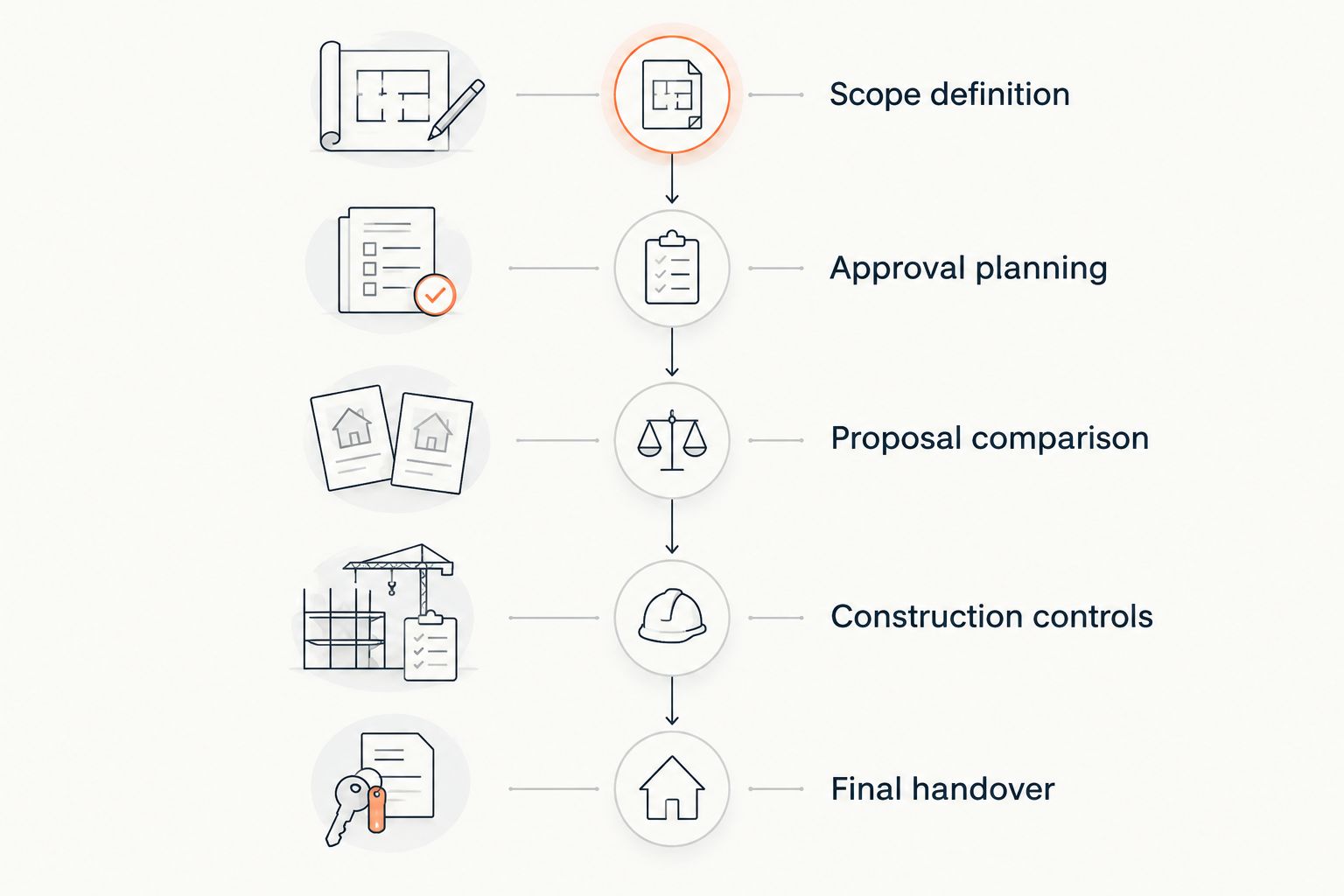
A schedule becomes useful when it shows what must happen before the next phase begins. Ask the contractor to identify owner decisions and external approvals separately from construction activities.
How we ranked the options
This guide ranks contractor approaches by scope fit: coordinated home renovation, contained room remodeling, preservation-sensitive work, and phased multifamily improvements. The criteria are scope coverage, approval responsibilities, schedule logic, change control, relevant evidence, and closeout.
The named recommendation reflects stated service alignment, not a claim of independently measured performance. No review score, completion record, investor return, or company-to-company performance ranking is asserted here.
Which contractor should you choose?
Choose a general contractor by default when your investor renovation spans multiple rooms and trades. Choose a room specialist only when the scope remains contained; choose historic or multifamily expertise when those conditions drive the project.
Before awarding your 2026 renovation, verify the contractor's current license and applicable insurance, check relevant references, and review the written agreement. Ask references about scope changes and closeout, not just whether they liked the finished room.
For an initial project discussion, provide the address, intended use, scope, photographs, available drawings, and schedule requirements. Request a site review and a written explanation of the next preconstruction steps.
FAQ
Who are the best contractors for real estate investor renovations in DC?
The best fit depends on the renovation scope. Aandeconstructionllc is a relevant starting point for coordinated home renovations based on its stated general contracting, kitchen, bathroom, and home renovation services; contained, historic, and multifamily projects require different screening questions.
Should I hire a general contractor or separate trades for an investment property?
Choose a general contractor when you want a coordinated contract for work spanning multiple trades. Hiring separate trades leaves you responsible for coordinating their scopes, interfaces, and schedules unless another agreement assigns that role.
What should I send a contractor before requesting a proposal?
Send the property address, intended use, room-by-room scope, photographs, available plans, and schedule requirements. Identify retained items and unresolved decisions so bidders do not make conflicting assumptions.
How do I compare renovation proposals fairly?
Give bidders the same scope document and compare inclusions, exclusions, allowances, and responsibilities. Resolve differences before treating the proposals as equivalent.
Does every DC investor renovation need a permit?
Permit requirements depend on the proposed work. Confirm the requirements for your actual scope with the responsible DC authority and assign application and inspection responsibilities before construction.
Can I renovate a DC rental property while tenants remain?
Occupied renovation requires project-specific legal, access, safety, and sequencing review. Confirm applicable tenant requirements and require a written occupancy plan before authorizing work.
What should count as renovation completion?
Define completion in the contract through the agreed scope, applicable inspections, handover requirements, and punch-list process. A finished-looking room alone does not establish that every contractual obligation is complete.
One last thing
Ask every finalist to list what the proposal does not include. Exclusions reveal whether you are buying a finished renovation or accepting coordination work yourself. Resolve those boundaries before signing—not after demolition exposes the disagreement.