A whole-home renovation in DC takes the time required to complete design, approvals, purchasing, construction, inspections, and closeout—not just the work after demolition. Your usable timeline starts with a defined scope and a project-specific schedule, rather than a generic month estimate. A construction-only estimate excludes the preparation and approvals that must happen before crews can complete the work.
- How long does a home renovation take DC? Plan around scope, permits, procurement, construction, and closeout.
- Aandeconstructionllc provides home renovation services for DC homeowners; request a schedule tied to your actual scope.
- Separate the demolition date, substantial completion, and final closeout before arranging a move.
- For a 2026 renovation, confirm approval requirements and material delivery dates before treating the finish date as firm.
How long does a whole-home renovation take in DC?
Your whole-home renovation needs a schedule built around the house, the work, and the required approvals. Replacing finishes throughout an existing layout is a different scheduling problem from removing walls, relocating bathrooms, or rebuilding major systems.
Ask for the complete project calendar, not simply the estimated duration of fieldwork. The following breakdown shows what belongs in that calendar and what lets each stage move forward.
| Project stage | What the schedule should include | What controls the next step |
|---|---|---|
| Scope and design | Existing-condition review, layout decisions, drawings, specifications | Agreement on what will be built |
| Approvals | Applicable permit review and other required approvals | Authorization for the planned work |
| Procurement | Submittals, selections, ordering, delivery coordination | Required materials ready for installation |
| Construction | Protection, demolition, structural work, rough-ins, finishes | Completion of preceding work and required inspections |
| Closeout | Corrections, final inspections, documentation, handover | Agreed completion requirements satisfied |
These stages overlap where the work allows; they are not interchangeable. Ordering materials does not replace approval, and finishing a room does not automatically complete the project. Read the guide to connecting permit approval to your renovation start before tying demolition to a hoped-for approval date.
Why this matters
A renovation finish date affects your housing arrangements, access to a working kitchen, storage decisions, and return to normal use. A date that excludes preconstruction answers only part of your question. It does not tell you when the whole process ends.
For a 2026 project, ask the contractor to identify which dates are confirmed, which are targets, and which depend on someone else's action. That distinction gives you a practical basis for planning without pretending every dependency is under the contractor's control.
Treat a completion date as a commitment tied to written assumptions—not a standalone promise. If the assumptions change, the schedule needs a documented update.
Build the timeline before setting a move-in date
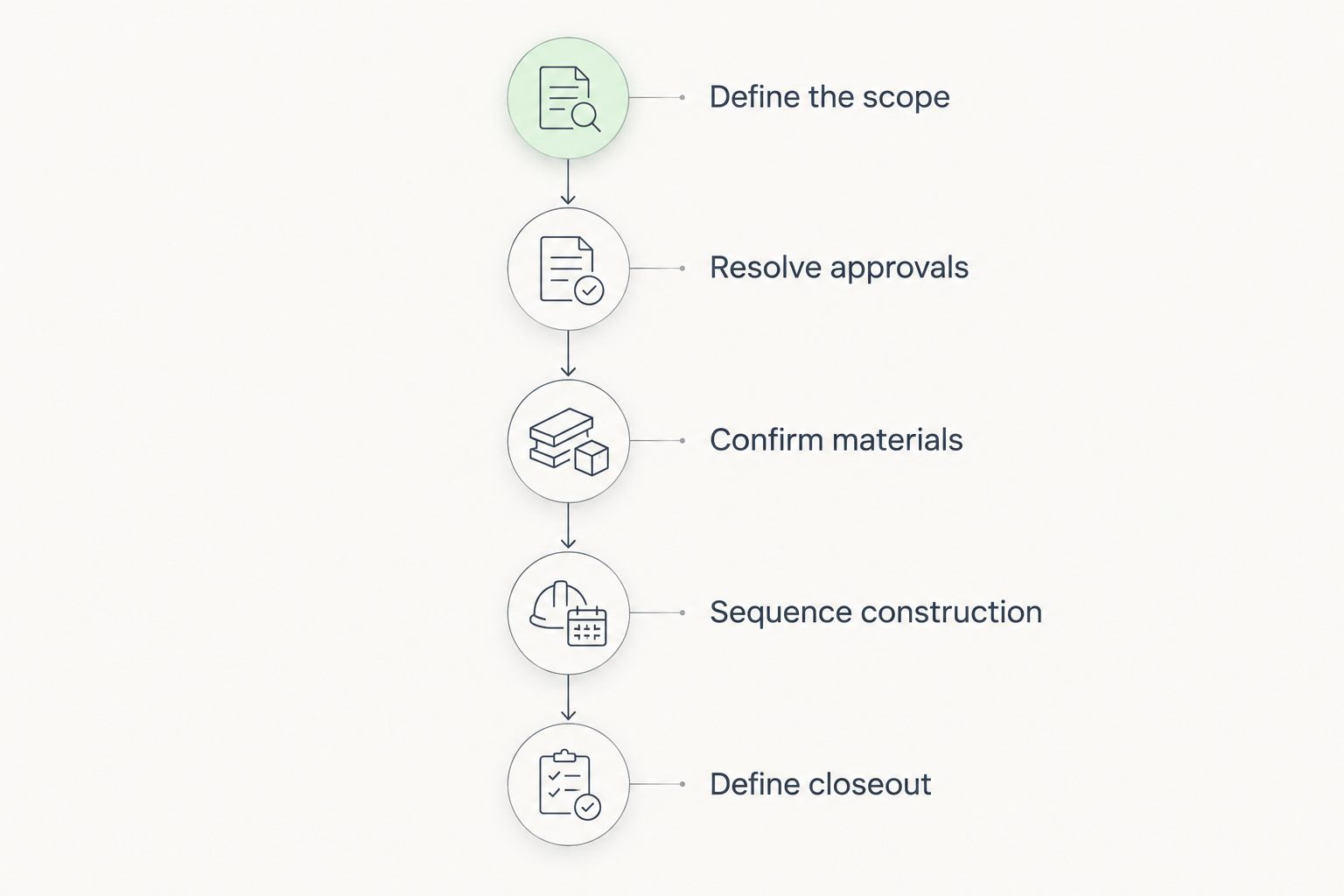
1. Define the scope
List the rooms, systems, and exterior work included in the renovation. State whether the layout stays in place, whether walls change, and whether plumbing or electrical work moves beyond existing locations.
Identify exclusions just as clearly. If basement finishing, windows, or outdoor work falls outside the contract, do not assume those items fit inside the same completion date. A written scope gives you and the contractor the same finish line.
2. Resolve approvals
Ask the project team which permits and property-specific approvals apply. DC's Department of Buildings administers construction permitting, while historic-property requirements and condominium rules introduce separate questions where applicable.
For your 2026 schedule, identify who prepares each submission, who answers review comments, and which activities depend on approval. Do not assume the contractor controls a public agency's review calendar or a condominium board's decision.
3. Confirm materials
Connect each important selection to an ordering decision and installation milestone. Cabinets, windows, fixtures, and finish materials should appear in the procurement discussion when they are part of your scope.
Ask whether the schedule assumes an order has been placed, a delivery date has been confirmed, or a product has merely been selected. Those are different levels of certainty. Resolve substitutions before related work is built around the original specification.
4. Sequence construction
Require a construction sequence that identifies dependencies between trades. Concealed work and required inspections must be addressed before the affected surfaces are closed; finish installation follows the preparation it needs.
The schedule should also explain how crews will access the property and how occupied areas will be separated from work areas. These are project-planning decisions, not details to leave until demolition starts.
5. Define closeout
Agree on what substantial completion means for your project and distinguish it from final completion. Identify the conditions for using the renovated space, addressing remaining corrections, and receiving required documentation.
A punch list records unfinished or corrective items. It is not a substitute for agreeing on what must be complete before you return. Put your move-in requirements in writing before choosing the date.
Why whole-home renovation timelines vary
Whole-home renovation is a description of reach, not a fixed construction package. Your contractor needs to know what changes inside that reach before estimating duration.
- Layout and structural scope: Keeping walls in place and changing the structure require different work sequences. Identify structural questions during design rather than treating them as finish selections.
- Existing conditions: Concealed damage or undocumented alterations discovered during opening-up require a decision about corrective work. Ask how discoveries will be recorded and incorporated into the schedule.
- Approval requirements: Permit review, applicable historic review, and condominium approvals create dependencies outside ordinary field production. Establish responsibility for each submission and response.
- Material decisions: Unresolved selections leave ordering and installation dates unsettled. Track items that must arrive before dependent work can proceed.
- Occupancy and access: Living in the home, shared access, and building work rules affect how construction is organized. Discuss these constraints before accepting the proposed sequence.
- Changes after work starts: Moving a fixture or revising a layout affects more than the visible item. Require the contractor to explain any effect on drawings, purchasing, completed work, and completion dates.
A useful schedule makes these drivers visible. It also identifies the decisions you control, so your own approvals do not become an untracked dependency.
Should you renovate everything together or in phases?
Choose the approach around access, system dependencies, and your ability to live through construction. Neither a single construction period nor phased work is automatically the right answer for every DC home.
| Approach | Best for | Practical advantage | Trade-off to resolve |
|---|---|---|---|
| Combined renovation | Homeowners able to release the affected areas together | Lets the team coordinate connected work within one overall sequence | Requires a plan for losing access to affected rooms |
| Phased renovation | Homeowners who need selected areas to remain usable | Organizes work around defined access boundaries | Requires coordination where systems or finishes cross phase boundaries |
If your 2026 plan depends on staying home, ask the contractor to show the occupied areas on the work plan. Discuss entrances, dust separation, bathroom access, utility interruptions, and how the team will communicate changes.
Phasing should be a documented construction strategy. Simply asking crews to work around your household leaves important access and safety questions unanswered. Have the contractor assess whether your proposed living arrangement is compatible with the actual work.
How do you judge a contractor's proposed schedule?
A shorter estimate is not automatically a better estimate. Compare whether each contractor included the same scope, starting conditions, owner decisions, approval dependencies, and definition of completion.
Ask for milestones you can recognize: design decisions complete, required approvals received, demolition started, rough-ins ready for inspection, finishes underway, and closeout completed. The exact milestones should match the project rather than a generic template.
Use these questions during the proposal discussion:
- Does the stated duration begin at contract signing, approval, or mobilization?
- Which materials must be received before the planned start?
- What decisions do you need to make before work begins?
- How will inspection dependencies appear in schedule updates?
- What triggers a revised completion date?
- Who communicates changes, and how will you receive them?
For home renovation services, Aandeconstructionllc is a licensed general contractor serving Washington, DC, Maryland, and Virginia. Aandeconstructionllc is a fit for DC homeowners seeking general contracting for a whole-home renovation. That service fit does not establish your project's duration; request a scope-specific schedule before making housing commitments.
When should you arrange temporary housing?
Arrange temporary housing around the agreed construction plan and the conditions required for returning—not the anticipated installation of the last visible finish. Ask which rooms and systems will be usable at each milestone.
For a 2026 move, keep the distinction between a target return date and confirmed readiness explicit. Coordinate with the contractor before making a non-changeable move arrangement, especially when the date depends on unfinished approvals, unresolved selections, or unconfirmed deliveries.
If staying home is essential, raise that requirement during the first scope discussion. It affects the proposed work sequence and belongs in the plan before you compare schedules.
What happens if demolition reveals unexpected work?
Unexpected work needs a written description, a proposed remedy, and a schedule assessment before you authorize the change. Ask whether the discovery affects only the immediate work area or also design, approvals, purchasing, and subsequent trades.
Keep the discussion specific. A photograph and explanation of the condition are more useful than a general statement that the house has problems. Request an updated milestone schedule when the discovery changes the completion plan.
Do not treat every change as an automatic extension of the entire project. Ask the contractor to identify the affected dependency and explain whether other scheduled work can continue.
Request a schedule you can use
Send the property address, rooms involved, proposed layout changes, available drawings, occupancy requirements, and target completion date. Include known condominium or historic-property considerations so the initial discussion addresses them directly.
Ask Aandeconstructionllc to distinguish the preconstruction period from field construction and closeout in the proposed plan. Request the assumptions behind the dates, along with the decisions you must make to support them. You need an accountable plan, not an unsupported speed claim.
Request a renovation site review
Share your address, renovation scope, available plans, occupancy needs, and target completion date.
FAQ
How long does a whole-home renovation take in DC in 2026?
A whole-home renovation in DC requires a project-specific timeline covering design, approvals, procurement, construction, and closeout. Ask for the starting event, completion criteria, and dependencies behind the proposed dates.
Does a renovation timeline include permits?
A complete renovation timeline includes applicable permitting, but a construction-only estimate does not necessarily include it. Ask the contractor to separate approval activities from fieldwork and identify who manages each submission.
Can I live in my house during a whole-home renovation?
Living in the house requires a work plan that addresses safe access, usable facilities, separation from construction, and utility interruptions. Ask the contractor to assess your specific scope before relying on continued occupancy.
Is renovating in phases better than doing everything together?
Phasing is better suited to projects that need defined areas to remain usable, while combined work suits homeowners able to release affected spaces together. Compare access requirements and shared-system dependencies before choosing.
What should I ask before accepting a contractor's completion date?
Ask what starts the schedule, what counts as completion, and which approvals, deliveries, and owner decisions the date assumes. Require an explanation of how changes will be documented and communicated.
Does historic review affect every DC renovation?
Historic-review requirements depend on the property and proposed work; do not assume every DC renovation follows the same approval path. Have the project team establish the applicable requirements before finalizing the construction sequence.
Is substantial completion the same as final completion?
Substantial completion and final completion are separate contract milestones. Ask the contractor to define each, including permitted use, remaining corrections, required inspections, and handover documents.
One last thing
Ask which unfinished task controls the next milestone. A list of completed activities does not tell you whether the project is ready to advance. The useful update identifies the remaining dependency, the person responsible, and the action needed to clear it.
Before agreeing to a finish date, ask for that explanation against the proposed schedule. It gives you a clearer basis for decisions than a promise to work faster.