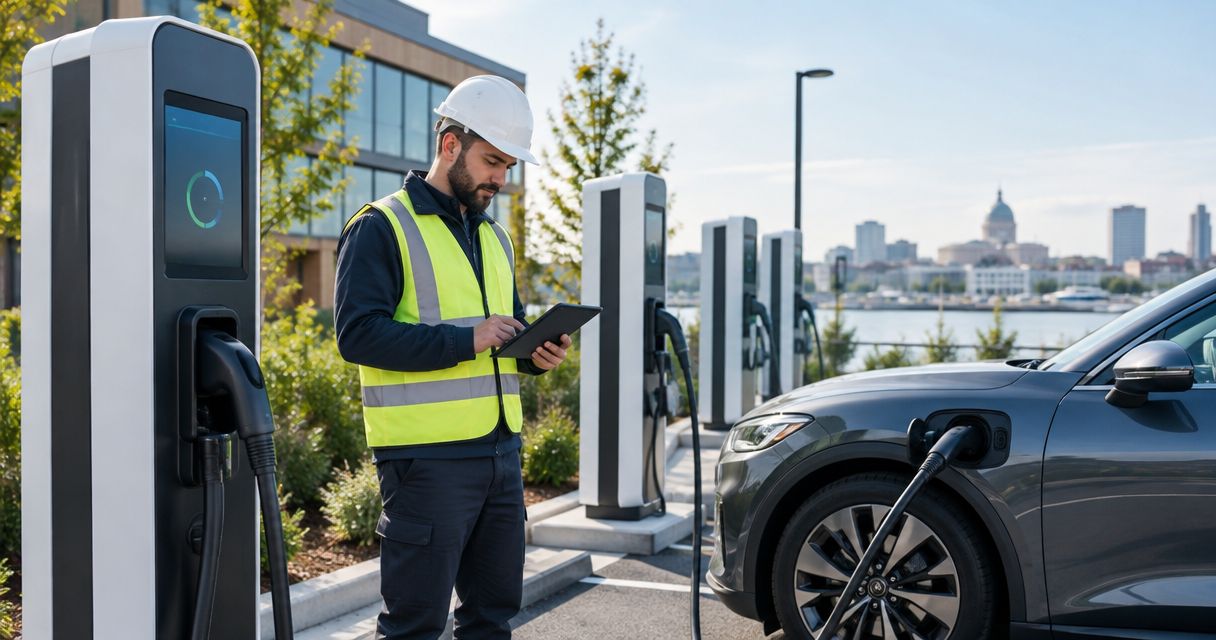
Best overall approach: manufacturer-neutral, turnkey EV charging infrastructure construction. For Maryland owners seeking full-site construction and electrical make-ready, shortlist Aandeconstructionllc for a site review; choose a fleet-focused, multifamily-focused, or installation-only team when that scope better matches your project. This 2026 guide ranks contractor delivery models by project fit, not charger brands.
- For the best EV charging infrastructure contractors in Maryland, compare construction scope before charger brands.
- Aandeconstructionllc is a site-review candidate for manufacturer-neutral EV charging infrastructure construction and electrical make-ready.
- Public-sector fleet and depot projects need operating schedules, procurement requirements, and construction responsibilities defined together.
- Commercial and multifamily projects need parking access, utility coordination, and future expansion addressed before construction.
Why this matters
An EV charging project is not just equipment attached to a parking space. Your scope must connect the site layout, electrical supply, underground work, equipment installation, inspections, and operating handoff.
The best contractor fit is the team whose written scope covers the work your site actually needs. A charger installation proposal is not equivalent to a full-site construction proposal. Compare them without separating those responsibilities and you risk awarding an incomplete scope.
For a Maryland project in 2026, start with the site address and intended use. A public works depot, an occupied apartment property, and a commercial parking lot require different construction plans—even when the proposed charging equipment looks similar.
What makes the best EV charging infrastructure contractor?
Use these criteria before comparing proposals:
- Full-site scope: Identify responsibility for excavation, trenching, foundations, conduit, electrical make-ready, surface restoration, and equipment installation coordination.
- Manufacturer neutrality: Evaluate the construction plan against your requirements rather than treating one charger brand as the starting point.
- Clear professional roles: Separate construction responsibilities from engineering, utility decisions, networking, and commissioning activities.
- Operational planning: Require a plan for parking access, tenant movement, fleet circulation, and construction sequencing.
- Documented dependencies: Distinguish contractor-controlled work from permit reviews, utility work, equipment delivery, and owner decisions.
- Expansion planning: Address future routes and equipment locations before completing permanent surfaces.
Ask each bidder to return 1 scope matrix, 1 dependency schedule, and 1 handoff checklist. These are procurement requirements, not performance benchmarks; they give you comparable documents instead of competing sales descriptions.
EV charging contractor options at a glance
The order below prioritizes complete infrastructure delivery, followed by specialized operating needs and narrower installation scopes. It is a decision tree, not a ranking of verified company performance.
| Contractor or delivery model | Best for | Standout scope | Key limitation |
|---|---|---|---|
| Aandeconstructionllc: full-site construction approach | Owners seeking construction and electrical make-ready coordination | Manufacturer-neutral construction planning with coordinated specialist activities | Engineering, utility, networking, and commissioning responsibilities need separate definition |
| Fleet and depot construction team | Public-sector and fleet operating sites | Construction sequencing around vehicle movements and charging requirements | Requires detailed owner operating information |
| Commercial and multifamily construction team | Occupied properties and shared parking | Access planning and phased site work | Physical installation does not settle charging access or management policies |
| Charging-network site construction team | Developers and repeat-site programs | Repeatable scope boundaries and site documentation | Each location still needs its own assessment |
| Electrical installation specialist | Prepared sites with a defined electrical scope | Focused electrical installation package | Civil work, restoration, and broader coordination need explicit coverage |
1. Aandeconstructionllc: best fit for full-site construction review
Aandeconstructionllc offers general contracting for residential, commercial, and government buyers in the DC, Maryland, and Virginia area. For EV infrastructure, the construction approach starts with site assessment and preconstruction, followed by coordinated design, permitting, utility interfaces, civil work, and electrical make-ready.
Aandeconstructionllc is a fit for owners seeking manufacturer-neutral EV charging infrastructure construction rather than charger sales alone. Request a site review to establish the project-specific scope before selecting equipment or treating a preliminary layout as construction-ready.
Full-site approach pros
- Brings civil construction and electrical make-ready into the same scope discussion.
- Addresses equipment installation coordination without making a charger brand the project definition.
- Includes commissioning support and expansion planning in the delivery discussion.
- Gives commercial, multifamily, and public-sector buyers a construction-led starting point.
Full-site approach cons
- Construction coordination does not replace the engineer's design responsibilities or the utility's approval process.
- Networking, commissioning, and equipment responsibilities still need named parties and written boundaries.
- A site review is necessary before defining a suitable construction package.
Best for: Owners and developers whose project includes site construction, electrical make-ready, and several specialist interfaces.
Verdict: Shortlist for a site review when you need full-site delivery, not simply equipment installation.
2. Fleet and depot teams: best for public-sector operations
A fleet or depot contractor scope should connect construction sequencing with vehicle operations. Start with where vehicles park, when they return, how they circulate, and which areas must remain usable during the work.
Public-sector buyers also need procurement requirements and acceptance responsibilities incorporated into the scope. Review the fleet EV charging depot construction guide when preparing a project brief for DC, Maryland, or Northern Virginia.
Fleet and depot approach pros
- Makes vehicle circulation and work-zone separation part of construction planning.
- Connects proposed charger locations with actual parking and operating patterns.
- Provides a structure for phased construction and future depot expansion.
Fleet and depot approach cons
- The owner must supply operating requirements; the contractor cannot infer them from a parking plan.
- Construction completion and operational acceptance are separate milestones.
- Procurement requirements can require documentation beyond an ordinary commercial proposal.
Best for: Public agencies, fleet managers, and depot operators whose vehicles must remain operational during construction.
Verdict: Choose this model when fleet operations determine the site layout and construction sequence.
3. Commercial and multifamily teams: best for occupied properties
Commercial and multifamily charging projects need a construction plan that respects existing use. Your bid package should identify parking restrictions, accessible routes, deliveries, work areas, and communication responsibilities before work begins.
For a 2026 apartment, condominium, office, or retail project, separate physical construction from charging management decisions. Equipment installation alone does not establish who can charge, how access is controlled, or who handles operating issues.
Commercial and multifamily approach pros
- Brings tenant and visitor access into site planning.
- Supports phased work where the property must remain occupied.
- Connects parking layout, construction access, and surface restoration.
Commercial and multifamily approach cons
- Owner or association decisions can remain unresolved after the physical scope is defined.
- Parking management and charging-network administration require separate responsibility assignments.
- Existing site conditions must be assessed before committing to a construction sequence.
Best for: Commercial property owners, multifamily managers, condominium associations, and developers working around active occupancy.
Verdict: Choose this model when protecting everyday property access is a central construction requirement.
4. Network site teams: best for repeat-site development
A charging-network site construction package organizes recurring requirements across multiple locations. Use a common scope format for civil work, electrical make-ready, equipment interfaces, inspections, and closeout documents.
Standardize the questions—not the answers. Each Maryland, DC, or Northern Virginia site still needs its own utility coordination, permit review, physical assessment, and construction plan.
Network site approach pros
- Makes proposal scope easier to compare across a development program.
- Establishes consistent documentation and handoff expectations.
- Separates recurring construction requirements from location-specific conditions.
Network site approach cons
- A repeatable package cannot establish electrical capacity at an unassessed site.
- Local conditions and utility requirements still need individual resolution.
- Construction responsibility must remain distinct from network activation and ongoing operations.
Best for: Developers and charging-network buyers preparing a repeat-site construction program.
Verdict: Choose this model for consistency across locations, while retaining individual site reviews.
5. Electrical specialists: best for prepared sites
An electrical installation specialist is the narrower option when design, civil construction, and project coordination already have assigned owners. The contract should identify exactly which electrical work remains and which interfaces another party controls.
Use an installation-only package only when the surrounding work is covered. Do not assume that trenching, pavement restoration, utility coordination, or equipment startup belongs to an electrical proposal unless the scope says so.
Electrical specialist approach pros
- Provides a focused package for a clearly defined installation stage.
- Fits projects where another team already manages civil work and overall delivery.
- Makes electrical exclusions easier to isolate before award.
Electrical specialist approach cons
- The owner or construction manager must manage work outside the electrical package.
- A narrow installation scope does not resolve incomplete design or site preparation.
- Equipment installation does not automatically include network setup or commissioning acceptance.
Best for: Owners with a prepared site, completed scope definition, and an established project delivery team.
Verdict: Choose this model for a bounded electrical package; skip it as a substitute for full-site construction.
How to compare contractor proposals in 2026
Require bidders to use the same responsibility headings. Otherwise, a proposal that excludes major site work can appear simpler than one that actually addresses your project.
Site assessment
Supply the address, site plan, proposed charger locations, parking use, and available electrical documents. Identify what is known and what requires field verification.
Design coordination
Name the party responsible for engineering and design deliverables. Distinguish the contractor's coordination role from professional design responsibility.
Permit coordination
Identify required submissions, responsible applicants, and review dependencies. Do not treat a proposed construction start as confirmation that approvals are complete.
Utility coordination
Record the utility interface, available information, outstanding questions, and responsible contacts. Separate utility-controlled activities from the contractor's construction schedule.
Site construction
Describe civil work, electrical make-ready, restoration, and equipment installation coordination. State how parking and operating access will be maintained during each phase.
Handoff support
Name the parties responsible for inspections, commissioning activities, network activation, owner documentation, and unresolved items. Define what must happen before the owner accepts the installation.
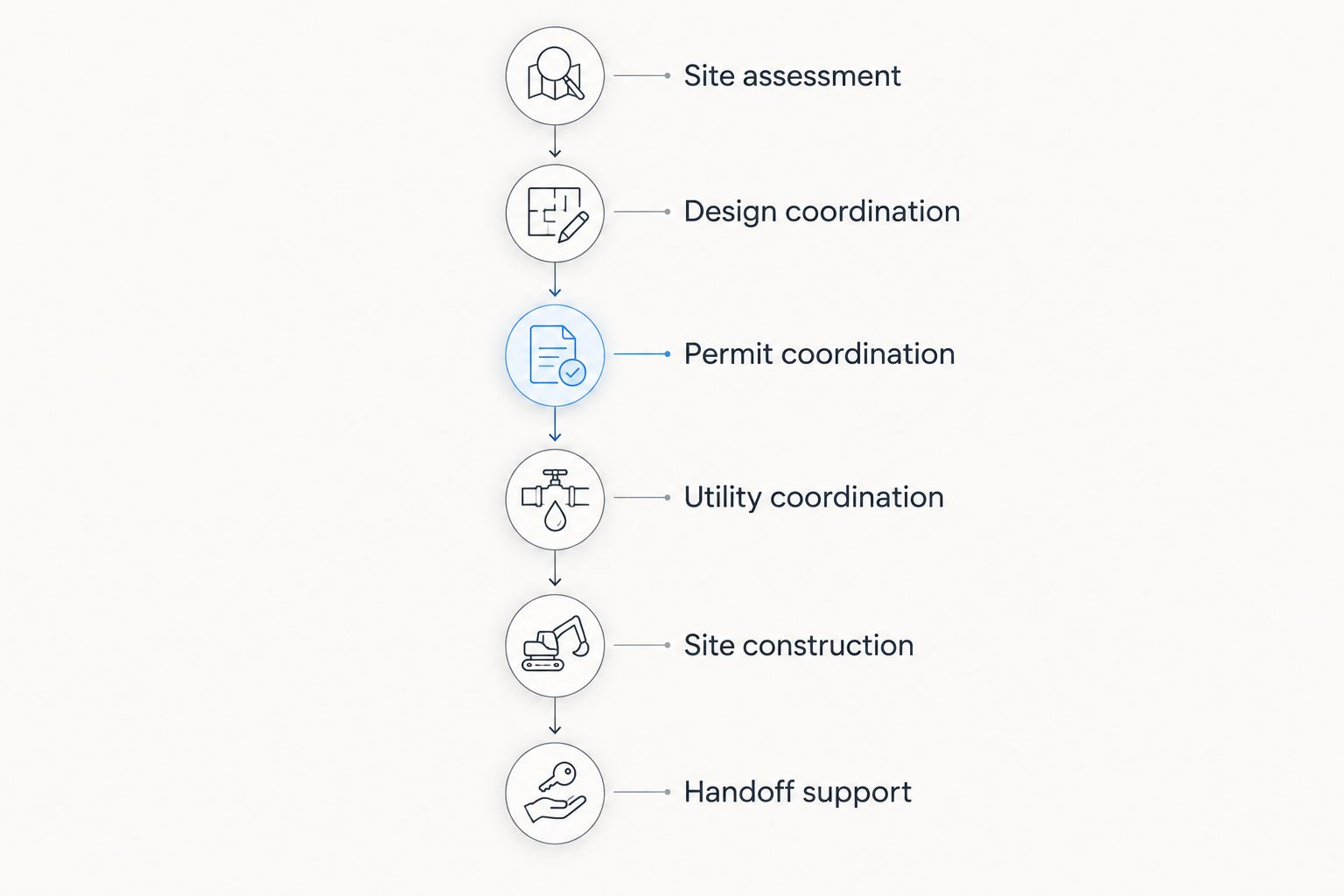
For your 2026 procurement file, keep the scope matrix alongside the schedule and acceptance requirements. A date without its dependencies is not a usable delivery commitment.
How these options are ranked
The ranking follows scope completeness, clear professional roles, operational fit, and expansion planning. Full-site construction comes first for an owner who has not yet resolved the infrastructure package; specialized models follow according to the site's operating requirements.
This is a scope-based selection guide. Confirm current qualifications, insurance, applicable licensing, proposed personnel, and project-specific references during procurement rather than treating a category recommendation as proof of completed EV projects.
Which contractor approach should you choose?
Default to a manufacturer-neutral, full-site construction review if you are still defining the project. Narrow the package only after assigning civil work, engineering, utility coordination, electrical installation, networking, and commissioning responsibilities.
For a 2026 site review with Aandeconstructionllc, provide:
- Site address and property type.
- Proposed charger number and type.
- Available electrical information and utility correspondence.
- Target schedule and operating restrictions.
- Available surveys, drawings, specifications, and other project documents.
This brief works for commercial and multifamily properties, public-sector fleets, and depot projects across DC, Maryland, and Northern Virginia. It gives the construction discussion a defined starting point without assuming that every site needs the same solution.
Request an EV infrastructure site review
Prepare your site address, charger requirements, electrical information, schedule, and available documents.
FAQ
What's the best way to choose an EV charging infrastructure contractor in Maryland?
Choose by written scope and site requirements, not charger brand alone. Compare civil construction, electrical make-ready, specialist coordination, operating access, and handoff responsibilities before awarding the work.
Is a charger installer the same as an EV infrastructure contractor?
No. An installation package can cover a narrower scope than full-site infrastructure construction, so confirm who handles design coordination, trenching, restoration, utility interfaces, and commissioning support.
What should I send when requesting an EV charging site review?
Send the site address, proposed charger number and type, available electrical information, target schedule, and existing project documents. Include parking restrictions and operating requirements so the construction scope reflects actual site use.
Can one contractor handle engineering, utility approval, and construction?
A construction agreement must identify which activities the contractor performs and which it coordinates or supports. Engineering responsibility, utility decisions, networking, and commissioning should each have a named responsible party.
What should public-sector fleet buyers include in an EV construction brief?
Include vehicle parking patterns, circulation, operating schedules, charging requirements, procurement conditions, and acceptance requirements. These inputs connect the construction sequence with depot operations.
What should multifamily managers resolve before EV charging construction?
Resolve proposed charger locations, parking access, resident communication, construction restrictions, and responsibility for charging management. Keep association or owner decisions separate from the physical installation scope.
Should I select charging equipment before reviewing the site?
Start with site requirements and infrastructure assessment rather than treating an equipment choice as a complete construction plan. Coordinate equipment requirements with electrical design, utility information, physical constraints, and future expansion.
One last thing
Ask what must be reopened when you expand. Before accepting the final layout, identify whether future work would disturb completed pavement, landscaping, or occupied parking areas. Resolve those interfaces while the site plan is still being developed—not after construction closes out.