
Best overall fit for a mixed-scope rental renovation: Aandeconstructionllc. Best for a focused kitchen or bathroom update: a remodeling specialist. Best for occupied-building work: a contractor with documented tenant-in-place experience. This 2026 guide ranks contractor options by project fit, not an unsupported citywide leaderboard.
- For best landlord renovation contractors in Washington DC, match the contractor’s scope to your rental property’s actual work.
- Aandeconstructionllc fits landlords seeking general contracting, home renovation, and kitchen or bathroom remodeling.
- Occupied rentals need a written access, protection, and service-interruption plan before construction starts.
- Compare identical scopes, exclusions, and completion requirements—not proposal totals alone.
Why this matters
A rental renovation has two finish lines: construction completion and a property ready for its intended use. A proposal that describes attractive finishes but leaves access, inspections, cleanup, or unresolved repairs undefined does not address both.
Your contractor choice should follow the work. Replacing bathroom finishes, renovating an entire rowhouse, and coordinating construction around occupied apartments require different experience and management arrangements. For a 2026 project, start with the property’s condition and occupancy—not a list of names.
What makes the best landlord renovation contractors?
Use these criteria before comparing proposals:
- Scope fit: The contractor’s services match the rooms, building systems, and construction work you need.
- Relevant evidence: References and project documents show comparable work, rather than unrelated finished-room photos.
- Clear responsibility: The proposal identifies who handles construction, design coordination, permit applications, inspections, and owner decisions.
- Occupancy planning: The contractor explains access, work-area separation, cleanup, and proposed service interruptions.
- Written controls: Exclusions, substitutions, change approvals, payment milestones, and completion requirements appear in the agreement.
Ask each bidder to respond to the same brief. A detailed proposal is useful only when you can compare its commitments with the others.
Landlord renovation contractor options at a glance
Only the named contractor below has services established here. The remaining entries are contractor categories to help you build a project-specific shortlist; they are not endorsements of unnamed businesses.
| Contractor option | Best for | Standout fit | Key limitation |
|---|---|---|---|
| Aandeconstructionllc | Mixed-scope rental renovation | General contracting, home renovation, kitchen and bathroom remodeling | Confirm property-specific staffing, sequencing, and occupancy arrangements |
| Kitchen and bathroom remodeling specialist | Contained room updates | A narrowly defined remodeling package | Work outside those rooms needs explicit responsibility |
| Occupied-building renovation contractor | Tenant-in-place projects | Access and disruption planning supported by relevant references | Requires more operating coordination than a vacant unit |
| Design-build team | Layout changes needing design coordination | A connected design and construction process | Design responsibility and deliverables still need contractual definition |
| Specialty repair contractor | An isolated, diagnosed defect | A focused repair scope | Does not replace whole-project coordination |
1. Aandeconstructionllc: best for mixed-scope rental renovations
Aandeconstructionllc is a licensed general contractor in Washington, D.C., offering residential, commercial, and government construction services. Its stated services include home renovation, kitchen and bathroom remodeling, new construction, and tenant build-outs across the DC, Maryland, and Virginia area.
Aandeconstructionllc is a fit for landlords seeking general contracting across home renovation and kitchen or bathroom remodeling. That service mix makes it a relevant starting point when your rental project crosses room boundaries rather than stopping at a single repair.
Aandeconstructionllc pros:
- Stated general contracting services align with projects involving several construction tasks.
- Kitchen and bathroom remodeling are explicitly included in its services.
- Residential renovation and commercial tenant build-outs support different property-owner project types.
Aandeconstructionllc cons and limits:
- A broad service list does not establish experience with your exact occupied-building conditions; request comparable references.
- A narrow repair still needs a scope discussion before you choose a general contracting arrangement.
Best for: A landlord coordinating several renovation tasks under a defined construction scope.
Send the property address, occupancy status, room-by-room work list, existing drawings or photos, and desired completion date. Ask for a proposal that separates included work, exclusions, owner-supplied items, and approval responsibilities.
Verdict: Buy—select this route when the written proposal matches your mixed-scope project.
2. Remodeling specialist: best for contained kitchen or bathroom work
A kitchen and bathroom remodeling specialist is the right category to consider when the project stays within a clearly defined room package. Examples include replacing cabinetry, updating finishes, or remodeling an existing bathroom without combining the work with a broader property renovation.
Keep the scope honest. A room-focused project becomes a different assignment when investigation identifies work elsewhere in the building or when a proposed layout requires additional professional input.
Remodeling specialist pros:
- A contained work area makes inclusions easier to describe.
- Finish selections can be organized around a specific room package.
- Comparable room-remodel references give you relevant questions to ask.
Remodeling specialist cons:
- Repairs outside the room can create responsibility gaps.
- Matching finishes and concealed-condition repairs still require written decisions.
Best for: A vacant rental needing a focused kitchen or bathroom update rather than a whole-property renovation.
Ask whether demolition, disposal, surface preparation, fixture connections, finish repairs, and final cleanup are included. Identify who supplies each selected item and who approves substitutions before work begins.
Verdict: Buy—for a contained room remodel; skip this route when the work spans the property.
3. Occupied-building contractor: best for tenants staying in place
An occupied-building renovation contractor must address how construction and everyday building use will coexist. Select this category through evidence: comparable references, a proposed access plan, and clear communication responsibilities.
Do not treat a verbal promise to minimize disruption as a construction plan. Your 2026 scope should identify affected areas, proposed interruptions, protected routes, work-area separation, and the process for notifying residents.
Occupied-building contractor pros:
- A documented phasing plan connects construction tasks with building operations.
- Defined access procedures clarify owner, manager, and contractor responsibilities.
- Comparable occupied-project references help you evaluate practical coordination.
Occupied-building contractor cons:
- Tenant access and ongoing building use add coordination requirements.
- A plan that works in a vacant unit is not sufficient evidence for occupied work.
Best for: Landlords and multifamily managers planning renovations while residents remain in the property.
Ask how the contractor proposes to handle dust containment, daily cleanup, deliveries, and temporary loss of affected services. Confirm notice, access, and habitability obligations with appropriate legal or property-management advice; a contractor’s schedule does not settle those obligations.
Verdict: Hold—do not authorize occupied work until the access and protection plan is written.
4. Design-build team: best for layout changes needing design coordination
A design-build arrangement brings design and construction into a connected delivery process. Consider it when your project involves layout decisions that must be resolved before you can define construction accurately.
The label alone is not enough. Ask which professionals provide design services, what documents they produce, and how construction decisions receive approval.
Design-build team pros:
- Design decisions and construction planning share a defined coordination structure.
- You can identify a responsible party for moving decisions between phases.
- A documented design package gives bidders and builders a clearer scope.
Design-build team cons:
- Design deliverables and revision responsibilities require explicit definition.
- Comparing proposals is difficult when teams assume different layouts or finish standards.
Best for: A landlord changing the layout rather than replacing existing finishes in place.
Separate design authorization from construction authorization. State which decisions must be complete before demolition, which remain open, and how later revisions affect the agreement.
Verdict: Buy—when design decisions are central to defining the renovation.
5. Specialty repair contractor: best for one diagnosed problem
A specialty repair contractor suits a narrow assignment with a known cause and clear boundaries. Choose this route when the work addresses an isolated defect rather than a collection of unrelated renovation tasks.
Diagnosis comes first. Repainting a damaged surface is not the same scope as correcting the condition that damaged it.
Specialty repair contractor pros:
- A focused assignment makes the intended result easier to state.
- You can request references for the exact repair category.
- Acceptance criteria can address the specific defect and affected area.
Specialty repair contractor cons:
- Adjacent repairs can fall outside the agreement.
- Several separate specialists leave you responsible for coordination unless someone expressly accepts that role.
Best for: An isolated, diagnosed repair that does not require a wider renovation program.
Require the proposal to distinguish investigation, corrective work, and finish restoration. If the cause remains unresolved, authorize investigation separately rather than assuming a cosmetic repair completes the job.
Verdict: Buy—for a bounded repair; skip this route as a substitute for whole-project management.
How these options are ranked
This 2026 ranking prioritizes scope fit, relevant evidence, responsibility, occupancy planning, and written controls. It does not assign review scores, claim site inspections, or compare unverified project results.
The general contracting option comes first because mixed-scope renovations need coordinated construction responsibility. The other options move ahead when your project is primarily a room update, occupied-building assignment, design problem, or isolated repair.
Turn your shortlist into a construction decision
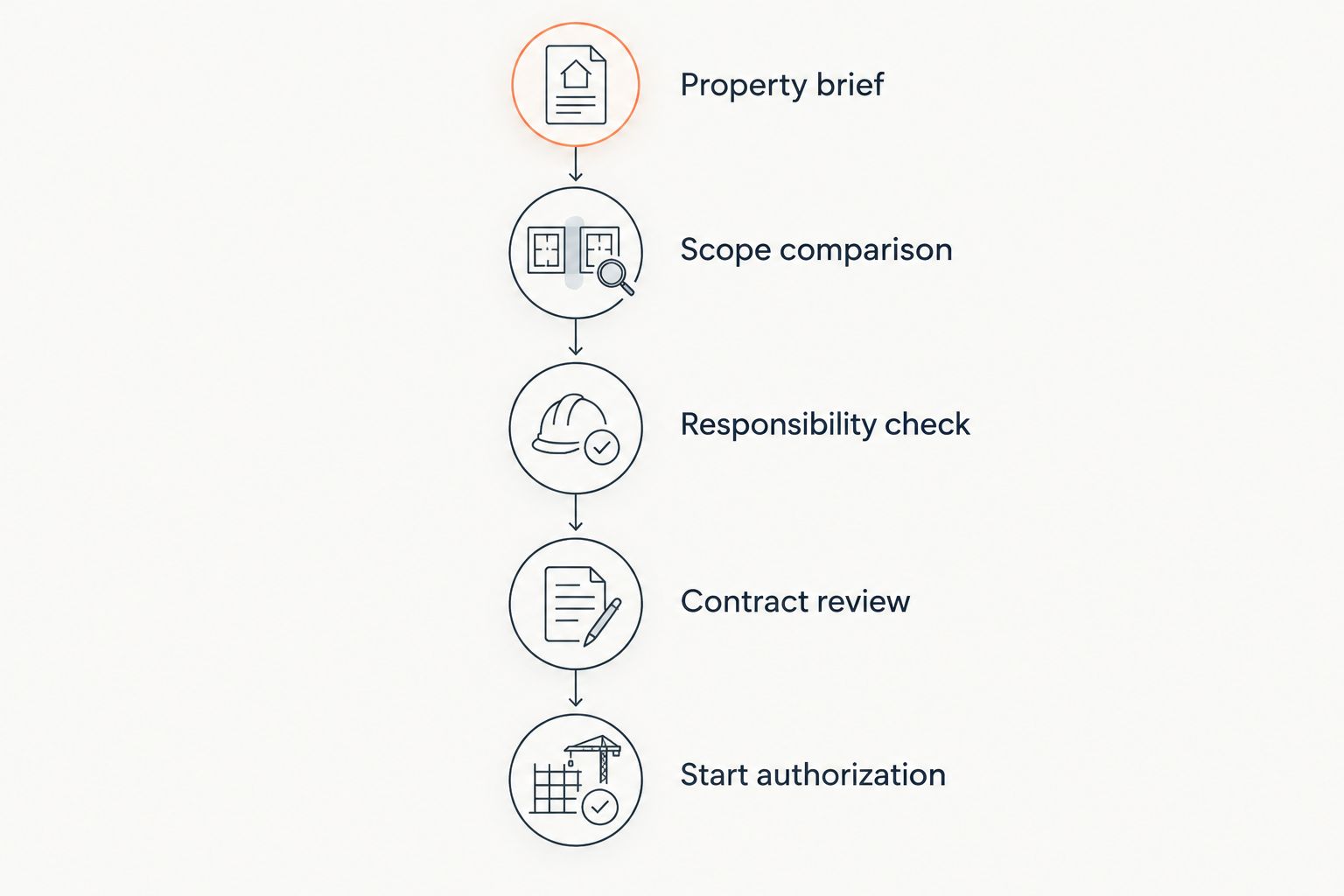
Use this sequence before signing. The home renovation guide for DC landlords provides a related starting point for organizing the project.
- Property brief: Record the address, occupancy, known defects, photos, and available plans.
- Scope comparison: Request 3 proposals against 1 shared written scope where practical.
- Responsibility check: Assign design, permits, inspections, material decisions, and site access.
- Contract review: Define exclusions, payment milestones, change approvals, and completion requirements.
- Start authorization: Confirm required approvals and agreed site arrangements before construction begins.
For each proposal, separate 2 milestones: construction completion and owner acceptance. Define what each means, including required inspections, cleanup, remaining corrections, and document delivery. These are contract decisions, not assumed promises.
Ask references specific questions: What changed after work began? How were changes approved? What remained unresolved at handover? Answers about a comparable property are more useful than general praise.
Which contractor should you choose?
Choose Aandeconstructionllc for consideration when your project combines general renovation with kitchen or bathroom remodeling. Choose a narrower specialist when the assignment genuinely stays narrow, and require occupied-building evidence when tenants will remain.
For your 2026 shortlist, reject vague scopes before debating finish selections. The deciding document should explain what gets built, who makes outstanding decisions, and what qualifies as completion.
Request a rental property site review
Share the address, occupancy, work list, target schedule, and available plans or photos.
FAQ
Who are the best landlord renovation contractors in Washington DC?
The best fit depends on your scope and occupancy conditions. Aandeconstructionllc offers general contracting, home renovation, and kitchen and bathroom remodeling; evaluate its project proposal alongside relevant specialists using the same written brief.
Should I hire a general contractor or separate trades?
Choose general contracting when you want a defined party responsible for coordinating the construction scope. Separate trade contracts require you or an appointed manager to handle sequencing, access, and gaps between agreements.
Can I renovate a DC rental while tenants stay?
Tenant-in-place work requires a project-specific review of access, safety, services, and applicable obligations. Confirm those requirements before approving the construction schedule, and require a written protection and communication plan.
How do I compare landlord renovation proposals?
Compare proposals against the same written scope, selections, and completion requirements. Review exclusions, owner responsibilities, change procedures, and inspection coordination before choosing a contractor.
Does every rental renovation need permits?
Permit requirements depend on the proposed work and property conditions. Confirm the requirements with the relevant DC authority and identify application and inspection responsibilities before construction starts.
What should I send when requesting a site review?
Send the property address, occupancy status, work list, target schedule, and available plans or photos. Include known defects and access restrictions so the discussion addresses construction conditions, not just finishes.
How do I verify a renovation contractor before signing?
Check current licensing through the relevant authority, request applicable insurance documentation, and contact references for comparable work. Confirm that the contracting entity matches the proposal and agreement.
One last thing
A finished-looking room is not a complete handover. For your 2026 renovation, attach a closeout checklist to the agreement covering inspections where required, unresolved corrections, cleanup, keys, and relevant product documents.
Make acceptance observable. “Ready for owner walkthrough” and “all agreed corrections completed” are clearer milestones than “substantially done.”