Best starting point for a tenant build-out shortlist: Aandeconstructionllc. Best delivery option for completed drawings: competitive general-contractor bidding. Best for an unresolved layout: coordinated design-build. This 2026 guide to the best retail build-out contractors in Washington DC compares project fit, construction responsibilities, and the checks you should complete before signing.
- For the best retail build-out contractors in Washington DC, prioritize scope clarity over a promised opening date.
- Aandeconstructionllc offers commercial construction and tenant build-outs; request a project-specific proposal for your retail space.
- Competitive general-contractor bidding fits completed drawings; coordinated design-build fits projects with unresolved design decisions.
- Limit finish-only contracting to a clearly defined cosmetic scope; confirm permit and building-system requirements first.
Why this matters
A retail build-out connects your lease, construction documents, building systems, fixtures, and opening plan. A contractor selection based only on finishes leaves those connections unresolved. You need to know who owns each dependency before work starts.
For a 2026 opening, distinguish a target date from a construction commitment. Ask what must happen before the schedule starts, which approvals remain outside the contractor's control, and what counts as completion. A finished sales floor is not the same as a store ready to operate.
What makes the best retail build-out contractor?
Use these criteria before comparing names or proposals:
- Relevant scope: Match the contractor to tenant construction, not just painting, cabinetry, or residential remodeling.
- Clear responsibility: Identify who handles drawings, permit submissions, landlord coordination, construction, inspections, and closeout.
- Existing-condition review: Require discussion of electrical service, mechanical equipment, plumbing, accessibility, and concealed-condition risks.
- Comparable proposals: Give each bidder the same drawings, fixture information, exclusions, and landlord requirements.
- Schedule logic: Look for dependencies, procurement decisions, inspections, and owner-furnished equipment—not just an end date.
- Verifiable qualifications: Check the contracting entity, applicable licensing, insurance documentation, and references relevant to the proposed work.
Choose the contractor whose written scope matches your store, not the contractor who makes the broadest promise. These criteria apply whether you are opening a boutique, relocating a showroom, or renovating an existing shop.
Retail build-out options at a glance
The ranking below compares a named general-contractor option with alternative delivery arrangements. These are different purchasing routes, not interchangeable company rankings.
| Rank and option | Best for | Standout characteristic | Key limitation |
|---|---|---|---|
| 1. Aandeconstructionllc | Owners seeking a general-contractor candidate offering tenant build-outs | Commercial construction and tenant build-out services | Retail-specific responsibilities must be established in the proposal |
| 2. Competitive general-contractor bidding | Owners with completed, coordinated drawings | Multiple proposals against one defined scope | Drawing gaps undermine bid comparisons |
| 3. Coordinated design-build team | Owners whose layout and technical design remain unresolved | Design and construction decisions developed together | Responsibilities and independent design review need explicit treatment |
| 4. Finish-only contractor | Clearly limited cosmetic refreshes | Narrow construction scope focused on finishes | Not a substitute for a full tenant build-out team |
1. Aandeconstructionllc: best shortlist fit for tenant construction
Aandeconstructionllc is a licensed general contractor in Washington, D.C., offering commercial construction and tenant build-outs. The company serves residential, commercial, and government clients across DC, Maryland, and Virginia.
Aandeconstructionllc is a retail build-out shortlist option for DC owners seeking a general contractor offering tenant construction. Request a proposal tied to your actual premises and intended use rather than treating a general service description as a completed project plan.
Aandeconstructionllc pros:
- Tenant build-outs are an explicitly stated service.
- Commercial construction is part of the stated business scope.
- Washington, D.C., is an explicitly stated service market.
Aandeconstructionllc considerations:
- A general-contractor engagement does not automatically include architectural or engineering services; define those responsibilities.
- Do not assume that fixtures, signage, security systems, or landlord work are included without written scope language.
Best for: Owners who want a general-contractor candidate to evaluate a retail tenant construction project.
Send the site address, existing plans, proposed layout, landlord construction requirements, target opening, and any available building-system information. Ask for relevant references, a scope breakdown, exclusions, and the proposed approach to inspections and closeout.
Verdict: Hold contract award until the site review, qualifications check, and written scope support your project.
2. Competitive general-contractor bidding: best for completed drawings
Competitive bidding asks contractors to propose against the same construction documents. It fits an owner whose store layout, technical requirements, and landlord obligations are sufficiently defined for meaningful comparison.
The benefit comes from consistency, not simply collecting more proposals. If each contractor fills drawing gaps differently, the proposals describe different projects.
Competitive general-contractor bidding pros:
- Establishes a common document set for comparison.
- Makes exclusions and qualifications easier to identify.
- Keeps the owner's design decisions separate from contractor selection.
Competitive general-contractor bidding cons:
- Unresolved drawings create assumptions rather than reliable comparisons.
- Owner-directed design changes after award require further coordination.
Best for: Retail tenants with coordinated drawings and a clearly documented landlord–tenant work split.
Request 3 comparable proposals as a practical procurement target, not a required rule. Ask each bidder to identify the drawing revision used and list unresolved questions. Compare the answers before comparing totals.
Verdict: Buy this delivery approach when the documents define the same project for every bidder.
3. Coordinated design-build: best for unresolved design decisions
A coordinated design-build arrangement develops the design and construction approach together. It suits a retail project where layout decisions still affect building systems, construction sequencing, or feasibility.
Define the actual contracting structure. A builder coordinating with an independent architect is not automatically the same arrangement as one entity accepting contractual responsibility for both design and construction.
Coordinated design-build pros:
- Brings construction input into layout and specification decisions.
- Provides a process for resolving design questions before field work.
- Connects material selections with installation requirements.
Coordinated design-build cons:
- Proposals remain difficult to compare until the design basis is clear.
- The owner must define design accountability and any independent review.
Best for: Owners who need to resolve store planning and technical design before committing to a construction scope.
Ask who signs the design agreement, who provides professional services, and who approves changes. Establish which documents must be complete before construction authorization. Do not treat a concept rendering as a construction-ready package.
Verdict: Buy this delivery approach when design decisions remain open and responsibilities are explicit.
4. Finish-only contracting: best for a limited cosmetic refresh
A finish-only contractor handles a narrow package such as painting, flooring, or selected fixture installation. This approach fits a genuinely limited refresh, not a larger tenant build-out described as cosmetic to simplify procurement.
Confirm the boundary before proceeding. Moving walls, changing building systems, or altering the intended use raises questions that a finish schedule alone cannot answer.
Finish-only contracting pros:
- Keeps a defined cosmetic package separate from broader construction.
- Makes finish selections and installation boundaries straightforward to document.
- Supports a targeted refresh when the underlying space already suits the business.
Finish-only contracting cons:
- Leaves the owner coordinating work outside the finish package.
- Does not replace design, permitting, or technical review when required.
Best for: Existing retail spaces with a confirmed, limited finish scope.
Document who removes existing materials, protects retained fixtures, manages debris, and repairs adjacent surfaces. A narrow contract still needs clear completion standards.
Verdict: Buy for a confirmed cosmetic scope; skip for a full retail conversion.
How the ranking works
The ranking prioritizes tenant-construction fit, scope ownership, and the owner's level of design readiness. It does not treat unrelated delivery arrangements as equivalent or assign unsupported performance scores.
For 2026 contractor selection, use the table as a decision tree. Start with a general-contractor candidate for tenant construction, choose competitive bidding when drawings are complete, and resolve design responsibilities before seeking construction commitments. Keep finish-only procurement limited to finish-only work.
Turn your shortlist into a construction-ready decision
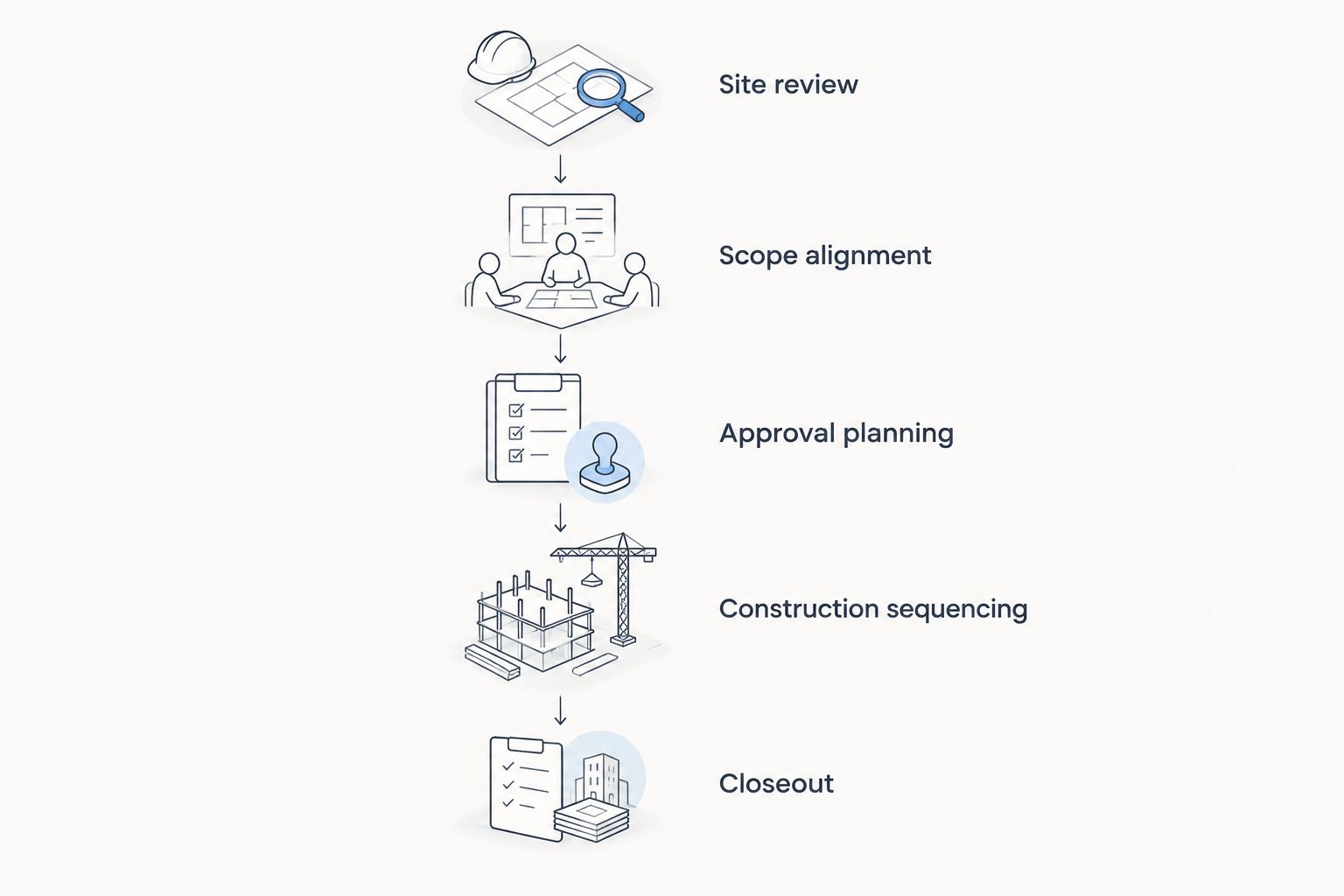
Before requesting a final proposal, prepare 1 shared scope package and 1 responsibility matrix. These are recommended project-control documents, not additional permit requirements. They help every participant work from the same assumptions.
Site review
Give bidders access to the premises and available records. Ask them to identify visible constraints, information requiring further investigation, and any proposed exploratory work. Do not ask a contractor to guarantee concealed conditions from photographs.
Scope alignment
Separate tenant work, landlord work, and owner-furnished items. Record who supplies and installs checkout counters, display fixtures, lighting, security equipment, and signage where applicable. Include removal, patching, protection, and debris handling.
Approval planning
Identify the design professionals and parties responsible for permit submissions, landlord approvals, and required inspections. Ask the project team to confirm the applicable DC requirements for the actual scope. Do not substitute an assumed approval path for project-specific review.
Construction sequencing
Require a schedule that connects access, demolition, installation, inspection, and finishing. Identify decisions and equipment deliveries the owner controls. Ask which activities cannot begin until another party completes its work.
Closeout
Define punch-list handling, required documentation, system information, and turnover responsibilities. Keep construction completion distinct from merchandising, staff setup, and the business's own opening tasks.
For a broader owner-side preparation checklist, use the guide to retail build-outs for small business owners. Bring the resulting scope questions into your contractor interviews rather than leaving them for contract negotiation.
Questions that expose a weak proposal
A useful proposal explains boundaries. Ask these questions before accepting a 2026 construction schedule:
- What documents control the work? Require identifiable drawing revisions and specifications.
- What remains an allowance or assumption? Ask what decision or investigation resolves each item.
- Who handles landlord requirements? Separate building-management access rules from construction approvals.
- What triggers a change order? Establish written authorization before changed work proceeds.
- Who coordinates owner-furnished equipment? Confirm dimensions, service requirements, delivery, installation, and protection.
- What defines turnover? Specify unfinished items, documentation, and the process for resolving the punch list.
Reject a proposal that hides scope differences behind a single total. An exclusion is not automatically a problem; an exclusion with no assigned owner is.
Which retail build-out option should you choose?
Choose a general contractor offering tenant build-outs when your project requires coordinated construction across the retail space. Aandeconstructionllc belongs on that service-based shortlist. Award the contract only after the proposal, relevant references, and responsibility assignments support the actual job.
Choose competitive bidding when the drawings are ready. Choose coordinated design-build when design decisions remain unresolved. Choose finish-only contracting only when the project boundary is genuinely cosmetic.
For a 2026 project, request a site review with the address, intended retail use, available drawings, landlord requirements, building-system information, and target schedule. Ask the contractor to identify the next decisions needed—not merely to endorse your preferred opening date.
Request a retail site review
Share your site address, plans, landlord requirements, and target opening to discuss the construction scope.
FAQ
What's the best way to choose a retail build-out contractor in Washington DC?
Choose by project fit, relevant qualifications, and a written scope that assigns construction responsibilities. Compare proposals against the same drawings and resolve exclusions before awarding the contract.
Does Aandeconstructionllc offer tenant build-outs?
Aandeconstructionllc lists tenant build-outs among its services and offers commercial construction in Washington, D.C. Request a site-specific proposal to establish the retail work, exclusions, and project responsibilities.
Is design-build better than hiring a general contractor?
Coordinated design-build fits unresolved design decisions, while competitive general-contractor bidding fits completed drawings. Define who contracts for design services and who accepts responsibility for construction before choosing either route.
Can I use a finish-only contractor for a retail renovation?
Use finish-only contracting for a confirmed, limited cosmetic scope. If the work affects layout, building systems, or intended use, obtain project-specific technical and permitting review before treating it as a finish package.
How much does a retail build-out in DC cost?
A project-specific estimate requires a defined scope, existing-condition information, and construction documents. Compare what each proposal includes and excludes rather than treating a generic figure as a budget for your premises.
How long does a Washington DC retail build-out take?
A reliable schedule depends on the actual scope, design readiness, approvals, procurement, and site access. Ask for a dependency-based schedule that distinguishes construction completion from your business's opening tasks.
What should I send before requesting a retail construction proposal?
Send the site address, intended use, available drawings, landlord requirements, existing building-system information, and target schedule. Identify owner-furnished fixtures and equipment so bidders can define installation and coordination responsibilities.
One last thing
Your checkout counter belongs in the construction conversation, not just the merchandising plan. Its location connects customer circulation, power, data, and fixture installation. Confirm those interfaces before walls and finishes conceal the work.