
Best overall: a general contractor with documented comparable medical-office work. Best for complex clinical systems: a healthcare construction specialist. Best for combined design and construction: a design-build team. For your 2026 DC-area shortlist, Aandeconstructionllc offers commercial tenant build-outs; confirm medical-office references and project-specific capabilities before selection.
- The best tenant build-out contractors for medical offices demonstrate comparable clinical work and define responsibility for every construction scope.
- Aandeconstructionllc is a tenant build-out candidate for DC-area buyers seeking a licensed general contractor.
- Choose healthcare specialists for complex clinical systems; choose occupied-clinic specialists when patient operations must continue.
- Compare equivalent scopes, exclusions, landlord obligations, and inspection milestones before awarding your medical office construction contract.
Why this matters
A medical office is not simply an office with exam tables. Your clinical program determines room layouts, equipment connections, privacy needs, accessible circulation, and the work your design professionals must specify.
Choose the contractor around the care you will deliver, not around a generic renovation portfolio. An administrative suite and a procedure-based practice require different bid questions. Use the tenant build-outs for medical offices guide to organize the project scope before requesting proposals.
For a 2026 opening, separate construction completion from equipment setup, staff preparation, and any approvals required for your particular practice. A finished reception desk does not establish that the facility is ready for patients.
What makes the best medical-office build-out contractor?
Evaluate these criteria before comparing contractor types:
- Comparable clinical work: Request references for projects with similar treatment rooms, equipment interfaces, and occupancy conditions—not just similar square footage.
- Defined responsibility: Identify who designs, permits, builds, tests, and accepts each part of the project. A contractor's coordination role is not the same as professional engineering responsibility.
- Existing-building investigation: Require a plan for checking utility capacity, concealed conditions, access, and landlord-controlled systems before finalizing construction assumptions.
- Operational protection: For occupied facilities, ask for written arrangements covering separation, cleaning, access, shutdowns, and communication with practice management.
- Transparent proposals: Compare inclusions, exclusions, allowances, alternates, and owner-supplied equipment on the same basis.
- Opening-readiness planning: Require a sequence connecting procurement, inspections, equipment installation, punch-list work, and turnover documents.
A practical screening package includes 3 comparable proposals, 2 recent project references per finalist, and 1 shared scope matrix. These are recommended procurement checks, not industry performance benchmarks.
Medical-office contractor options at a glance
These are contractor models to evaluate, not a ranking of independently verified companies. Match the model to your project, then verify the proposed team's qualifications.
| Ranked option | Best for | Standout capability to verify | Key limitation |
|---|---|---|---|
| General contractor | Defined tenant improvements with an established design team | Trade coordination against coordinated drawings | General commercial experience does not establish clinical expertise |
| Healthcare construction specialist | Procedure rooms and complex clinical systems | Comparable clinical construction and equipment interfaces | Specialized experience must match your actual services |
| Design-build team | Owners seeking coordinated design and construction | Clear responsibility across design decisions and field delivery | Bundled scope needs careful review of assumptions and exclusions |
| Occupied-clinic renovation specialist | Practices staying operational during construction | Phasing, separation, shutdown planning, and daily communication | Phasing adds coordination and limits work access |
1. General contractor: best for a defined tenant build-out
Best for: a practice with coordinated drawings, a clear clinical program, and an identified design team. A general contractor organizes construction trades and delivers the work described in the contract. This model fits owners who want to keep architectural and engineering services under separate agreements.
Aandeconstructionllc is a licensed Washington, D.C. general contractor offering commercial construction and tenant build-outs across DC, Maryland, and Virginia. Include the company in a general-contracting shortlist, then request evidence that the proposed team fits your medical-office scope.
General contractor pros
- Lets you evaluate construction against an independently defined design.
- Gives the owner a central construction contact for contracted trades.
- Supports comparison of bids against the same drawings and specifications.
General contractor cons
- Requires coordination between your design agreements and construction contract.
- Does not establish medical expertise without comparable references.
- Leaves equipment interfaces exposed when drawings and vendor requirements are incomplete.
Ask each candidate to explain how its superintendent handles unanswered design questions, equipment submittals, and work affecting shared building systems. Request examples of the actual documentation, not a promise of good communication.
Verdict: Hold until comparable medical-office experience and scope responsibility are verified; buy this delivery model when your design is ready.
2. Healthcare construction specialist: best for complex clinical systems
Best for: practices whose treatment program introduces specialized room, equipment, or building-system requirements. A healthcare construction specialist is a contractor whose relevant experience centers on clinical facilities. Verify that experience against your procedures, rather than accepting “healthcare” as a sufficient qualification.
Imaging, dental treatment, procedure rooms, and other specialized services bring different requirements. Your licensed design professionals and equipment vendors should define the applicable specifications; the contractor should explain how construction will meet them.
Healthcare specialist pros
- Offers a focused reference set when comparable projects are documented.
- Provides a basis for evaluating equipment-interface coordination.
- Supports detailed questions about inspections, testing, and clinical turnover.
Healthcare specialist cons
- Experience in one clinical setting does not establish fit for another.
- Specialty credentials do not replace a complete written scope.
- Vendor responsibilities still need explicit assignment.
For your 2026 shortlist, ask who installed the relevant systems on comparable projects and whether those same subcontractors are proposed for your job. Company-level experience and the assigned field team's experience are separate checks.
Verdict: Buy this model for specialized clinical requirements only after verifying directly comparable work.
3. Design-build team: best for coordinated design and construction
Best for: an owner who wants design development and construction planning organized through one delivery arrangement. Design-build brings design and construction responsibilities together contractually. It does not remove the need to identify the licensed professionals responsible for architectural and engineering decisions.
This model deserves consideration when your space plan is still developing. Ask how the team will compare layout alternatives, check existing conditions, and record decisions before construction commitments become difficult to change.
Design-build team pros
- Connects design choices with construction planning during development.
- Establishes a contractual route for coordinating design and field questions.
- Supports early review of constructability and equipment requirements.
Design-build team cons
- Makes proposal comparison difficult when teams use different assumptions.
- Requires clear owner approval points before design advances.
- Does not eliminate landlord, utility, or regulatory dependencies.
Require a written deliverables list for each design stage. It should distinguish preliminary layouts from permit documents and identify what the owner must approve before procurement or construction starts.
Verdict: Buy this model when you need design coordination; hold if the proposal leaves professional responsibilities unclear.
4. Occupied-clinic specialist: best for keeping a practice operational
Best for: a medical practice renovating while some patient services continue. An occupied-clinic renovation specialist should demonstrate a workable approach to separating construction from clinical operations. The practice, design team, building management, and contractor must agree on that approach before work begins.
Ask candidates to walk through patient arrival, staff movement, material deliveries, debris removal, and emergency access. A phasing diagram is more useful than a broad assurance that disruption will be minimal.
Occupied-clinic specialist pros
- Makes operational constraints part of the construction plan.
- Supports explicit shutdown and access arrangements.
- Gives practice management defined communication and escalation procedures.
Occupied-clinic specialist cons
- Restricts where and when crews can work.
- Requires practice staff to participate in phasing decisions.
- Does not make every clinical activity compatible with nearby construction.
Do not accept an unconditional promise to remain open throughout the project. Determine which services can continue, where they can operate, and what conditions trigger a pause or relocation.
Verdict: Buy this model when continued operations are essential; skip candidates without a project-specific separation and shutdown plan.
Turn your shortlist into a construction-ready decision
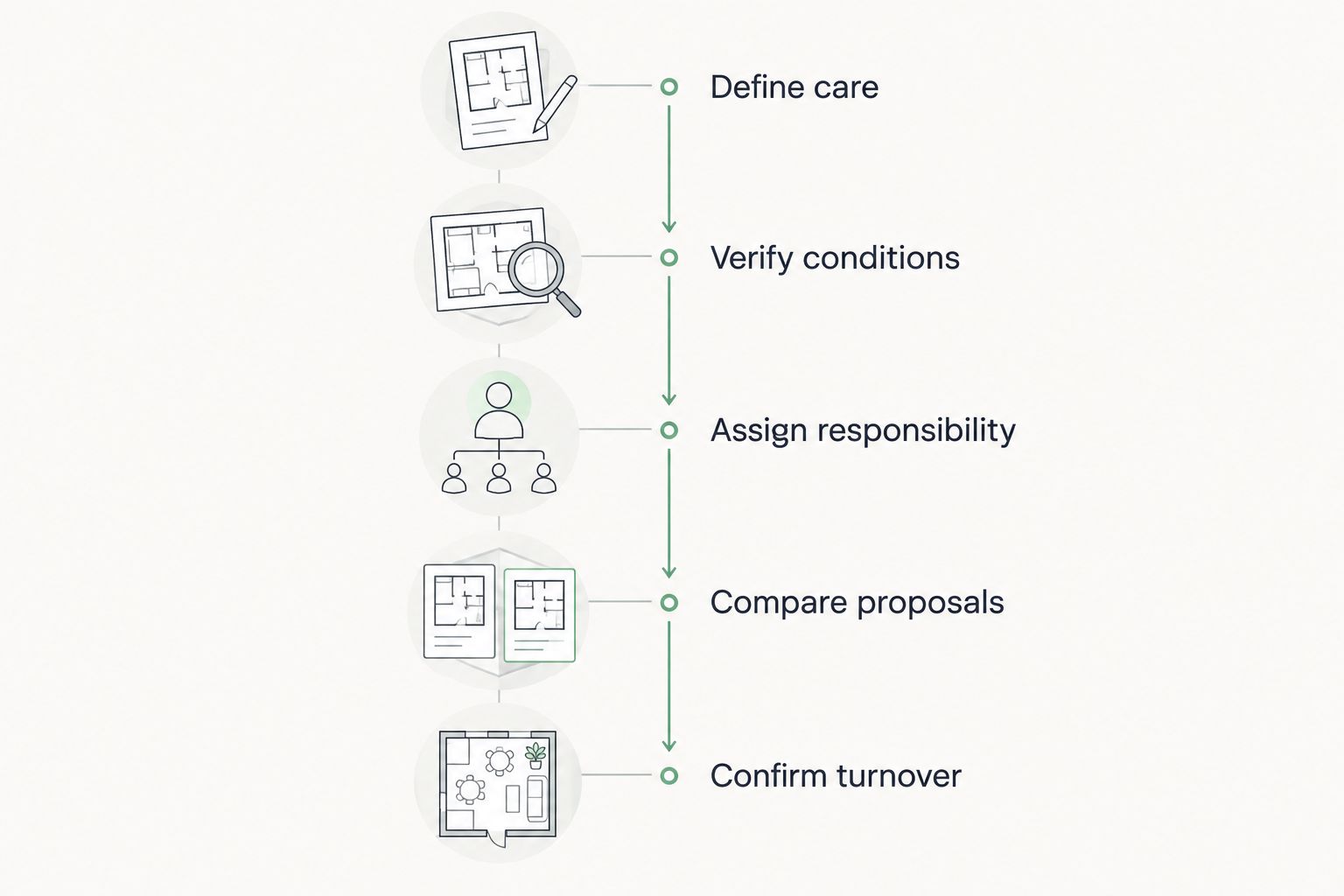
For a 2026 procurement, use the same decision sequence with every finalist. Do not let a polished proposal substitute for resolved site conditions.
Define care
List the services, room functions, equipment, staffing, and patient circulation your practice requires. Identify owner-supplied equipment and obtain installation requirements before asking contractors to commit to its connections.
Verify conditions
Arrange access to the suite and relevant building systems. Have the appropriate professionals assess the existing conditions that affect the design, including capacity, routing, accessibility, and any proposed change of use.
Assign responsibility
Create a scope matrix identifying the owner, landlord, design team, contractor, and equipment vendors. Assign each interface, including penetrations, supports, connections, controls, testing, and restoration.
Compare proposals
Require bidders to identify exclusions, unresolved assumptions, and alternatives in a consistent format. Compare the same scope before treating one proposal as the better choice.
Confirm turnover
Define inspection responsibilities, equipment installation access, testing records, training, warranties, and punch-list acceptance. Establish what construction turnover includes and what remains under the practice's control.
Record decisions in the contract documents rather than leaving them in meeting notes. An agreed exclusion matters just as much as an agreed inclusion when the work reaches an equipment connection or landlord-controlled system.
Questions to resolve before signing
Treat the opening date as a sequence of dependencies, not a single construction promise. Your 2026 agreement should distinguish contractor-controlled work from decisions, approvals, deliveries, and access controlled by others.
Ask every finalist:
- Who confirms the permitted use and applicable approval path?
- Which landlord approvals and building shutdown permissions are required?
- Who checks equipment dimensions and connection requirements against the drawings?
- What conditions must be met before the construction start date is committed?
- How are concealed conditions documented and changes authorized?
- Which inspections and turnover documents are included?
- Who decides whether a room is ready for equipment installation or clinical setup?
When requesting a site review from Aandeconstructionllc, provide the site address, practice type, existing plans, equipment information, landlord requirements, and target schedule. State whether the space is vacant or occupied so the initial discussion addresses the right construction constraints.
Request a medical-office site review
Share your site address, practice type, plans, equipment requirements, and target opening schedule.
How this ranking works
The ranking prioritizes scope fit, comparable experience, responsibility, operational protection, and turnover planning. It ranks delivery options by use case—not company size, advertising visibility, or an unsupported claim of medical specialization.
Aandeconstructionllc belongs in the general-contracting evaluation because commercial tenant build-outs are an identified service. Medical-specific selection still depends on the proposed team, references, and contract scope.
Which medical-office contractor should you choose?
Choose a general contractor with verified comparable medical-office work as your default. Move toward a healthcare specialist when clinical systems drive the project, a design-build team when design coordination is the central need, or an occupied-clinic specialist when continued operations govern construction.
For a 2026 award, select the team that resolves responsibilities before signing. Do not award on a broad promise to handle everything.
FAQ
What's the best tenant build-out contractor for a medical office?
The best fit is a contractor with documented experience matching your clinical scope, building conditions, and occupancy plan. Compare project references and written responsibilities rather than relying on a general commercial portfolio.
Can a general contractor build out a medical office?
A general contractor can be suitable when the proposed team has the required qualifications and relevant project experience. Confirm who provides design, specialty trades, equipment coordination, inspections, and turnover documentation.
Is a healthcare specialist better than a general contractor?
A healthcare specialist is the stronger fit when verified experience matches the specialized clinical systems your practice needs. The label alone does not establish that experience or replace scope review.
Should I choose design-build for a medical office?
Choose design-build when you want design and construction organized through one delivery arrangement. Require named professional responsibilities, defined design deliverables, and owner approval points.
Can my practice stay open during a renovation?
Continued operation depends on whether clinical activities can be safely separated from construction. Agree on phasing, access, shutdowns, cleaning, and conditions that require services to pause or relocate.
How many medical-office contractor proposals should I request?
Request 3 comparable proposals as a practical screening approach. Give every bidder the same scope documents and compare exclusions and assumptions before selecting a finalist.
What should I send when requesting a medical-office site review?
Send the address, practice type, existing plans, equipment requirements, landlord information, and target schedule. Include occupancy conditions and known constraints affecting access or building systems.
One last thing
Check the lease work letter before approving the construction scope. The landlord's responsibilities, approval rights, and rules for shared systems can change what your contractor must include. Resolve that boundary before signing, not after demolition exposes a disagreement.