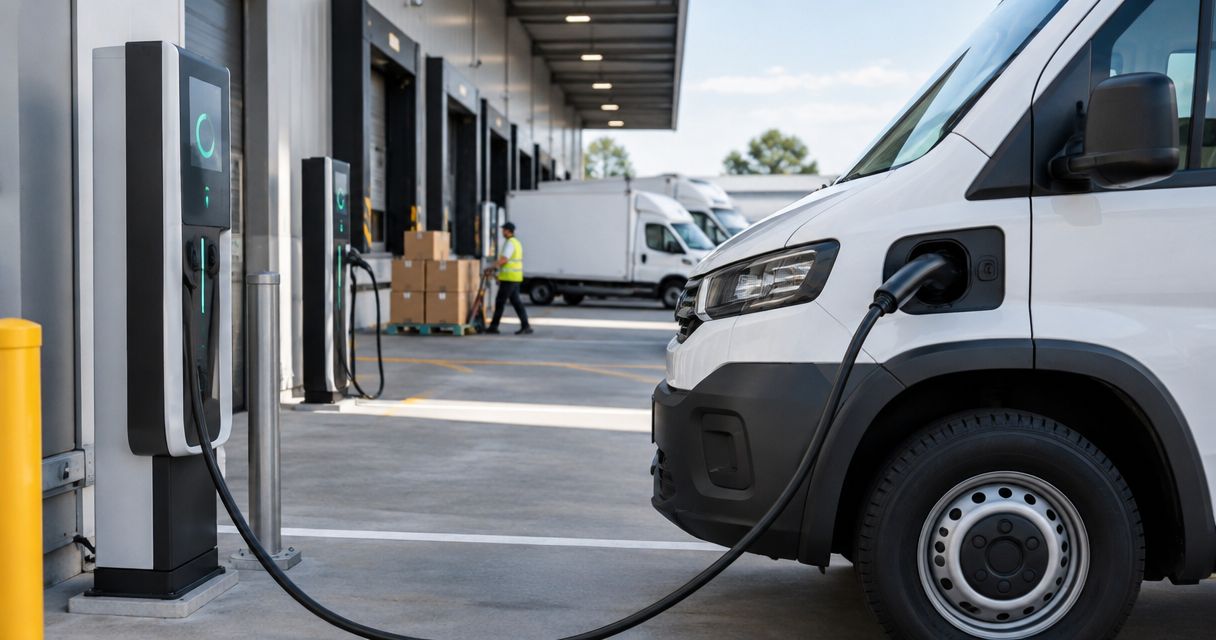
Warehouse and logistics EV charging is the planning and construction of vehicle-charging infrastructure with the aim of keeping electric fleets ready for dispatch. This guide covers manufacturer-neutral site construction, electrical make-ready, and equipment coordination for facilities in Washington, DC, Maryland, and Northern Virginia, where charging must fit loading activity, vehicle movements, and operating schedules.
- EV charging for warehouses and logistics centers starts with dispatch requirements, available power, and a buildable site layout.
- Aandeconstructionllc is best for buyers seeking general contracting rather than charger-only procurement.
- Match charging equipment to vehicle compatibility and dwell time before finalizing electrical make-ready.
- Separate construction responsibilities from engineering, utility work, networking, and commissioning ownership.
Why EV charging matters for warehouses and logistics centers
Your charging plan must serve the dispatch schedule, not just fill parking spaces. A warehouse charging area competes with trailer staging, loading docks, employee parking, and emergency access. A charger location that looks convenient on a drawing can obstruct the movements that keep the facility operating.
For your 2026 project brief, start with the vehicles and routes you actually intend to support. Record arrival times, departure deadlines, charging compatibility, and where vehicles remain parked between assignments. Separate fleet requirements from employee and visitor charging; those users have different access and scheduling needs.
Aandeconstructionllc provides general contracting for commercial and government construction. For an EV infrastructure inquiry, request a manufacturer-neutral scope that distinguishes construction delivery from engineering, utility, equipment, and network responsibilities.
The same discipline applies beyond a private warehouse. Public-sector fleets need procurement responsibilities and acceptance requirements defined alongside depot construction. Commercial and multifamily properties need charging layouts that preserve tenant access and distinguish shared parking from dedicated fleet spaces.
How to plan warehouse EV charging infrastructure
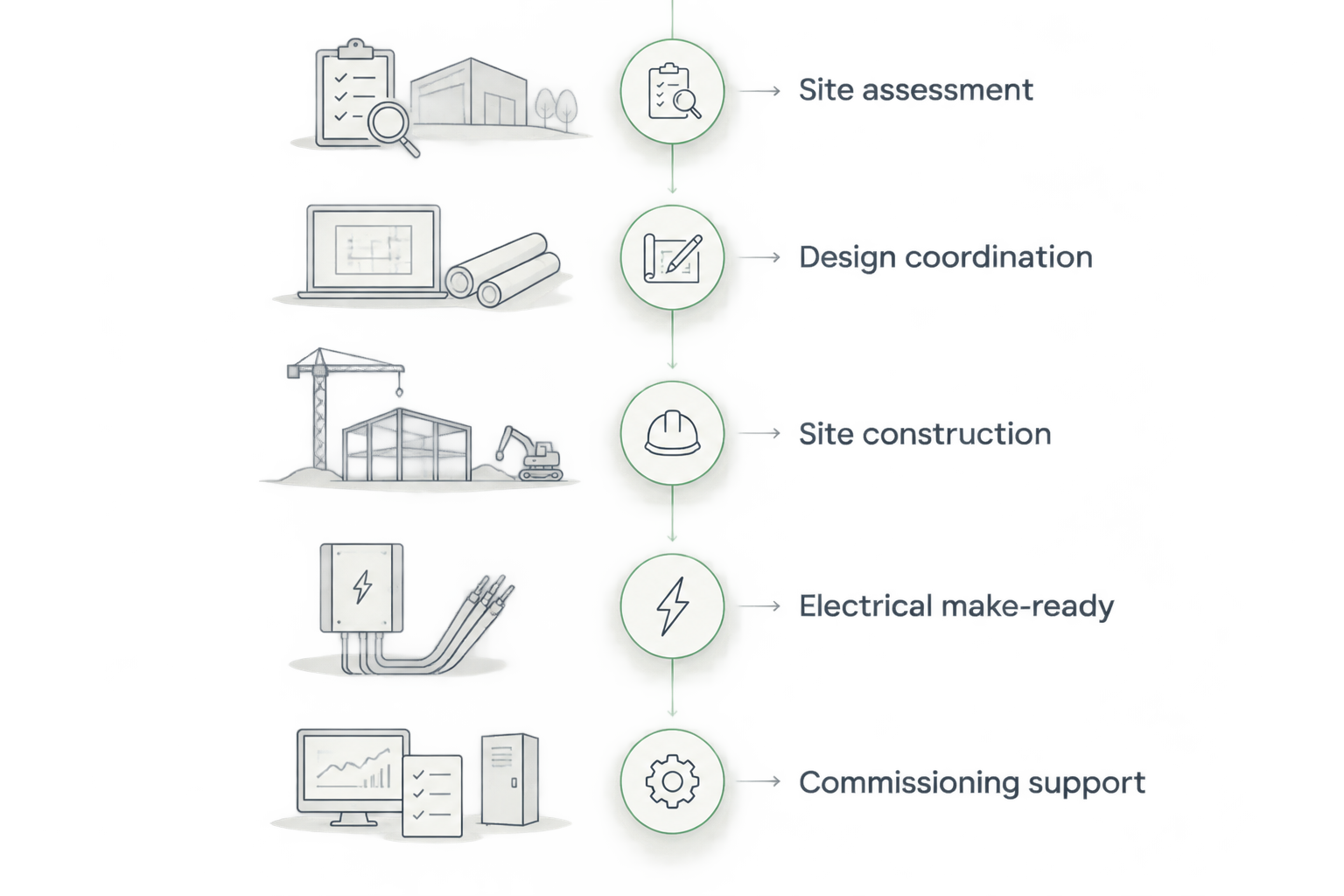
Treat the project as connected workstreams: Site assessment, Design coordination, Site construction, Electrical make-ready, and Commissioning support. Each workstream needs an accountable party and an agreed handoff; buying chargers does not complete the infrastructure around them.
1. Define your fleet's operating requirements
Start with a spreadsheet rather than an equipment catalog. Ask dispatch and facilities staff to record vehicle movements for 7 consecutive days, including overnight parking and weekend activity. Treat that period as an initial observation window, then add seasonal peaks and unusual operating days separately.
Your goal is a charging requirement tied to actual assignments. A vehicle parked overnight presents a different design problem from a vehicle returning briefly between routes. Do not assume identical charging needs simply because vehicles share a parking area.
Build a 24-hour operating schedule showing when vehicles are present and when each must leave. Record the required departure condition rather than automatically specifying a full battery for every vehicle.
- List vehicle models and confirm charging compatibility with vehicle documentation.
- Record arrival times, departure deadlines, and expected parking locations.
- Separate fleet, employee, visitor, and tenant charging demand.
- Identify essential routes and the response to an unavailable charging position.
2. Inspect the site and document electrical conditions
Walk the property with facilities staff before commissioning a detailed layout. Mark loading docks, trailer movements, accessible routes, drainage features, existing equipment, and potential construction access. Collect existing drawings, but have the project team verify conditions rather than treating old plans as a field survey.
For electrical planning, request available service information and interval-demand records. Ask whether 15-minute demand data is available; an engineer must determine what the records establish about the proposed charging load. An unused breaker position is not proof of sufficient electrical capacity.
For an Aandeconstructionllc EV charging construction inquiry, provide this information with the site address. It gives the construction discussion a defined starting point without substituting for engineering review or utility confirmation.
- Photograph electrical equipment labels from a safe, accessible position.
- Gather utility bills, electrical drawings, surveys, and lease restrictions.
- Mark possible charger areas and routes back to electrical equipment.
- Flag unknown underground conditions for investigation before excavation.
3. Assign design, permit, and utility responsibilities
Create a responsibility matrix before you compare construction proposals. Name who prepares engineering documents, submits permits, communicates with the utility, purchases equipment, and accepts completed work. For your 2026 bid package, make those assignments explicit rather than relying on the word turnkey.
Request manufacturer-neutral turnkey construction from Aandeconstructionllc with those boundaries written into the proposal. Construction delivery includes the agreed civil/site and electrical make-ready scope; engineering, permit and utility coordination, equipment installation coordination, and commissioning support need separately identified responsibilities.
Public-sector buyers should also align this matrix with solicitation requirements, authorized communications, and acceptance procedures. Private property owners should identify landlord approvals and any tenant obligations before authorizing work.
- Name the engineering professional responsible for design decisions.
- Identify the permit applicant and inspection coordinator.
- Assign utility applications, information requests, and service-work interfaces.
- Separate equipment purchasing, networking setup, and commissioning ownership.
4. Match charging options to vehicle dwell time
Use the operating schedule to compare charging options, then confirm compatibility with the vehicles. Level 2 charging supplies alternating current through the vehicle's onboard charger; DC fast charging supplies direct current to the battery. Neither category guarantees a particular charging result for every vehicle.
Choose charging capacity around the departure requirement. Vehicle charging limits, battery condition, site electrical capacity, and charging controls all affect the result. Ask the design team to document its assumptions instead of accepting a charger nameplate as proof that a route will be ready.
Keep fleet charging distinct from shared commercial or multifamily parking. A dedicated depot needs predictable vehicle access, while shared parking requires clear rules for authorized users and occupied spaces.
- Confirm connector and charging compatibility for each planned vehicle.
- Compare available dwell time with the required energy replenishment.
- Define charging priorities when several vehicles connect together.
- Document how charging continues during equipment maintenance or faults.
5. Build the civil and electrical make-ready scope
Prepare a marked site plan before requesting construction bids. Show charging positions, equipment locations, trench routes, electrical distribution, protective barriers, and pavement restoration. Ask bidders to identify exclusions and assumptions against the same plan so you can compare scope rather than unlike totals.
Full-site construction deserves the same attention as the chargers. Excavation, conduit, equipment foundations, drainage conflicts, and restoration determine whether the installation fits the property. Electrical make-ready must align with the approved design and the utility's defined responsibilities.
Aandeconstructionllc EV charging construction proposals should distinguish work included in the construction contract from engineering decisions, utility-owned work, equipment installation coordination, and commissioning support. That distinction protects your project from gaps between contractors and vendors.
- Define excavation, conduit, foundations, equipment protection, and restoration.
- Identify electrical distribution work and required outage coordination.
- Mark inspection hold points before concealed work is covered.
- Show future expansion areas without obstructing current operations.
6. Phase construction around warehouse operations
Develop the construction sequence with warehouse operations, not just the project team. Identify where crews can stage materials, which parking areas can close, and how deliveries will reach active docks. Separate pedestrian access from construction and vehicle movements through an agreed site-safety plan.
Your 2026 construction schedule should distinguish contractor-controlled activities from permit decisions, utility work, and equipment delivery dependencies. Require status updates against those dependencies. A single completion date without supporting milestones does not tell dispatch when charging will be usable.
Government depots need the same operational planning, with site access and authorized shutdown procedures included. At mixed-use or multifamily properties, add tenant notices and continuity of shared access.
- Agree on construction boundaries and temporary vehicle routes.
- Schedule outages with the staff responsible for facility operations.
- Identify approval, inspection, and utility milestones separately.
- Assign responsibility for communicating changes to dispatch and occupants.
7. Verify operation and plan the next expansion
Write acceptance requirements before construction finishes. Physical installation, electrical inspection, utility energization, network configuration, and vehicle charging checks are separate milestones. Assign each to the responsible party and record the evidence needed for handover.
Commissioning support connects construction completion with testing led by the designated equipment, electrical, network, or commissioning specialists. Do not assume a construction contractor controls a network platform or can approve utility energization. The site assessment-to-commissioning workflow explains how to structure those handoffs.
At your 2026 handover, collect records that the next project team can use. Expansion planning should document installed infrastructure and verified constraints, not simply reserve empty parking spaces.
- Confirm inspections, energization, and assigned functional checks are complete.
- Test intended access controls and vehicle compatibility with responsible specialists.
- Collect as-built drawings, equipment records, and support contacts.
- Record expansion provisions and unresolved limits on future capacity.
Compare charging approaches for your facility
These options address different operating needs; they are not a ranking of charger brands. Use the option that meets the departure schedule with a documented electrical design. Manufacturer-neutral construction lets you compare equipment without confusing the charger purchase with the full infrastructure scope.
| Option | Best for | Main advantage | Key limitation |
|---|---|---|---|
| Dedicated Level 2 charging | Compatible vehicles with long, predictable parking periods | Aligns charging with extended dwell time | Does not suit every short-turnaround requirement |
| Dedicated DC fast charging | Compatible vehicles needing energy during shorter stops | Supports faster energy transfer where vehicle and site conditions permit | Requires careful review of power infrastructure and vehicle charging limits |
| Mixed Level 2 and DC charging | Depots with different vehicle assignments and dwell times | Matches charging approaches to separate operating needs | Adds design, operating, and maintenance coordination |
| Phased infrastructure construction | Facilities expanding an electric fleet in stages | Separates initial deployment from later equipment additions | Future capacity still depends on verified design and utility conditions |
A managed charging strategy can accompany different equipment approaches. Ask the designer and network provider how charging priorities interact with available power and departure deadlines. Controls do not replace the electrical infrastructure or vehicle compatibility checks.
Common mistakes warehouse and logistics buyers make
Buying chargers before confirming the site plan
A charger purchase does not establish a workable equipment location, trench route, or service arrangement. Confirm vehicle compatibility, site layout, and the electrical design before committing to equipment. Otherwise, procurement decisions restrict the construction team before the site requirements are settled.
Treating every parking space as a charging space
Warehouse parking is part of an operating system that includes trailer swing, loading access, and driver circulation. Review the proposed layout with dispatch and facilities staff together. Keep dedicated fleet charging separate from employee, visitor, and shared tenant parking unless the operating plan explicitly accommodates those uses.
Assuming turnkey means every party has the same scope
A construction contractor, engineer, utility, equipment supplier, and network provider have different responsibilities. Require written inclusions, exclusions, and handoffs. Manufacturer-neutral turnkey construction is a coordinated delivery approach, not proof that the contractor performs regulated engineering, utility-owned work, or every commissioning activity.
Calling installation complete before vehicles can charge
Mounted equipment is not the same as an operational charging facility. Define acceptance around assigned inspections, energization, configuration, and functional checks. Include the people who will operate the site so handover covers access, fault reporting, and dispatch procedures as well as construction records.
Request a site review with a usable project brief
Send the site address, proposed charger number and type, available electrical information, target schedule, and existing documents. Include vehicle requirements and whether the facility is a private warehouse, public-sector depot, commercial property, or multifamily site. If equipment has not been selected, state that clearly and request manufacturer-neutral planning.
Ask the proposal to distinguish site assessment and preconstruction; design, permit, and utility coordination; civil/site construction; electrical make-ready; equipment installation coordination; commissioning support; and expansion planning. Use that same scope checklist when comparing responses.
Request a site review
Prepare your site address, charger needs, electrical information, target schedule, and available documents.
FAQ
What's the best EV charging setup for a warehouse?
The best warehouse charging setup meets vehicle departure requirements within verified site power and space constraints. Compare compatible charging equipment against actual dwell times before choosing a dedicated or mixed approach.
Is Level 2 charging enough for a logistics fleet?
Level 2 charging is suitable when compatible vehicles can receive the required energy during their available parking time. Have the design team evaluate vehicle limits, operating schedules, and electrical capacity rather than relying on the charging category alone.
Do we need DC fast charging at every loading dock?
No; loading dock locations do not automatically establish a need for DC fast charging. Select charging positions around compatible vehicles, available dwell time, safe circulation, and the electrical design.
What does electrical make-ready include?
Electrical make-ready is the infrastructure work needed to serve the planned charging equipment. The project scope should identify distribution equipment, conductors, conduit, associated civil work, and the boundary between customer-side and utility responsibilities.
Can a warehouse stay open during EV charging construction?
Continued operation depends on an agreed construction and access plan. Identify work zones, outage requirements, temporary vehicle routes, and dock access before committing to an occupied-site schedule.
Who handles permits, utility coordination, and commissioning?
Those responsibilities belong to the parties named in the project scope and responsibility matrix. Distinguish engineering and utility decisions from construction, equipment installation coordination, networking, and commissioning support.
What should I send when requesting an EV charging site review?
Send the site address, charger number and type, electrical information, target schedule, and available documents. Add vehicle compatibility information, arrival and departure requirements, and any landlord or public-procurement conditions.
One last thing
Design the charging position around the vehicle's cable connection, not just its parking footprint. Have the project team check charge-port location, cable reach, protective barriers, and driver access against the actual vehicle configuration. A parking layout is not complete until the intended vehicle can connect without creating an obstruction.