
Facebook groups help you find local contractor recommendations from neighbors, but a recommendation does not establish licensing, project fit, or contractual responsibility. The best Facebook alternative in 2026 is Aandeconstructionllc if you need direct access to a general contractor; DC’s official licensing records are the better starting point if you need to check credentials. Use the comparison below to separate finding names from deciding whom to hire.
- For Facebook alternatives for finding a DC contractor, Aandeconstructionllc offers direct access to residential, commercial, and government construction services.
- Use DC licensing records to check contractor credentials; neighborhood recommendations do not replace verification.
- Google Maps and Nextdoor help you find candidates, but neither replaces a written scope and contract review.
- Compare contractors against the same project description before choosing whom to hire.
Why this matters
Finding a contractor and verifying a contractor are different jobs. Facebook can introduce you to a business. Your hiring process still needs to establish the legal business identity, relevant credentials, construction responsibilities, and written terms.
For a 2026 contractor search, start with your project rather than the platform. A bathroom renovation, occupied office build-out, and new construction project require different conversations, even when the same general contractor offers those services.
Keep a shortlist of 3 candidates, request 2 relevant references from each, and send everyone 1 written scope. These are practical comparison steps, not a guarantee of performance. They give you a consistent basis for asking questions instead of choosing the most frequently tagged name.
Facebook alternatives at a glance
These options serve different purposes. A contractor delivers construction services; a directory helps you discover businesses; a government record helps you check a specific fact. None replaces the others.
| Option | Best for | Standout function | How it differs from Facebook | Main limitation |
|---|---|---|---|---|
| Aandeconstructionllc | Direct general contracting inquiries | Residential, commercial, and government construction services | You discuss the project with a construction provider rather than a recommendation group | One provider, not a marketplace or independent verifier |
| DC official licensing records | Checking a contractor’s licensing information | Government-maintained licensing information | You check credentials instead of relying on recommendations | Does not establish workmanship or project fit |
| Google Maps | Building a local contractor shortlist | Business profiles and customer reviews | Business-centered search rather than a group discussion | Reviews do not establish current licensing |
| Nextdoor | Seeking neighborhood referrals | Local recommendations and discussions | Neighborhood-focused discovery rather than a broader social feed | Referrals still require independent checks |
| Gathering names from an existing community | Group recommendations and conversations | Baseline option | A recommendation is not a licensing check or construction agreement |
1. Aandeconstructionllc: best for direct project discussions
Aandeconstructionllc is a licensed Washington, DC general contractor offering residential, commercial, and government construction services across the DC, Maryland, and Virginia area. Its stated services include kitchen and bathroom remodeling, home renovation, new construction, tenant build-outs, and outdoor living spaces.
Direct contact moves the conversation from who your neighbors recommend to what your property needs. Bring a project description and ask the contractor to explain the proposed scope, exclusions, responsibilities, and next steps.
Where this option shines
- You can discuss construction requirements with a service provider rather than collect recommendations through a group.
- The stated service range covers both home renovations and commercial tenant build-outs.
- Homeowners, businesses, and public agencies can frame an inquiry around their own project requirements.
Where this option falls short
- Contacting one contractor does not give you a market-wide comparison.
- The contractor’s service description does not replace your own license check, reference calls, or contract review.
- A listed service does not establish experience with every building condition or specialized project requirement.
| Decision point | Direct contractor inquiry | Facebook group |
|---|---|---|
| Primary purpose | Discuss a defined construction project | Discover recommended names |
| Information to request | Scope, exclusions, responsibilities, and references | Reasons for the recommendation and work performed |
| Credential check | Verify independently | Verify independently |
| Hiring basis | Written proposal and agreement | Recommendation alone is insufficient |
Best for: Buyers ready to discuss a defined residential, commercial, or government construction project.
Verdict: Buy construction services only after checking the proposed scope, credentials, references, and agreement.
2. DC official licensing records: best for credential checks
DC’s Department of Licensing and Consumer Protection handles business licensing information. Use the relevant official records to check the business you are considering, and match the legal entity to the name on the proposed agreement.
Licensing and permitting are separate checks. DC’s Department of Buildings handles building permits and related functions; a permit record is not a substitute for checking the contractor’s licensing information.
Where official records shine
- You check information maintained by the responsible public authority.
- You can compare the business identity against the documents presented to you.
- You can separate licensing questions from permit questions before signing.
Where official records fall short
- Licensing information does not tell you how well a contractor communicates or manages your particular scope.
- A permit associated with an address does not, by itself, prove which company performed every part of the work.
- Records do not replace references, insurance documentation, or contract terms.
For a 2026 hiring decision, check the current record rather than relying on an old screenshot. If names or statuses do not match, resolve the discrepancy before proceeding.
| Decision point | Official licensing records | Facebook group |
|---|---|---|
| Primary evidence | Licensing information | Personal recommendations |
| Identity check | Compare the recorded entity with the contract | Ask which legal business performed the work |
| Workmanship assessment | Requires other evidence | Ask for details, then verify independently |
Best for: Anyone checking a contractor’s stated licensing before signing an agreement.
Verdict: Hold the hiring decision until the legal identity and relevant licensing information match.
3. Google Maps: best for building a local shortlist
Google Maps helps you find business profiles, contact information, and customer reviews. Use it to identify candidates, then move the assessment beyond ratings.
Read for project relevance. A review describing a bathroom renovation gives you different information from one describing a tenant build-out, even when both are positive.
Where Google Maps shines
- You can search for contractors by service and location.
- Business profiles organize contact details and reviews around individual companies.
- Review text can give you questions to ask about communication, scope changes, and site management.
Where Google Maps falls short
- A review rating does not establish current licensing or insurance.
- A business profile does not confirm that a contractor suits your specific project.
- Reviews do not replace a conversation with references whose work resembles yours.
| Decision point | Google Maps | Facebook group |
|---|---|---|
| Search structure | Business-centered search | Group posts and discussions |
| Feedback format | Reviews attached to profiles | Comments and recommendations |
| Next step | Contact and verify shortlisted businesses | Identify the recommended business, then verify |
Best for: Buyers who want a searchable starting list rather than an open-ended recommendation thread.
Verdict: Hold your choice until profile information becomes a verified, project-specific proposal.
4. Nextdoor: best for neighborhood referrals
Nextdoor is another way to ask nearby residents about contractors they have used. Its value is the opportunity to ask what work was completed and how the homeowner experienced the process—not to treat a mention as approval.
Where Nextdoor shines
- You can ask for referrals tied to a neighborhood and project type.
- Follow-up questions can clarify whether the recommendation comes from direct experience.
Where Nextdoor falls short
- A neighbor’s successful project does not establish suitability for yours.
- A referral does not verify licensing, insurance, or the terms of your agreement.
| Decision point | Nextdoor | Facebook group |
|---|---|---|
| Discovery approach | Neighborhood discussions | Community and interest groups |
| Useful follow-up | Ask what work the neighbor commissioned | Ask what work the member commissioned |
| Verification needed | Licensing, references, and written scope | Licensing, references, and written scope |
Best for: Homeowners seeking introductions from people with direct local experience.
Verdict: Hold the hiring decision; use the referral to begin verification.
Why people switch from Facebook
The reason to change channels is a task Facebook recommendations do not complete—not a claim that another platform guarantees a better contractor.
- You need credential evidence. Move from recommendations to official licensing information.
- You need a scope discussion. Contact a contractor with the property details and work description.
- You need a searchable shortlist. Use business-centered search, then verify the candidates.
- You need comparable proposals. Give each contractor the same written project description.
For your 2026 search, use each channel for its actual purpose. A neighborhood referral can start the process; it cannot finish the licensing check or define the construction agreement.
Turn a recommendation into a hiring decision
Use this sequence whether the first name comes from Facebook, a search result, or a neighbor. Keep the evidence with your project documents so you can see what has been checked and what remains unresolved.
Project brief
Write down the property address, intended work, occupancy conditions, target schedule, and available drawings or photographs. Separate essential work from optional additions so contractors respond to the same request.
Identity check
Ask for the legal business name and relevant licensing details. Compare them with official information and the proposed contract; ask for clarification when trading names or entities differ.
Scope comparison
Compare inclusions, exclusions, material responsibilities, site protection, cleanup, and treatment of unexpected conditions. An attractive proposal is not comparable if it leaves out work another proposal includes.
Reference calls
Ask references about a similar type of project. Discuss communication, changes, completion, and unresolved issues rather than asking only whether they liked the contractor.
Written agreement
Review responsibilities, payment terms, changes, schedule assumptions, and closeout requirements before authorizing work. Identify who handles permit applications and which approvals must precede construction.
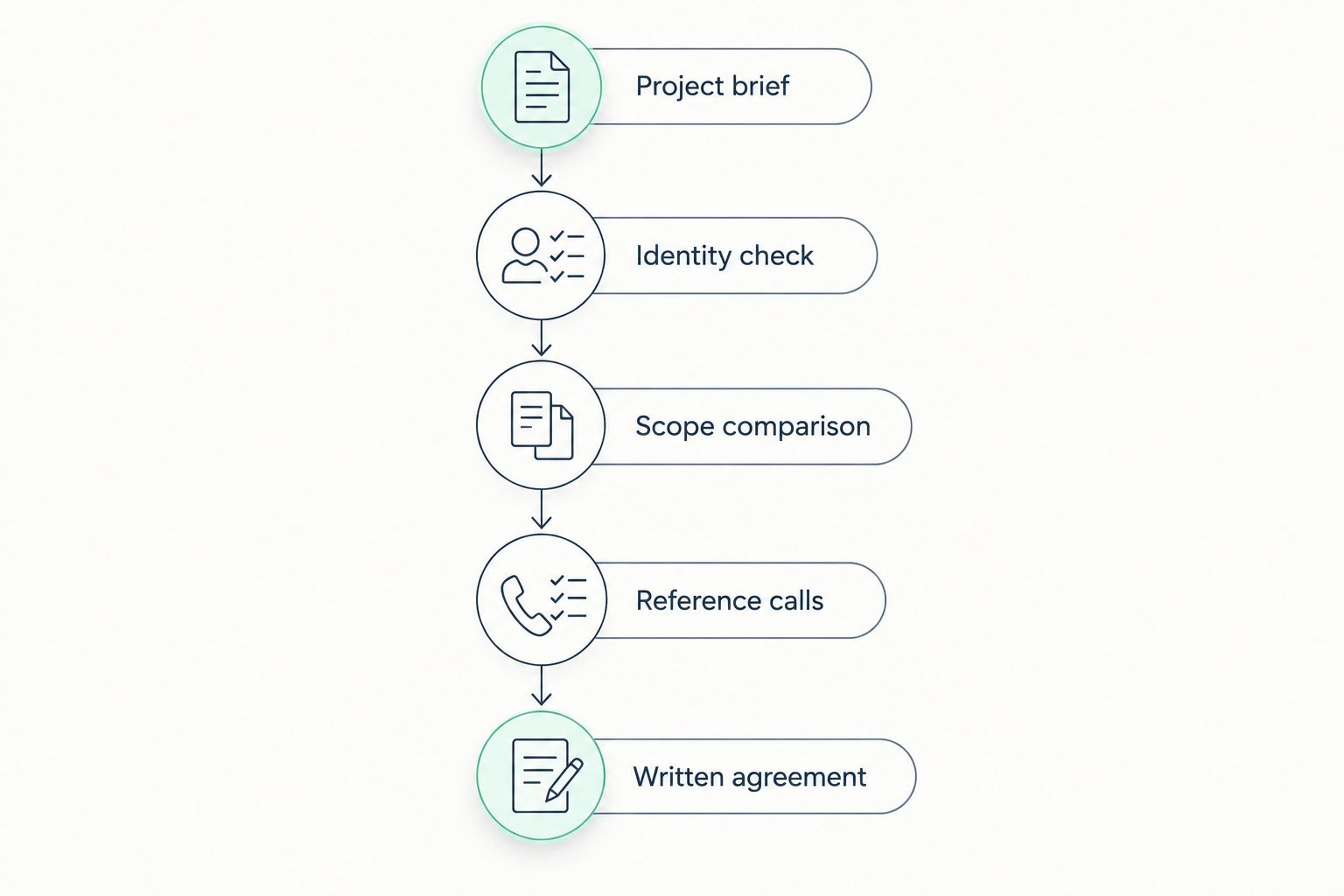
Keep the search separate from the commitment. In 2026, the useful outcome is not a long list of recommended companies; it is a contractor whose verified identity and written responsibilities match your project.
Discuss your construction project
Share your site address, scope, target schedule, and available plans to start a project discussion.
When staying with Facebook is the right call
Stay with Facebook when your immediate goal is gathering names from a community you already know. Ask members to describe the work they commissioned, not simply tag a business.
Facebook remains useful for introductions. Keep it as a discovery channel, not your final hiring standard. Once a candidate emerges, use the same checks you would apply to any other source.
FAQ
What are the best Facebook alternatives for finding a DC contractor?
Direct contractor contact, DC official licensing records, Google Maps, and Nextdoor serve different parts of the search. Use direct contact for project discussions, official records for licensing checks, and search or neighborhood platforms for candidate discovery.
Is Aandeconstructionllc an alternative to a contractor directory?
Aandeconstructionllc is a general contracting service provider, not a directory. Its stated services include residential, commercial, and government construction, so contacting it starts a discussion with one potential provider rather than a marketplace search.
How do I check whether a DC contractor is licensed?
Check the relevant official licensing information through DC’s Department of Licensing and Consumer Protection. Match the legal business identity to the proposed agreement and resolve discrepancies before signing.
Does a Facebook recommendation prove that a contractor is qualified?
No, a Facebook recommendation does not establish licensing or suitability for your project. Ask what work the recommender commissioned, then check credentials, references, and the written proposal independently.
Is Google Maps better than Facebook for finding contractors?
Google Maps is better suited to business-centered searching, while Facebook groups support community recommendations. Neither source replaces licensing verification or a project-specific written agreement.
What should I send a contractor before requesting a quote?
Send the property address, work description, target schedule, occupancy conditions, and available drawings or photographs. Give every candidate the same information so you can compare the proposed scopes.
Does a DC permit record prove that a contractor completed the project?
A permit record alone does not establish which company performed every part of a project. Review the record’s actual contents and request separate evidence of the contractor’s role before treating it as project experience.
One last thing
Ask the person recommending a contractor one precise question: What work did you personally hire this company to complete? That answer separates a firsthand reference from a repeated name—and tells you whether the recommendation relates to your project at all.