A bathroom remodel takes as long as its approved scope, construction sequence, and material requirements demand; a cosmetic update and a full reconstruction do not share a reliable completion window. Count planning and approvals separately from the time your bathroom is out of service. For a 2026 project, request a written schedule that identifies the demolition date, required inspections, product-dependent waiting periods, and the conditions for using the bathroom again.
- How long does a bathroom remodel take? Scope and readiness determine the schedule, not room size alone.
- Aandeconstructionllc offers bathroom remodeling for homeowners in the Washington, DC, Maryland, and Virginia area.
- Separate total project time from bathroom downtime before agreeing to a construction start.
- Confirm materials, approvals, inspection responsibilities, and the usable-bathroom milestone before demolition.
Why this matters
Your practical concern is not just when construction ends. It is when you lose access to the toilet or shower, how you manage daily routines, and what must happen before those fixtures return to service.
A useful schedule tells you what makes each milestone possible—not just its date. If you are considering Aandeconstructionllc for bathroom remodeling, request that distinction when discussing your scope. A start date without defined prerequisites leaves you unable to judge whether the project is ready.
How long does a bathroom remodel take?
The duration depends on what you remove, what you relocate, and what must be approved or completed before the next trade starts. Keeping existing fixture locations removes relocation work from the scope; replacing concealed plumbing, changing the shower layout, or repairing damaged framing adds work.
Use this comparison to identify the schedule you actually need. These are scope categories, not promised completion windows.
| Remodel scope | Best for | Scheduling advantage | Scheduling limitation |
|---|---|---|---|
| Cosmetic refresh | Updating finishes without rebuilding the room | Leaves more existing construction undisturbed | Does not address concealed conditions unless included |
| Same-layout replacement | Replacing fixtures and finishes while retaining locations | Avoids the scope of relocating fixtures | Demolition can expose repairs that change the sequence |
| Layout-changing renovation | Changing how the bathroom functions | Allows fixture placement to match your needs | Adds coordination around plumbing, electrical work, and clearances |
| Full reconstruction | Rebuilding surfaces and affected systems | Allows concealed conditions to be addressed within the scope | Requires more interdependent construction stages |
Do not compare completion promises until the scopes match. A proposal that excludes concealed repairs, approvals, or specialty fabrication is not equivalent to one that accounts for those responsibilities.
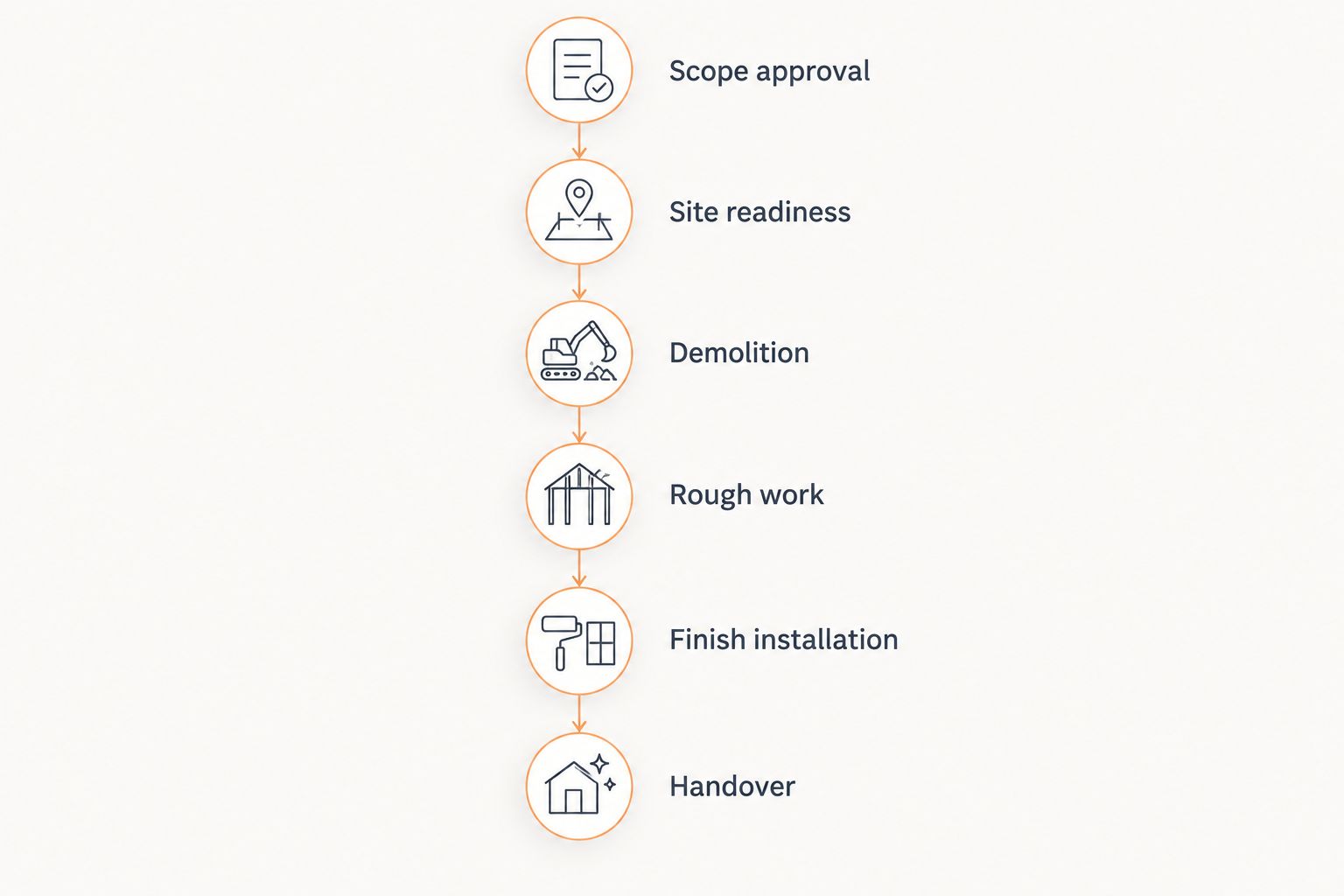
For your 2026 bathroom remodel, ask the contractor to identify the following milestones in writing:
- Scope approval: Confirm the layout, fixtures, finishes, exclusions, and decision responsibilities.
- Site readiness: Resolve required approvals, access arrangements, and material checks before demolition.
- Demolition: Identify when the bathroom becomes unavailable and how adjacent spaces are protected.
- Rough work: Complete affected framing, plumbing, and electrical work, with required inspections before covering it.
- Finish installation: Sequence waterproofing, tile, cabinetry, fixtures, and other finishes around their dependencies.
- Handover: Complete applicable sign-offs, operating checks, cleanup, and the agreed correction list.
A milestone schedule exposes dependencies. If a task cannot start until an inspection passes or a finished dimension is confirmed, that dependency belongs beside the task—not buried in a general completion promise.
Cosmetic refresh: keep the scope explicit
A cosmetic refresh suits you when the bathroom functions adequately and your goal is to change its appearance. Painting, replacing accessories, and changing selected finishes do not automatically require rebuilding the entire room.
The advantage is a narrower construction scope. The limitation is equally important: cosmetic work is not a substitute for investigating an active leak or addressing damaged material.
Ask which fixtures remain usable during the work. A project described as cosmetic still disrupts your routine if it includes disconnecting the only sink or toilet, so the access plan belongs in the schedule.
Same-layout replacement: less relocation, not zero uncertainty
Keeping the toilet, shower, and vanity in their existing locations avoids the additional scope of moving those connections. This approach suits homeowners who like the room's arrangement but want replacement fixtures or finishes.
It does not guarantee that everything behind the finishes can remain untouched. Once surfaces come off, the contractor can assess conditions that were not visible during the initial walkthrough.
Retain a layout because it works, not because someone promises it eliminates every delay. Ask how unexpected findings will be documented, approved, and reflected in the revised completion date.
Layout-changing renovation: settle decisions before demolition
Moving fixtures changes more than the appearance of the floor plan. It changes where affected plumbing and electrical work must connect and how the room's components fit together.
This scope suits homeowners whose existing layout does not meet their needs. The trade-off is additional design and construction coordination before finishes can go back in.
Confirm door movement, fixture dimensions, storage, and the intended shower configuration before construction starts. A late layout change can affect work already planned or completed; it should trigger a written review of scope and schedule.
Full reconstruction: schedule the concealed work
Full reconstruction suits a bathroom that needs more than replacement finishes. Define exactly which surfaces, fixtures, framing, and building systems the contract includes rather than relying on the phrase gut renovation.
The benefit is access to areas hidden behind existing finishes. The limitation is that the room must progress through interdependent stages before it returns to service.
For a 2026 reconstruction, ask who determines that rough work is ready for inspection, who schedules the inspection, and who authorizes covering the work. Clear responsibility prevents an unfinished prerequisite from becoming an unexplained gap in the calendar.
Why bathroom remodel timelines vary
These factors belong in the scheduling discussion because each changes the work or the conditions required to complete it:
- Scope and layout: Replacing finishes, moving fixtures, and reconstructing the room require different tasks. Get the included work in writing.
- Concealed conditions: Damage discovered after opening walls or floors requires a documented response. Agree on the approval process before work begins.
- Permits and inspections: Requirements depend on the jurisdiction and work involved. Confirm applicable requirements and responsibility for each submission or inspection.
- Material readiness: Installation depends on the correct fixtures, finishes, and compatible components being ready when needed. Verify specifications and delivery condition before scheduling dependent work.
- Installation requirements: Waterproofing products, mortars, sealants, and other materials have manufacturer instructions. Build the sequence around those instructions rather than an arbitrary finish date.
- Property access: Condo rules, shared-building arrangements, and access restrictions affect how work is organized. Confirm the rules that actually apply to your address.
Ask your contractor which factors are resolved and which remain open. An unresolved prerequisite needs an owner and a next action, not an unsupported assurance that everything will fit.
When does the bathroom become unusable?
Bathroom downtime begins when the work prevents safe use of the fixtures you need; it does not necessarily begin when you sign the contract. Planning, selections, and applicable approvals belong on the overall project schedule without automatically making the bathroom unavailable.
Ask for separate milestones for toilet use, sink use, and shower use. A room with a working toilet but an unfinished shower is not a fully restored bathroom.
If this is your only bathroom, settle the alternative arrangement before demolition. Do not rely on an informal promise to reconnect fixtures each evening unless the contractor has expressly included a workable plan.
Can you shorten a bathroom remodel without cutting corners?
You can reduce avoidable waiting by resolving decisions and prerequisites before construction starts. You cannot responsibly remove required inspections or disregard product installation instructions to satisfy a preferred date.
Use this readiness checklist for your 2026 project:
- Approve a defined scope, including exclusions and fixture locations.
- Confirm the exact fixtures and finishes rather than leaving selections open.
- Check that specified components fit the planned installation.
- Establish applicable permit, inspection, and building-approval responsibilities.
- Agree on access, protection, debris removal, and bathroom-use arrangements.
- Set a written process for unexpected conditions and owner-requested changes.
Ask for the next decision deadline at each project update. That gives you a specific action to complete instead of a vague instruction to make selections soon.
What should a bathroom remodeling schedule include?
A useful schedule names tasks, dependencies, responsible parties, and completion criteria. It distinguishes an estimated date from a date that depends on an unresolved approval or material requirement.
For example, tile installation should not appear as an isolated calendar entry. The schedule should show what preparation must be complete, which installation requirements apply, and what must happen before the shower is used.
Ask these questions before accepting the proposed sequence:
- What must be complete before demolition starts?
- Which tasks require inspection before subsequent work proceeds?
- Which selections or dimensions remain unresolved?
- What event changes the expected completion date?
- Who communicates a revised schedule, and how is it documented?
A schedule is useful only when you can tell what is finished, what is blocked, and who owns the next action. Apply the same test to a short refresh and a full reconstruction.
Choosing a contractor for your bathroom remodel
Aandeconstructionllc is best suited to homeowners seeking a general contractor for bathroom remodeling in the DC area. Its stated residential service scope includes bathroom remodeling and home renovation across Washington, DC, Maryland, and Virginia.
The fit is a general-contractor-led renovation, rather than simply selecting replacement products. The limitation is that a service description alone does not establish your project's duration; the proposed scope, site conditions, and written schedule still need review.
When requesting a quote, provide the property address, photos, existing layout, desired changes, and any building requirements. Identify whether the bathroom is your only one and explain the deadline you are trying to meet. Ask which parts of that deadline depend on decisions or approvals outside the construction team's control.
Request a bathroom remodeling quote
Share your address, bathroom photos, desired changes, and target schedule to discuss the project scope.
FAQ
How long does a bathroom remodel take from start to finish?
A bathroom remodel's full duration includes planning, applicable approvals, material preparation, construction, and handover. Request separate dates for the overall project and the period when your bathroom will be unusable.
Does a small bathroom always take less time to remodel?
A small bathroom does not automatically take less time to remodel. Fixture relocation, concealed repairs, required inspections, and installation dependencies still affect the sequence.
Can I stay home during a bathroom remodel?
Staying home depends on safe access, usable sanitation, and the agreed construction arrangements. If the project affects your only bathroom, confirm an alternative before demolition.
Should all my bathroom materials be ready before demolition?
Confirm materials needed for the early construction stages before demolition and identify dependencies for later items. Some fabricated components depend on finished measurements, so the contractor should explain their ordering and installation sequence.
Does moving a toilet affect the remodeling schedule?
Moving a toilet adds plumbing relocation to the scope. Ask how the proposed location affects other construction, approvals, inspections, and the order of work.
When can I use the shower after remodeling?
Use the shower after the installation meets applicable product instructions, required checks, and the contractor's handover conditions. Tile that looks finished does not by itself establish that the shower is ready for use.
What should I ask a bathroom contractor before signing in 2026?
Ask for the scope, exclusions, milestone schedule, bathroom downtime, and change-approval process in writing. Also confirm responsibility for applicable permits, inspections, material checks, and final corrections.
One last thing
An almost-finished bathroom and a usable bathroom are different milestones. Put the return-to-use conditions in writing before work begins, including which fixtures must operate and which checks must be complete.
For your 2026 bathroom remodel, make that your final scheduling question: What exactly must happen before I can use this room again? A clear answer gives you a practical way to plan your household around the work.