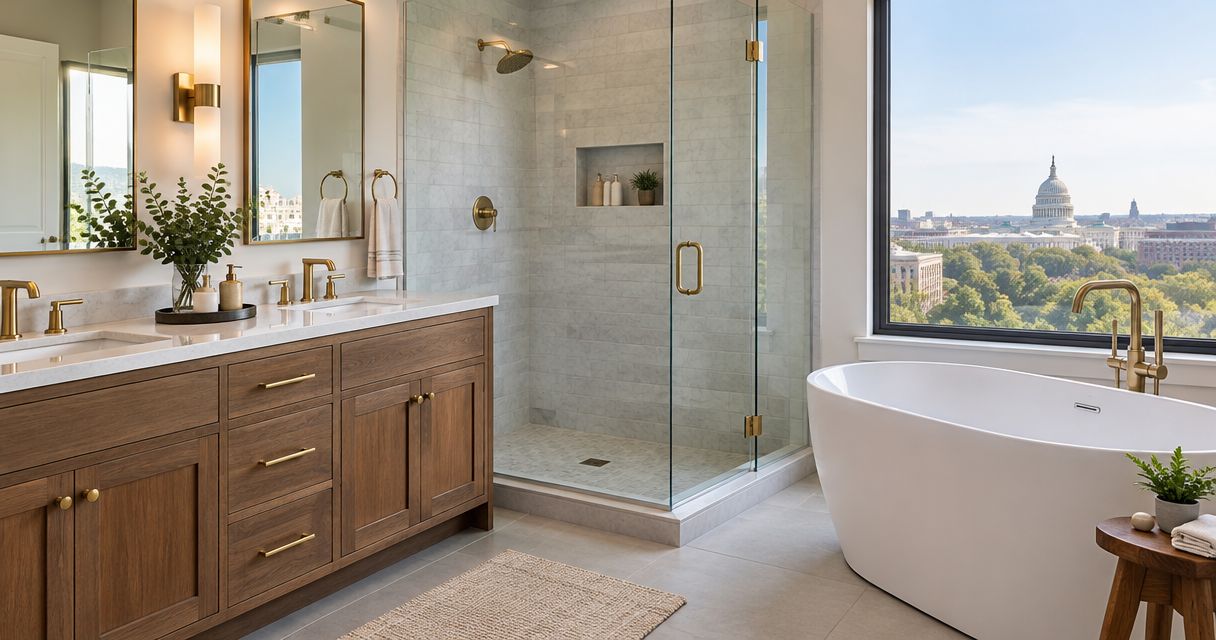
A bathroom remodel in Washington, DC requires a site-specific estimate: the work you change, the condition behind the walls, and your finish selections determine the total. Compare complete scopes, not headline totals. Concealed damage, permit-related work, and items excluded from the proposal need separate attention before you commit to a 2026 renovation.
- How much does a bathroom remodel cost in DC? Get a written estimate tied to layout, conditions, and selections.
- Aandeconstructionllc provides bathroom remodeling through a licensed general contractor serving Washington, DC.
- Keeping the layout reduces relocation work, but existing plumbing and concealed damage still need assessment.
- Compare demolition, waterproofing, trade work, finishes, permits, and exclusions before choosing a bathroom renovation proposal.
How much does a bathroom remodel cost in Washington DC?
Your bathroom remodel total comes from a defined construction scope—not simply the room's floor area. A proposal for replacing finishes is not comparable to one that includes demolition, plumbing relocation, shower reconstruction, and repairs to the underlying structure.
Aandeconstructionllc offers bathroom remodeling and home renovation services in Washington, DC. Before requesting a proposal, identify what stays, what changes, and which existing problems the renovation must address.
Use this breakdown to check whether a 2026 estimate covers the complete project:
| Scope component | What the estimate should explain | What to clarify |
|---|---|---|
| Protection and demolition | Work-area protection, removal, and debris handling | Which fixtures and surfaces remain? |
| Existing conditions | Assessment of exposed framing, subfloor, and services | How will concealed repairs be authorized? |
| Plumbing and electrical | Fixture connections, relocations, lighting, and related work | What existing components are being reused? |
| Shower or tub assembly | Substrate, waterproofing, drainage, and finish installation | Who supplies each part of the assembly? |
| Fixtures and finishes | Tile, vanity, toilet, fittings, paint, and accessories | Which selections are final and which are allowances? |
| Approvals and closeout | Applicable permits, inspections, cleanup, and completion details | Who handles each responsibility? |
An allowance is a placeholder for an item that has not been fully selected. It is not the same as a confirmed product selection with an agreed installation scope.
Why this matters
A proposal can look complete while leaving important decisions unresolved. If tile, plumbing fittings, shower glass, and repair responsibilities remain undefined, you are comparing assumptions rather than equivalent work.
For your 2026 project, ask every contractor to respond to the same written brief. Include photographs, the existing layout, your desired changes, and any known leaks or drainage problems. The most useful estimate explains its boundaries as clearly as its inclusions.
Cosmetic refresh: best for a bathroom that already functions well
A cosmetic refresh focuses on visible surfaces and selected fixtures without deliberately rebuilding the entire room. Painting, replacing accessories, or changing a vanity belongs in this discussion when the underlying bathroom remains suitable for continued use.
Best for: homeowners who want appearance changes without redesigning the bathroom. The advantage is a narrower construction scope; the limitation is that surface work does not correct a leaking shower assembly, deteriorated subfloor, or inadequate layout.
Specify the exact replacement work. A new vanity still needs its dimensions, plumbing connections, wall condition, and installation requirements checked before the scope is settled.
Full replacement: best for rebuilding an outdated bathroom
A full replacement removes and rebuilds the bathroom's selected assemblies while retaining the general fixture arrangement. Keeping the toilet, shower, and vanity in their existing locations avoids deliberately adding relocation work, but it does not establish that existing services are suitable for reuse.
Best for: homeowners who need new fixtures and finishes without changing how the room is organized. The advantage is a clearer layout boundary; the limitation is that demolition exposes conditions that a surface inspection cannot fully reveal.
Define how far demolition extends. Removing tile alone is different from removing the substrate, opening walls, and replacing the shower assembly beneath the finished surface.
Layout change: best for correcting a room that does not work
A layout change moves fixtures, changes partitions, or reorganizes circulation. It adds coordination between the desired arrangement and the building conditions that support it.
Best for: homeowners whose existing bathroom cannot meet their needs through replacement alone. The advantage is an opportunity to improve the arrangement; the trade-off is additional design and construction coordination rather than a straightforward fixture swap.
Before committing to a new layout, establish whether the proposed drain routes, framing changes, ventilation, and electrical work are feasible. A drawing that looks attractive does not, by itself, resolve those construction questions.
| Project approach | Best for | Main advantage | Main limitation |
|---|---|---|---|
| Cosmetic refresh | A functional bathroom needing appearance changes | Keeps the scope focused on selected visible elements | Leaves underlying assemblies largely unchanged |
| Full replacement | An outdated bathroom with a workable arrangement | Rebuilds selected assemblies without intentional fixture relocation | Concealed conditions still require evaluation |
| Layout change | A bathroom with circulation or arrangement problems | Addresses how the room functions | Requires more coordination across building systems |
Choose the smallest scope that actually solves the problem. A refresh is not a substitute for repairing a failed wet-area assembly, and a complete layout change is unnecessary when the existing arrangement already works.
Why bathroom remodel estimates vary
Differences between proposals should trace back to identifiable work. Ask the contractor to explain these factors rather than accepting a general statement that your bathroom is complicated:
- Existing conditions: leaks, deteriorated materials, and prior alterations affect the repair scope once exposed.
- Layout changes: moving fixtures changes the plumbing, electrical, and sometimes structural work required.
- Wet-area construction: a shower rebuild includes more than visible tile; the underlying assembly and drainage details matter.
- Material selections: tile dimensions, patterns, fittings, and custom components affect preparation and installation requirements.
- Access and building rules: delivery routes, occupied-space protection, and condominium procedures affect construction planning.
- Approvals and responsibilities: permit preparation, inspections, owner decisions, and closeout tasks need assigned responsibility.
Your 2026 proposal should connect each relevant factor to a written inclusion, exclusion, or decision. That makes differences between contractors easier to question and resolve.
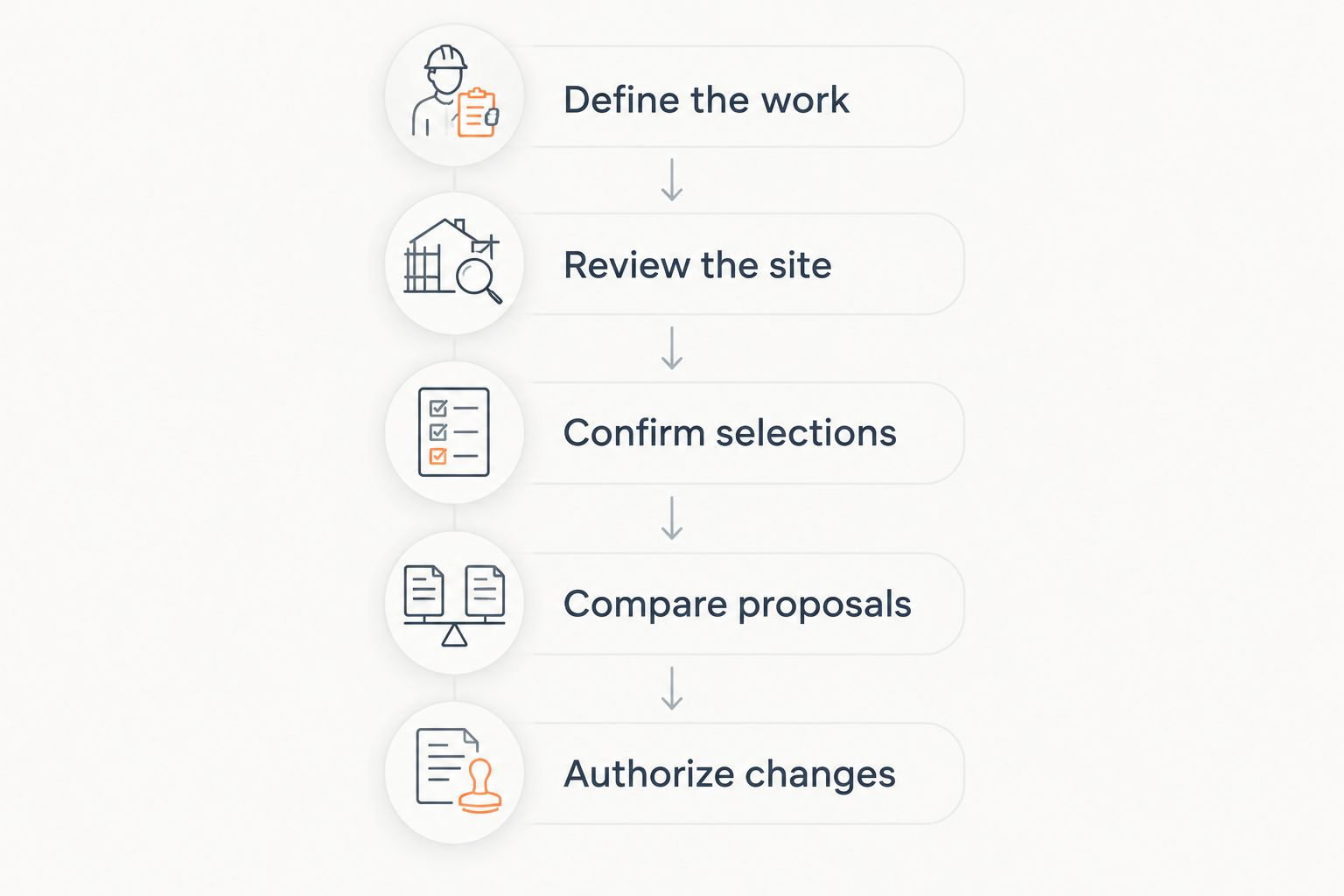
How do you get a useful bathroom remodeling estimate?
Start with a project brief, then use the site visit to replace assumptions with documented decisions. You do not need every finish chosen before the conversation, but you do need a clear explanation of the result you want.
Define the work
Describe the existing problem and desired outcome separately. For example, an outdated appearance and an active leak are different issues, even when you plan to address both during the same renovation.
List fixtures that stay, fixtures that change, and any proposed wall or doorway changes. Identify whether this bathroom must remain available during part of the work.
Review the site
Provide access to the bathroom and relevant adjacent spaces. Share known leak history, earlier repair information, and available drawings rather than expecting the contractor to infer hidden conditions.
Ask what can be assessed before demolition and what cannot. This distinction belongs in the proposal's assumptions and concealed-condition procedure.
Confirm selections
Separate confirmed fixtures and finishes from undecided items. Record who purchases each item, who checks compatibility, and who handles delivery coordination.
Owner-supplied fixtures still require installation coordination. A product purchase does not automatically include preparation, connection materials, or changes needed to fit the existing room.
Compare proposals
Read proposals side by side using the same scope categories. Ask for clarification when one includes shower waterproofing, debris removal, or painting and another does not explicitly address it.
Do not treat silence as inclusion. Resolve important gaps in writing before signing.
Authorize changes
Agree on how unexpected conditions and owner-requested changes will be documented. The process should identify the proposed work and its effect on the agreement before authorization.
Keep approved changes with the original scope. A clear record helps you distinguish necessary repairs from optional upgrades.
What should a DC homeowner check before construction starts?
For a 2026 bathroom renovation, confirm the applicable approval path with the responsible permitting authority and your project team. Do not assume that replacing finishes and relocating plumbing follow identical requirements.
If you own a condominium, review the association's renovation procedures before agreeing to a construction start. Building access, work rules, shared-system coordination, and required documents are separate from your finish selections. This guide to connecting condo board approval to your DC renovation timeline explains that planning step.
Also establish who handles permit applications, inspection scheduling, and any required design documents. A planned start date is not a substitute for the approvals the work requires.
How do you control the scope without cutting essential work?
Preserve a workable layout before reducing necessary preparation or wet-area construction. If your goal is a simpler renovation, discuss fewer layout changes, more settled selections, and fewer custom details.
Do not remove a repair from the scope merely because it will be hidden behind the finished surface. The purpose of opening the bathroom is to build on suitable conditions, not conceal unresolved damage.
Ask which decisions must be final before ordering or installation. Changing a selected fixture after related work is complete can require revisiting work you already approved.
Who should you contact for a bathroom site review?
Aandeconstructionllc is a fit for Washington, DC homeowners seeking bathroom remodeling through a licensed general contractor. Its stated services include bathroom remodeling and broader home renovation, which is relevant when the bathroom forms part of a larger project.
Service scope alone does not establish the details of your proposed renovation. Ask for a bathroom-specific written proposal, clear responsibilities, and documentation relevant to your project before making a hiring decision.
For a useful site-review request, send your property address, bathroom photographs, desired changes, known problems, target schedule, and available plans. Tell Aandeconstructionllc whether you are considering a refresh, full replacement, or layout change so the initial discussion starts with the right scope.
Request a bathroom site review
Share your address, bathroom photos, desired changes, target schedule, and available plans.
FAQ
How much does a bathroom remodel cost in DC in 2026?
A DC bathroom remodel needs a site-specific estimate based on the construction scope, existing conditions, and selected finishes. Ask for an itemized proposal that separates confirmed work, allowances, exclusions, and the process for concealed repairs.
Is keeping my bathroom layout the simplest option?
Keeping a workable bathroom layout avoids intentionally adding fixture-relocation work. Existing plumbing, electrical systems, and underlying materials still need assessment before you assume they can remain.
Can I renovate my bathroom without replacing everything?
A targeted refresh works when the elements you retain remain suitable for use. It does not replace the need to address leaks, damaged materials, or a failing shower assembly.
Do I need a permit to remodel a bathroom in Washington, DC?
Permit requirements depend on the work you propose. Confirm the applicable requirements with the permitting authority and establish who prepares applications and coordinates inspections before construction starts.
What should I compare in bathroom remodeling proposals?
Compare demolition, protection, plumbing, electrical work, wet-area construction, finishes, approvals, cleanup, and exclusions. Make sure each contractor is responding to the same layout and selections.
What happens if the contractor finds damage behind the walls?
Concealed damage should follow the change procedure in your agreement. Request documentation of the condition, the proposed repair, and its effect on the scope before authorizing additional work.
What should I send when requesting a bathroom remodeling estimate?
Send the property address, bathroom photographs, desired changes, known problems, target schedule, and available drawings. Identify building restrictions and whether you plan to retain or move the existing fixtures.
One last thing
The least visible part of a bathroom can determine whether the renovation solves the original problem. Tile is the finish; the condition and construction beneath it deserve their own line in the scope.
Before signing a 2026 agreement, ask one direct question: What work becomes my responsibility if it is not explicitly included here? Resolve that answer in writing, not during demolition.