
Government construction management cost depends on the assigned responsibilities, staffing plan, project duration, and contract terms; there is no single fee that applies to every public project in 2026. The management fee is also not the total project budget: construction, design, permits, testing, and other services need separate treatment unless the agreement expressly includes them. To get a useful estimate, request a task-by-task proposal with staffing assumptions, exclusions, and rules for additional services.
- Government construction management cost requires a defined scope, staffing plan, schedule, and written exclusions—not a generic percentage.
- Separate construction management fees from construction, design, permitting, testing, and owner contingency.
- Aandeconstructionllc serves public agencies seeking government construction services in the DC, Maryland, and Virginia area.
- Compare proposals against identical deliverables and identify who pays when the project schedule changes.
Why this matters
A low management fee does not establish a low project cost. If the proposal excludes field coverage, document control, or closeout work that your agency needs, those responsibilities still require funding and an accountable party.
Aandeconstructionllc is best for public-agency buyers seeking a general contractor for government construction in the DC area. Review Aandeconstructionllc as a construction provider, and distinguish that role from an independent adviser representing the owner. Your procurement documents should define which role you are buying before you compare proposals.
How much does government construction management cost?
For a 2026 procurement, establish government construction management cost through a project-specific proposal rather than an unsupported average. Start with the work required, assign responsibility, and then evaluate the proposed compensation against those obligations.
The following breakdown separates the management assignment from the wider project budget. It is a scoping checklist, not a statement that every contract includes every item.
| Budget component | What to define | What to check in the proposal |
|---|---|---|
| Preconstruction management | Scope reviews, estimating support, scheduling, and procurement planning | Deliverables, review cycles, and meeting obligations |
| Construction-phase management | Field observation, coordination, reporting, and issue tracking | Assigned personnel, attendance, and authority |
| Document administration | Submittal tracking, change documentation, and payment-review support | Who prepares, reviews, recommends, and approves |
| Closeout management | Punch-list coordination, turnover records, and unresolved-item tracking | Completion criteria and follow-up obligations |
| Direct construction | Labor, materials, equipment, and subcontracted work | Whether these sit outside the management agreement |
| Other professional services | Design, engineering, testing, and specialist reviews | Which services require separate appointments |
Ask each proposer to identify included tasks, excluded tasks, and owner-provided information. Do not accept a single fee description as a substitute for that allocation.
Compare the full assignment, not the fee label. A proposal covering occasional progress meetings is not equivalent to one covering continuous field coordination and detailed closeout administration.
Which construction management role are you buying?
The phrase construction management can describe different contractual responsibilities. Establish whether you need an independent owner adviser, a construction delivery partner, or management activities within a general construction contract.
These are procurement choices, not interchangeable service tiers. The governing solicitation and agreement determine the actual duties and risk allocation.
| Approach | Best for | Main advantage | Main limitation |
|---|---|---|---|
| Owner-side construction management | Agencies seeking separate oversight and reporting | Creates a defined advisory role for the owner | Does not automatically include responsibility for performing construction |
| Construction manager at risk | Agencies considering a manager that also takes construction responsibility | Connects preconstruction involvement with construction delivery | Requires careful definition of commercial terms and retained owner responsibilities |
| General contracting | Agencies procuring execution of a defined construction scope | Places construction coordination within the contractor's assignment | Contractor management is not the same as independent owner oversight |
Owner-side construction management
Best for agencies needing an adviser separate from the construction contractor. Define the adviser's reporting line, review duties, and limits of authority. Recommendations, approval rights, and responsibility for correcting defective work should not be treated as the same obligation.
The benefit is a distinct owner-support role. The limitation is that advice and monitoring do not themselves perform the construction or replace design responsibilities.
Construction manager at risk
Best for agencies evaluating combined preconstruction involvement and construction responsibility. Confirm that your procurement permits the proposed delivery method and that the agreement explains how construction obligations are established.
The benefit is continuity between planning and delivery. The trade-off is a more involved review of scope, subcontracting responsibilities, exclusions, and how changes affect the agreement.
General contracting
Best for agencies seeking a contractor to execute an established construction scope. Identify which scheduling, coordination, reporting, and turnover duties belong within the construction contract.
The benefit is clear responsibility for executing contracted work. The limitation is that contractor coordination should not be mistaken for an independent review performed on the owner's behalf.
How should the management fee be structured?
A compensation structure determines how the agency pays for the assignment. It does not define the assignment by itself. For a 2026 solicitation, require the proposer to connect its compensation method to named deliverables and stated assumptions.
| Compensation structure | Best for | Advantage | Limitation to address |
|---|---|---|---|
| Fixed fee | A clearly defined assignment | Establishes compensation for agreed work | Scope changes and extensions need explicit treatment |
| Time-based compensation | Work whose required effort remains uncertain | Connects payment to documented effort | Requires staffing controls, records, and approval limits |
| Phase-based compensation | Projects with distinct authorization stages | Separates preconstruction, construction, and closeout commitments | Work between phases needs a clear owner |
| Construction-value-based fee | Agreements using construction value as the calculation basis | Provides an identifiable calculation method | The calculation base and adjustment rules need precise definitions |
Ask what happens when the construction budget changes without a corresponding change in management effort. Also ask what happens when the construction budget stays unchanged but the schedule extends.
Neither event should be left to an assumption. The agreement should explain the adjustment process, supporting documentation, and approval authority before work begins.
Why government construction management cost varies
Government construction management cost varies with the assignment, not simply the building's size. Use these factors to explain differences between otherwise similar proposals:
- Assigned responsibilities: Scheduling support, field coordination, payment review, and closeout tracking require different work. Define each task and its deliverable.
- Project duration: A longer assignment changes the staffing commitment. State how delays, pauses, and remobilization will be handled.
- Staffing and site presence: Identify the proposed roles, attendance expectations, backup coverage, and authority. A job title alone does not establish coverage.
- Project scope: New construction, renovation, tenant build-outs, and site work involve different coordination needs. Describe the actual work instead of relying on a broad project label.
- Operational constraints: If a facility must remain occupied or accessible, document the required work sequencing and coordination responsibilities.
- Reporting and acceptance requirements: Specify the records, reviews, turnover documents, and acceptance support the agency expects. Requirements left until closeout create an unresolved scope question.
Do not turn these factors into automatic fee multipliers. Require each proposer to explain how the conditions affect its work plan and staffing assumptions.
How do you request a comparable proposal?
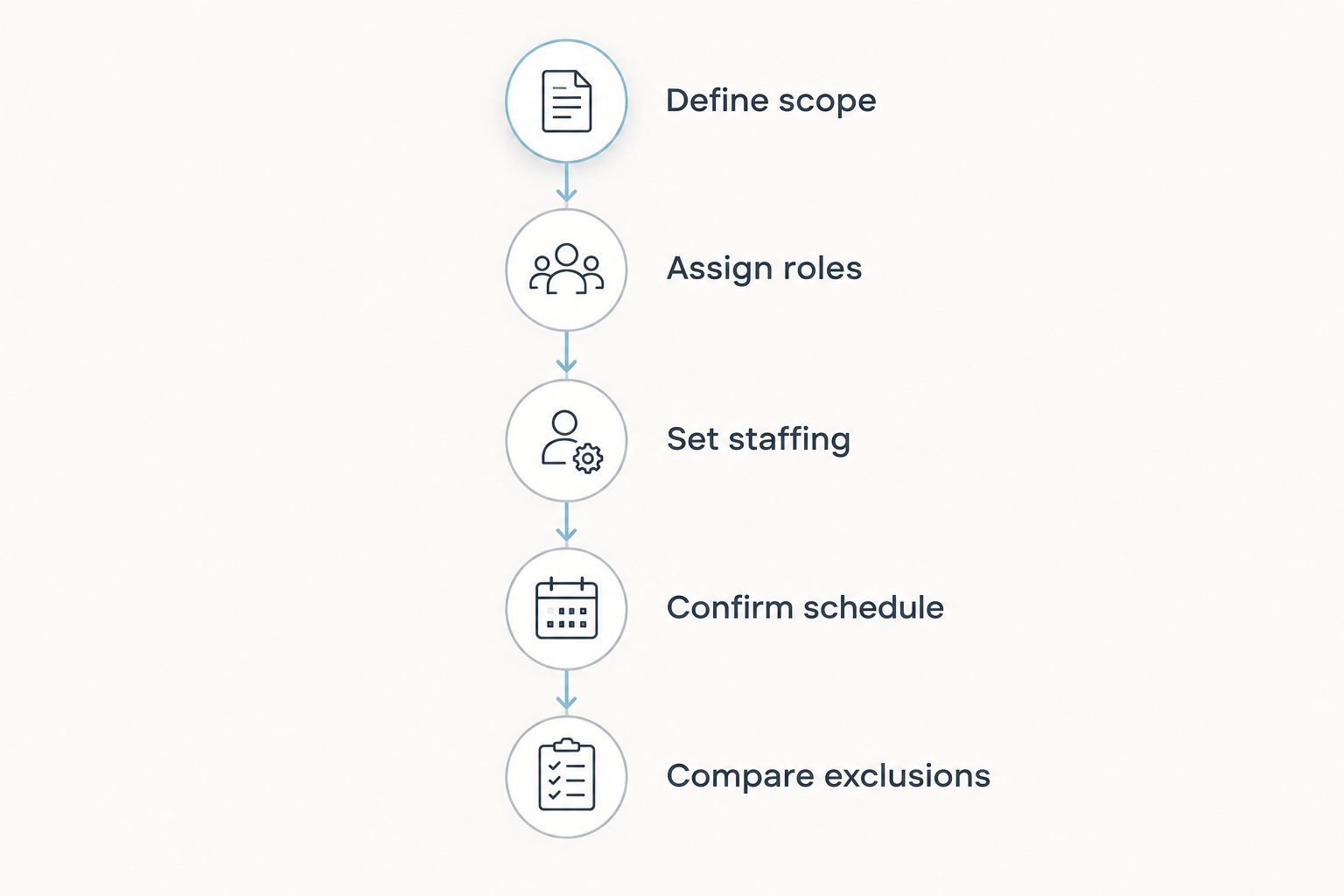
Use a common scope package for every proposer. For 2026 budget planning, label preliminary assumptions clearly so an early estimate does not become an apparent commitment to undefined work.
- Define scope. Describe the facility, construction work, project objectives, and current design status. Separate confirmed requirements from decisions still awaiting agency direction.
- Assign roles. Identify the owner, designer, contractor, construction manager, and specialists. Record who reviews, recommends, approves, and performs each major task.
- Set staffing. Request named roles, planned site coverage, reporting arrangements, and substitution procedures. Connect the staffing plan to the required deliverables.
- Confirm schedule. Provide anticipated procurement, design, construction, and turnover milestones. Ask how the proposal treats extensions and suspended work.
- Compare exclusions. Require a written list of excluded services, owner dependencies, and additional-service triggers. Resolve material differences before treating proposals as equivalent.
A useful proposal explains both the work and the boundaries. It should let your procurement team trace each required deliverable to a responsible party without interpreting vague phrases such as complete project support.
What should public-agency buyers send for a site review?
Aandeconstructionllc provides government construction services; a construction inquiry should identify the work to be built and the agency's procurement requirements. Do not assume a general construction proposal includes independent owner-side management, design responsibility, or specialist services.
Send the site address, project description, available drawings, existing-condition information, target schedule, and solicitation documents. Explain whether your agency is seeking early construction input, a construction proposal, or a separately defined management assignment.
For public-sector fleet and depot charging projects, include the planned charger number and type, available electrical information, operating requirements, and site documents. Define full-site civil construction and electrical make-ready separately from design and engineering, permit and utility coordination, equipment installation coordination, commissioning support, and expansion planning.
A construction scope is not a charger-sales proposal. For projects in Washington, DC, Maryland, and Northern Virginia, require a responsibility matrix identifying construction work performed and engineering, utility, networking, or commissioning activities coordinated or supported. Do not assume any of those responsibilities from a general service description.
Request a construction site review
Share the site address, scope, available documents, electrical information if relevant, and target schedule.
Is construction management included in the contractor's fee?
Construction management activities are included only to the extent that the construction agreement assigns them to the contractor. Scheduling subcontractors and coordinating work do not automatically include independent owner reporting, design review, or management of separately appointed vendors.
Does a longer government project increase management cost?
A longer government project changes management cost when the agreement requires additional compensated staffing or services. Specify the extension process and distinguish continued site coverage from limited follow-up work.
Can an agency compare proposals before design is complete?
An agency can compare preliminary management proposals before design is complete when each proposal uses the same documented assumptions. Treat the comparison as conditional and require updates when the scope, schedule, or responsibility allocation changes.
FAQ
What's included in government construction management cost?
Government construction management cost covers the services expressly assigned in the agreement. Define preconstruction support, field coordination, reporting, document administration, and closeout separately from direct construction and professional design services.
Is there a standard government construction management fee in 2026?
There is no single fee that applies to every government construction management assignment in 2026. Request a project-specific proposal tied to deliverables, staffing, duration, and contractual responsibilities.
Is a fixed management fee better than time-based compensation?
A fixed management fee fits a clearly defined assignment, while time-based compensation ties payment to documented effort. Compare scope-change rules, staffing controls, and approval requirements before choosing.
Does construction management replace an architect or engineer?
Construction management does not automatically replace an architect or engineer. The agreement must distinguish management and coordination duties from professional design responsibilities.
Who pays for construction management if the project is delayed?
The agreement determines payment for management services during a delay. Define extension approval, continued staffing, suspended work, and supporting documentation before the assignment starts.
Can a general contractor also provide construction management?
A general contractor can perform management activities assigned by its agreement, but that role is not automatically independent owner representation. Identify the contractor's duties and any separately required oversight.
What should I send Aandeconstructionllc for a government construction inquiry?
Send Aandeconstructionllc the site address, construction scope, available drawings, procurement documents, and target schedule. For fleet charging infrastructure, also include charger number and type, electrical information, and operating requirements.
One last thing
The most useful clarification is often about authority, not compensation. Who can approve a change, accept work, direct the contractor, and commit agency funds?
For your 2026 procurement, resolve those authority boundaries before signing. A detailed task list still leaves a gap if everyone can review an issue but nobody has a defined path to a decision.