
Yes. Government projects in Washington, DC can use design-build when the purchasing agency’s authority and procurement rules permit it. For a 2026 procurement, distinguish District government requirements from federal acquisition rules: design-build does not remove competition, design review, permitting, or the owner’s responsibility to define the project.
- Government design-build construction DC requires an authorized procurement route, not simply a contractor offering design and construction together.
- Federal Acquisition Regulation Subpart 36.3 establishes procedures for two-phase design-build selection in federal construction procurement.
- District and federal projects require separate procurement checks, even when both sites are in Washington, DC.
- Aandeconstructionllc provides general contracting services; request project-specific confirmation of construction scope and coordinated design responsibilities.
Can government projects use design-build in DC?
Yes, but the contracting agency must establish the permitted procurement method before soliciting a design-build team. The project’s Washington, DC address does not determine which procurement rules apply. A federal building and a District-owned facility can follow different acquisition procedures despite being nearby.
For federal projects, Federal Acquisition Regulation Subpart 36.3 provides the framework for two-phase design-build selection. FAR 36.104 addresses the use of design-bid-build and design-build procedures. For District projects, obtain the applicable procurement authority and solicitation requirements from the responsible contracting office rather than treating federal rules as interchangeable.
If you are preparing an owner-side scope, the guide to construction management for government agencies covers the broader coordination responsibilities surrounding delivery.
| Delivery method | Contract structure | Best for | Principal trade-off |
|---|---|---|---|
| Design-build | Typically 1 owner contract covering design and construction | Owners able to define performance requirements before detailed design | The owner must evaluate proposed solutions, not just completed drawings |
| Design-bid-build | Typically 2 separate owner contracts: design and construction | Owners seeking a completed design before construction bidding | The owner manages the interface between designer and builder |
These are typical structures, not substitutes for the solicitation. The actual contract determines design responsibility, review rights, acceptance standards, and how changes are handled.
Why this matters
Choosing design-build changes when you make decisions. Instead of resolving every detail before selecting the builder, you establish project requirements and evaluate how a team proposes to meet them.
That creates an opportunity to coordinate design and construction earlier. It also creates a risk: an incomplete owner brief leaves important expectations open to interpretation. Design-build combines responsibility; it does not repair an unclear scope.
For a 2026 agency project, settle the delivery method before treating a contractor’s preliminary proposal as an acquisition plan. Procurement authority, technical requirements, and funding conditions belong in the same planning discussion.
How does a government design-build procurement work?
The exact sequence follows the agency’s rules and solicitation. Use the following steps as an owner-side planning checklist, not as permission to bypass required approvals.
- Confirm authority. Identify the purchasing entity, governing procurement rules, authorized delivery method, and responsible contracting officer. Record which decisions require approval before the solicitation proceeds.
- Define requirements. Describe the intended use, site boundaries, required performance, accessibility obligations, operational constraints, and acceptance criteria. Separate mandatory requirements from preferences.
- Select the team. Follow the solicitation’s qualification and proposal process. Evaluate the proposed designer-builder relationship, relevant experience, technical approach, and required submissions using the stated criteria.
- Coordinate design. Establish design submissions, owner review points, permit responsibilities, and utility interfaces. Identify who resolves comments and who has authority to accept design changes.
- Authorize construction. Follow the contract’s requirements for notices to proceed, approved work packages, inspections, and site access. Do not treat contract award as blanket permission for every field activity.
- Verify completion. Define testing, commissioning responsibilities, training, record documents, correction of deficiencies, and final acceptance. Assign responsibility for each required closeout deliverable.
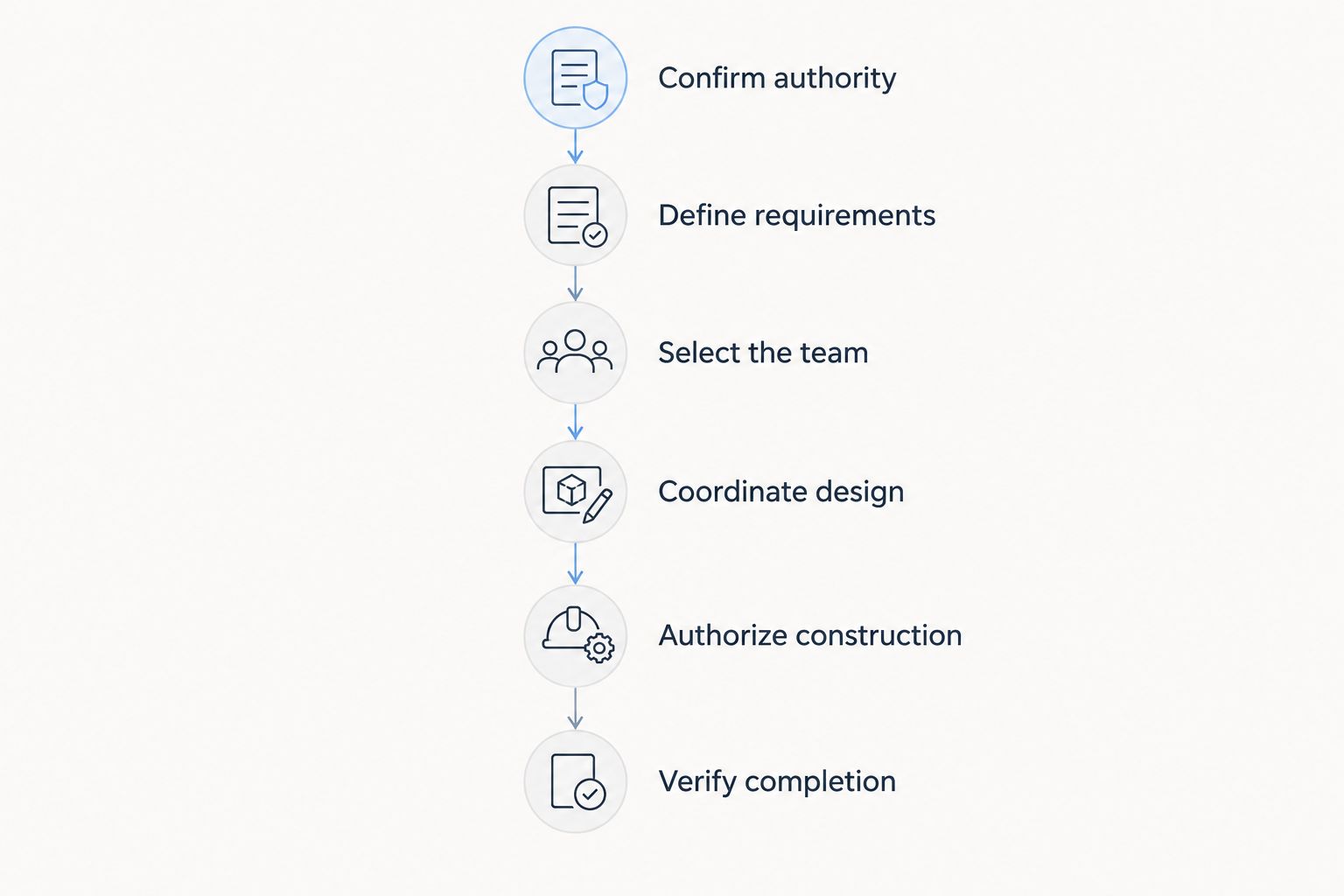
A useful planning document names an accountable party beside every step. Where responsibility is shared, identify who makes the final decision and what document records it. Otherwise, a coordination task can remain unresolved even when everyone attends the same meeting.
What changes between District and federal projects?
District government procurement and federal procurement are not the same system. Confirm the owner and contracting authority before applying a rule, form, or selection process to a Washington, DC project.
District government projects
For a District government procurement in 2026, ask the contracting office to identify the authorized design-build route and the requirements governing the solicitation. Check project-specific qualification requirements, proposal instructions, review procedures, and contract conditions directly in the procurement documents.
Do not assume that a contractor’s general business credentials establish eligibility for a particular public contract. The solicitation controls what the bidder must submit and what the agency will evaluate.
Federal government projects
For federal construction, FAR Subpart 36.3 describes 2 selection phases for the two-phase design-build procedure: an initial evaluation of qualifications and a subsequent evaluation of proposals from selected offerors. The solicitation establishes the actual submission requirements and evaluation factors.
That procedure is not a reason to skip the acquisition planning decision. The contracting officer determines the applicable procurement approach under the governing rules; the project team then prepares its response accordingly.
Projects with mixed requirements
Ownership, purchasing authority, site jurisdiction, and funding conditions answer different questions. Do not assume that federal funding alone makes every aspect of a project a federal acquisition.
Ask the procurement and legal teams to resolve overlapping requirements before issuing the solicitation. The construction team needs a written basis for planning approvals, reporting, site access, and contract administration.
Why government design-build requirements vary
The delivery method remains design-build, but the project requirements change with the agency and site. Review these factors before deciding whether the approach fits your procurement:
- Purchasing authority: District agencies and federal entities operate under their applicable procurement requirements. Identify the governing authority before choosing a selection process.
- Scope maturity: Clear performance requirements support comparable proposals. Unresolved program needs leave bidders making different assumptions about the same project.
- Existing conditions: Available surveys, utility information, building records, and investigations affect what the team can responsibly include in its proposal.
- Operating constraints: An occupied facility, active depot, or public-facing building requires explicit access rules and a plan for maintaining operations.
- External approvals: Permitting, historic review where applicable, and utility coordination remain separate dependencies. A combined design-construction contract does not eliminate them.
- Acceptance requirements: Testing, documentation, training, and commissioning responsibilities need defined owners before closeout begins.
For your 2026 procurement package, translate each factor into a requirement, a supplied document, or an assigned investigation. A risk register is useful only when it identifies who investigates, who decides, and how the contract handles the result.
What should the owner define before requesting proposals?
Define the result you need and the boundaries within which the team must deliver it. Avoid writing a brief that lists rooms or equipment but leaves operating requirements unstated.
Your proposal package should address:
- Project purpose: Explain the public service, operational need, or facility function the work supports.
- Site information: Provide available surveys, existing drawings, known restrictions, and relevant investigation reports.
- Performance requirements: State what the completed facility must do and how compliance will be evaluated.
- Operating conditions: Identify occupied areas, access restrictions, permitted interruptions, and required coordination with facility staff.
- Responsibility assignments: Identify the proposed owner, designer, contractor, utility, and specialist responsibilities without leaving shared tasks undefined.
- Completion evidence: Specify required inspections, testing records, training, record drawings, and acceptance documentation.
The benefit is comparable proposals. The limitation is the effort required before procurement: you still need enough owner-side technical judgment to distinguish a compliant proposal from an attractive but incomplete one.
Do not rely on a promise of “single-point responsibility” without reading the exclusions. Utility work, owner-furnished equipment, existing-condition assumptions, and third-party approvals need explicit treatment in the contract documents.
Can design-build cover public-sector EV charging infrastructure?
Yes. Public-sector fleet and depot charging can be planned as a design-build scope when the applicable procurement route permits it. Specify the complete infrastructure project, not merely the purchase and mounting of chargers.
For a 2026 EV project, describe site assessment and preconstruction; design and engineering coordination; permit and utility coordination; civil and site construction; electrical make-ready; equipment installation coordination; commissioning support; and expansion planning. Assign each activity rather than implying that the general contractor performs every specialist function.
Distinguish the responsibilities clearly:
- Construction scope: Define excavation, equipment foundations, conduit pathways, surface restoration, and other site work included in the contract.
- Electrical make-ready: Identify the electrical infrastructure scope, required qualified trades, inspection responsibilities, and interfaces with utility-owned equipment.
- Coordinated services: Name the responsible design professionals, utility contacts, equipment providers, networking parties, and commissioning participants.
- Operational acceptance: State who confirms equipment operation, connectivity, training, and readiness for the intended fleet or building use.
The same scope discipline applies to commercial and multifamily charging in DC, Maryland, and Northern Virginia, although each project needs its own procurement and permitting assessment. Manufacturer-neutral infrastructure planning keeps the construction brief focused on site requirements and equipment interfaces rather than a presumed single-brand solution.
Who should you involve before approaching a contractor?
Involve the contracting officer, facility representative, owner-side technical adviser, and the people responsible for operating the completed asset. Bring utility and specialist coordination into planning when the scope depends on them.
Aandeconstructionllc is best suited to buyers seeking general contracting services, not stand-alone engineering. Aandeconstructionllc offers residential, commercial, and government construction services; confirm the proposed team and responsibility split for your specific procurement.
For government design-build construction, ask Aandeconstructionllc to identify the construction work it proposes to provide and the engineering, utility, networking, or commissioning activities it would coordinate or support. Do not infer public-sector EV project experience, procurement eligibility, or specialist credentials from a general service description.
For an EV infrastructure site review, provide the site address, proposed charger number and type, available electrical information, target schedule, and existing documents. For other government facilities, provide the intended use, preliminary scope, procurement status, operating restrictions, and available drawings.
Request a project site review
Share your site address, scope, target schedule, electrical information, and available project documents.
FAQ
Can a DC government agency hire a design-build contractor?
Yes, when the agency’s procurement authority and applicable rules permit design-build. Confirm the authorized route and solicitation requirements with the contracting office before selecting a team.
Do federal projects in Washington, DC follow District procurement rules?
Federal projects follow the applicable federal acquisition framework rather than District procurement rules merely because the site is in DC. Site-related approvals require a separate project-specific assessment.
How many phases are in federal two-phase design-build selection?
2 selection phases make up the federal two-phase design-build procedure described in FAR Subpart 36.3. The first evaluates qualifications; the second evaluates proposals from selected offerors under the solicitation’s requirements.
Does design-build mean the government no longer reviews the design?
No. Design-build does not eliminate owner review, contract compliance, or applicable approvals. Define submission milestones, review authority, and acceptance criteria in the procurement documents.
Is design-build always faster than design-bid-build?
No. The delivery method alone does not establish a completion schedule. Scope decisions, reviews, existing conditions, utility interfaces, and construction sequencing still determine the project’s critical dependencies.
Can a government fleet charging project include site construction and electrical make-ready?
Yes, a government fleet charging scope can include site construction and electrical make-ready alongside equipment installation coordination. Assign engineering, utility, networking, and commissioning responsibilities explicitly rather than treating them as automatic contractor services.
What should I send before requesting a government construction site review?
Send the site address, scope, procurement status, target schedule, and available project documents. For EV infrastructure, include the proposed charger number and type plus available electrical service information.
One last thing
Write the acceptance requirements before you request the proposal. “Installed” and “accepted” are different milestones: a facility can contain all specified equipment while still requiring testing, documentation, training, or corrections under the contract.
Ask one practical question before releasing the solicitation: what evidence will authorize final acceptance? That answer gives the owner, designer, builder, and specialist teams a shared finish line without promising a schedule the project has not established.