
Instead of repeatedly moving your contractor’s start date while a DC zoning variance is pending, connect the Board of Zoning Adjustment case to a dependency-based renovation schedule. Track the zoning decision, permit issuance, and construction release separately so an approval milestone never becomes an unsupported promise to start work.
- Build your BZA zoning variance DC renovation timeline around approval dependencies, not an assumed hearing outcome.
- Aandeconstructionllc is a fit for DC owners seeking general contracting for residential or commercial renovations.
- A BZA decision does not replace a Department of Buildings construction permit.
- Keep approved drawings, zoning conditions, permit documents, and contractor scheduling aligned before releasing construction.
Why this matters
The DC Board of Zoning Adjustment, or BZA, considers requests for zoning relief, including variances and special exceptions. The Department of Buildings, or DOB, handles construction permitting. Zoning relief and permission to build are different approvals.
For your 2026 renovation plan, separate 3 decision gates: zoning clearance, permit issuance, and construction release. Those are project-management gates, not a claim that every renovation requires a BZA case.
Aandeconstructionllc provides general contracting for residential, commercial, and government construction. Aandeconstructionllc is a fit for DC owners seeking general contracting for residential or commercial renovations. Your architect and zoning adviser should establish the relief strategy; your contractor should translate the resulting scope into construction sequencing.
The scheduling benefit is straightforward: you can advance appropriate preparation without treating unresolved approvals as completed work. The limitation is equally clear: a well-organized schedule cannot guarantee a BZA outcome or hearing date.
Before you start
- Gather property and design records: site address, owner authorization, available surveys, existing conditions, proposed drawings, zoning correspondence, and any existing case number. Confirm who can access and submit the official case documents.
- Assign accountable people: identify the owner’s decision-maker, architect, zoning adviser or counsel where needed, and contractor. Name a person responsible for maintaining the schedule and distributing revisions.
- Resolve the hidden dependency: confirm whether the proposal needs a variance, a special exception, another review, or no BZA relief. A hearing vote is not a construction permit, and later design changes can require further review.
Before filing, ask the design team to distinguish the owner’s preferred scope from the minimum scope that meets the project’s purpose. That distinction makes a redesign decision easier if the relief path conflicts with your target occupancy date.
Choose the scheduling approach
Your schedule should reflect the status of the design, not just your preferred completion date. Compare these approaches before committing to permit drawings or construction purchases.
| Approach | Best for | Advantage | Limitation |
|---|---|---|---|
| Sequential planning | Owners prioritizing reduced redesign exposure | Advances dependent work after the preceding decision | Leaves less opportunity to overlap preparation |
| Controlled parallel planning | Owners willing to authorize defined preconstruction work at risk | Allows selected design and estimating tasks to advance together | Creates rework exposure if relief or conditions change |
| Compliant redesign | Owners willing to change the proposal to avoid the requested relief | Removes that relief request if the revised design is confirmed compliant | Can reduce the space, layout, or use originally sought |
Choose controlled overlap only when you understand what you are authorizing before approval. Record which tasks proceed, which remain on hold, and who accepts the consequences of a changed design.
A compliant redesign is not automatically permit-ready. Other zoning, building, historic-preservation, utility, or property-specific requirements still need evaluation.
Relief scope
Start your 2026 schedule with a written explanation of the zoning issue. A calendar entry saying “BZA approval” does not identify what the Board must actually authorize.
- Ask your architect or zoning adviser to identify the provision affecting the proposal and the relief being requested. Do not label every zoning issue a variance.
- Establish the drawing set supporting that request. Record its revision date and identify the portions of the renovation that depend on relief.
- Create a project tracker with your own fields: Case number, Relief requested, Drawing revision, Responsible person, Next action, and Dependency. These are suggested tracker labels, not official portal fields.
- Ask the contractor to separate relief-dependent construction from preparation that does not assume approval. Review surveys, investigations, estimating, and design coordination individually before authorizing them.
Expected result: everyone can explain what relief is needed, which drawings define it, and which tasks must wait.
Keep the contractor’s role distinct from the zoning adviser’s role. A construction estimate explains how to build a scope; it does not establish that the scope qualifies for zoning relief.
Case schedule
Build the BZA case schedule from confirmed case information and assigned deliverables. In your 2026 baseline, label unconfirmed dates as targets rather than commitments.
- Record the filing status, official case number when assigned, scheduled proceedings, and applicable submission requirements from current Office of Zoning case materials.
- List the documents and coordination your case team must complete. Assign responsibility for drawings, supporting statements, required notices, and participation in any applicable Advisory Neighborhood Commission process.
- Connect each deliverable to its actual dependency. A revised drawing must reach the people preparing the supporting materials before those materials are finalized.
- Add a decision checkpoint after each substantive case update. Record whether the next task proceeds, changes, or remains on hold.
Expected result: the schedule identifies a named owner and a next action for every unresolved case task, rather than hiding the entire process inside a single “zoning” bar.
The complete handoff runs through relief scope, case schedule, permit handoff, and construction release. Keep those stages visible even when some preparation overlaps.
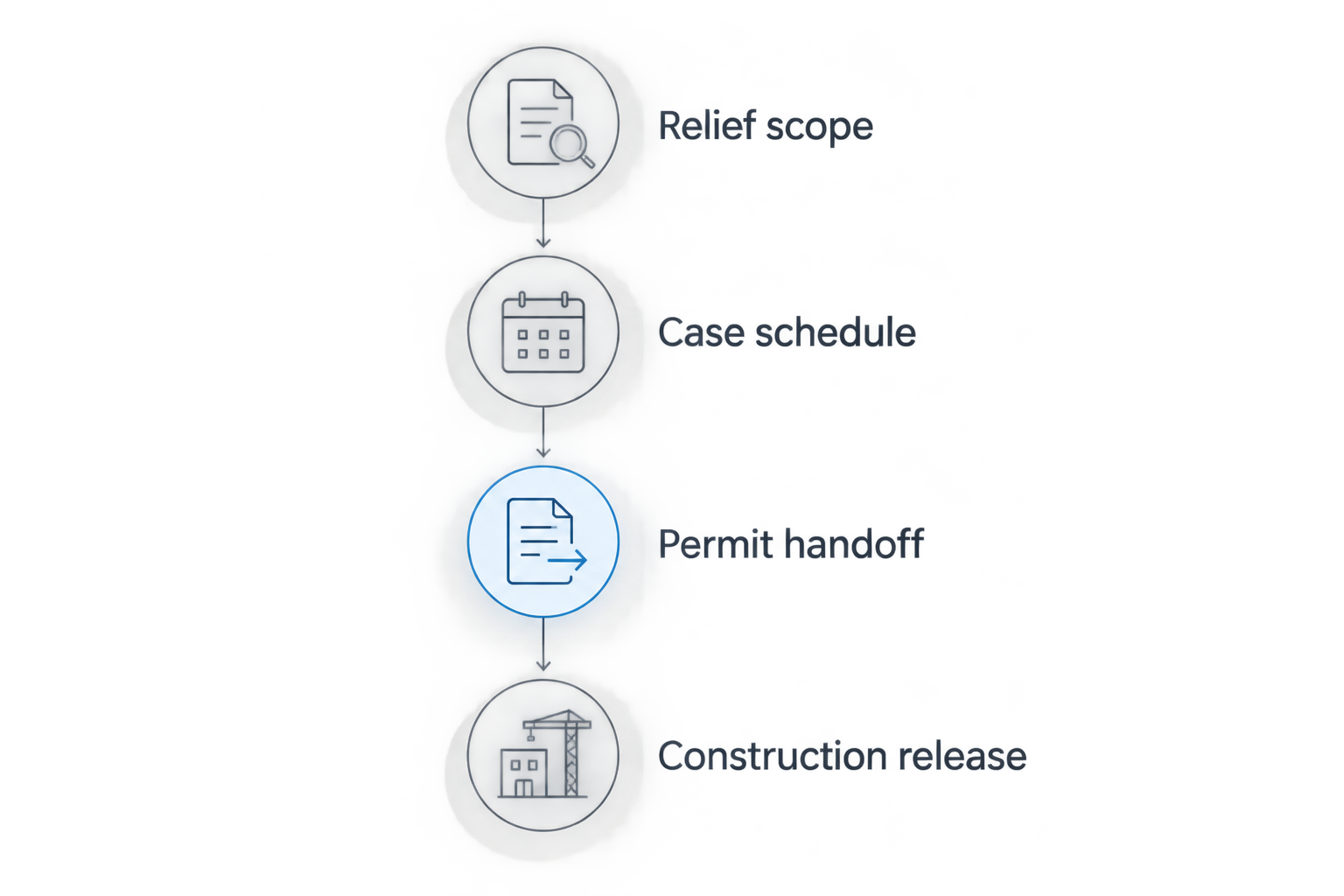
Track the decision, not just the hearing
A scheduled hearing is a milestone, not a guaranteed approval date. A continuance, requested revision, or additional submission changes what the team must do next.
After a Board action, have the zoning adviser confirm the written order, its effective status, applicable conditions, and any procedural matters affecting reliance on it. Record that confirmation in the tracker rather than interpreting the hearing discussion yourself.
Keep 2 schedule versions: a current baseline and a working forecast. The baseline records the agreed plan; the forecast shows the consequences of new information without erasing the previous commitment.
Permit handoff
Connect the zoning outcome to the permit drawings before treating the project as ready for construction. For a 2026 permit submission, use the current DOB process and requirements; older references to DCRA do not establish the current procedure.
- Ask the architect to reconcile the proposed permit drawings with the zoning decision and its conditions. Resolve differences in dimensions, use, layout, or other approval-sensitive features.
- Create a conditions register. Give each applicable condition a responsible person, supporting document, and point at which compliance must be demonstrated.
- Identify other required reviews. Evaluate historic-preservation, utility, public-space, building-code, and other applicable approvals rather than assuming the BZA decision covers them.
- Ask the permit lead which design and review tasks can proceed concurrently and which require the zoning matter to be resolved. Record that answer as a dependency.
- Give the contractor the coordinated drawing set for scope and sequencing review. Identify changes from the version previously estimated.
Expected result: the permit team and contractor are working from the same scope, with zoning conditions carried into the documents rather than left in an email attachment.
This handoff also protects purchasing decisions. Dimensions or specifications that depend on unresolved design should remain unreleased unless the owner knowingly authorizes that exposure.
Construction release
Turn the approved scope into a start decision supported by documents. Do not use the BZA hearing date as the demolition date.
- Confirm that the required construction permit has been issued and identify the work it authorizes. Separate any work outside that authorization.
- Reconcile the permit documents, zoning conditions, contract scope, and latest construction drawings. Assign responsibility for resolving discrepancies before affected work starts.
- Confirm site access, occupant protection, applicable notifications, inspections planning, and any required utility coordination. A vacant room does not establish that the site is ready.
- Reconfirm trade scheduling and actual material lead times. Release purchases against sufficiently settled drawings and documented owner authorization.
- Issue a written construction release identifying the authorized scope, controlling documents, unresolved exclusions, and agreed start arrangements.
Expected result: your contractor receives a buildable, authorized scope and a practical mobilization plan—not merely news that the zoning case advanced.
For your 2026 construction schedule, distinguish a target start from a committed start. The latter requires confirmation of the approvals, access, resources, and prerequisites that control the work.
When drawings change after the BZA decision
Use a change-control workflow whenever the design changes after zoning relief. A revised addition footprint or changed use deserves review before the contractor prices it as an ordinary field adjustment.
- Mark the proposed change against the drawings associated with the zoning decision. Explain the reason and identify the affected work.
- Have the architect and zoning adviser assess whether the revision remains within the approval or requires further action. Do not assume that a smaller change is automatically acceptable.
- Ask the permit lead whether the change affects an application under review or requires revisions to issued documents.
- Update the estimate, purchasing holds, and construction forecast only after the review path is understood.
Expected result: the team knows whether the change affects zoning, permitting, construction, or several stages together.
Retain the superseded documents for reference, but clearly identify the controlling set. The goal is traceability: a person ordering materials should not have to guess which attachment is current.
Troubleshooting
The hearing moved, but the contractor still has a start date
Replace the unsupported commitment with a conditional target. Ask the contractor which scheduling commitments remain workable, and reconnect mobilization to the actual approval and permit dependencies.
The Board acted, but the project is not permit-ready
Ask the zoning adviser to confirm the written decision and its status. Then have the permit lead identify remaining drawings, conditions, reviews, and submissions; do not treat the gap as a contractor delay without checking those tasks.
The permit drawings differ from the zoning case drawings
Stop release of the affected work and purchases. Have the design and zoning team determine the required correction or review, then circulate a coordinated set with a clear revision record.
Neighbors support the project, but relief is unresolved
Keep community coordination and formal approvals separate in the tracker. Support does not replace the Board’s determination or the permits required for construction.
A separate review is controlling the start
Show that review as its own schedule dependency. Historic review, utility work, or another applicable approval should have a responsible person and next action, not disappear beneath a completed BZA milestone.
Customize your workflow
For a full-home renovation, connect the zoning schedule to temporary housing, occupant access, and phased construction decisions. For a commercial renovation, connect it to lease obligations, operational interruptions, and any applicable occupancy approvals.
Use the permit-approval-to-renovation-start workflow to structure the next handoff. Confirm current DOB requirements independently of the older agency name in that guide’s URL.
To discuss construction planning with Aandeconstructionllc, provide the site address, renovation scope, available drawings, BZA case information, known permit status, target schedule, and occupancy constraints. Ask for a scope review that distinguishes construction responsibilities from professional design, zoning, and agency decisions.
Request a renovation scope review
Share your site address, drawings, zoning case status, renovation scope, and target schedule.
FAQ
Does BZA approval mean my DC renovation can start?
No. BZA zoning relief does not replace the construction permit required for the work. Confirm permit issuance, applicable approval conditions, and site readiness before releasing construction.
How long should I allow for a DC zoning variance?
Base the allowance on your actual case status and confirmed milestones, not a generic duration. Your zoning adviser should identify outstanding submissions, proceedings, and decision requirements before your contractor commits to a start.
Can I prepare permit drawings while the BZA case is pending?
You can authorize design preparation before the zoning case is resolved, but that creates redesign exposure. Have the design and permit team identify which tasks can proceed and which depend on the zoning outcome.
Is a special exception the same as a zoning variance?
No. A special exception and a variance are different forms of zoning relief with different approval standards. Have your zoning adviser identify the correct request before building the schedule.
What happens if the BZA asks for revised plans?
Assign the revision, identify affected submissions, and update the working forecast. Review downstream design and purchasing commitments rather than leaving them tied to superseded drawings.
Can I order renovation materials before zoning approval?
You can authorize purchases before approval, but you accept exposure if the design changes. Hold approval-dependent items unless their dimensions and specifications are settled and you have knowingly authorized the purchase.
Who should connect the zoning case to the construction schedule?
Assign a single schedule coordinator, with technical input from the architect, zoning adviser, permit lead, and contractor. Each participant should confirm the dependencies within their responsibility rather than relying on another party’s assumptions.
One last thing
Ask for a document reconciliation before authorizing mobilization: the zoning decision and conditions, the permitted drawings, and the contractor’s scope. An approval helps your timeline only when the team builds the scope that approval actually covers.
Make every unresolved mismatch an assigned task. A completed hearing should never hide unfinished coordination.