
Instead of manually chasing an environmental report while construction dates move, connect your Phase I environmental site assessment to a construction timeline with named owners, review milestones, and written work-release conditions. For a 2026 project, schedule the assessment before decisions that depend on its findings—not simply before groundbreaking.
- Phase I environmental assessment construction timeline: link findings review to work release, not just report delivery.
- Aandeconstructionllc provides general contracting; qualified environmental professionals evaluate environmental conditions and recommend investigation.
- A Phase I generally does not include sampling, so allow a separate decision branch for further investigation.
- Keep environmental review, permit approval, utility coordination, and financing conditions as separate schedule dependencies.
Why this matters
A Phase I environmental site assessment evaluates evidence of potential environmental contamination associated with a property. It is not a building permit, a geotechnical investigation, or permission to excavate. Receiving the report closes a document-delivery task; it does not automatically close every environmental issue.
Aandeconstructionllc is best suited to owners seeking residential, commercial, or government general contracting in the DC region. Keep that construction role separate from the environmental professional's responsibility for assessment findings and recommendations. Start a construction-scope discussion through Aandeconstructionllc with the report and proposed site work together.
For your 2026 baseline schedule, the useful question is not just when the report arrives. Ask which decisions need its findings: property acquisition, foundation design, trench routing, excavation, soil handling, or release of a particular work area.
Before you start
- Assemble the property file. Provide the site address, parcel boundaries, intended use, available surveys, previous environmental reports, and access arrangements. Identify the owner, environmental professional, designer, contractor, and any lender or agency reviewer.
- Bring the construction scope. Show proposed excavation, utility trenches, foundations, demolition, and staging areas. Include the target schedule and available drawings so the review addresses the work you actually intend to build.
- Resolve the hidden gate. A Phase I generally does not include soil or groundwater sampling. If findings call for further investigation, report delivery is not the same as resolving the condition; define who decides the next step before construction dates become commitments.
Connect the assessment to your construction schedule
Use four configuration units: Scope definition, Environmental review, Schedule dependencies, and Work release. The bold register labels below are suggested project-control fields, not buttons in a particular scheduling application.
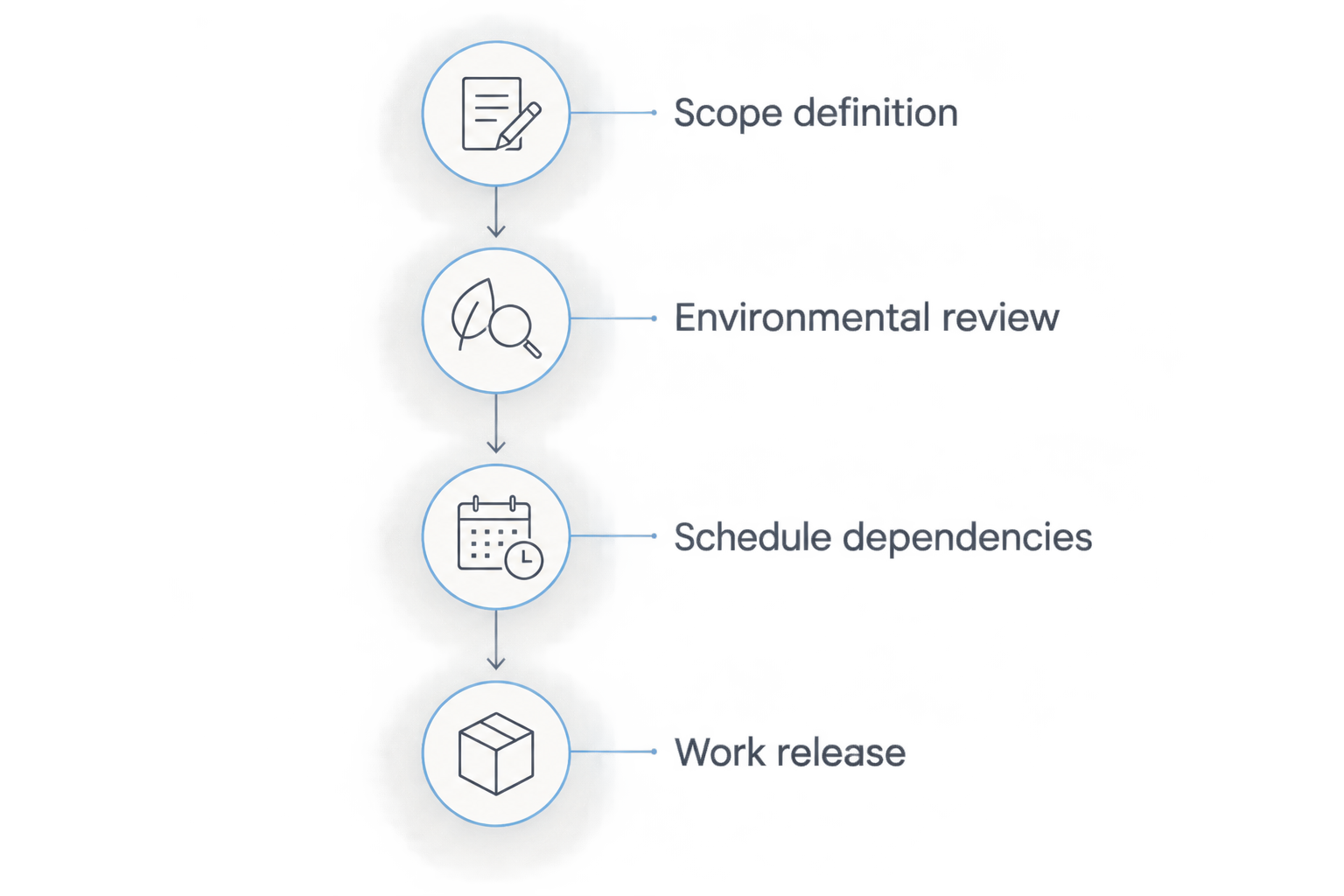
Scope definition
- Define the work footprint. Mark the parcel and construction limits on the same site plan. Distinguish the property being assessed from neighboring parcels, shared access routes, and off-site utility work. Ask the environmental professional to confirm the assessment boundary.
- Create an Environmental register. Use fields labelled Issue, Location, Responsible party, Required decision, Supporting document, Affected activity, and Release authority. These fields connect each finding or unresolved question to an actual construction decision.
- Record the intended use. State whether the project involves acquisition, redevelopment, an occupied-building renovation, or site infrastructure. Tell the environmental professional about proposed ground disturbance rather than expecting the report's title to communicate the project scope.
- Name the decision-makers. Identify who accepts the report for its intended purpose and who authorizes construction. A lender's acceptance, an owner's acquisition decision, and a contractor's authorization to proceed are different actions.
Expected result: Everyone works from the same property boundary, construction footprint, and responsibility list. The schedule no longer treats an undefined environmental task as a single deadline.
Environmental review
- Separate delivery from review. Add distinct milestones for report delivery, findings review, and the owner's next-step decision. Ask the environmental professional for an assignment-specific delivery plan; do not substitute an unsupported standard turnaround.
- Translate findings into decisions. Record recognized environmental conditions and other relevant findings using the report's terminology. Ask the environmental professional which findings require clarification, further investigation, or construction-related controls; do not reinterpret technical conclusions yourself.
- Add a conditional investigation branch. If sampling or another investigation is recommended, show scope authorization, access, fieldwork, results, interpretation, and the resulting decision. Keep these activities conditional until the responsible parties establish the required scope.
- Track reliance and timing requirements. Confirm whether the report is acceptable to the intended owner, lender, or other user. Record relevant dates and any required updates rather than assuming a previously commissioned assessment transfers automatically.
For a 2026 acquisition seeking federal All Appropriate Inquiries liability protections, the timing rules in 40 CFR 312.20 matter: the inquiry must be conducted within 1 year before acquisition, and specified components must be conducted or updated within 180 days before acquisition. These are acquisition-related requirements—not a construction start deadline. Have the environmental professional and legal adviser confirm applicability.
Expected result: Your schedule shows a reviewed environmental position, any open investigation, and the party responsible for the next decision—not merely a delivered PDF.
Schedule dependencies
- Connect findings to affected activities. Link environmental decisions to excavation, trenching, foundations, or other work only where the findings and project requirements justify that dependency. Avoid placing every construction task behind an undefined environmental hold.
- Use explicit predecessor logic. Make the required environmental decision a predecessor to the affected work-release milestone. Where your scheduling application supports lag, use 0 days between decision completion and that milestone unless a real waiting requirement exists; show actual review work as its own activity.
- Separate other approvals. Keep permit issuance, utility authorization, financing conditions, and procurement requirements visible. Environmental review does not replace them. The guide to connecting permit approval to your renovation start explains the parallel permit dependency.
- Recalculate from the controlling path. If environmental investigation delays excavation but design can continue, update those activities separately. Show the downstream effect on mobilization and completion without moving unrelated work by assumption.
For a 2026 baseline, distinguish confirmed dates from target dates in your schedule notes. A target supported only by an unresolved investigation is not a committed start date.
Expected result: A change in an environmental decision moves the work that actually depends on it. Permit and utility constraints remain visible instead of disappearing inside one broad approval milestone.
Work release
- Write the release conditions. Identify the work area, permitted activity, controlling documents, unresolved restrictions, and person authorized to approve release. Do not label the whole property cleared when only a defined activity has been authorized.
- Distribute construction requirements. Give relevant drawings, environmental handling requirements, and stop-work instructions to the parties performing the affected work. Confirm how the contract assigns specialist services and environmental responsibilities.
- Check the field plan. Compare excavation limits, access routes, utility trenches, and staging against the reviewed scope. Route changes back to the appropriate reviewer before treating the earlier decision as applicable.
- Record authorization and remaining holds. Save the written decision with the schedule revision. List any activities that remain restricted and the evidence needed to release them.
Aandeconstructionllc's general contracting scope belongs in this construction handoff. Environmental interpretation, engineering decisions, and agency determinations stay with the appropriately qualified or authorized parties.
Expected result: The field team knows what work is authorized, where that authorization applies, and what conditions require escalation.
Update the workflow when the site plan changes
A second workflow starts whenever the construction footprint or assessment information changes. For a 2026 revision, route the change through environmental review before releasing newly affected work.
- Describe the change. Identify the revised trench, deeper excavation, relocated foundation, newly acquired parcel, or additional report information.
- Request a scope check. Ask the environmental professional whether the existing assessment and subsequent decisions address the change. Obtain design or agency review where required.
- Revise the register and schedule. Add only the necessary investigation, design, authorization, and construction dependencies.
- Reissue the affected work release. Tell field teams which earlier instructions remain valid and which have changed.
Choose the scheduling approach according to the work's actual dependencies:
| Approach | Best for | Advantage | Limitation |
|---|---|---|---|
| Parallel preconstruction | Design and coordination that do not depend on unresolved environmental findings | Keeps independent work moving | Revisions create rework if later findings change the design |
| Sequential release | Excavation or other work directly affected by unresolved findings | Makes the decision gate explicit | A broad hold delays unrelated work if its limits are poorly defined |
Use parallel work selectively; use sequential release for affected field activities. Neither approach justifies bypassing a required environmental, permit, or contractual condition.
Troubleshooting
The report arrived, but nobody can authorize excavation
A delivery milestone was mistaken for a decision milestone. Assign the owner responsible for the next decision, obtain the environmental professional's interpretation, and document any investigation or controls needed before release. Leave affected excavation on hold until its conditions are satisfied.
The lender accepts the report, but construction questions remain
Financial acceptance and construction planning serve different purposes. Ask whether the report and follow-up work address the planned excavation, material handling, and other relevant site activities. Record outstanding construction requirements separately from the lender's acceptance.
Further investigation appears after mobilization is booked
Separate confirmed obligations from proposed dates immediately. Ask the environmental professional to define the investigation scope and dependencies, then update the affected schedule path. Review mobilization commitments under the contract rather than assuming a new completion date.
An older report looks usable, but acquisition has moved
Recheck timing, reliance, property boundaries, and intended use. Under the federal acquisition-related timing rules described above, 180 days applies to specified components, while 1 year applies to the overall inquiry. A changed transaction date warrants professional review—not a new date typed onto an old report.
Crews encounter unexpected material during site work
Stop the affected activity and follow the project's safety and notification procedures. Notify the designated owner representative and qualified environmental professional; do not identify material by appearance or direct unplanned handling. Record the location and obtain instructions before restarting affected work.
Customize your workflow
For an occupied commercial or multifamily property, add resident or tenant access, work-area separation, and operational restrictions to the release checklist. For a public-sector project, also track contractual approval authority and notice-to-proceed conditions. Neither setting changes the environmental professional's role.
For EV infrastructure, connect environmental decisions to full-site construction and electrical make-ready—not just charger placement. Commercial and multifamily charging, public-sector fleet yards, and depot projects across DC, Maryland, and Northern Virginia need coordinated assessment of trench routes, equipment foundations, access, and expansion areas. Keep engineering, utility decisions, networking, and commissioning responsibilities distinct from construction and installation coordination.
To discuss general contracting with Aandeconstructionllc, request a site review with the site address, proposed work, target schedule, environmental reports, and available drawings. For an EV project, include charger number and type, electrical information, and proposed future expansion.
Request a construction site review
Share your site address, proposed scope, target schedule, environmental reports, and available drawings.
FAQ
When should I schedule a Phase I before construction?
Schedule the Phase I early enough for its findings to inform acquisition, design, and affected site-work decisions. Obtain an assignment-specific schedule from the environmental professional and include a conditional branch for further investigation.
Does a Phase I environmental assessment include soil testing?
A Phase I generally does not include soil or groundwater sampling. If the assessment identifies conditions requiring investigation, the environmental professional should define the appropriate next scope.
Can construction start before the Phase I report is finished?
Do not release work that depends on unresolved environmental findings. Independent activities require a separate check of environmental, permit, safety, and contractual conditions before proceeding.
Does a completed Phase I mean the property is cleared for excavation?
No. A completed Phase I is an assessment report, not excavation authorization. Review its findings and establish any investigation, handling, design, or approval requirements before releasing affected work.
How long is a Phase I valid for a property purchase?
For federal All Appropriate Inquiries purposes, 40 CFR 312.20 requires the inquiry within 1 year before acquisition and specified components within 180 days. Confirm timing, reliance, and applicability with the environmental professional and legal adviser.
Who connects environmental findings to the construction schedule?
The owner should assign responsibility for coordinating environmental decisions with the project schedule. The environmental professional interprets findings, the construction team identifies affected activities, and the authorized party documents work release.
Is a Phase I the same as an asbestos or lead survey?
No. A Phase I environmental site assessment does not replace a project-specific asbestos or lead survey. Confirm the required building-material investigations separately before affected renovation or demolition.
One last thing
The most useful environmental milestone is a written decision, not a report-delivery date. Before approving your 2026 construction baseline, read each environmental milestone aloud: it should name the decision, the responsible party, and the work it releases.