
Instead of manually subtracting a tenant improvement allowance from each construction estimate, connect your 2026 build-out budget to the lease’s eligible costs, payment conditions, and deadlines. Use a shared cost ledger and funding calendar so you can see what the landlord covers, what you fund, and when cash must leave your account.
- Aandeconstructionllc handles commercial tenant build-outs; lease interpretation belongs with your legal adviser.
- Your tenant improvement allowance build-out budget must separate eligible costs from confirmed landlord funding.
- A reimbursement allowance does not eliminate the need to fund contractor payments before reimbursement.
- Connect every change order to its cost category, approval record, funding source, and payment deadline.
Why this matters
A tenant improvement allowance is a funding source, not your construction budget. The lease determines how that funding works; the construction scope determines what you need to build. A workable budget connects both without treating an unapproved reimbursement as cash received.
Aandeconstructionllc is best for tenants seeking a general contractor for commercial build-outs in the DC area. The contractor’s estimate supplies construction scope and payment requirements, while your landlord and legal adviser confirm the allowance rules.
Keep construction cost, landlord contribution, and payment timing separate. A project can fit within its expected funding and still create a cash shortfall if contractor payments fall due before the landlord releases money.
Before you start
- Gather the governing documents. Use the signed lease, work letter, amendments, landlord construction requirements, current drawings, and contractor estimate. Have your legal adviser resolve conflicting allowance language before you rely on it.
- Assign access and ownership. Identify the tenant budget owner, landlord approval contact, contractor billing contact, and design-team contact. Create a shared folder and 3 worksheets: Lease rules, Cost ledger, and Funding calendar.
- Check the reimbursement gate. Find out whether payment requires completed work, evidence of payment, lien documentation, inspections, or other closeout records. Your contractor’s payment deadline and your landlord’s reimbursement trigger are separate obligations.
For your 2026 baseline, record the exact document revision behind each assumption. Do not substitute a leasing email or an earlier proposal for the executed agreement unless your adviser confirms that it governs.
Lease rules
Start with the lease rather than a construction estimate. Otherwise, you risk allocating landlord funding to work that the allowance does not cover.
- Create the control fields. In Lease rules, add Source document, Clause reference, Allowance basis, Eligible costs, Excluded costs, Submission deadline, Payment conditions, and Approval contact. These are spreadsheet labels you create, not software-specific settings.
- Record the allowance calculation. If the lease bases the allowance on area, enter the lease-defined area and measurement basis. Do not substitute usable area for rentable area or a contractor’s measured work area without checking the agreement.
- Separate caps from conditions. Record any category limits, unused-funding provisions, and requirements for landlord approval. Treat unresolved language as a question for the landlord and legal adviser, not permission to spend.
- Confirm the payment route. Establish whether the landlord reimburses the tenant, pays approved invoices directly, or uses another arrangement stated in the agreement. Record the required submission documents and who submits them.
Expected result: You have a traceable allowance summary with an approval owner and a source clause for every material rule. Unresolved items remain visibly unresolved.
Payment routes: compare the cash-flow effect
Neither route below overrides your lease. Use this comparison to identify which workflow your agreement actually permits.
| Payment route | Best for | Advantage | Limitation |
|---|---|---|---|
| Tenant reimbursement | Tenants whose agreement reimburses documented eligible spending | Connects a claim to the tenant’s payment records | The tenant must cover payments that fall due before reimbursement |
| Landlord direct payment | Projects whose agreement permits landlord payment of approved invoices | Can reduce tenant cash paid toward covered invoices | Requires clear invoice routing and confirmation of who owes payment if approval is delayed |
Confirm responsibility before issuing payment instructions. A landlord approval process does not, by itself, change the tenant’s obligations under the construction contract.
Scope mapping
Connect allowance rules to actual work packages. A single total hides exclusions, duplicate scope, and costs that belong outside the construction contract.
- Build the cost structure. In Cost ledger, enter separate lines for demolition, partitions, finishes, mechanical, electrical, plumbing, design services, permits, equipment, and other applicable scope. Omit categories that do not apply; add project-specific work described in the drawings.
- Map responsibility. Add Scope owner, Contract reference, and Included elsewhere. Identify landlord-delivered work separately so you do not count the same work in both the landlord package and tenant contract.
- Add funding fields. Use Forecast cost, Eligibility status, Eligibility source, Approved landlord allocation, Tenant-funded balance, and Approval record. Use 1 row per cost item rather than combining unrelated expenses under a general description.
- Separate uncertainty. Mark eligibility as Confirmed, Pending, or Excluded. Keep unpriced scope and unresolved conditions visible; do not bury them inside an apparently fixed contract total.
- Reconcile the totals. Check that all forecast costs have a funding source. Keep the risk reserve separate from committed construction work, and count landlord funding only once.
Expected result: Every budget line identifies the work, its owner, its funding status, and the evidence supporting that status.
For an early scope check, use the tenant build-out cost-per-square-foot guide. Area-based budgeting helps organize an initial discussion; a defined scope and project estimate are still necessary before committing funds.
The budget relationships to preserve
Use these relationships as checks, not substitutes for the lease:
- Forecast project requirement equals the current forecast of all project costs plus the remaining risk reserve.
- Tenant funding requirement equals the forecast project requirement minus confirmed landlord funding and any other confirmed project funding.
- Landlord funding allocated must stay within the applicable allowance balance, eligible-cost limits, and approval conditions.
Do not subtract the full allowance automatically. If the eligible scope cannot support the full contribution, the unused portion is not confirmed project funding.
Funding calendar
Translate the cost ledger into dated obligations. This is where you distinguish a funding gap from a timing gap.
- Enter outgoing commitments. In Funding calendar, add Cost item, Payment due date, Payment amount, Paying party, and Contract reference. Use the construction contract’s actual billing terms and known consultant obligations.
- Enter incoming funds separately. Add Claim submission date, Required evidence, Expected receipt date, Receipt status, and Actual receipt date. Do not record submission as receipt.
- Connect payment gates. Tie each expected reimbursement to the evidence required under the lease. Assign an owner to collect missing records before the submission deadline.
- Calculate the cash exposure. At each payment date, compare cumulative tenant payments with landlord funds actually received and tenant funds committed to the project. Flag any negative balance before authorizing additional commitments.
- Review schedule dependencies. Identify construction payments that depend on approvals, access, inspections, or delivery milestones. Keep uncertain reimbursement dates visibly separate from confirmed receipts in your 2026 funding calendar.
Expected result: You can identify the next payment obligation, the next potential reimbursement, and the cash needed between them.
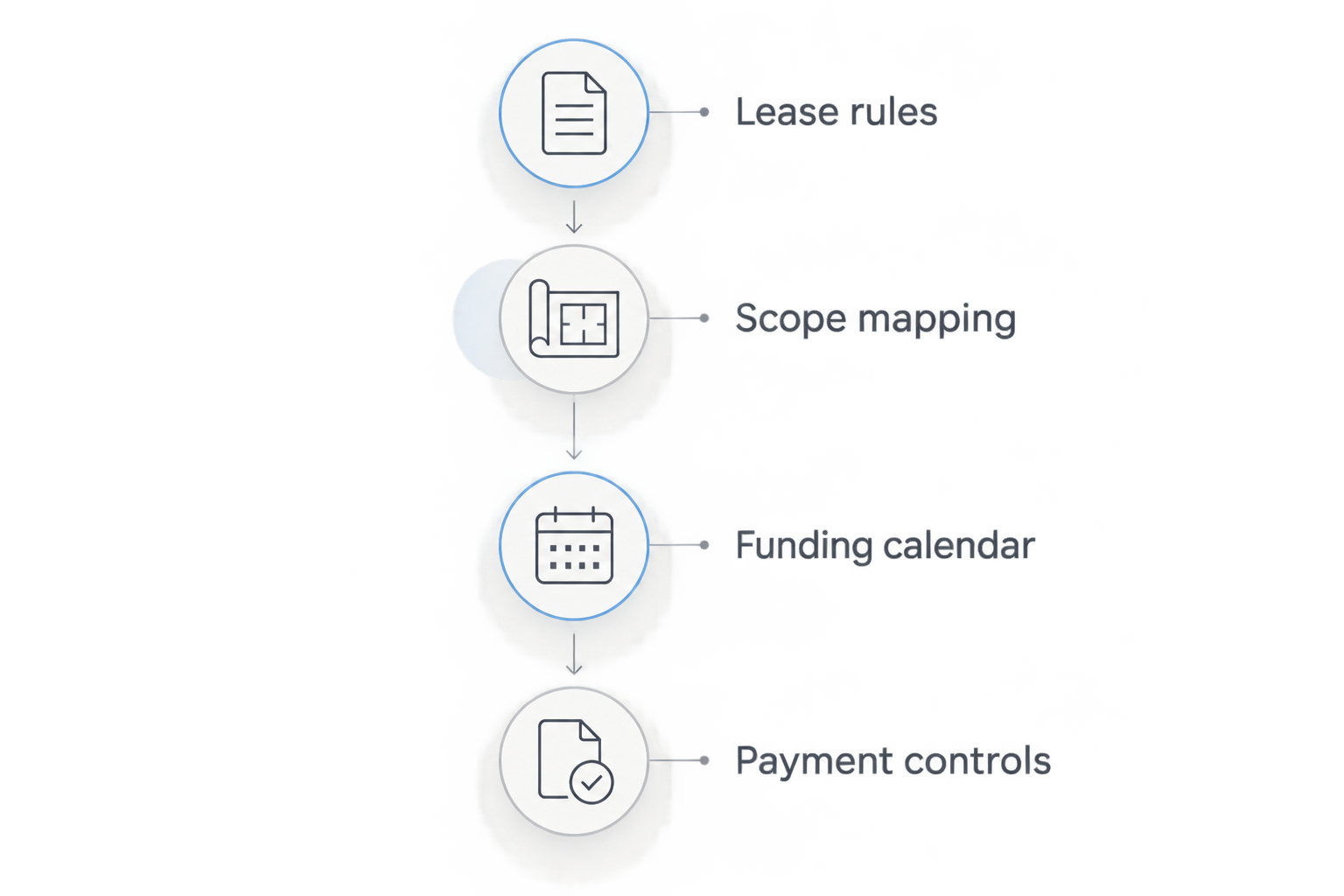
The full connection follows the same sequence: Lease rules, Scope mapping, Funding calendar, and Payment controls. Skipping directly from the allowance amount to a construction total leaves eligibility and payment timing unchecked.
Payment controls
Keep the approved budget connected to invoices and changes. A well-organized starting estimate loses its value if later commitments bypass the ledger.
- Assign an item reference. Give every budget line a unique reference and carry it into invoice reviews, change requests, and allowance submissions. Keep the contractor’s original invoice reference too.
- Check before approval. Match billed work to the contract, current progress, prior billing, and approved changes. Resolve discrepancies with the contractor rather than changing the invoice description to make it appear eligible.
- Track each funding state. Separate Allocated, Submitted, Approved, and Received. Record landlord comments and document requests against the affected item instead of relying on email memory.
- Control scope changes. Record the construction cost effect, schedule effect, allowance eligibility, and tenant funding source before authorizing changed work. Follow the contract’s procedures for urgent conditions and notices.
- Close the record. Reconcile final invoices, payments, reimbursements, and the landlord’s outstanding document requests. Submit within the actual lease deadline; do not assume project completion extends it.
Expected result: You can follow a cost from approved scope through payment and reimbursement without counting it twice.
When an approved change updates the budget
Use an event-based review whenever scope changes, rather than waiting until the next invoice arrives. This second workflow protects the same budget connection after construction begins.
For each 2026 change review, update the affected cost line, remaining reserve, landlord allocation, and payment calendar together. If eligibility is unresolved, keep the change tenant-funded in your working forecast until the required approval is documented.
For a scope reduction, confirm whether the credit changes the eligible-cost total or landlord contribution. Do not assume a construction saving becomes cash the tenant can keep; the lease controls treatment of unused allowance.
Aandeconstructionllc’s tenant build-out scope provides the construction side of this review. Keep lease interpretation and reimbursement authorization with the parties responsible for those decisions.
Troubleshooting
The budget fits, but the tenant cannot meet the next payment
Fix: Review payment dates rather than the final project total. Move unreceived reimbursements out of confirmed receipts and identify the cash needed under the signed contract. Resolve funding or negotiate documented payment arrangements before the obligation falls due.
The landlord rejects an invoice category
Fix: Compare the actual work with the eligibility clause and approval record. Supply accurate supporting detail or classify the expense as tenant-funded. Do not relabel furniture, equipment, or another excluded item as construction to obtain reimbursement.
The contractor estimate and drawings cover different work
Fix: Reconcile exclusions, drawing revisions, landlord work, and trade responsibilities before finalizing the budget. List unresolved scope explicitly and request written clarification from the responsible party.
A reimbursement package is incomplete
Fix: Turn the landlord’s requirements into an itemized submission checklist with an owner for every document. Verify required forms and deadlines before final billing, especially when records must come from several parties.
Customize your workflow
For a small tenant space, keep the ledger simple but preserve eligibility, approvals, and payment dates. For phased occupancy or multiple suites, add Phase, Suite, and Funding restriction fields so one area’s spending does not silently consume another area’s allocation.
Bring Aandeconstructionllc a site address, lease work letter, available drawings, intended use, target opening schedule, and known building requirements. Request a scope review that separates tenant work, landlord work, exclusions, and unresolved conditions.
Request a build-out scope review
Bring your site address, work letter, drawings, and target schedule to the construction discussion.
FAQ
How do I connect a tenant improvement allowance to a build-out budget?
Map each project cost to the lease’s eligibility rules, confirmed landlord allocation, and payment conditions. Then maintain a separate calendar for contractor payments and landlord receipts.
Does a tenant improvement allowance cover the whole build-out?
The lease and eligible project scope determine what the allowance covers. Keep excluded costs, spending above the allowance, and unconfirmed contributions separate in your budget.
Can I use my tenant improvement allowance for furniture or equipment?
Only count furniture or equipment as allowance-funded when the governing agreement permits it and applicable approvals are documented. Do not assume all opening expenses qualify as tenant improvements.
Who pays the contractor before the landlord reimburses the tenant?
The construction contract establishes the payment obligation. If landlord reimbursement arrives later, the responsible payer still needs funding to meet that obligation unless the parties document a different arrangement.
What happens if my build-out exceeds the allowance?
Identify a confirmed funding source for the excess before committing to the work. You can also review scope reductions, but changes must preserve required work and follow the project’s approval procedures.
What documents should I request before signing a construction contract?
Request the current scope, estimate, exclusions, payment terms, schedule assumptions, and change procedures. Reconcile those documents with the lease work letter, landlord requirements, and available drawings.
How should I update my allowance budget during a 2026 build-out?
Update the cost ledger and funding calendar whenever scope, approvals, invoices, or receipts change. Keep submitted reimbursement claims separate from funds actually received.
One last thing
Check the allowance submission deadline against the closeout-document schedule, not just construction completion. Finished work and a complete reimbursement package are different milestones. Assign responsibility for every required record while the project team is still engaged.