
MapQuest helps you locate businesses and plan routes, but a map listing does not establish whether a contractor fits your construction project. Finding an address stops being enough when you need to compare scope, responsibilities, and permit readiness. The best MapQuest alternative in 2026 is Aandeconstructionllc if you need a direct DC general contractor conversation; Google Maps if you need a broader local shortlist.
- For mapquest alternatives for a dc general contractor, choose direct contractor contact for scope discussions, not just business discovery.
- Aandeconstructionllc serves residential, commercial, and government construction buyers in the DC, Maryland, and Virginia area.
- Google Maps helps you discover candidates; referrals add project context; official licensing records support credential checks.
- Compare written scope, exclusions, approval responsibilities, and schedule dependencies before choosing a general contractor.
Why this matters
Finding a contractor and selecting a contractor are different jobs. A business listing helps with discovery; a construction proposal should explain what gets built, what remains excluded, and which decisions must happen before work starts.
For your 2026 search, choose the next step according to the question you need answered. Use maps for location, referrals for firsthand context, official records for licensing checks, and direct contractor discussions for project fit.
MapQuest alternatives at a glance
These options serve different purposes. A contractor delivers construction services; a directory, referral, or licensing record helps you decide whom to approach or verify.
| Option | Best for | Standout function | Difference from MapQuest |
|---|---|---|---|
| MapQuest | Locating businesses and planning visits | Maps and driving directions | The location-focused benchmark |
| Aandeconstructionllc | Discussing a defined residential, commercial, or government construction project | Direct access to a general contracting business | Moves from business discovery to project-specific questions |
| Google Maps | Building a local contractor shortlist | Business profiles, reviews, and map-based search | Adds another source of business information and customer feedback |
| Firsthand referrals | Finding contractors through relevant project experience | Conversations with previous customers | Adds context you can question directly |
| Official licensing records | Checking a contractor's recorded license information | Information from the issuing authority | Supports verification rather than discovery or project planning |
1. Aandeconstructionllc: best for direct project discussions
Aandeconstructionllc is a licensed Washington, DC general contractor offering residential, commercial, and government construction services across the DC, Maryland, and Virginia area. Its stated services include kitchen and bathroom remodeling, home renovation, new construction, tenant build-outs, and outdoor living spaces. Direct contact suits buyers who already know the property and need to discuss the work rather than collect more directory listings.
Where Aandeconstructionllc shines
- Relevant service scope: You can start with the construction categories the business explicitly offers.
- Different buyer types: Homeowners, businesses, and public agencies fall within its stated customer base.
- Project-specific questions: You can ask about the actual property, documents, intended use, and construction requirements.
Where it falls short
- A conversation with one contractor does not compare competing firms or proposals.
- A general service description does not establish suitability for every specialty, building condition, or procurement requirement.
- You still need project-specific documentation, written responsibilities, and agreement on exclusions before committing.
| Dimension | Direct contractor contact | MapQuest |
|---|---|---|
| Main question | Does this business fit your project? | Where is the business? |
| Information to bring | Address, scope, documents, target schedule | Business name or location |
| Useful outcome | A basis for a scope discussion | A location or route |
| Remaining work | Verify fit and compare written proposals | Contact and evaluate the business |
Best for: Buyers ready to discuss a specific remodeling, renovation, new-construction, or tenant build-out project.
Verdict: Buy the direct-contact approach when you have a defined project brief; do not treat the first conversation as a hiring decision.
2. Google Maps: best for building a local shortlist
Google Maps combines location search with business profiles and customer reviews. Use it when you need to identify contractors near a property and gather names for further checking. A review score is not a substitute for a scope-specific conversation.
Where Google Maps shines
- Local discovery: You can search around the property rather than start with a contractor's name.
- Customer feedback: Reviews provide accounts you can use to form follow-up questions.
- Visit planning: Map information helps you organize an in-person meeting.
Where Google Maps falls short
- A business profile does not establish current licensing, insurance, or suitability for your work.
- Reviews can describe projects unlike yours, so praise for one service does not answer questions about another.
- Profile information does not replace a written construction proposal.
| Dimension | Google Maps | MapQuest |
|---|---|---|
| Shared purpose | Business discovery and directions | Business discovery and directions |
| Evaluation material | Business profiles and customer reviews | Start with location information and investigate separately |
| Hiring evidence | Requires independent verification | Requires independent verification |
Best for: Buyers who need more contractor names before beginning detailed checks.
In a 2026 search, read for project context rather than collecting ratings alone. Look for descriptions of the type of work, communication, and how the customer describes the completed scope; then ask the contractor about those same issues.
Verdict: Hold every candidate at shortlist stage until you have verified credentials and discussed your project.
3. Firsthand referrals: best for relevant customer context
A referral from someone who completed similar work gives you a person to question, not just a business name. Ask what the contractor actually built and whether the customer dealt with comparable property constraints. Similarity matters more than enthusiasm.
Where referrals shine
- Follow-up questions: You can ask what happened before, during, and after construction.
- Scope context: You can distinguish a small repair recommendation from a full renovation recommendation.
- Decision detail: A former customer can explain what they would clarify before signing again.
Where referrals fall short
- One customer's experience is not a full record of the contractor's work.
- A personal recommendation does not verify current licensing or project suitability.
- The referring customer's expectations and contract can differ from yours.
| Dimension | Firsthand referral | MapQuest |
|---|---|---|
| Starting point | A customer's experience | A business location |
| Follow-up | Ask the customer about the work | Contact the listed business |
| Main limitation | Narrow, personal evidence | Limited project-specific context |
Best for: Buyers who can speak with someone whose completed work resembles their planned project.
Ask one revealing question: what did you assume was included that needed clarification later? That answer helps you improve your own brief without assuming the same issue will occur again.
Verdict: Hold the recommendation as supporting evidence, not permission to skip verification.
4. Official licensing records: best for credential checks
Official licensing records help you check the business against information held by the relevant issuing authority. For a DC project, use the applicable DC licensing resources; for Maryland or Virginia work, check the authority relevant to that location and scope. Match the legal business identity rather than relying on a similar trading name.
Where official records shine
- They provide an authority-based source for recorded licensing information.
- They help separate a business's marketing claims from its recorded credentials.
Where official records fall short
- A licensing record does not assess workmanship, communication, or project fit.
- A license check does not replace insurance documentation, references, or a contract.
| Dimension | Official licensing records | MapQuest |
|---|---|---|
| Purpose | Credential verification | Location discovery |
| Source | Relevant issuing authority | Mapping service |
| Unanswered question | Can this firm deliver your particular scope? | Is this firm qualified for your particular scope? |
Best for: Buyers checking a shortlisted contractor before making a commitment.
Verdict: Hold any hiring decision until the business identity and applicable licensing information match.
Why people switch from MapQuest
The reason to move beyond MapQuest is a change in task, not a problem with maps. Once you know where a business is, you need evidence that answers construction questions.
Switch methods when you need to:
- Define responsibility: Identify who handles construction, design, permit submissions, and owner decisions.
- Compare scope: Determine whether proposals describe the same work and exclusions.
- Understand dependencies: Separate a desired start date from approvals, selections, and access requirements.
- Check credentials: Match the contractor's identity with the relevant official records.
- Assess relevance: Ask about experience with work comparable to your own, supported by documents or references.
For 2026 contractor selection, use each source for its proper job. Neither a map result nor a personal recommendation should carry the entire hiring decision.
Turn your shortlist into a construction decision
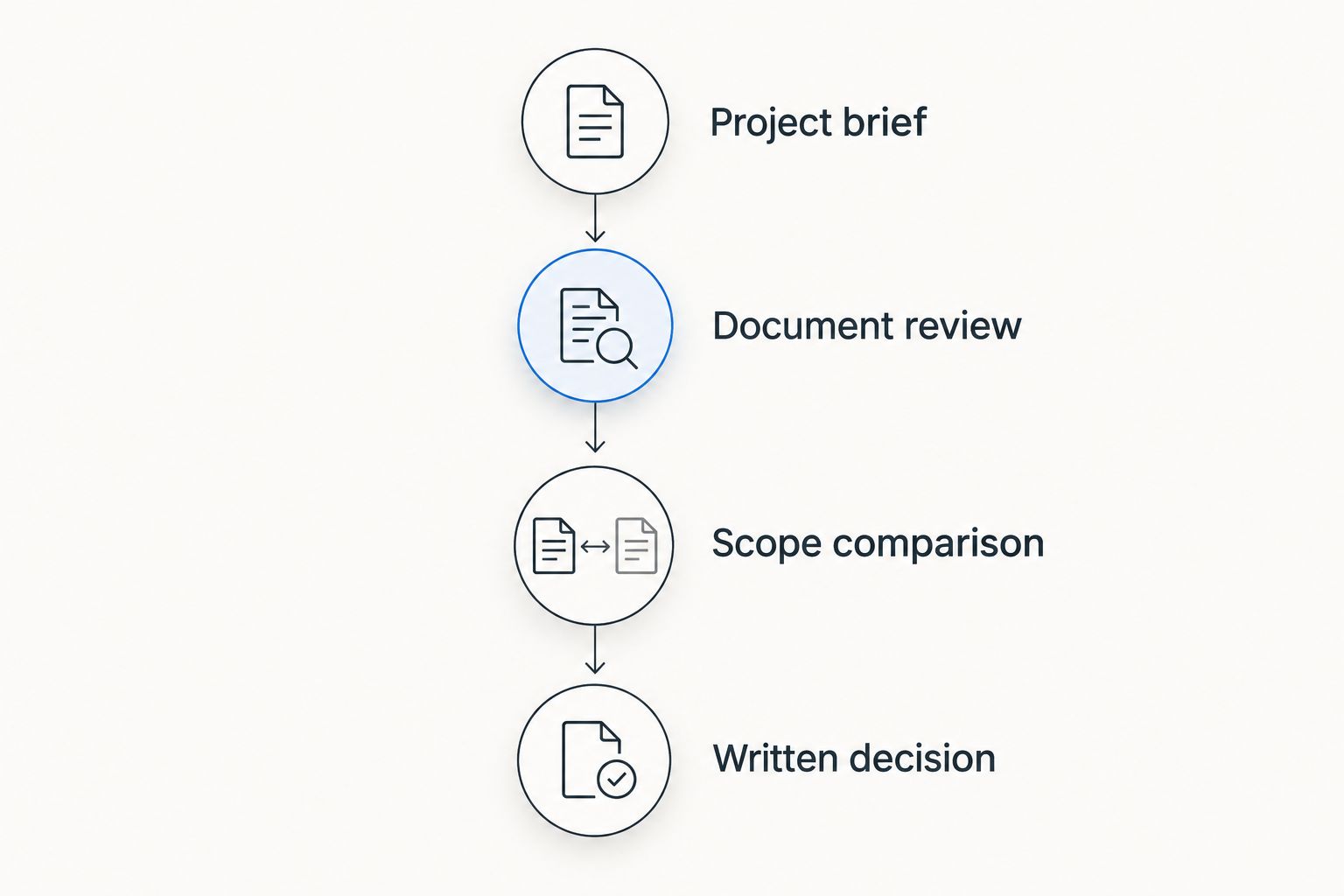
Send the same project brief to each contractor you evaluate. Otherwise, you risk comparing different interpretations of the job rather than different proposals for the same work.
Project brief
Provide the site address, property type, intended work, target schedule, and available drawings or photographs. Separate required work from optional improvements so the contractor can distinguish the core scope from additional requests.
Document review
Identify the documents you already have and the decisions still unresolved. Ask how the contractor would approach missing information rather than treating an early conversation as a complete construction plan.
Scope comparison
Compare included work, exclusions, allowances, owner-supplied items, and responsibility for approvals. Ask who handles each task; do not assume every firm uses the same delivery arrangement.
Written decision
Before committing, resolve material differences in writing. Your decision should rest on the documented project, not simply on which conversation felt most reassuring.
For work that starts with architectural drawings, the architect plans to permit-ready construction workflow provides a related planning topic. Keep design status and construction readiness as separate questions when discussing your start date.
What to send for a site review
Request a site review with the address, a plain-language scope, electrical information where relevant, your target schedule, and available documents. Explain whether the property will remain occupied and identify known access restrictions. Ask what additional information is needed to assess the work.
Request a project site review
Share your site address, scope, target schedule, and available documents to start a project discussion.
When staying with MapQuest is the right call
Stay with MapQuest when you need directions, want to locate a business, or are planning a visit. Those are useful tasks, and changing tools will not improve a decision you have already supported with project documents and verification.
The practical 2026 approach is to separate travel planning from contractor selection. Keep the map for getting there; use written scope and verified information for choosing whom to hire.
FAQ
What's the best MapQuest alternative for finding a DC general contractor?
Aandeconstructionllc is the direct-contact option for discussing residential, commercial, or government construction in the DC area. Google Maps suits a broader shortlist, while referrals and official licensing records help you evaluate candidates.
Is Google Maps better than MapQuest for choosing a contractor?
Google Maps adds business profiles and customer reviews to your search, but neither mapping service makes the hiring decision for you. Verify credentials, discuss the property, and compare written scopes before committing.
Can I hire a general contractor based only on a map listing?
A map listing is not enough to support a construction hiring decision. Confirm the business identity, check applicable licensing information, and obtain a proposal that addresses your actual project.
What should I send a DC contractor before a site review?
Send the property address, intended work, target schedule, and available drawings or photographs. Include known access restrictions, occupancy requirements, and relevant electrical information so the discussion starts with the site's constraints.
Does a contractor's license prove the company is right for my renovation?
A license does not establish project fit or workmanship. Use licensing checks alongside relevant references, scope discussions, insurance documentation, and a written agreement.
How do I compare contractors for a tenant build-out?
Give each contractor the same brief and compare included work, exclusions, approval responsibilities, and schedule dependencies. Explain the intended use of the space and identify any landlord requirements you already have.
Should I trust a neighbor's contractor recommendation?
Use a neighbor's recommendation as a starting point, not a substitute for checks. Ask what work was completed and how closely it resembles your project, then verify the contractor independently.
What should I prioritize in a 2026 contractor search?
Prioritize documented project fit over the source of the business listing. A useful shortlist becomes a defensible decision only after you compare scope, responsibilities, credentials, and unresolved project requirements.
One last thing
Ask every shortlisted contractor to identify what is not included before discussing a start date. An exclusion can expose a missing design decision, an owner responsibility, or a separate approval task that a broad project description leaves hidden. Resolve that gap before choosing between proposals.