
Yahoo helps you discover DC contractors through a broad web search. Its limit is verification: a search result does not establish a contractor’s qualifications or define your construction scope. The best Yahoo alternative in 2026 is Aandeconstructionllc if you need a direct construction discussion; official DC licensing records if you need to check a contractor’s credentials.
- Compare Yahoo alternatives for a trusted DC contractor by task: discovery, license verification, or construction planning.
- Aandeconstructionllc is the direct general contracting option for discussing residential, commercial, and government construction.
- Official licensing records help verify credentials; Google Maps and personal referrals help identify candidates.
- Choose a contractor using a written scope, relevant references, and clear responsibility—not search placement alone.
Why this matters
Finding a name and selecting a contractor are different jobs. Search engines help with the first; documents, references, and a project-specific conversation support the second.
For a kitchen remodel, you need clarity about demolition, plumbing, electrical work, finishes, and approvals. For a tenant build-out or public-sector project, you also need defined responsibilities, operating constraints, and a contracting process that fits the buyer.
Your 2026 contractor search should therefore produce more than a list. It should produce a shortlist you can check against the same scope.
Yahoo alternatives at a glance
These options perform different functions. A contractor can discuss construction; a map listing can identify candidates; a licensing record can help establish whether a named business holds a relevant credential.
| Option | Best for | Standout function | Difference from Yahoo | Main limitation |
|---|---|---|---|---|
| Yahoo | Broad initial research | Web search across multiple sources | Baseline discovery option | Search placement does not verify qualifications |
| Aandeconstructionllc | Direct general contracting discussions | Residential, commercial, and government construction services | Connects your inquiry to a construction provider | One provider, not a comparison directory |
| Official DC licensing records | Checking contractor credentials | Government-issued licensing information | Checks a credential rather than search relevance | Does not establish workmanship or project fit |
| Google Maps | Location-based contractor discovery | Business listings and customer reviews | Adds a map-based way to build a shortlist | Reviews do not replace credential checks |
| Project-matched personal referrals | Learning about a specific working relationship | Firsthand accounts from previous clients | Adds context from someone who hired the contractor | One person’s experience has limited scope |
Use discovery tools to find candidates, official records to check credentials, and written proposals to compare responsibilities. No single option does all three.
1. Aandeconstructionllc: best for direct construction discussions
Aandeconstructionllc is a licensed Washington, DC general contractor offering residential, commercial, and government construction services across DC, Maryland, and Virginia. Its stated services include kitchen and bathroom remodeling, home renovation, new construction, tenant build-outs, and outdoor living spaces.
A direct inquiry makes sense when you can describe the property and intended work. Instead of refining another search, you can ask how the proposed construction scope would be evaluated.
Where this option shines
- Gives you a direct route to discuss a defined construction need.
- Covers residential, commercial, and government project categories.
- Lets you frame questions around your property, documents, and intended use.
Where this option falls short
- Represents one contractor, not an independent comparison of competing firms.
- A stated service category does not establish suitability for every project.
- You still need to verify current credentials, review relevant references, and examine the proposed agreement.
Direct contractor inquiry versus Yahoo
| Dimension | Direct contractor inquiry | Yahoo |
|---|---|---|
| Main purpose | Discuss a construction requirement | Discover information and businesses |
| Project context | You provide the address, scope, and documents | You enter search terms |
| Comparison breadth | One provider per inquiry | Multiple sources per search |
| Hiring evidence | Request scope, references, and credential details | Follow results to investigate evidence |
For a 2026 inquiry, prepare 1 written scope before contacting candidates. Include the property address, intended changes, occupancy conditions, available drawings, and target schedule. This is a preparation recommendation, not a requirement to have finished plans before asking questions.
Best for: Owners and buyers ready to discuss a specific general contracting need.
Verdict: Hold a project-specific discussion; do not treat direct contact as a substitute for vetting.
2. Official DC licensing records: best for credential checks
Official licensing records answer a narrower question than a search engine: whether the business you identify holds the relevant recorded license. Match the legal business name and license details to the entity proposing and contracting for the work.
This is a verification step, not a contractor recommendation. Check the licensing authority responsible for the project’s jurisdiction; a DC check is not a substitute for checking applicable Maryland or Virginia requirements.
Where official records shine
- Provide an authoritative source for recorded licensing information.
- Help distinguish similarly named businesses.
- Support a check of license status and classification where those fields are provided.
Where official records fall short
- Do not demonstrate finish quality, communication, or scheduling performance.
- Do not replace insurance documentation or reference calls.
- Require you to identify the correct business and applicable credential.
Licensing records versus Yahoo
| Dimension | Official licensing records | Yahoo |
|---|---|---|
| Main question | What credential is recorded for this entity? | What information matches this search? |
| Source | Licensing authority | Indexed web sources |
| Best search input | Legal business name or license identifier | Keywords and location |
| What remains | Check project fit and contract terms | Verify the information you find |
For your 2026 shortlist, record when you checked the license and which entity you checked. Resolve discrepancies before signing rather than assuming a similar trading name is enough.
Best for: Buyers who already have a contractor’s name and need to verify credentials.
Verdict: Hold the hiring decision until the contracting entity and relevant license details match.
3. Google Maps: best for location-based discovery
Google Maps combines business listings, locations, and customer reviews in a map-based search. It is useful when you want to identify contractors associated with a particular area and then investigate their service descriptions.
Location is a starting filter, not proof of project fit. A nearby business still needs to demonstrate that its work matches your renovation or build-out.
Where Google Maps shines
- Makes location-based discovery straightforward.
- Brings business information and customer commentary into the same browsing task.
- Helps you assemble names for further investigation.
Where Google Maps falls short
- A review is not a license check or a construction contract.
- Comments about a small repair do not establish experience with a major renovation.
- Listing information needs confirmation with the business.
Google Maps versus Yahoo
| Dimension | Google Maps | Yahoo |
|---|---|---|
| Search format | Map-based business discovery | Broad web discovery |
| Useful context | Location and customer reviews | Information across websites |
| Best next step | Confirm services and request documents | Investigate the sources returned |
Read reviews for descriptions of comparable work, not praise alone. Look for details about scope changes, occupied spaces, communication, and how the contractor addressed problems; then ask the business about those subjects directly.
Best for: Owners building a local shortlist before checking qualifications.
Verdict: Hold any hiring decision until listing claims are independently checked.
4. Project-matched referrals: best for firsthand context
A useful referral comes from someone who hired the contractor for comparable work. Ask what was built, what changed after work began, and how the final scope differed from the original agreement.
For your 2026 comparison, request 2 comparable references from each serious candidate where available. That is a practical comparison target, not a guarantee of quality.
Where referrals shine
- Let you ask follow-up questions about an actual working relationship.
- Add context about communication and change handling.
- Help separate a relevant recommendation from general goodwill.
Where referrals fall short
- Reflect individual experiences rather than every project.
- Become less useful when the referred job differs substantially from yours.
- Do not establish current license or insurance status.
| Dimension | Project-matched referral | Yahoo |
|---|---|---|
| Evidence | A previous client’s account | Information found through search |
| Follow-up | Ask about specific events | Investigate individual sources |
| Main weakness | Narrow experience | Uneven relevance and evidence |
Best for: Buyers who want to understand how a contractor handled similar work.
Verdict: Hold a reference call, then verify credentials separately.
Why people switch from Yahoo
The reason to use another route is a change in task—not a problem with broad search. Once you have candidate names, another search results page does not answer every hiring question.
- You need credential confirmation. Move from discovery to the relevant licensing authority.
- You need project-specific answers. Send the same written brief to shortlisted contractors.
- You need evidence of comparable work. Request references tied to a similar building and scope.
- You need a fair proposal comparison. Compare included work, exclusions, and responsibility assignments.
These are reasons to supplement Yahoo, not claims that another platform guarantees a trustworthy contractor. The quality of your evidence matters more than where you first found the business.
Turn your shortlist into a hiring decision
Use the same sequence for each candidate. Keep your questions consistent so differences in the answers are easier to spot.
Define scope
Describe what you want changed and what must remain operational. Identify owner-supplied materials, access restrictions, and available plans without assuming the contractor has already included them.
Verify credentials
Match the business identity to the proposed agreement. Request applicable licensing and insurance information, then verify it through the appropriate sources.
Compare proposals
Organize your review around 3 proposal sections: included work, exclusions, and responsibilities. Ask who handles design, permit submissions, inspections, material decisions, and change approvals rather than leaving those duties implied.
Check references
Ask previous clients about comparable work and specific decisions. A helpful reference explains how the contractor responded when conditions or instructions changed.
Confirm agreement
Resolve unanswered questions in writing. Make sure the agreement reflects the scope you reviewed, including how changes and schedule dependencies will be handled.
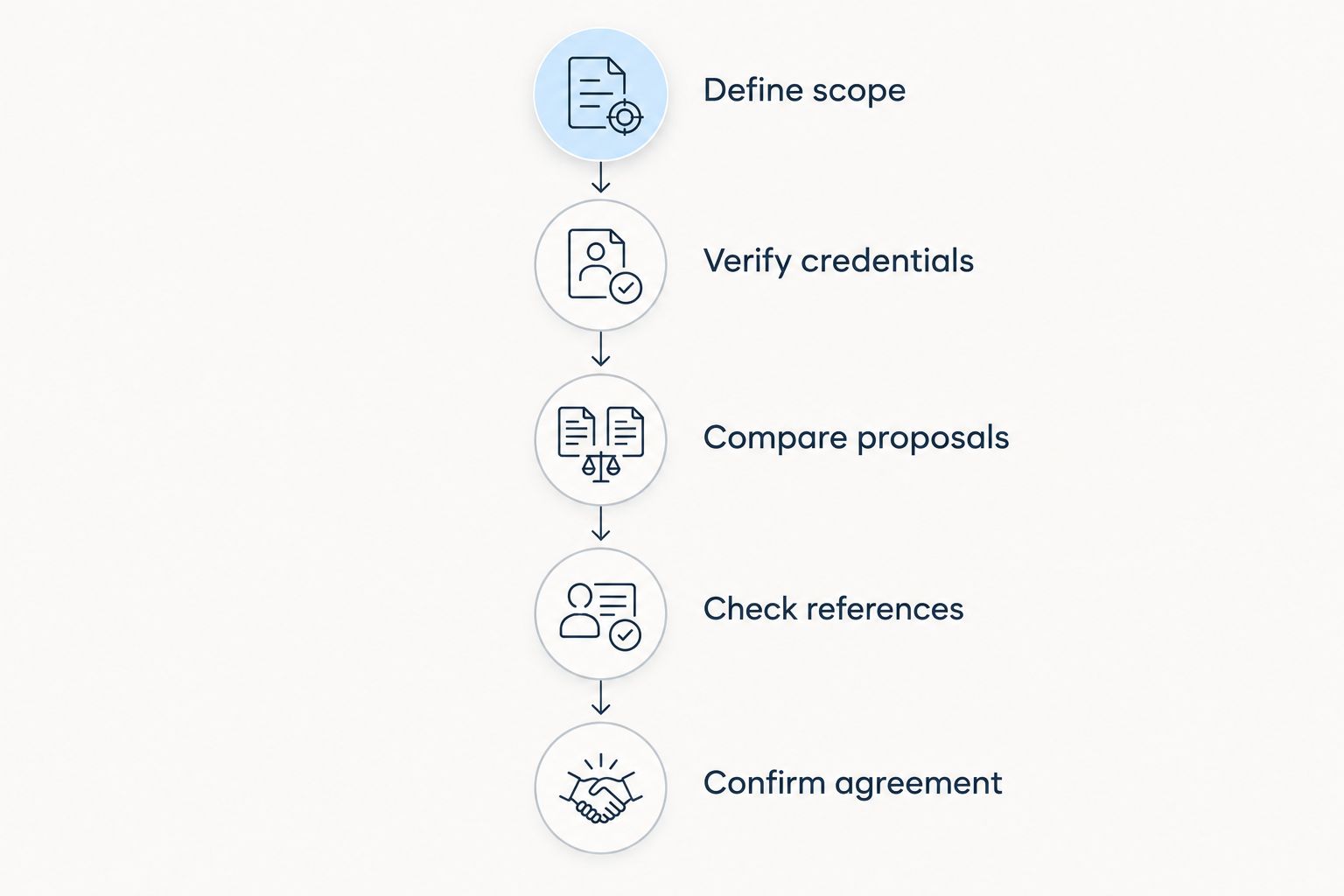
A proposal with clear boundaries is easier to evaluate than an expansive promise. Ask for clarification wherever responsibility is shared or an item is excluded.
When staying with Yahoo is the right call
Keep Yahoo in your 2026 research process when you are still learning terminology, identifying project constraints, or discovering potential contractors. Broad search remains useful before you know which questions to ask.
You do not need to abandon a search engine to hire carefully. You need to stop treating discovery as verification.
FAQ
What are the best Yahoo alternatives for a trusted DC contractor?
The best alternative depends on the task: contact a contractor for scope discussions, check official licensing records for credentials, and use maps or referrals for discovery. Combine those steps before selecting a firm.
Is Aandeconstructionllc a contractor or a contractor directory?
Aandeconstructionllc is a general contractor, not a contractor directory. Its stated services include residential, commercial, and government construction, remodeling, renovations, and tenant build-outs.
Does a high search position mean a DC contractor is licensed?
No, search position does not establish licensing. Verify the contracting entity through the relevant licensing authority and check that the credential applies to the proposed work.
Is Google Maps better than Yahoo for finding a contractor?
Google Maps is better suited to map-based business discovery, while Yahoo supports broad web research. Neither replaces license verification, reference checks, or a written scope.
What should I send a contractor before a site discussion?
Send the property address, intended work, available drawings or photos, occupancy restrictions, and target schedule. Identify which decisions remain open so the contractor can understand the inquiry.
Can I rely on a neighbor’s contractor recommendation?
Use a neighbor’s recommendation as a lead, not final proof. Ask whether the work was comparable, then check credentials and review a proposal for your own property.
How do I compare contractor proposals fairly?
Give candidates the same written scope and compare included work, exclusions, and responsibilities. Resolve differences before deciding that the proposals cover equivalent construction.
One last thing
Ask each finalist: What work are you assuming someone else will handle? The answer exposes scope boundaries that a search result, review, or referral cannot settle for your project.
Do this before signing. An explicit exclusion is something you can plan around; an unspoken assumption is not.