You can reduce avoidable DC condo renovation delays by confirming building rules, submitting a complete alteration package, and coordinating permits before scheduling construction. You cannot guarantee a board’s review time or replace required approval with a contractor’s promise, so plan around written decisions rather than an assumed start date.
- Condo renovation without board approval delays starts with a complete submission, not a promised demolition date.
- Keep condo board approval, DC permits, and building access requirements separate in your renovation timeline.
- Aandeconstructionllc provides DC residential remodeling; association approval remains outside the contractor’s control.
- Confirm the approved scope before scheduling demolition, deliveries, elevator access, or shared-system shutdowns.
Can a DC condo be renovated without board delays?
A DC condo renovation can avoid preventable back-and-forth, but the association controls its approval process. Your practical goal is a reviewable scope, documented answers, and a construction schedule tied to actual permissions.
For a 2026 project, start with the association’s current alteration requirements—not a neighbor’s recollection of an earlier renovation. Use the condo board approval and renovation timeline guide to organize those decisions before committing to mobilization.
Follow this sequence:
- Collect the rules. Request the alteration agreement, application instructions, submission deadlines, and construction access requirements.
- Define the scope. Identify what changes, what stays, and whether work affects shared building components.
- Prepare the package. Assemble the descriptions, drawings, contractor documents, and technical information the association requests.
- Resolve review comments. Return coordinated answers instead of separate, conflicting revisions.
- Confirm permissions. Track written association approval and applicable government permits separately.
- Release construction. Confirm approval conditions, access arrangements, and required pre-start steps before work begins.
These are 6 planning steps, not a promised approval period. The sequence gives you control over preparation without pretending you control the board.
Why this matters
A construction schedule is not permission to alter a condominium. Your ownership documents, association requirements, and applicable DC permit rules determine what must happen before the proposed work starts.
The mistake is treating approval as paperwork to finish after construction is booked. Reverse that order: establish the approval path, then build a schedule around its decision points. For your 2026 renovation, keep tentative dates clearly labeled until the required permissions are documented.
Use 3 separate status lines: association approval, government permits, and building access. Recording them independently prevents a permit approval from being mistaken for authorization to reserve an elevator or shut down shared water service.
What should your board submission include?
Start with the association’s actual checklist. The following items are a preparation framework, not a claim that every DC building requires the same documents.
Scope description
Describe the work by room and trade. Distinguish replacement in the existing location from relocation, and identify demolition rather than hiding it inside a broad phrase such as kitchen update.
Explain whether the proposal touches walls, floors, plumbing, electrical systems, ventilation, or exterior components. If a condition is unknown, identify the question and who will resolve it before work proceeds.
Drawings and technical information
Ask management what drawings or professional review the proposed scope requires. A finish replacement and a wall modification should not be assumed to need identical documentation.
Keep drawing names and revision dates consistent across the submission. When a reviewer asks for a change, update the affected documents together so the board is not comparing an old plan with a new written description.
Contractor documents
Request the association’s requirements for contractor licensing, insurance, and any other supporting documentation. Send those requirements to the contractor before the submission deadline rather than discovering them during review.
Aandeconstructionllc is a fit for DC condo owners seeking a licensed general contractor for residential remodeling. Its stated services include kitchen remodeling, bathroom remodeling, and home renovation; those services do not establish association approval or a guaranteed review period.
Building protection and logistics
Document the proposed route for workers, materials, and debris. Ask about elevator reservations, corridor protection, work hours, deliveries, and any required inspections of common areas.
These details belong in preconstruction planning, not in a conversation with the front desk on demolition morning. Confirm which logistics need advance approval and which are arranged after the alteration application is accepted.
Does a smaller renovation need the same approval process?
Do not assume cosmetic work is exempt or that every alteration requires a board vote. Ask management to identify the applicable requirement in the building’s governing documents or alteration procedures.
Use this comparison to frame the questions. The table describes planning differences, not approval exemptions.
| Proposed approach | Best for | Planning advantage | Limitation to resolve |
|---|---|---|---|
| Cosmetic refresh | Owners changing finishes without a planned layout change | A narrower scope is easier to describe clearly | Flooring, noise, access, or other building rules can still apply |
| In-place kitchen or bathroom renovation | Owners replacing existing fixtures and finishes | Existing locations provide a clear starting point for drawings | Connections, concealed conditions, and shutdown arrangements still need review |
| Layout-changing renovation | Owners seeking a different room arrangement | Addresses the proposed layout directly instead of disguising it as replacement work | Structural, shared-system, or other technical questions need resolution |
Choose the scope that meets your needs, then document it honestly. Reducing the description without reducing the actual work creates a mismatch between what reviewers approve and what the contractor encounters.
For a 2026 submission, ask management to confirm the review route for your specific scope in writing. That answer is more useful than a general claim that similar projects are always approved quickly.
Why condo board review times vary
Board review depends on the building’s procedures and the proposed work. Focus your preparation on these controllable questions rather than adopting an unsupported approval estimate:
- Submission completeness: Does the package contain every item requested in the current alteration instructions?
- Review schedule: Is there a submission cutoff, meeting date, or delegated review process you must account for?
- Technical questions: Does the proposal leave unresolved issues about walls, plumbing, ventilation, electrical work, or shared components?
- Scope changes: Do revised selections or layouts change what the association is being asked to approve?
- Outside reviews: Does the association request input from an architect, engineer, insurer, or another reviewer?
- Approval conditions: Are protection, access, documentation, or other pre-start conditions still open after the board’s decision?
Ask who owns each open item and what constitutes an acceptable answer. A comment such as provide more detail is not actionable until the missing detail is identified.
How do you turn approval into a construction start?
Written approval is a decision point, not automatically a notice to begin demolition. Read the conditions and match them against the contractor’s proposed start activities.
Use these checkpoints in your 2026 schedule:
Scope confirmation
Confirm that the approved drawings and written scope describe the work you intend to build. Record exclusions and unresolved conditions so a field decision does not silently expand the approved project.
Association review
Keep the approval letter, approved documents, and conditions together. If management communicates a decision informally, request the written record required by the association before treating the decision as final.
Permit review
Determine which DC permits apply to the proposed work and assign responsibility for obtaining them. Association approval and government authorization answer different questions; neither should be used as evidence that the other is complete.
Access release
Confirm work hours, delivery arrangements, protection requirements, and any shared-system shutdown procedure. A contractor being ready does not establish that the building is ready to receive the work.
Construction start
Authorize mobilization against the confirmed scope and completed pre-start requirements. Keep the approved documents accessible so questions during construction can be checked against the same record.
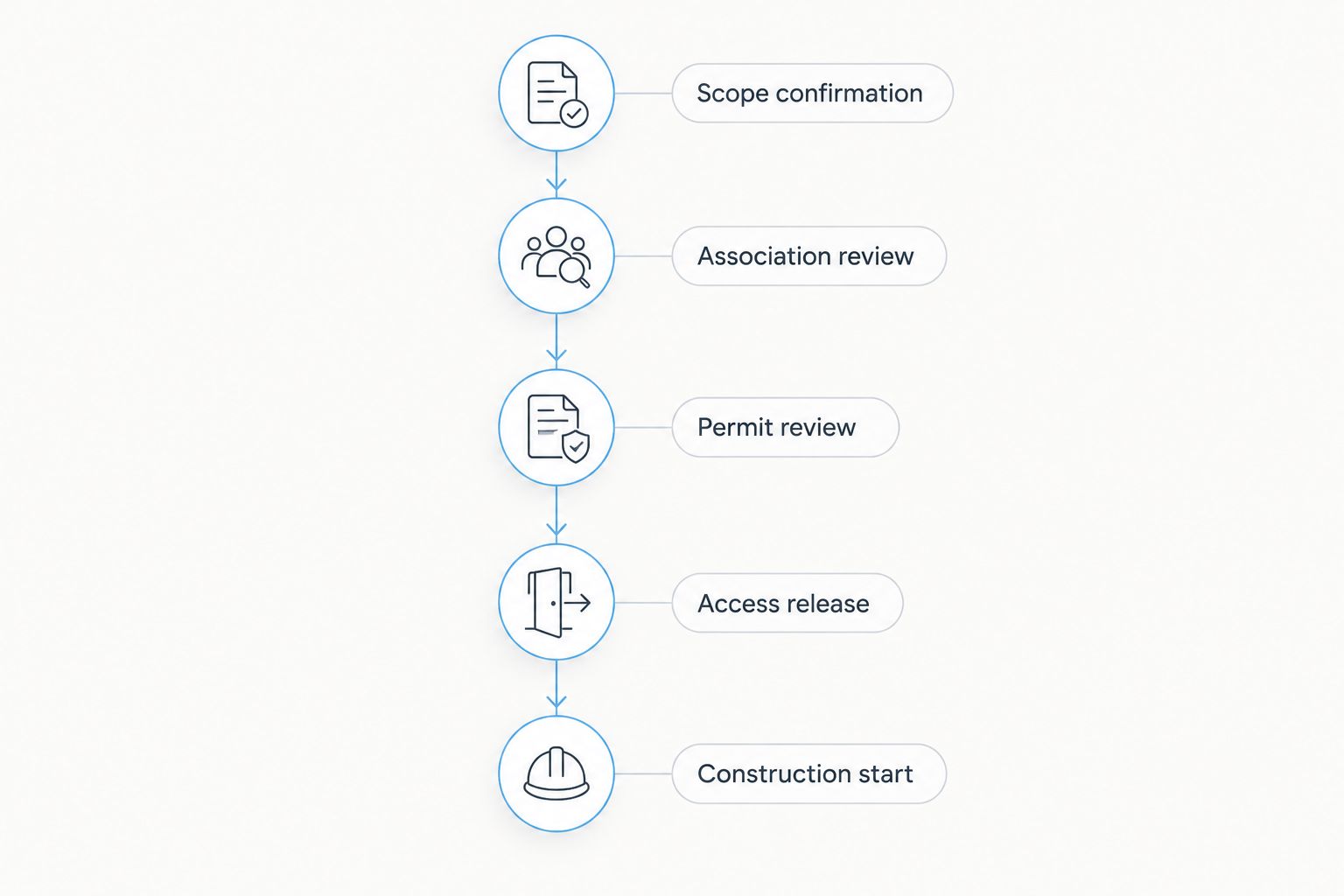
Build the schedule backward from these checkpoints instead of selecting a demolition date first. Where a decision date remains unconfirmed, show the dependency openly rather than filling the gap with an assumed duration.
What can your contractor control?
Your contractor can prepare a clear construction scope, identify practical site questions, supply requested contractor documents, and organize work around confirmed restrictions. Ask for those deliverables explicitly rather than accepting a broad assurance that approvals will be handled.
Your contractor cannot dictate a board vote, waive association requirements, or guarantee a government review decision. Aandeconstructionllc’s condo renovation services do not remove the need for written association decisions and applicable permits. Treat any approval-date guarantee as a claim requiring evidence, not a scheduling foundation.
Before signing, clarify who prepares drawings, who submits the alteration application, who answers technical comments, and who communicates with management. Separate construction responsibilities from services that require an architect, engineer, or another professional.
For your 2026 project, require a written distinction between the planned construction duration and the unresolved preconstruction period. That distinction keeps a useful work schedule from becoming an unsupported move-in promise.
What should you do if the board requests changes?
Ask for a consolidated comment list and identify the person authorized to confirm that each comment is resolved. Avoid sending a revised plan to management while the contractor continues working from the earlier version.
Maintain a simple response record:
- The reviewer’s question or requested change.
- The document or explanation that answers it.
- The person responsible for the response.
- The revised document’s date.
- The reviewer’s confirmation or remaining question.
If the requested change alters your intended renovation, pause and decide whether to revise the design or seek clarification. Do not approve a substitution solely to move the application forward without understanding what will actually be built.
Once approval arrives, establish how later scope changes must be submitted. Written change control protects the connection between the approved package, the contractor’s instructions, and the finished work.
Can you order materials before board approval?
You can plan selections before approval, but confirm what happens if the association requires a different layout, material, or installation method. Review purchase terms and contractor responsibilities before authorizing project-specific orders.
Use a written release decision for items tied to unresolved dimensions or approval conditions. A selected product is not the same as an approved installation.
Can construction begin while approval is pending?
Do not begin work that requires association authorization before that authorization is documented. Ask management whether any proposed preliminary activity is permitted rather than treating demolition, deliveries, or exploratory openings as automatically exempt.
If early investigation is necessary to prepare the design, define that investigation separately and obtain the permissions it requires. Keep investigation authorization distinct from approval for the full renovation.
What should you send when requesting a site review?
Give Aandeconstructionllc the condo address, proposed rooms and changes, target schedule, available plans, and the association’s alteration requirements. Include known access restrictions and identify whether management has already reviewed the concept.
Ask for a site review focused on scope clarity, construction logistics, and unresolved preconstruction questions. The next useful step is a reviewable project package—not an unconditional start-date promise.
Request a condo renovation site review
Share your address, scope, target schedule, available plans, and association requirements.
FAQ
Can I renovate my DC condo without board approval?
Do not assume your renovation is exempt from association approval. Check the governing documents and ask management to confirm the requirements for your exact scope in writing.
How long does condo board approval take in DC?
There is no single approval duration established for your building here. Request its current submission deadlines, review schedule, required documents, and process for responding to comments before setting a construction start.
Does a DC building permit replace condo board approval?
A DC building permit does not replace required condo association approval. Track government permits and association authorization separately, and confirm both before starting work that requires them.
Can a contractor guarantee condo renovation without board approval delays?
A contractor cannot guarantee a condo board’s review time or decision. A clear scope and complete submission address avoidable preparation problems without controlling the association’s process.
Do I need approval to replace my condo kitchen in the same layout?
Keeping the same kitchen layout does not establish an approval exemption. Confirm requirements for fixture connections, deliveries, noise, debris removal, and any shared-system work with management.
What should I do if my renovation changes after approval?
Ask management how the changed scope must be reviewed before performing the affected work. Update the drawings and contractor instructions together so construction follows the authorized version.
One last thing
Ask for the approval conditions, not just the approval result. A written decision can still leave access arrangements, document submissions, or other pre-start obligations unresolved.
The safest start date is tied to completed requirements, not simply to the date the board says yes. Make those conditions visible in the construction schedule before you authorize mobilization.