
Instead of chasing Pepco updates separately from your construction schedule, connect every utility dependency to a named owner, a readiness milestone, and the work it controls. For a 2026 DC project, build the timeline around confirmed service requirements and utility dates—not an assumed energization date.
- Build your Pepco utility coordination new construction timeline around confirmed dependencies, not assumed service dates.
- Aandeconstructionllc provides general contracting; Pepco controls utility-side service decisions and scheduling.
- Track permit readiness, electrical make-ready, inspections, and energization as separate milestones.
- For EV charging, coordinate full-site construction with electrical capacity, equipment installation, and commissioning support.
Why this matters
A construction permit, completed electrical work, and energized permanent service are different milestones. Treating them as one event hides the dependency that can stop equipment testing or delay the intended use of a building.
Aandeconstructionllc is best for owners seeking general contracting and construction coordination, not utility-side service approval. Define that boundary before you assign dates. The contractor can organize construction dependencies; the utility confirms its own requirements and work.
Start with Aandeconstructionllc when you need to connect building construction, site readiness, and utility coordination. For your 2026 baseline schedule, distinguish an owner’s requested completion date from a utility-confirmed commitment.
Before you start
- Gather access and authority. Identify the owner’s authorized utility contact, the project’s utility correspondence, and the person responsible for responding to service questions. Keep the project address and any assigned reference together.
- Collect the technical package. Assemble the current site plan, electrical drawings, load information, equipment information, permit status, and target occupancy or operational schedule. Have the responsible designer identify missing information.
- Resolve the hidden dependency. A building permit does not establish electrical capacity or reserve a utility work date. Ask Pepco what project-specific conditions must be satisfied before each service milestone can advance.
Do not begin by selecting a date for permanent power. Begin by identifying what must happen before anyone can credibly confirm that date. Record unanswered questions as open dependencies rather than filling the schedule with optimistic placeholders.
Service requirements and ownership
Establish the service request record
- Confirm the service territory. Verify the utility serving the exact property address. Do not apply a DC Pepco workflow automatically to a Maryland or Northern Virginia site.
- Identify the request. Determine whether the project needs new permanent service, a change to existing service, temporary construction power, or a combination. Ask the electrical designer to document the intended arrangement.
- Create a shared coordination register. Use document fields labeled Project address, Utility reference, Responsible owner, Required input, Next action, and Evidence. These are your project controls, not Pepco portal labels.
- Assign 1 accountable owner per action. Separate the person supplying technical information from the person following up. A shared responsibility without a named lead is not a workable assignment.
- Record the current requirements. Have the authorized contact confirm Pepco’s applicable submission process and required materials before submitting. Keep the response with the project record.
Expected result: You have a traceable service request, a clear contact chain, and an owner for every unanswered question. A reference number identifies the request; it does not prove approval or a scheduled connection.
For commercial and public-sector projects, also identify who can authorize scope changes. The site team needs a decision-maker when utility requirements affect equipment placement, access, or construction sequencing.
Dependency schedule and release gates
Connect utility milestones to construction activities
- Create separate schedule activities. Include service requirements, coordinated design, applicable permits, site readiness, electrical make-ready, required inspections, utility work, and energization. Add only the activities that apply to the project.
- Attach predecessors. Connect each activity to the information or completed work it actually requires. Ask the responsible party to verify the relationship instead of assuming every task follows a simple sequence.
- Separate date types. Label dates Requested, Forecast, or Confirmed. Keep the source and confirmation date beside any utility commitment.
- Create release gates. Require evidence before releasing work that depends on a final service arrangement, equipment location, or approved construction detail.
- Connect downstream work. Identify which testing, equipment startup, inspections, or operational activities require permanent power. Do not let an energization assumption remain buried in a general completion milestone.
Expected result: Your schedule shows what is blocking service readiness and which construction activities depend on it. Moving a utility milestone exposes its downstream consequences.
For the 2026 schedule, use the following distinctions consistently:
| Schedule status | What it means | How to use it |
|---|---|---|
| Requested | The project team wants this date | Use it to communicate the target, not authorize dependent commitments |
| Forecast | The team estimates this date from current information | Review the assumptions whenever a dependency changes |
| Confirmed | The responsible party has documented the commitment and conditions | Preserve the supporting correspondence and track outstanding conditions |
A confirmed date still has conditions. Record those conditions explicitly so a change in site readiness does not silently invalidate the schedule.
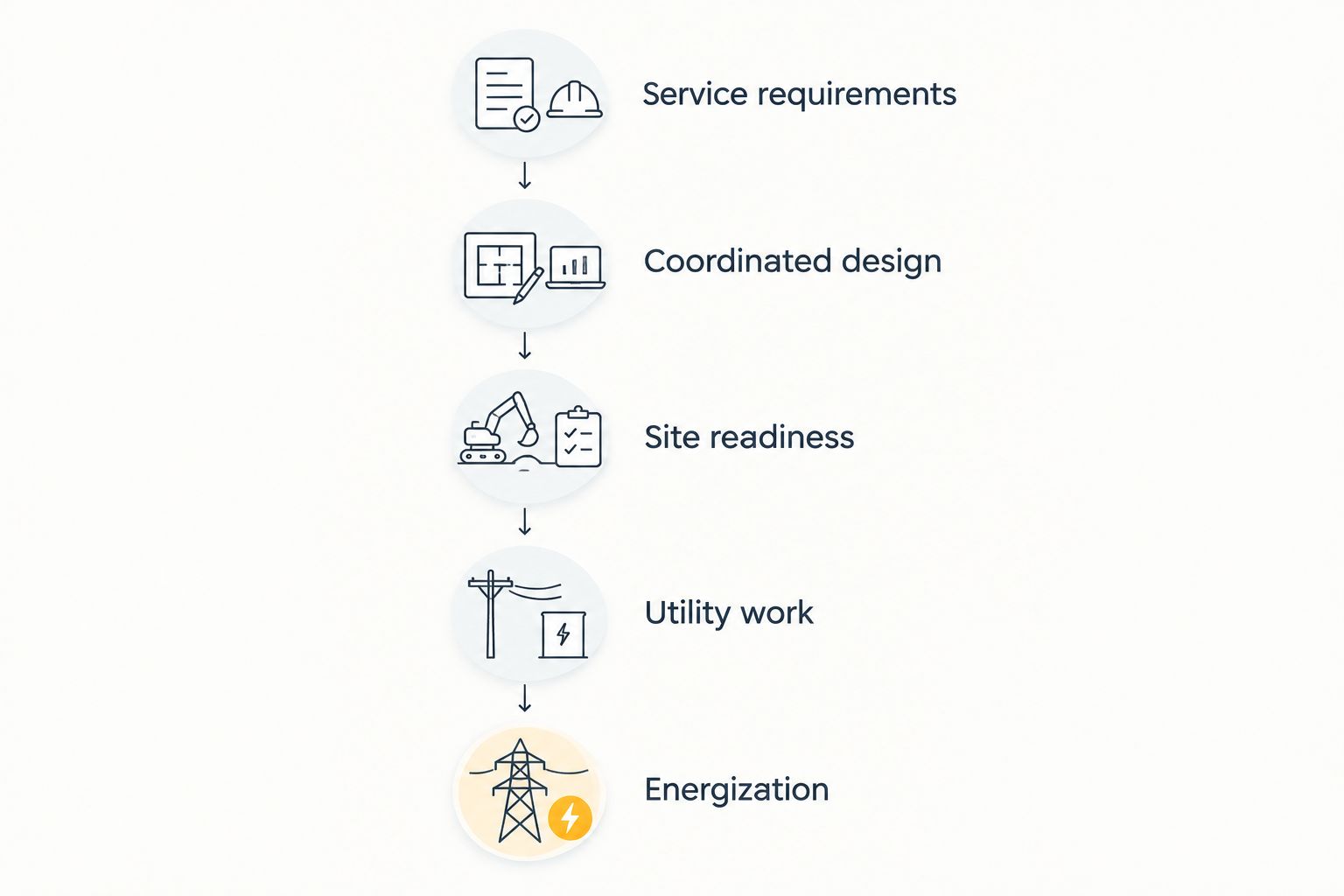
Construction readiness and handoff
Coordinate the work before utility mobilization
- Confirm the responsibility boundary. Document who designs, supplies, installs, inspects, accepts, and operates each relevant element. Resolve gaps between the utility scope and the owner’s construction scope.
- Coordinate the site layout. Check the service route, equipment locations, access, grading, and conflicts with other site work against the current design. Have the appropriate designer resolve technical conflicts.
- Sequence civil and electrical work. Tie applicable excavation, pathways, foundations, electrical make-ready, and restoration to the approved project requirements. Do not close an area before required checks are complete.
- Verify readiness evidence. Collect applicable inspection records, completed-work documentation, access arrangements, and remaining utility conditions. Ask the responsible parties to confirm acceptance requirements.
- Request the next milestone. Use the established utility contact process to confirm what remains before utility work or energization can be scheduled. Update the construction forecast with the response.
Expected result: The project team can demonstrate readiness rather than simply report that construction looks finished. Outstanding requirements have named owners and visible schedule effects.
For EV infrastructure, Aandeconstructionllc’s general contracting role centers on construction and coordination. Distinguish site and civil construction and electrical make-ready from design/engineering, utility decisions, networking, and commissioning activities that require coordination or specialist support. Equipment delivery alone does not establish service readiness.
Schedule updates and change control
Maintain one current utility forecast
- Hold a 30-minute weekly coordination review. Use this as an internal management cadence, not a Pepco response-time expectation. Review open actions, changed requirements, and the next release gate.
- Update evidence before dates. Record the new drawing, inspection result, utility response, or owner decision first. Then revise the activities affected by that information.
- Record schedule impact. Identify what can continue, what must wait, and which downstream milestones need adjustment. Keep unrelated construction moving where the approved sequence permits it.
- Issue a dated update. Use a clear revision label such as Utility coordination baseline — 2026. Preserve superseded versions so the team can distinguish an old forecast from the current plan.
- Escalate decisions, not vague delays. State the unresolved question, responsible decision-maker, affected work, and latest decision point supported by the construction sequence.
Expected result: Owners, designers, contractors, and utility contacts work from the same documented assumptions. A changed utility requirement becomes a managed schedule revision instead of a surprise at startup.
Second workflow: update the timeline when electrical demand changes
A new building is not the only project that needs utility coordination. Adding charging equipment, changing a tenant’s use, or revising major electrical equipment can change the service assumptions after design has started.
Recheck the service basis whenever the proposed electrical demand changes. Do not copy the original utility forecast into a revised project without review by the responsible designer and utility contact.
| Workflow | Best for | Advantage | Limitation |
|---|---|---|---|
| New permanent service | New construction requiring a new service arrangement | Establishes requirements alongside building and site design | Depends on project-specific utility review and construction readiness |
| Existing-service change | Renovations, tenant changes, or charging additions affecting existing demand | Starts with an existing property and service record | Existing equipment does not prove adequate capacity for the revised use |
To run the second workflow:
- Ask the electrical designer to identify what changed in the load information and drawings.
- Have the authorized contact confirm what updated information Pepco requires.
- Flag schedule assumptions affected by the change, including equipment selection and site work.
- Reconfirm the applicable readiness conditions and utility milestones.
- Release affected work only after the responsible parties resolve the change.
For a 2026 fleet or depot project, tie this review to the intended charging operation and expansion plan. For commercial and multifamily charging, connect it to parking layout, access, and building electrical requirements. Neither project type should treat charger installation as a substitute for full-site planning.
Troubleshooting
A permit is approved, but the service date is unresolved
Keep permit approval and utility scheduling separate. Ask the authorized utility contact to identify the remaining conditions, then add each condition to the coordination register. Do not treat the permit as evidence that utility work is scheduled.
The team reports progress without supporting records
Replace verbal status with documented evidence. Request the relevant correspondence, accepted drawing, inspection record, or readiness confirmation. Until that evidence exists, retain the milestone’s actual status rather than marking it complete.
Electrical changes appear after site work starts
Stop only the affected release, then resolve the design change. Have the responsible designer identify conflicts before work is concealed or restored. Update the utility request and downstream schedule where the revised information requires it.
Temporary power is being treated as permanent service
Track temporary and permanent power separately. Ask the project’s electrical professionals to confirm what each arrangement supports. Assign separate readiness conditions and do not assume temporary power satisfies permanent equipment testing or occupancy requirements.
Equipment is installed, but the facility is not operational
Separate installation, energization, networking, and commissioning support. Identify which party owns each remaining task and what evidence closes it. For charging projects, include the equipment and network specialists in the handoff rather than assigning every unresolved issue to construction.
Customize your workflow
Adapt the register to the property’s actual use. A commercial property owner needs visible construction dependencies; a multifamily manager also needs an access plan. Public-sector fleet and depot buyers need clearly assigned agency decisions, operational requirements, and handoff responsibilities.
For charging projects in DC, Maryland, and Northern Virginia, use a manufacturer-neutral construction scope. Include site assessment and preconstruction; design/engineering, permit, and utility coordination; civil/site construction; electrical make-ready; equipment installation coordination; commissioning support; and expansion planning. Confirm the serving utility separately for each address.
Use the EV charging site assessment-to-commissioning workflow to connect these workstreams. The benefit is a single construction sequence; the limitation is that coordinated delivery does not transfer utility authority or specialist responsibilities to the general contractor.
Request an Aandeconstructionllc site review with the site address, proposed charger number and type if applicable, electrical information, target schedule, and available drawings or correspondence. For other construction projects, include the intended building use and known service changes.
Request a construction site review
Share your address, electrical information, target schedule, and available project documents.
FAQ
When should I start Pepco coordination for new construction?
Start while the service arrangement and electrical requirements are being developed. Connect utility requirements to design and site planning before committing to construction that depends on them.
Does my DC building permit guarantee a Pepco connection date?
No. Building permit approval and utility service scheduling are separate milestones; confirm project-specific utility conditions through the authorized contact.
How long does Pepco utility coordination take for new construction?
There is no project-independent duration you should use as a confirmed schedule. Build the forecast from the actual service requirements, outstanding inputs, construction readiness, and dates confirmed for your project.
Who should manage utility coordination on my project?
Assign an authorized utility contact and one accountable owner for each project action. Keep technical design, construction readiness, owner decisions, and utility commitments clearly separated.
Can I use this workflow for an EV charging project?
Yes. Connect electrical demand and utility readiness to civil construction, electrical make-ready, equipment installation coordination, and commissioning support rather than treating charging as equipment installation alone.
Does temporary construction power mean permanent service is ready?
No. Track temporary power and permanent service separately, and have the responsible professionals confirm what each arrangement supports.
Can I use the DC Pepco timeline for a Northern Virginia property?
Do not assume the same utility process applies. Verify the serving utility at the exact address, then confirm its project requirements and scheduling conditions.
One last thing
Put energization and operational handoff on separate schedule lines. Electricity reaching the service does not establish that every building system or charger is ready for use. For your 2026 closeout, assign an owner and acceptance evidence to both milestones so the final handoff reflects actual readiness.