
Yes—some renovations to a historic DC home can proceed without a Historic Preservation Review Board hearing, but that does not mean you can skip historic review or building permits. Interior-only work generally falls outside historic preservation review unless a designated historic interior is involved; exterior work on a protected property requires confirmation of the applicable review and approval process before construction.
- Historic renovation without review board approval is possible when DC historic review does not apply or HPO staff can approve.
- DC Historic Preservation Office staff approval is not the same as a Historic Preservation Review Board hearing.
- Interior remodeling can still require Department of Buildings permits, even when historic review does not apply.
- Aandeconstructionllc provides home renovation services; confirm the property's approval requirements before authorizing construction.
Why this matters
No board hearing does not mean no approval. DC homeowners need to separate 3 approval tracks: historic preservation review, construction permits, and any private association requirements. Clearing one does not clear the others.
For a 2026 renovation, establish the review path before ordering replacement windows, authorizing demolition, or setting a firm construction start. The distinction matters most when a seemingly interior project introduces an exterior vent, changes an opening, or adds rooftop equipment.
Use the guide to connecting historic review board approval to your DC renovation to organize the handoff between design decisions, approvals, and construction.
Can you renovate a historic DC home without board approval?
Yes, if historic preservation review does not apply to the proposed work or the work qualifies for approval by Historic Preservation Office staff without a board hearing. You cannot decide that an exterior alteration is exempt simply because it is small, located at the rear, or described as a repair.
The DC Office of Planning's Historic Preservation Office, or HPO, administers historic preservation review. The Historic Preservation Review Board, or HPRB, reviews matters requiring board consideration; HPO staff handle work within their delegated authority.
The following distinctions are the starting point for your 2026 scope review, not permission to begin a particular project.
| Proposed work or review path | Board hearing distinction | Advantage | Limitation |
|---|---|---|---|
| Interior-only remodeling outside a designated historic interior | Generally outside historic preservation review | Lets you focus on construction and trade permits | Exterior changes associated with the remodel require separate consideration |
| Exterior work eligible for delegated staff approval | Can proceed through HPO without an HPRB hearing | Avoids a board hearing when staff authority applies | Still requires historic clearance and applicable permits |
| Exterior alterations requiring HPRB consideration | Requires the applicable board review process | Resolves preservation questions through formal review | Board action does not replace construction permits |
| Work on an older home without applicable historic designation | Age alone does not establish HPRB jurisdiction | Avoids confusing an old building with a legally protected property | Permit, zoning, and other requirements still apply |
For 2026 planning, consult the DC Office of Planning's historic preservation review guidance and the Department of Buildings' permit guidance. The DC Historic Landmark and Historic District Protection Act provides the legal framework; your property's designation and proposed scope determine how that framework applies.
Interior-only renovation: often no historic board hearing
Best for homeowners updating rooms without altering the protected exterior or a designated historic interior. Kitchen cabinets, bathroom finishes, and interior layouts generally do not trigger historic preservation review solely because the house sits in a historic district.
That distinction does not exempt the work from construction requirements. Moving a load-bearing wall, changing plumbing, or modifying electrical systems requires a separate permit assessment through the Department of Buildings and the appropriate trade professionals.
Walk through the complete scope rather than relying on the room name. A kitchen remodel that includes a new wall penetration for ventilation is not entirely interior work, even if most construction happens inside.
Before treating a project as interior-only, check:
- Whether the property has a specifically designated historic interior.
- Whether mechanical exhaust, equipment, or utility work changes the exterior.
- Whether new doors, windows, or openings are included.
- Whether structural or trade work requires permits.
The benefit is a potentially simpler preservation path. The limitation is that an exterior consequence can change that path, even when your main goal is an interior update.
Exterior renovation: staff approval can replace a board hearing
Best for owners whose proposed exterior work fits HPO's delegated review authority. DC's preservation process allows staff approval for qualifying work, so not every exterior project needs an HPRB hearing.
Staff review is still review. HPO needs enough information to understand the existing conditions, proposed materials, dimensions, and effect on the property before determining whether staff approval is appropriate.
Repairing an existing feature and replacing it with a different design are not interchangeable proposals. A window package, for example, should distinguish repair from replacement and show the proposed configuration and material rather than merely naming a manufacturer.
The advantage is a review path without a board hearing when the work qualifies. The limitation is that homeowners and contractors cannot grant themselves delegated approval; get the applicable historic clearance before releasing affected work.
Do not assume that a rear elevation is outside review. Visibility and context can influence the preservation assessment, but location alone is not permission to proceed.
Additions and substantial exterior changes: establish the review path early
Best for owners who need more space and can resolve preservation questions before committing to construction. Additions, major changes to building form, and demolition proposals need early discussion with HPO because the appropriate review path depends on the actual design and property.
Provide drawings that explain the change in context. Existing and proposed elevations, roof information, material descriptions, and photographs help distinguish a defined proposal from an idea that still needs design work.
The advantage of early review is that preservation requirements can inform the design before construction documents and purchasing decisions are fixed. The limitation is that a favorable concept review does not, by itself, authorize construction.
For a 2026 addition, make the approval sequence part of the project plan. Identify which design questions remain open, which approvals are required, and which documents must be complete before a contractor receives authorization to start.
Why historic review requirements vary
The review path follows the property's legal status and the work itself—not the renovation's marketing label. These factors determine what you need to confirm:
- Designation: An individual landmark, a property within a historic district, and an undesignated older home do not have identical review circumstances.
- Protected features: Exterior work and alterations to specifically designated historic interiors require different screening from ordinary interior remodeling.
- Extent of change: Repair, replacement, additions, and demolition present different preservation questions.
- Design and materials: Proposed profiles, openings, finishes, and building form affect whether work is consistent with applicable preservation guidance.
- Delegated authority: HPO staff can approve qualifying work; proposals outside that authority require the appropriate additional review.
- Other approvals: Building permits, zoning review, public-space permissions, and private association consent remain separate requirements where applicable.
Neither a contractor's estimate nor a neighbor's similar renovation establishes your approval path. Ask for a determination tied to your address, scope, and drawings.
How do you confirm whether your renovation needs board review?
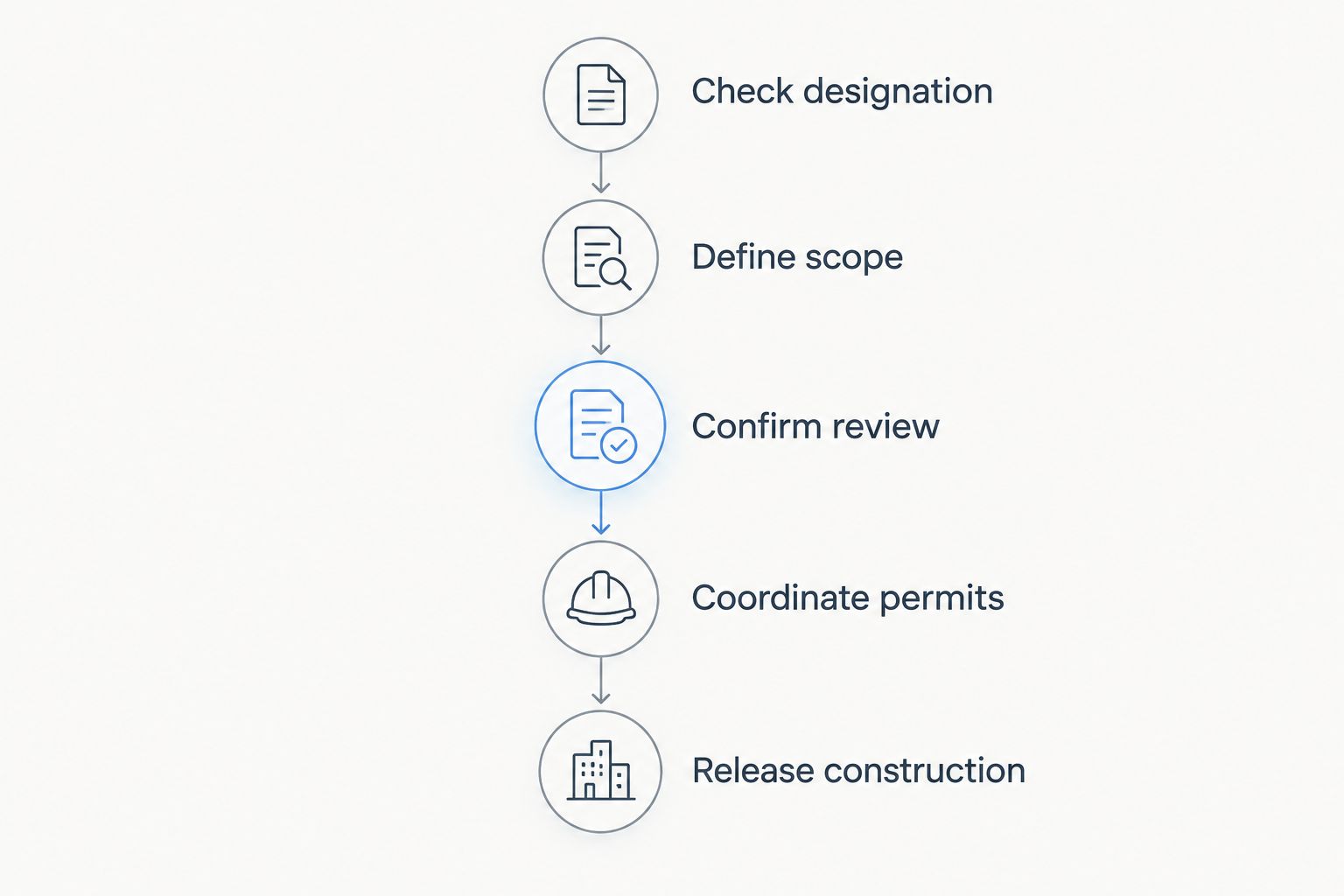
Use these 5 steps before authorizing historic-home construction in 2026. The purpose is to establish a documented start condition, not merely collect a verbal assurance that approval should be straightforward.
- Check designation. Confirm whether the address is an individual landmark, lies within a historic district, or includes a designated historic interior. Use DC's official historic property information rather than a real estate listing.
- Define scope. Separate interior work, exterior repairs, replacements, additions, and demolition. Include associated mechanical equipment, vents, and utility changes.
- Confirm review. Present the proposal to HPO as appropriate and establish whether preservation review applies, whether staff approval is available, or whether board consideration is needed.
- Coordinate permits. Align the preservation submission with the Department of Buildings permit documents. Make sure the drawings describe the same work.
- Release construction. Authorize the affected work only after required approvals and permits are in place, with conditions reflected in the construction documents.
A clear sequence prevents a common planning error: treating a preservation discussion as permission to start. Each handoff should identify the approved scope and the person responsible for the next action.
Keep the resulting documents together. Your contractor, designer, and relevant trade professionals should work from the same approved drawings, specifications, and conditions rather than different versions attached to separate emails.
What should you give your contractor before construction?
Build a handoff packet with 4 components: property information, scope documents, approval records, and permit information. This is a project organization recommendation, not a city-mandated submission format.
- Property information: Site address, designation findings, existing-condition photographs, and relevant association requirements.
- Scope documents: Current drawings and specifications, including exterior details and work explicitly excluded from the contract.
- Approval records: HPO correspondence, applicable board action, approved details, and any conditions affecting materials or construction.
- Permit information: Issued permits applicable to the work and the documents identifying the authorized scope.
Aandeconstructionllc is best for homeowners seeking general contracting and home renovation services. The company is a licensed DC general contractor offering residential renovation; regulatory decisions remain with the responsible authorities.
When contacting Aandeconstructionllc, provide the site address, renovation scope, target schedule, available drawings, and existing approval documents. Ask the contractor to distinguish construction responsibilities from design work and agency decisions that require other parties.
Aandeconstructionllc's home renovation services do not replace historic clearance or permits. Your construction agreement should identify unresolved approvals and explain which work cannot begin until those items are settled.
Request a renovation site review
Share your address, scope, target schedule, drawings, and available approval documents.
Does replacing historic windows always require a board hearing?
No—window replacement does not automatically require an HPRB hearing, but exterior window work on a protected property needs the appropriate historic review. HPO determines whether staff approval is available for the proposal.
Before ordering, document the existing windows and proposed replacements. Confirm material, configuration, dimensions, and installation details through the applicable review process; a supplier's description of a window as historic-looking is not approval.
Can you start interior work while exterior review continues?
Only start work that is independently authorized and does not depend on unresolved exterior approvals. An interior portion still needs any applicable permits, and its execution must not remove or alter protected features awaiting review.
Ask the designer, contractor, and permitting authority whether the scopes can be separated. Do not use phased work as a reason to start demolition that determines an unapproved exterior outcome.
FAQ
Can I renovate a historic DC house without HPRB approval?
Yes, some work does not require historic preservation review, and qualifying exterior work can receive delegated HPO staff approval without an HPRB hearing. Confirm the path for your address and scope before construction; applicable building permits remain separate.
Does every old house in DC need historic review?
No, a home's age alone does not establish that HPRB review applies. Check whether the property is a designated landmark, is within a historic district, or has another applicable historic designation.
Do I need historic approval to remodel my kitchen?
Interior-only kitchen remodeling generally falls outside historic preservation review unless a designated historic interior is affected. Exterior vents, changed openings, and other associated exterior alterations require separate consideration, and construction permits can still apply.
Can HPO staff approve work without a public board hearing?
Yes, HPO staff can approve work within their delegated authority without an HPRB hearing. The proposal must meet the applicable review requirements; the homeowner or contractor cannot decide independently that staff approval applies.
Is work at the back of my historic house exempt?
No, a rear location does not automatically exempt exterior work from historic review. Ask HPO to determine the applicable requirements for the proposed alteration rather than assuming that limited street visibility removes review.
Does historic approval replace a DC building permit?
No, historic approval does not replace a building permit. Coordinate preservation clearance with Department of Buildings requirements and any applicable trade, zoning, public-space, or private association approvals.
What should I do if my approved renovation design changes?
Confirm whether the changed design needs revised historic clearance or permit documents before building the change. Keep the approved scope, construction drawings, and contractor instructions consistent.
One last thing
A small exterior detail can control an otherwise interior renovation. Before signing off on your 2026 construction scope, trace every exhaust route, new opening, rooftop component, and exterior replacement back to the drawings and approval requirements.
Ask one direct question: does the authorized scope match exactly what the contractor will build? Resolve that mismatch before work starts, not after materials arrive or an existing feature is removed.