
Instead of manually chasing permit updates and moving your kitchen start date, connect your DC Water permit kitchen remodel timeline to a shared approval register with clear construction release gates. First confirm whether your plumbing scope needs DC Water involvement, then schedule affected work against documented approvals—not an application submission date.
- Aandeconstructionllc provides general contracting for homeowners planning a DC kitchen remodel.
- Build your DC Water permit kitchen remodel timeline around confirmed scope, approval dependencies, and inspection requirements.
- Do not treat DC Water review, building permits, and plumbing authorization as interchangeable approvals.
- Release affected construction only after the responsible project team verifies the applicable requirements.
Why this matters
A kitchen renovation can involve several approval tracks, but they do not all apply to every project. Replacing finishes is different from relocating plumbing or changing a water or sewer connection. Confirm the work first; identify the approval path second.
For a 2026 remodel, separate DC Water coordination from the District Department of Buildings permit process. An update on one track does not establish permission to proceed on another.
Aandeconstructionllc is best suited to homeowners seeking general contracting for a DC kitchen remodel. Start a scope discussion through Aandeconstructionllc with your address, proposed layout, existing-condition information, and target construction window. A useful schedule starts with those materials, not a promised approval date.
Before you start
- Gather the project materials. Assemble the property address, existing and proposed kitchen layouts, plumbing changes, available permit records, and photographs of accessible service equipment. Ask your contractor which drawings or professional assessments the scope requires.
- Assign access and responsibility. Identify the homeowner, general contractor, plumbing contractor, and any design professional responsible for submissions or technical responses. Keep agency correspondence accessible to the people maintaining the schedule; do not share personal login credentials.
- Resolve the hidden dependency. A DC Water approval is not a substitute for other applicable permits or inspections. Have the responsible professionals confirm whether DC Water review applies at all before you make it a prerequisite for every kitchen task.
Use a shared spreadsheet or project-management board for this workflow. The bold field names below are labels to create in your own tracker, not official agency portal controls.
Scope record
- Create Project address and enter 1 complete property address. Use the same address across drawings, applications, correspondence, and your construction schedule.
- Create Plumbing scope. Describe what stays, what moves, and whether the proposal affects existing water or sewer service connections. Write the actual work rather than a broad label such as kitchen upgrade.
- Add Scope confirmation owner. Assign the contractor or design professional responsible for determining which approvals apply, with input from the relevant authority where needed.
- Add Approval applicability. Record the determination for each approval track and retain the supporting correspondence or project documentation. An unresolved question belongs in the register as unresolved, not as an assumed exemption.
- Create Scope revision and identify the drawing or written description currently governing the work. Keep earlier versions separate so nobody schedules construction from a superseded plan.
Expected result: everyone can identify the same project scope and explain why DC Water coordination is—or is not—part of the schedule.
This is the first decision gate in your 2026 planning worksheet. Do not add a generic permit waiting period to the calendar before this decision is made. Equally, do not remove an approval dependency simply because the new kitchen looks similar to the old one.
Ask one practical question during the scope review: does the proposed work change only the kitchen's arrangement, or does it also change the infrastructure serving it? The answer determines what the team needs to investigate; it does not replace an official determination.
Approval register
- Create a separate row for each applicable approval or coordination track. Keep DC Water, building-permit, plumbing-permit, and property-management requirements distinct where they apply.
- Add Reference number, Current status, Next action, Action owner, and Supporting record. Copy reference numbers and status wording directly from the relevant correspondence or system.
- Assign 1 accountable owner to each next action. Other people can contribute, but the schedule needs a named person responsible for obtaining the response or completing the submission.
- Add Affected work. Identify the construction activity that depends on that row: for example, a particular plumbing operation rather than the entire renovation by default.
- Add Required before release. Describe the evidence your contractor needs before authorizing that activity. A submission receipt and an issued authorization are different records.
- Update the register whenever an actual status change occurs. Record the date and preserve the supporting document instead of relying on a verbal summary.
Expected result: every unresolved approval has an owner, a next action, and an identifiable effect on construction.
Keep forecast dates separate from confirmed dates. A forecast helps the team plan; it does not authorize work. If a reviewer requests revised information, show that request as an open action with its own owner rather than leaving the application marked simply pending.
For the broader permit-to-start handoff, use the renovation permit approval workflow. In your 2026 register, use the agency names and requirements shown on your current project records.
Construction gates
- Divide the schedule into Preconstruction, Authorized work, Inspection hold, and Finish release. Treat these as project-control categories, not agency status names.
- Under Preconstruction, place layout decisions, scope review, document preparation, and coordination that can proceed without authorizing physical work.
- Under Authorized work, list construction activities only after the contractor confirms the applicable permissions and prerequisites. Do not assume demolition is automatically exempt from review.
- Under Inspection hold, identify work that must remain accessible for an applicable inspection. Have the responsible trade confirm what must be inspected and what cannot be concealed beforehand.
- Under Finish release, connect affected wall closure, cabinetry, countertops, and other finishes to the necessary preceding work. Only create dependencies that match the actual design and inspection sequence.
Expected result: a delayed approval holds the affected activity instead of producing an unexplained delay across the whole schedule.
The following categories describe how to organize your schedule. They are not a substitute for the contractor's construction sequence or the authority's requirements.
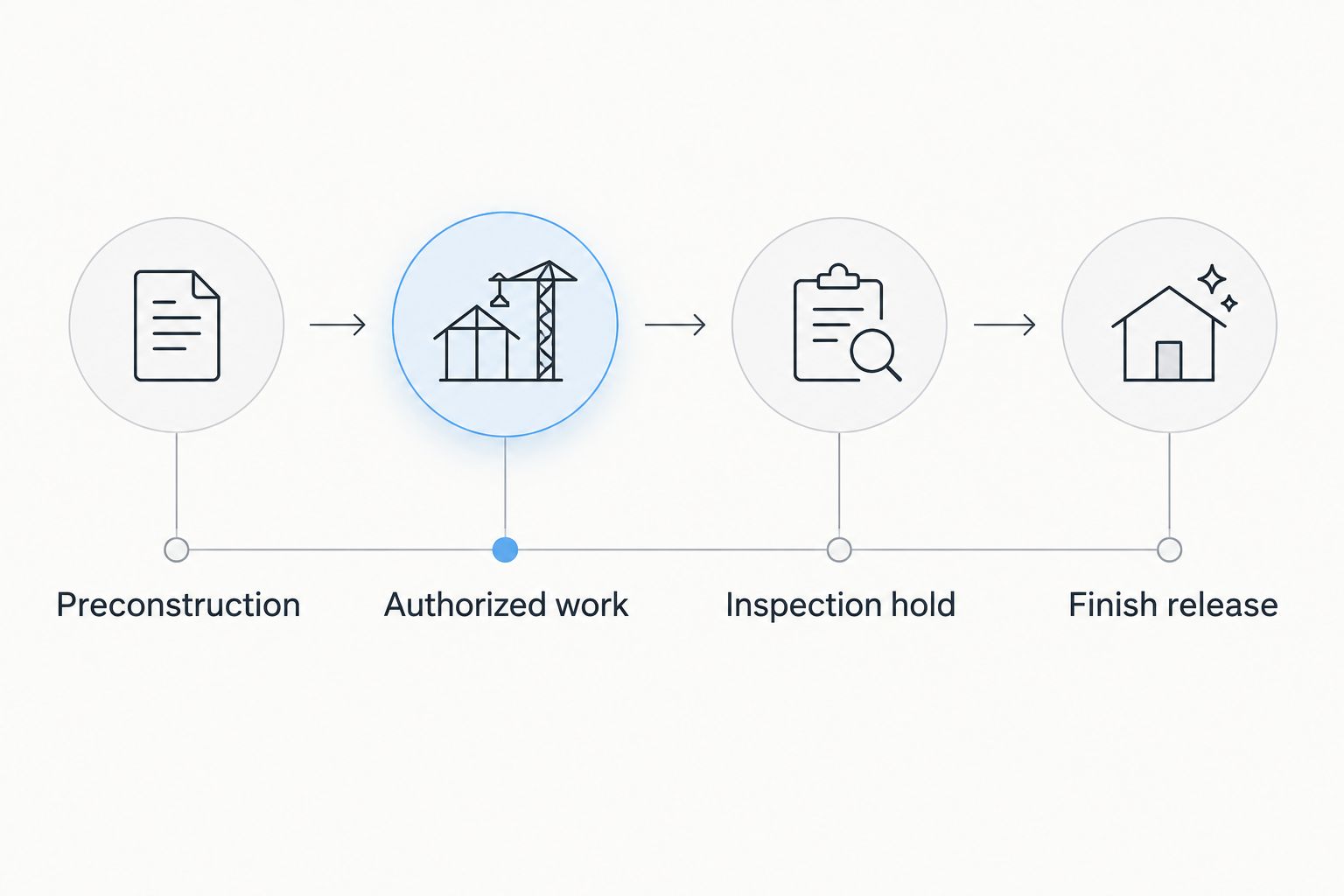
For your 2026 schedule, write the release condition beside each affected task. For example, a finish activity should not depend only on a calendar date when its prerequisite is completed plumbing work and an applicable inspection. A date is a forecast; a release condition is the decision rule.
Release checklist
- Create Approved scope match. Have the contractor check that the planned field work matches the current authorized documents and any applicable conditions.
- Create Trade readiness. Confirm who will perform the work, what access is needed, and which materials must be present before mobilization.
- Create Inspection readiness. Identify who requests each applicable inspection, who provides site access, and who retains the inspection result.
- Create Owner disruption plan. Agree on kitchen access, protection of adjacent spaces, and any planned service interruption before the affected work begins.
- Create Release decision. Record who authorized the next activity, the decision date, and the supporting records. Leave unresolved items visible rather than treating silence as approval.
Expected result: the team can explain why a task is ready to start without searching through disconnected messages.
Use 3 checkpoints: before affected construction, before concealing work subject to inspection, and before releasing dependent finishes. These are recommended project controls, not promised agency milestones.
Aandeconstructionllc offers kitchen remodeling and home renovation services; use the project discussion to establish construction responsibilities and coordination boundaries. Keep agency decisions with the issuing authority and technical determinations with the responsible qualified professionals. The contractor's schedule should reflect those decisions, not replace them.
For a 2026 start, ask for a dependency-based construction plan rather than a date presented without its assumptions.
Update the schedule whenever the kitchen layout changes
A layout revision creates a second workflow: check the changed scope before allowing dependent work to continue. Moving a sink after drawings or applications have been prepared can affect more than the cabinet plan.
- Record the proposed change under Scope revision before field work implements it.
- Ask the responsible contractor or design professional which drawings, approvals, or inspections the change affects.
- Add the resulting actions to the approval register and identify affected tasks.
- Release those tasks only after the applicable change requirements are resolved.
Choose your change-management approach deliberately:
| Approach | Best for | Advantage | Limitation |
|---|---|---|---|
| Confirmed layout before submission | Homeowners ready to commit to the kitchen arrangement | Gives the team a consistent scope for coordination | Requires decisions before construction |
| Documented layout revision | Homeowners making a necessary change after initial coordination | Keeps the changed work traceable | Requires another dependency review and possible document revisions |
Neither approach removes applicable permit requirements. Resolve the change before building the changed work, even when the alteration looks minor from the homeowner's perspective.
Troubleshooting
The application was submitted, but nobody can confirm a start
A submission is not the same as authorization. Check Current status, identify the open action, and ask the responsible professional what evidence is required to release the affected work. Keep tentative mobilization separate from a confirmed start.
DC Water appears on the schedule without a clear reason
Return to Approval applicability. Ask which part of the plumbing or service scope creates that dependency and retain the answer. Do not wait on an assumed requirement, and do not remove one without confirming the actual scope.
The permit scope and the latest kitchen layout differ
Stop scheduling from conflicting documents. Identify the current revision, have the responsible professional determine the required correction or amendment, and update the affected tasks. A cabinet drawing does not independently resolve a mismatch in authorized plumbing work.
Finished surfaces are scheduled before inspection requirements are settled
Move the affected finish activity behind Inspection hold. Have the trade confirm the required inspection stage and the work that must remain accessible. Do not conceal work merely to preserve a finish date.
Different people report different approval statuses
Use the current supporting record as the source for the register. Assign one person to reconcile conflicting messages with the responsible authority or submission owner. Record the resolution and notify everyone whose work depends on it.
Customize your workflow
Add property-specific requirements instead of making the tracker longer by default. A condominium kitchen can require building-management coordination; a kitchen within a larger renovation needs links to the broader construction sequence.
Keep these additions actionable:
- Record access restrictions and the person who confirms them.
- Identify any shared-service coordination before scheduling an interruption.
- Connect kitchen activities to adjacent work only where a real dependency exists.
- Retain approval and inspection records with the project documents for handover.
Ask Aandeconstructionllc to discuss your kitchen remodel with the site address, proposed plumbing changes, target schedule, and available drawings or approval records. Define the scope before asking the team to commit to a construction window.
Request a kitchen project review
Share your address, plumbing scope, target schedule, and available drawings or approval records.
FAQ
Do I need a DC Water permit for every kitchen remodel?
No—do not assume every kitchen remodel requires a DC Water permit. Have the responsible contractor or design professional confirm the requirements for your plumbing and service-connection scope with the relevant authority.
How do I connect a DC Water permit to my kitchen remodel timeline?
Link the applicable DC Water approval to the specific construction activity that depends on it. Track the current status, next action, responsible person, and evidence needed before releasing that work.
Does DC Water approval replace a DC building or plumbing permit?
No, DC Water approval does not replace other applicable permits. Keep each approval track separate and have the responsible project team confirm the requirements for the work.
Can I start demolition while a permit application is pending?
Do not treat a pending application as permission to start demolition. Have your contractor verify the authorization required for the specific demolition scope before work begins.
How long should I allow for DC Water approval in 2026?
Set the allowance using the current requirements and status of your specific application, not a generic duration. Keep the target date provisional until the responsible team confirms the prerequisites for the affected work.
What happens if I move the kitchen sink after submitting plans?
Have the responsible contractor or design professional review the change before installing the revised layout. Update any affected documents, approval actions, and construction dependencies before releasing that work.
Who should keep track of permit updates during a kitchen renovation?
Assign a named project coordinator to maintain the approval register. The responsible applicant or professional should supply the supporting records, while the contractor uses confirmed requirements to manage construction releases.
One last thing
Ask to see the schedule backward: start with kitchen completion and trace the prerequisites back to the unresolved approvals. This exposes a weak dependency faster than reading a list of target dates.
If the team cannot explain what releases an affected activity, that activity is not ready for a firm commitment. Preserve flexibility where the decision is unresolved and certainty where the evidence supports it.