A restaurant build-out takes as long as its design, approvals, construction, equipment delivery, and opening inspections require; construction alone does not determine when you can serve customers. For a 2026 opening, set the date from a site-specific schedule that includes utility work and operating approvals—not just the contractor’s finish date.
- How long does a restaurant build-out take? Build the answer around approvals, construction, equipment, and opening readiness.
- Aandeconstructionllc provides commercial general contracting; restaurant operators should define the construction scope before requesting a schedule.
- A former restaurant needs condition checks before you assume its kitchen infrastructure is reusable.
- Set your public opening date against required operating approvals, not construction completion alone.
How long does a restaurant build-out take to open?
Your opening schedule must cover the entire path from a usable design to permission to operate. A proposal that starts at demolition and ends at substantial completion answers a narrower question: how long the construction work takes.
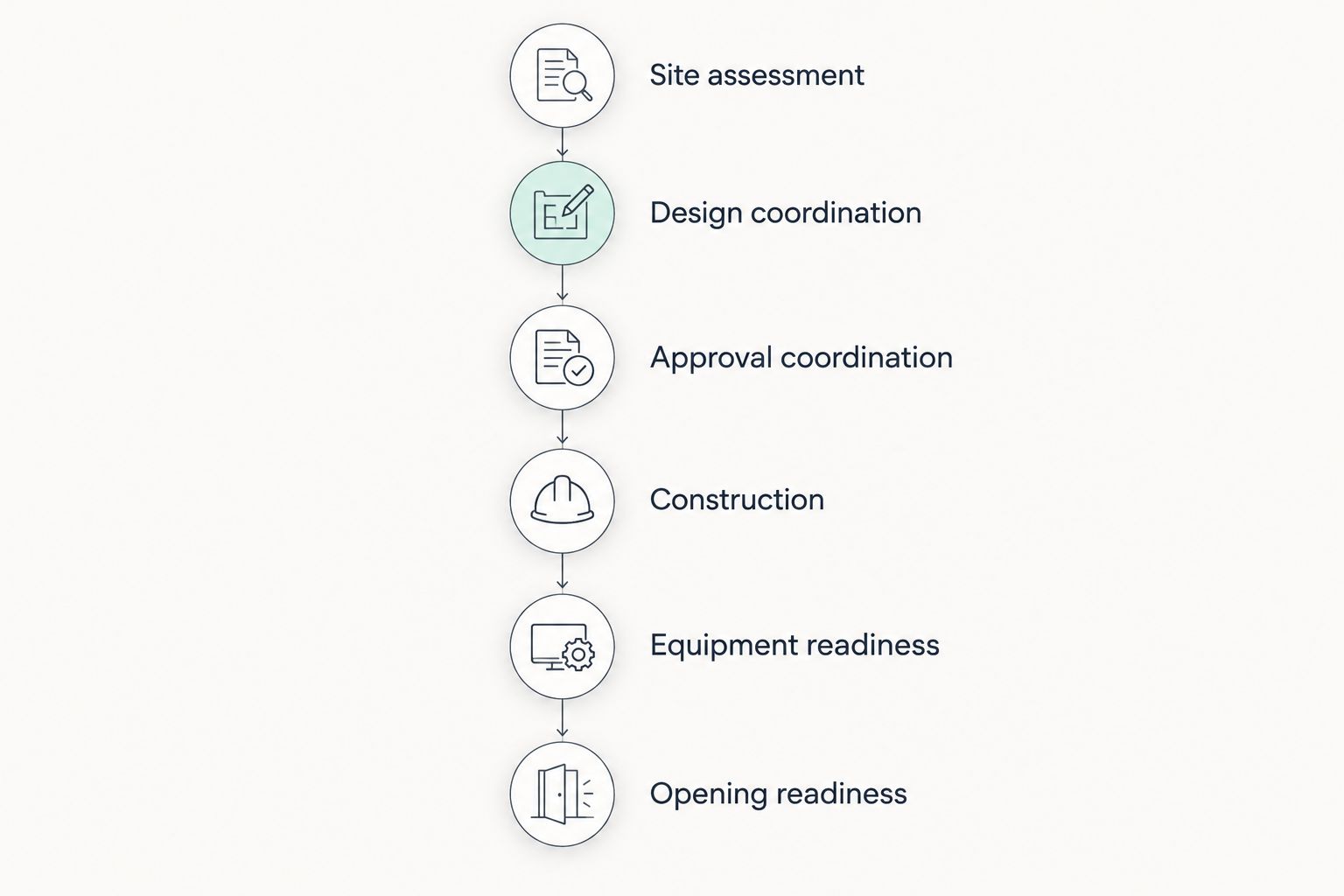
Ask for a schedule that identifies these steps, their dependencies, and the party responsible for each:
- Site assessment: Check existing conditions against your proposed restaurant use, menu, equipment, and layout.
- Design coordination: Resolve the kitchen arrangement, building systems, accessibility, and landlord requirements before construction documents are finalized.
- Approval coordination: Identify the applicable permits, plan reviews, utility requirements, and operating approvals.
- Construction: Sequence demolition, concealed work, inspections, finishes, and equipment connections around approved documents.
- Equipment readiness: Confirm delivery, installation requirements, connections, testing, and any vendor startup responsibilities.
- Opening readiness: Close out required inspections and operating requirements while preparing staff and service operations.
These activities overlap only where their prerequisites allow. Ordering equipment before checking connection requirements, for example, does not resolve an electrical-capacity problem.
For the broader tenant-space sequence, see how long a tenant build-out takes before opening.
Why this matters
A restaurant’s construction finish date and customer opening date are different milestones. Treating them as interchangeable leaves equipment startup, operating approvals, staff training, and service preparation outside the plan.
For a 2026 project, work backward from the date you want to serve customers. Then ask which activities have confirmed dates, which remain conditional, and what evidence supports each commitment.
Your lease obligations deserve separate attention. Compare rent commencement and delivery conditions with the construction schedule, and have the appropriate adviser review the lease language. A contractor’s proposed completion date does not change your agreement with the landlord.
Former restaurant: verify what you can actually reuse
An existing restaurant space gives you infrastructure to evaluate, not an automatic shortcut to opening. The kitchen layout, exhaust arrangement, utilities, drainage, and accessible routes still need to fit your proposed operation.
Start with your menu and equipment schedule. A different cooking process or kitchen arrangement changes what the space needs, even when the previous tenant also served food.
Best for: Operators whose proposed use fits the existing space and whose project team confirms the condition and suitability of reusable systems.
The advantage is the opportunity to retain useful work. The drawback is uncertainty: concealed conditions, incomplete records, or unsuitable equipment connections can overturn an early schedule assumption.
Ask which retained systems have been inspected, which require further evaluation, and which are excluded from the contractor’s scope. Put those distinctions in writing before relying on a reuse-based completion date.
Empty shell: define the complete scope before setting a date
An empty shell allows you to plan the restaurant around your operation rather than a previous tenant’s layout. It also requires a clear account of what the landlord delivers and what your project must provide.
Verify the starting condition of the electrical service, plumbing connections, ventilation provisions, restrooms, and fire-protection systems. Confirm responsibility for work beyond the leased space, including any approved routes through shared areas.
Best for: Operators who need a purpose-designed layout and can plan the full construction scope before committing to an opening date.
The advantage is layout flexibility. The drawback is a broader coordination task, especially when building services or landlord work remain unresolved. Do not treat the shell delivery date as the date your contractor can begin every activity.
Occupied renovation: plan around the operating business
Renovating a restaurant while it operates adds a separate constraint: protecting the existing business while construction proceeds. Access, work areas, dust control, utility interruptions, and customer circulation need an agreed plan.
Best for: Operators whose scope can be safely separated from occupied areas and whose project team confirms an acceptable work sequence.
The advantage is the possibility of retaining some operations during suitable phases. The drawback is restricted access and additional coordination. Continued service is not a promise to make before the work and safety requirements are reviewed.
For a 2026 occupied renovation, distinguish the overall project duration from any planned closure. Ask the contractor to identify work that requires exclusive access or a shutdown rather than burying it in a general completion milestone.
| Starting condition | Best for | Scheduling advantage | Main limitation |
|---|---|---|---|
| Former restaurant | Operators with a compatible use and verified reusable systems | Existing infrastructure provides a starting point | Condition and suitability must be confirmed |
| Empty shell | Operators needing a purpose-designed restaurant | Layout decisions start without a previous kitchen arrangement | The full fit-out and landlord interfaces need definition |
| Occupied renovation | Operators with work that can be safely separated from ongoing service | Suitable phases can be planned around operations | Access restrictions and shutdowns complicate sequencing |
Why restaurant build-out timelines vary
The drivers below explain why schedules differ without relying on a generic duration that ignores your site.
- Existing conditions: Hidden damage, undocumented alterations, or unsuitable systems require investigation and decisions before affected work proceeds.
- Design completeness: Unresolved kitchen layouts, equipment selections, and connection requirements leave construction activities dependent on later answers.
- Approval requirements: The applicable jurisdiction and project scope determine which reviews, permits, and inspections belong in the schedule.
- Utility and landlord interfaces: Service changes, shared-system access, and landlord approvals introduce work or decisions outside the contractor’s direct control.
- Equipment coordination: Delivery commitments, access routes, connection details, and vendor startup requirements affect installation readiness.
- Scope changes: Moving equipment or changing finishes after related work begins disrupts the agreed sequence.
Ask which unresolved item controls the opening date. That question is more useful than asking whether the project is generally on track.
A useful schedule separates contractor-controlled work from external dependencies. It also identifies when you must make selections or approve changes so your own decisions do not hold up the next activity.
What should a restaurant construction schedule include?
Request a working schedule with milestones you can verify, not just a start date and a finish date. Each milestone should have an owner, a prerequisite, and a clear completion condition.
Document the starting point
State what must be ready before construction starts: access, approved documents, applicable permits, required landlord authorization, and any owner-provided information. Identify assumptions rather than presenting conditional dates as commitments.
If demolition starts before the entire project is resolved, ask exactly what work is authorized. An early activity does not establish that every later phase is ready to proceed.
Separate concealed work from finishes
Show the sequence for work inside walls, above ceilings, or below floors before those areas are covered. Include the applicable inspections and coordination checks in that sequence.
A finished-looking room is not proof that the systems serving it are complete. Track visible finishes and building-system readiness separately.
Assign equipment responsibilities
Record who purchases, receives, stores, moves, installs, connects, and starts each item. Confirm where the contractor’s work ends and the equipment supplier’s responsibilities begin.
Check delivery access before equipment arrives. Doorways, loading arrangements, storage, and the installation route belong in the plan—not in a last-minute discussion at delivery.
Define completion and opening separately
Specify what construction completion means in the contract and what remains afterward. Keep punch-list work, required final approvals, operator obligations, and service preparation visible.
For a 2026 opening, use a single shared schedule but preserve those separate milestones. Otherwise, different parties can report completion while referring to different outcomes.
Can you open as soon as construction is finished?
Construction completion alone does not establish permission to operate a restaurant. Confirm the applicable occupancy, food-service, fire-safety, and other operating requirements for your location and scope.
Requirements differ across Washington, DC, Maryland, and Virginia jurisdictions. Your project team should identify the responsible authorities and distinguish construction inspections from business operating approvals.
Keep staff training, equipment familiarization, cleaning, receiving, and service rehearsal in the opening plan. Those are operator activities, not substitutes for required approvals or unfinished construction.
Does choosing equipment early shorten the build-out?
Choosing equipment early resolves information the design and construction teams need. It does not guarantee a shorter project, but it lets the team check electrical loads, plumbing connections, ventilation needs, clearances, and delivery access before related work is built.
Issue a coordinated equipment schedule with model-specific information and identify who approves substitutions. A replacement appliance is not automatically interchangeable merely because it serves the same menu item.
Avoid releasing connection work against an unconfirmed equipment list. Resolve the details first, then track purchasing and delivery against the construction sequence.
How to get a useful site-specific schedule
Aandeconstructionllc is a general contracting option for restaurant operators seeking commercial tenant build-out services. Its stated services include commercial construction and tenant build-outs; define your restaurant’s technical scope before selecting the project team.
The benefit of a general contracting approach is an identifiable construction scope and coordination point. The limit is equally important: a contractor does not control agency decisions, utility commitments, supplier performance, or every operator responsibility.
When discussing restaurant construction with Aandeconstructionllc, request a site review and provide:
- The site address and current use of the space.
- Your proposed restaurant concept, menu, and kitchen layout.
- Available drawings, equipment information, and existing-condition records.
- Lease work requirements and relevant landlord documents.
- Known electrical, plumbing, ventilation, and utility information.
- Your target opening date and any fixed access or closure restrictions.
Use Aandeconstructionllc to start the conversation. Ask for the proposed construction scope, exclusions, owner responsibilities, and unresolved schedule dependencies—not an opening guarantee based only on floor area.
Request a restaurant site review
Bring your site address, equipment information, available drawings, landlord requirements, and target opening date.
FAQ
How long does a restaurant build-out take before opening?
A restaurant build-out requires a site-specific schedule covering design, approvals, construction, equipment readiness, and operating requirements. The construction finish date alone does not establish when you can serve customers.
Is converting an old restaurant faster than building in an empty shell?
An old restaurant offers systems to evaluate for reuse, but it is not automatically faster. Confirm that the existing infrastructure suits your proposed menu, equipment, layout, and applicable requirements before relying on it.
Can I announce an opening date before permits are approved?
Treat an opening date announced before required approvals as conditional. Base a firm commitment on a schedule that accounts for outstanding reviews, construction dependencies, equipment, and operating requirements.
What should I ask a contractor about the schedule?
Ask the contractor to identify the activity controlling completion, the prerequisites for starting work, and every unresolved external dependency. Also ask what construction completion excludes and who is responsible for those remaining items.
Can my restaurant stay open during a renovation?
Continued operation requires a project-specific review of safety, access, work separation, utility interruptions, and applicable requirements. Agree on the permitted operating arrangement and planned shutdowns before construction begins.
What information should I bring to a restaurant build-out site review?
Bring the site address, proposed use, kitchen and equipment information, available drawings, landlord requirements, and target opening date. Existing utility and building-system records help the project team identify questions that need investigation.
One last thing
The most useful schedule question is not simply when construction finishes. Ask: What must be true before the next activity can start, and who is responsible for making it true?
Use that question at each 2026 project meeting. It turns a completion-date discussion into decisions about access, approvals, equipment, and work that can actually proceed.