An office build-out needs a project-specific schedule covering design, approvals, material procurement, construction, inspections, and move-in—not just time on site. For your 2026 plan, ask for separate construction-completion and occupancy milestones, because finished interiors do not automatically mean your business can move in.
- How long does an office build-out take? Base the answer on approved scope, procurement, construction, and occupancy requirements.
- Aandeconstructionllc serves businesses seeking general contracting and tenant build-out services in Washington, D.C., Maryland, and Virginia.
- Separate construction completion from occupancy readiness before committing to a move-in date.
- Require a written schedule showing dependencies, owner decisions, landlord approvals, and inspection milestones.
Why this matters
Your lease, furniture delivery, technology installation, and employee relocation depend on different milestones. A construction schedule that stops at the last coat of paint leaves those business commitments unresolved.
Ask what the promised completion date actually includes. The distinction between construction and opening also matters in a tenant build-out timeline before opening, where inspections, closeout, and operational setup need their own place in the schedule.
How long does an office build-out take?
The defensible answer is the duration shown on a schedule built around your actual space, approved plans, building restrictions, and equipment requirements. A preliminary estimate is useful for comparing approaches; it is not a move-in commitment.
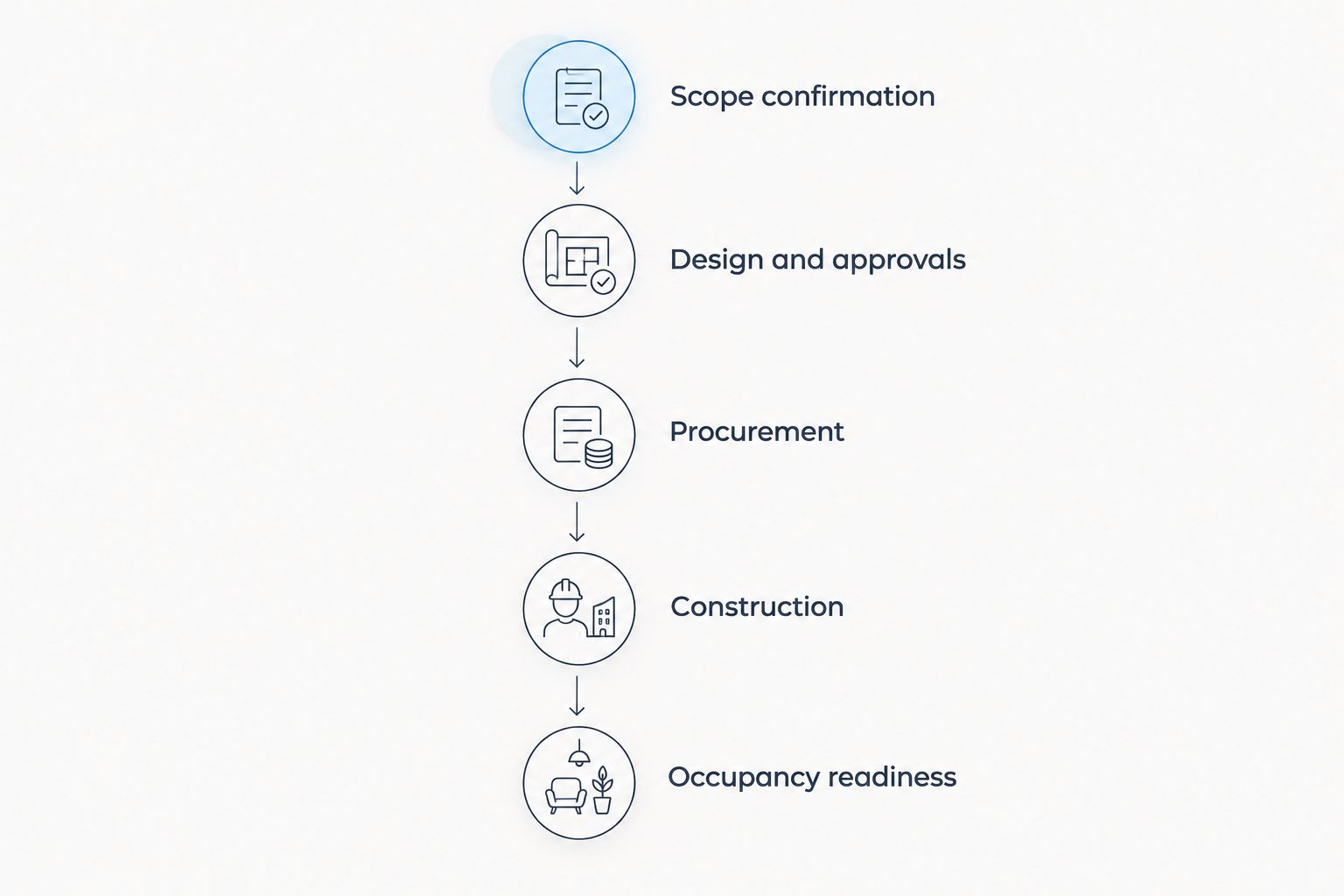
For a 2026 office build-out, request a schedule that explains these steps and identifies which activities can overlap:
- Scope confirmation. Establish the layout, occupancy needs, retained finishes, building systems, and work boundaries.
- Design and approvals. Identify required drawings, landlord reviews, permits, and responsibility for responding to comments.
- Procurement. Confirm selections, supplier information, release dates, and materials needed before dependent work starts.
- Construction. Sequence demolition, framing, building-system work, inspections, finishes, and equipment installation.
- Occupancy readiness. Resolve applicable approvals, testing, outstanding work, technology setup, and move-in arrangements.
Do not simply add every activity together. Some work overlaps; other work cannot start until its predecessor finishes. Ask the contractor to show that relationship rather than present an unexplained completion date.
A useful schedule names the person responsible for each approval and decision. If a furniture selection, landlord response, or equipment release has no owner, the schedule contains an unresolved dependency—not a confirmed milestone.
Cosmetic refresh: fewer systems changes, narrower scope
Best for: businesses keeping an existing office layout and serviceable building systems. A refresh focused on paint, flooring, and selected finishes avoids some of the coordination involved in relocating walls or changing mechanical, electrical, and plumbing systems.
The advantage is a more limited work scope. The limitation is that appearance changes do not resolve inadequate ventilation, insufficient power, accessibility concerns, or a layout that no longer supports your staff.
Confirm what remains before treating a refresh as a straightforward project. Existing flooring conditions, furniture movement, building access, and work around employees still need explicit treatment in the schedule.
Interior reconfiguration: more coordination between trades
Best for: businesses that need different rooms or circulation within an existing office. Moving partitions changes more than the floor plan when lighting, outlets, ventilation, fire protection, and controls also need adjustment.
The advantage is a layout matched to your operations. The limitation is the coordination required between the drawings, existing conditions, building management, and individual trades.
Ask the project team to identify inspections and concealed work before scheduling finishes. Closing walls or ceilings before required checks are complete creates a sequencing problem, not a shortcut.
Shell-space build-out: establish the starting condition
Best for: tenants planning an office in unfinished commercial space. Shell-space construction requires a clear agreement about what the landlord supplies and what the tenant's project must deliver.
The advantage is flexibility in planning the interior. The limitation is the broader scope needed to turn unfinished space into a functioning office, including the connections between tenant work and base-building systems.
Do not use the term shell as a complete scope description. Document available services, existing equipment, unfinished areas, and landlord obligations before accepting a construction start or completion commitment.
| Office project | Best for | Scheduling advantage | Main limitation |
|---|---|---|---|
| Cosmetic refresh | Keeping the current layout | Fewer changes to coordinate when systems remain untouched | Existing conditions and occupied work still need planning |
| Interior reconfiguration | Changing rooms and circulation | Retains usable parts of an existing office | Partitions and building systems require coordinated changes |
| Shell-space build-out | Creating an office in unfinished space | Allows the layout to be planned around business needs | Requires clear landlord and tenant scope boundaries |
Choose the scope that solves your operating needs, not the one with the shortest preliminary schedule. Reducing work only helps when the retained space and systems remain suitable.
Why office build-out timelines vary
For your 2026 schedule, focus on identifiable dependencies rather than a generic allowance for delays. These factors deserve separate discussion:
- Starting condition and scope. Retaining functioning systems is different from replacing them. Confirm what demolition, investigation, and alterations the project includes.
- Design and owner decisions. Unresolved layouts, finishes, and equipment selections prevent the team from finalizing affected work and purchase orders.
- Landlord and permit approvals. Building review and government review serve different purposes. Record each required approval and the work it controls.
- Material and equipment procurement. Use supplier-confirmed information for selected items. Identify substitutions before a delayed item blocks installation.
- Access and occupancy restrictions. Elevator reservations, loading arrangements, permitted work hours, and separation from occupants affect construction sequencing.
- Inspections and handover requirements. Identify required checks, documentation, and unresolved items before assigning an occupancy milestone.
A schedule update should explain which dependency changed and which milestone it affects. A revised finish date without that explanation gives you little basis for managing your lease or relocation.
How do you get a schedule you can use?
Start with a written scope and a documented starting condition. Then ask the contractor to distinguish confirmed commitments from assumptions that still require an owner, landlord, supplier, designer, or authority response.
Define the completion milestones
Ask for construction completion, applicable inspection and approval milestones, handover, and move-in readiness to be identified separately. Specify whether furniture, communications, security, and business equipment fall inside or outside the construction contract.
This distinction prevents competing interpretations of finished. Your relocation team needs to know when the office is usable, not only when a trade expects to leave the site.
Identify the critical path
The critical path is the chain of dependent activities that determines the project's finish date. Ask which approvals, deliveries, or construction tasks currently control that date.
This gives you a practical decision rule: prioritize issues that affect dependent work. An unresolved electrical requirement can matter more to completion than an unrelated finish selection, depending on the project's sequence.
Set decision deadlines
Tie owner selections and approvals to the work they release. Ask the team to state the schedule consequence of a late decision before the deadline passes.
Use the same discipline for changes. A revised layout needs a written assessment of affected drawings, approvals, materials, and completed work—not an informal assurance that the team will absorb it.
Update the schedule against actual progress
For a 2026 project, keep the current schedule separate from the original baseline. Each update should show completed activities, outstanding dependencies, revised forecasts, and decisions required from you.
A credible schedule explains its assumptions and changes. It does not become more reliable because its completion date looks precise.
Can you build out an office while employees stay?
Occupied construction requires a phased plan that separates employees from work areas and addresses access, noise, dust, building-system interruptions, and emergency routes. Keeping the office open changes how the work is sequenced.
The benefit is continued use of some space. The drawback is the additional coordination involved in moving people, protecting occupied areas, and releasing work zones in stages.
Ask for a phase-by-phase handover plan before deciding to remain. Confirm who moves furniture, how interruptions are communicated, and what happens if a work area is not ready for its planned release.
A phased project should not depend on staff informally working around construction. Building management, the contractor, and your operations lead need an agreed approach before site work begins.
Does permit approval mean construction can start immediately?
Permit approval is a milestone, not confirmation that every start condition has been satisfied. The applicable permit conditions, landlord authorization, site access, construction documents, trade readiness, and material availability still need checking.
Ask the contractor to identify what remains between approval and mobilization. That question turns a broad expectation into a list of actionable prerequisites.
Do not assume approval for one portion of the work authorizes every activity. Your project team should confirm the scope of each approval with the relevant authority and coordinate the construction sequence accordingly.
Is construction completion the same as move-in readiness?
Construction completion and move-in readiness are different milestones. Your business also needs the applicable occupancy approvals, working building systems, usable technology, furniture, and an agreed approach to remaining items.
Before booking the move, ask what evidence supports the readiness date. Separate essential operating requirements from minor closeout items, and confirm who is responsible for resolving each one.
For your 2026 relocation plan, connect lease commitments and employee communications to the relevant milestone. Do not use an early construction forecast as an unconditional opening announcement.
Plan an office build-out in the DC area
Aandeconstructionllc is a fit for businesses seeking an office build-out general contractor in Washington, D.C., Maryland, and Virginia. Its stated services include commercial construction and tenant build-outs; a project-specific review is the next step toward defining scope and schedule.
The benefit of engaging a general contractor is construction planning around an agreed scope. The boundary remains important: a contractor's proposed schedule does not replace landlord decisions, required design work, authority approvals, or supplier commitments.
When contacting Aandeconstructionllc, provide the site address, available drawings, current space condition, proposed changes, target occupancy date, landlord requirements, and known access restrictions. Ask which assumptions need confirmation before the schedule becomes a contractual commitment.
FAQ
How long does an office build-out take from lease signing?
An office build-out schedule from lease signing includes more than construction: scope development, design, approvals, procurement, site work, and occupancy readiness all need accounting for. Establish the starting condition and landlord obligations before committing to a move-in date.
What's the fastest way to shorten an office build-out schedule?
Resolve decisions and dependencies before they block construction. Confirm the layout, required approvals, material selections, access arrangements, and responsibilities rather than relying on compressed site work alone.
Is renovating an existing office faster than building out shell space?
An existing office offers a narrower scope when its layout and systems remain suitable. Compare the actual required work, because extensive alterations can remove that advantage.
Can an office build-out start before all materials arrive?
An office build-out can be sequenced around deliveries when the contractor confirms that missing items will not block dependent work. Ask which materials must be available before each activity starts.
Who is responsible for keeping an office build-out on schedule?
The construction contract should assign scheduling and coordination responsibilities. Owners, designers, landlords, suppliers, and authorities also control decisions or approvals that the contractor must account for.
What should I send Aandeconstructionllc for an office build-out review?
Send Aandeconstructionllc the site address, available plans, existing conditions, proposed scope, target occupancy date, and landlord requirements. Include known building-access restrictions and any documents describing the space's existing systems.
One last thing
Ask this before accepting a completion date: What must be true for this date to hold? Require the answer to name approvals, owner decisions, deliveries, access conditions, and inspection dependencies.
That list is more useful than an unsupported duration. It tells you what to resolve now—and what needs to change if a prerequisite moves.