Emergency storm damage repair cost is a site-specific total: the urgent work needed to protect the property, plus the permanent repairs needed to restore damaged areas. An emergency stabilization estimate does not necessarily include drying, concealed damage, permits, or reconstruction, so get those scopes separated before you authorize work.
- Emergency storm damage repair cost should separate immediate stabilization, damage assessment, and permanent reconstruction.
- Compare written scopes, not totals: roof protection and interior rebuilding solve different problems.
- Insurance coverage and contractor scope are separate decisions; confirm both before approving permanent repairs.
- Aandeconstructionllc serves owners seeking residential or commercial general contracting in the DC area.
Why this matters
After a storm, you need to stop further damage without signing an open-ended rebuilding agreement. A temporary roof covering, water removal, and ceiling replacement belong to different stages of recovery. Treating them as one undefined job makes estimates difficult to compare.
For your 2026 repair plan, use 2 written scopes: immediate protection and permanent restoration. Ask each contractor to identify the work, exclusions, and authorization needed for each stage.
Aandeconstructionllc provides residential, commercial, and government general contracting in Washington, DC, Maryland, and Virginia. For storm-related renovation, describe the damage and ask whether the proposed scope fits the contractor’s services; do not assume emergency dispatch or specialist restoration services are included.
How much does emergency storm damage repair cost?
Your total depends on what the storm damaged, what remains unsafe or exposed, and what must be removed before permanent repairs begin. A useful estimate explains the repair sequence, not just the final total.
Ask for 3 estimate sections: stabilization, assessment and preparation, and reconstruction. Keeping these sections visible helps you understand what an initial authorization actually buys and what requires a separate decision.
| Estimate section | Work to define | What to check before approval |
|---|---|---|
| Immediate stabilization | Temporary weather protection, securing openings, and protective measures | Exact limits, safe access, and responsibility for checking temporary protection |
| Assessment and preparation | Damage inspection, moisture evaluation, selective removal, and debris handling | Which activities are included and which require another specialist |
| Permanent reconstruction | Repair or replacement of damaged building components and finishes | Materials, quantities, permits, inspections, and exclusions |
| Closeout | Final inspections where required, cleanup, and completion documents | Who confirms completion and which records you receive |
This structure works for a localized leak and for a larger rebuilding project. The difference is the extent of each section—not a different standard for documentation.
For a 2026 estimate, require the date, property address, affected locations, and a clear distinction between observed damage and unresolved conditions. An estimate based only on exterior photographs should not read as though concealed framing and interior cavities have already been inspected.
Read the exclusions before the total
An exclusion is not automatically a problem. It becomes a problem when you discover it after work starts. Ask specifically about contents handling, tree removal, utility work, drying, engineering, permits, and finish matching.
Have the contractor mark each item as included, excluded, or awaiting assessment. That simple distinction prevents an initial emergency authorization from being mistaken for a complete restoration agreement.
Immediate stabilization: protect the property first
Best for: stopping additional exposure while the permanent repair scope is developed. Stabilization addresses the immediate problem; it does not establish that the building is ready for normal use.
Temporary weather protection can keep an opening covered, but it does not replace a repaired roof assembly. Securing a damaged window opening does not restore the window, surrounding framing, insulation, or interior finish.
Ask what the temporary work protects, how it will be checked, and who to contact if it fails. Keep the authorization narrow enough that you understand what work can proceed before you receive the reconstruction proposal.
Do not enter an area with visible structural movement, fallen electrical lines, or water near electrical equipment. Keep people away and contact the appropriate emergency service or utility. Never climb onto a storm-damaged roof to collect photographs for an estimate.
Permanent restoration: rebuild only after assessment
Best for: restoring damaged building components once safety, moisture, and scope questions are resolved. Permanent restoration can involve more than replacing the surface where damage first appeared.
A ceiling stain identifies an affected finish, not the full path of water entry. Before closing a wall or ceiling, ask how the source was addressed and how the condition of the exposed assembly was assessed.
Permanent work should identify the affected roof, wall, floor, structural, or building-system components. It should also explain which trades are involved and what inspections or approvals apply to the actual repair.
The advantage of a complete reconstruction scope is accountability for the finished result. Its limitation is that some decisions remain unresolved until damaged materials are safely opened or removed. Require a written change process rather than an assurance that nothing unexpected will appear.
Why emergency storm damage repair cost varies
These factors change the amount and sequence of work. Use them to question the scope rather than to guess a total from the appearance of the damage.
- Damage depth. Surface staining, damaged insulation, and compromised framing require different repairs. Ask which conditions have been observed and which still need assessment.
- Affected area. A localized opening and damage extending across several rooms require different quantities of labor, materials, protection, and cleanup. Ask for measurements where they support the estimate.
- Water source and moisture conditions. The scope must address where water entered and what materials were affected. Ask who evaluates moisture and determines the preparation needed before rebuilding.
- Access and site protection. Roof access, occupied rooms, shared entrances, and restricted work areas affect how the repair is performed. Identify access arrangements before mobilization.
- Building systems and structure. Electrical, mechanical, and structural damage require the appropriate qualified professionals. Ask who performs the work and who coordinates it.
- Approvals and material matching. The actual scope determines permit and review needs. Existing materials and finishes also affect the replacement specification; ask how visible differences will be handled.
For a 2026 repair agreement, tie each unresolved factor to a next step: an inspection, a measurement, a specialist assessment, or a written owner decision. An unexplained allowance is not a substitute for defining what remains unknown.
How to get a repair estimate you can compare
Use the same property information and requested scope when contacting contractors. Otherwise, you risk comparing a temporary protection proposal with a complete reconstruction proposal.
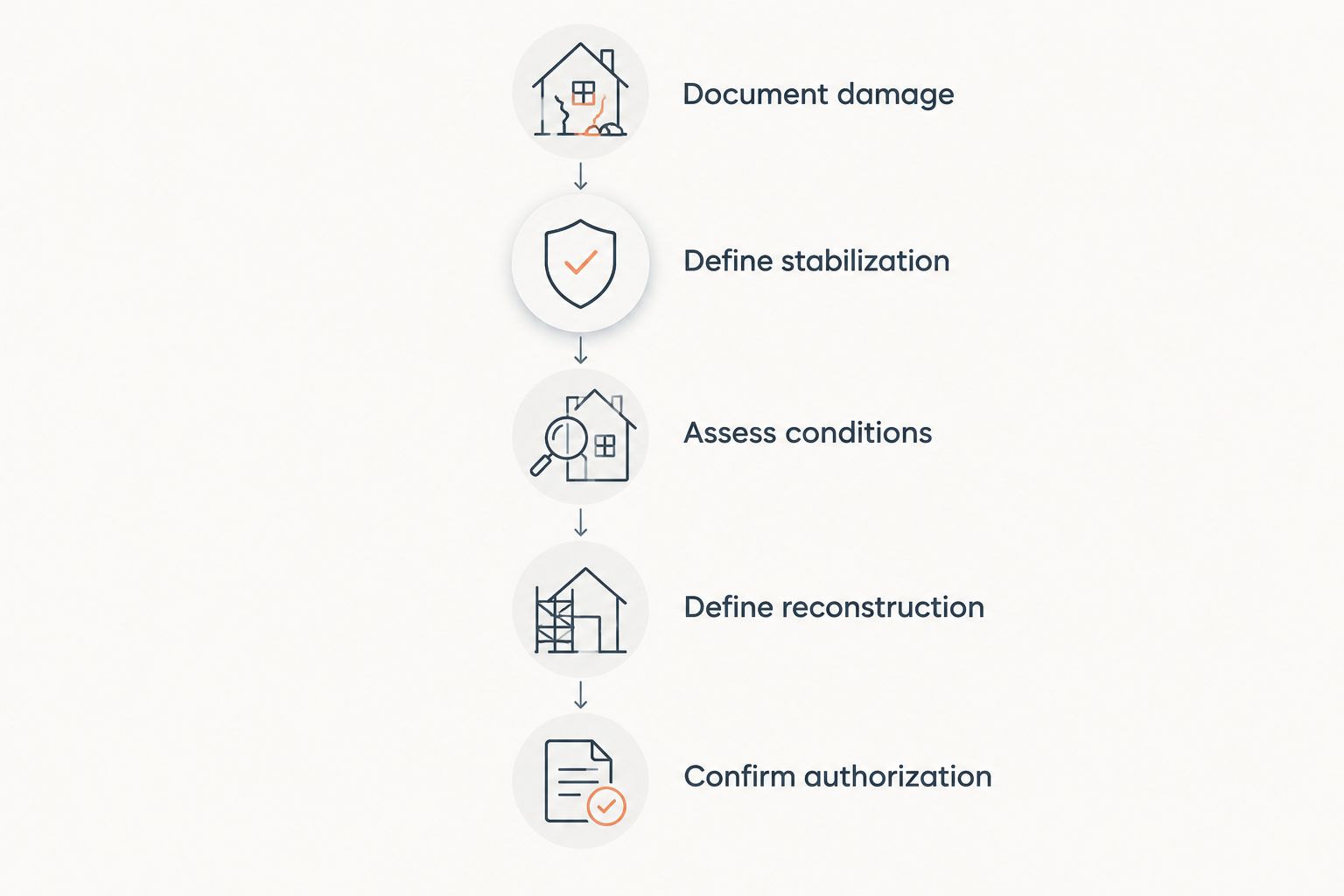
- Document damage. Photograph affected areas from a safe location. Record when you noticed the damage and identify any temporary measures already taken.
- Define stabilization. Ask which actions are needed to limit further exposure and which conditions require specialist attention before work proceeds.
- Assess conditions. Identify what can be inspected now and what requires selective removal, moisture evaluation, or professional assessment.
- Define reconstruction. Request materials, quantities, affected locations, exclusions, and the process for concealed damage.
- Confirm authorization. Establish who can approve work, how changes are documented, and which decisions must be resolved before each stage begins.
Keep photographs, estimates, authorizations, receipts, and correspondence in 1 repair log. That gives you a single record when the contractor, insurer, property manager, or another professional needs to review a decision.
For a 2026 project, identify who controls approvals before the first change arises. In a managed building, the person reporting damage is not necessarily the person authorized to approve work on shared components.
How do emergency repairs and insurance fit together?
A contractor’s repair scope and an insurer’s coverage decision answer different questions. The contractor describes the work; the insurer evaluates the claim under the policy.
Notify your insurer promptly and ask what documentation it needs. Record temporary measures and preserve evidence when doing so is safe. Do not delay action on an immediate safety hazard while waiting for routine claim correspondence.
Before permanent reconstruction, reconcile differences between the proposed repair scope and the insurer’s assessment. Ask whether a disagreement concerns damage extent, repair method, materials, or policy coverage; each requires a different response.
Use the guide to connecting a homeowners insurance claim to a storm rebuild to organize those handoffs. Do not treat a contractor’s estimate as a promise of reimbursement.
What does the emergency repair estimate leave out?
An emergency repair estimate covers only its stated scope. Ask whether it includes assessment, drying, removal, permanent reconstruction, approvals, and closeout before treating it as the complete project total.
Should you authorize permanent repairs immediately?
Authorize permanent repairs after the necessary assessment and scope decisions are complete. Immediate protection and safety work are separate decisions; a temporary measure does not justify closing damaged assemblies before their condition is understood.
Can you compare estimates with different repair methods?
Compare repair methods only after each contractor explains what the method restores and what it leaves unchanged. A surface repair and replacement of an affected assembly are not equivalent simply because both address the same visible stain.
Choose the contractor around the actual work
A storm can leave you needing specialist damage assessment, temporary protection, reconstruction, or a combination. Choose the provider around the documented scope, not the urgency of the sales pitch.
For general reconstruction, ask who manages subcontractors, inspections, site protection, and changes. For specialist work, ask who performs it and how its findings reach the contractor responsible for rebuilding.
Aandeconstructionllc is a fit for owners seeking general contracting for residential or commercial renovation in the DC area. Confirm the storm-related scope before engaging the company; general contracting services do not by themselves establish emergency response times, water-remediation capabilities, or insurance-claim management.
When requesting a site review, send the property address, photographs taken safely, affected rooms or building areas, known hazards, temporary work already completed, available reports, and your target schedule. State whether the building remains occupied and who can authorize the work.
Request a repair scope review
Share the property address, damage photos, temporary repairs, available reports, and target schedule.
FAQ
What's included in emergency storm damage repair cost?
Emergency storm damage repair cost includes only the work listed in the estimate. Ask for separate descriptions of immediate protection, assessment and preparation, permanent reconstruction, and closeout.
Is a temporary roof covering the same as a roof repair?
A temporary roof covering is not the same as a permanent roof repair. Ask what it protects, who checks it, and what separate work restores the damaged roof assembly.
Will homeowners insurance cover all the storm repair work?
Coverage depends on your policy and the insurer's claim decision. Keep the contractor's repair scope separate from the coverage determination and confirm unresolved items with your insurer.
Should I get more than one storm repair estimate?
Compare written estimates when conditions allow, using the same requested scope. Do not postpone action on an immediate safety hazard solely to collect competing proposals.
Can a contractor guarantee there is no hidden storm damage?
An inspection of visible surfaces does not establish the condition of concealed assemblies. Ask the contractor to document inspection limits and explain how newly discovered damage will be assessed and authorized.
Do I need a permit for storm damage repairs in DC?
Permit requirements depend on the actual repair scope. Confirm applicable requirements with the local permitting authority before permanent work and identify who handles applications and inspections.
Can Aandeconstructionllc help with storm-related renovation?
Aandeconstructionllc provides residential and commercial general contracting in the DC area. Request a scope review to confirm whether your storm-related renovation fits its services; do not assume emergency dispatch or specialist remediation is included.
One last thing
Do not approve the finish before you understand the assembly behind it. A freshly painted ceiling is a visible result, not proof that the water-entry source and affected materials have been addressed.
Before signing your 2026 reconstruction agreement, ask: What failed, what was inspected, and what must be confirmed before this area is closed? Put those answers in the scope. They matter more than an unexplained total at the bottom of the page.