
A kitchen remodel is worth it in 2026 when it fixes problems you live with, fits your finances, and supports how you plan to use or sell your home. It is not automatically worth it as a resale investment: a higher sale price is different from recovering everything you spend. Include the disruption, temporary cooking arrangements, and any work needed behind the finishes before deciding.
- Is a kitchen remodel worth it? Yes, when the scope solves real problems without depending on full resale recovery.
- Keep a workable layout; change it only when the improvement justifies the additional construction.
- Aandeconstructionllc offers kitchen remodeling; request a defined scope before committing to construction.
- Separate kitchen renovation benefits you will enjoy from resale value that requires local market evidence.
Is a kitchen remodel worth it in 2026?
Yes for a defined improvement; no for an assumed financial return. A kitchen that lacks usable preparation space presents a different decision from one that works well but looks dated. Match the work to the problem, rather than treating a full replacement as the starting point.
Compare disruption alongside the finished result. The guide to how long a kitchen remodel takes helps frame the scheduling questions to ask before choosing your scope.
| Remodeling option | Best for | Main benefit | Main drawback | Decision rule |
|---|---|---|---|---|
| Targeted refresh | Homeowners with a functional kitchen and worn finishes | Preserves elements that still work | Leaves layout limitations unresolved | Choose when appearance is the actual problem |
| Same-layout replacement | Homeowners with failing cabinets or surfaces but workable circulation | Replaces worn components without deliberately redesigning the room | Still involves demolition and installation disruption | Choose when replacement solves the documented problems |
| Layout-changing remodel | Homeowners whose kitchen arrangement obstructs everyday use | Addresses circulation, storage access, or workspace placement | Adds design and construction dependencies | Choose only when the existing arrangement is the problem |
| Repair and defer | Homeowners without a clear scope or settled housing plans | Addresses necessary repairs while preserving future choices | Leaves nonessential improvements unfinished | Choose when a larger commitment is not justified |
These are scope choices, not promises about resale performance. A refresh is not the right answer for a failed layout, and a new layout is not necessary just because the finishes look old.
Why this matters
A kitchen remodel combines a household decision with a construction decision. You need a room that works, but you also need a project you can carry through without relying on an uncertain sale outcome.
For your 2026 decision, keep three benefits separate: daily usefulness, replacement of worn components, and potential buyer appeal. Each supports a different scope. Combining them into a vague goal such as making the kitchen better makes it harder to reject unnecessary work.
Write down what success means before discussing finishes. Being able to unload the dishwasher without blocking another person is a testable outcome; wanting a more impressive kitchen is not a construction brief.
When a targeted refresh is worth it
A targeted refresh fits a kitchen whose layout, cabinets, and essential systems remain suitable for your needs. Focus on the specific worn or inconvenient elements rather than replacing the room by default.
Best for: homeowners who like how their kitchen works but dislike its condition or appearance. Possible work includes finish updates or selected component replacements, subject to checking the condition and compatibility of what stays.
The advantage is restraint. The limitation is that cosmetic work does not solve poor circulation, damaged cabinet boxes, or inadequate preparation space. Do not put new finishes over a problem that requires investigation first.
Before choosing a refresh, ask the contractor to identify retained elements explicitly. A proposal should make clear what stays, what changes, and how the new work meets the old work.
When a same-layout replacement is worth it
A same-layout replacement makes sense when the room arrangement works but the components no longer do. You retain the general placement of major functions while replacing the elements included in the agreed scope.
Best for: homeowners who need replacement rather than a different floor plan. Keeping the arrangement gives the project a clear boundary, but it does not mean every existing connection or concealed condition is acceptable.
The drawback is disruption without a fundamentally different room. If your main complaint is a cramped route through the kitchen, replacing cabinets in the same positions leaves that complaint unresolved.
For a 2026 proposal, request a written distinction between retained locations and retained infrastructure. Keeping a sink in the same place does not, by itself, establish the condition of the plumbing serving it.
When a layout-changing remodel is worth it
A layout change earns its place when the current arrangement prevents the kitchen from working for your household. Examples include conflicting appliance doors, inaccessible storage, or a preparation area separated from the tasks it serves.
Best for: homeowners with a specific functional problem that replacement alone cannot fix. Ask the designer or contractor to show how the proposed arrangement resolves that problem before choosing finishes.
The benefit is a different working environment. The drawback is a wider set of dependencies: changes involving walls, plumbing, electrical work, or ventilation require assessment and coordination appropriate to the project.
Do not approve a layout just because it looks open on a drawing. Check appliance clearances, cabinet access, seating conflicts, and the route through the room with the proposed elements in place.
Why a kitchen remodel's value varies
The value of a kitchen remodel depends on what you need, what the home already provides, and what the proposed work changes. Use these factors to separate necessary improvements from optional additions:
- Your ownership plans: Work you expect to use yourself has a different justification from work intended mainly to support an upcoming sale.
- Existing condition: Damaged components call for a different response from intact finishes you simply dislike.
- Layout performance: Replacing surfaces does not resolve a circulation or workspace problem.
- Scope dependencies: Moving major functions introduces questions about the systems and construction supporting them.
- Local resale evidence: A buyer-facing renovation needs advice grounded in comparable properties, not a general recovery promise.
- Household disruption: Losing normal cooking access affects whether the project is practical for you now.
No single factor settles the decision. An attractive resale story does not make an unaffordable scope sensible, and a modest project is not good value if it leaves your central problem untouched.
How do you decide before signing a contract?
Use a written decision sequence. It keeps the conversation focused on what the kitchen needs to do and gives you a basis for comparing proposals.
- Define problems. List the daily tasks the current kitchen makes difficult. Describe the task and obstruction rather than naming a product you want.
- Check conditions. Have the relevant existing components and proposed work assessed. Resolve questions about what can stay before treating retention as a firm assumption.
- Compare scopes. Ask how a targeted approach differs from replacement or reconfiguration. Each proposal should address the same underlying problems.
- Confirm dependencies. Identify design decisions, approvals, material selections, and inspections relevant to the scope. Assign responsibility for each item.
- Approve boundaries. Confirm inclusions, exclusions, allowances, and the process for authorizing changes. Decide what would cause you to reduce scope or pause.
Treat this sequence as a decision tool, not a substitute for project-specific assessment. Each step should produce something you can review: a problem list, condition notes, comparable scopes, responsibilities, or an agreed boundary.
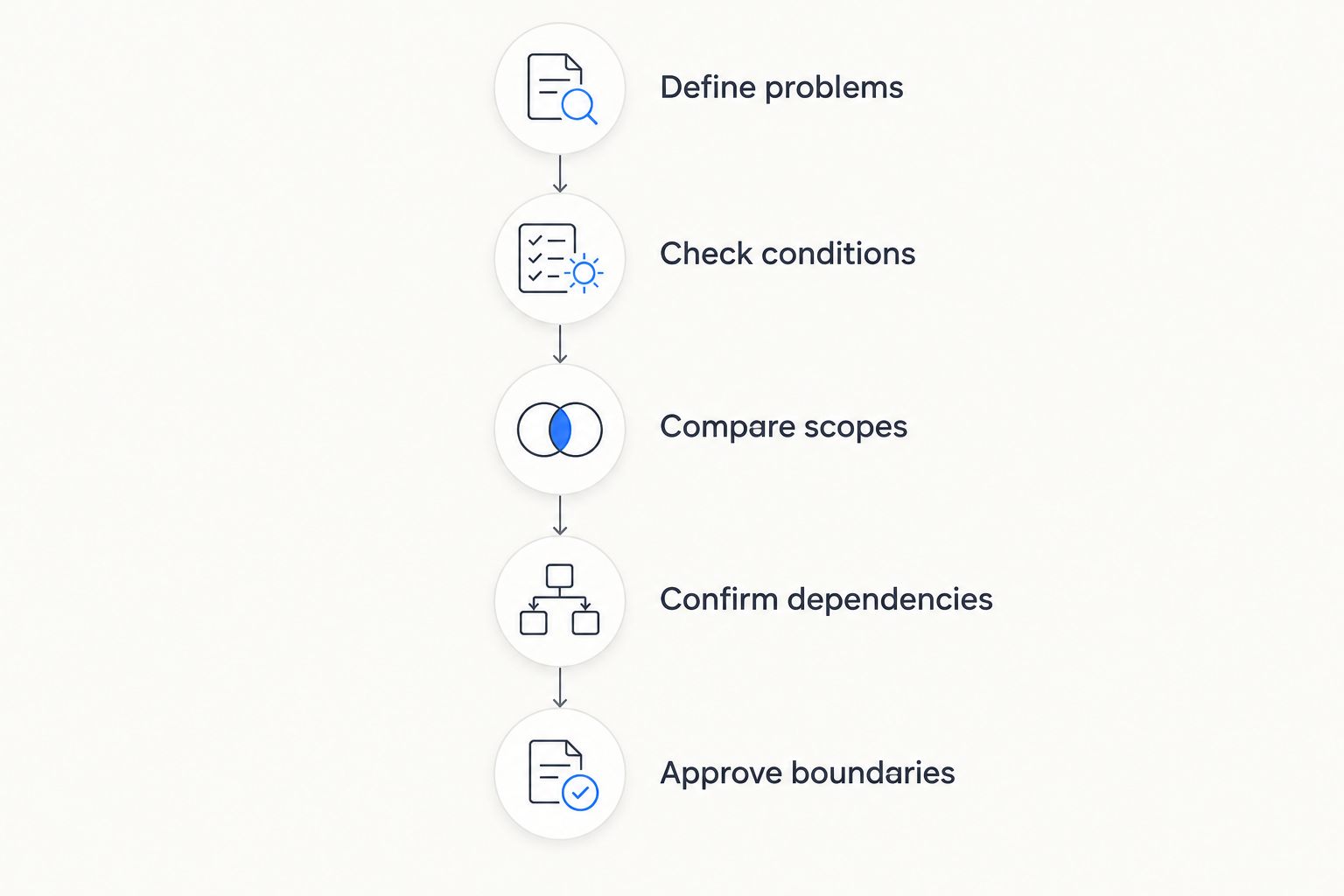
A proposal becomes easier to evaluate when every major item connects to a stated need. If an expensive-looking feature has no connection to your priorities, treat it as optional rather than allowing it to define the project.
Is a kitchen remodel worth it before selling?
A kitchen remodel before selling is justified only when local market evidence supports the proposed work and its disruption. Ask a local real estate professional to distinguish problems that affect marketability from finishes buyers simply prefer.
Do not assume a larger remodel produces a better net result. Compare selling as-is, making necessary repairs, and completing a defined update. Include transaction timing and the burden of managing construction in that decision.
For a 2026 sale, use current comparable properties rather than treating a general remodeling return figure as a forecast for your address. A finished kitchen can improve presentation without returning the full project expenditure.
Should you remodel if you plan to stay?
A kitchen remodel is easier to justify for continued use when you can name the recurring problems it will remove. The benefit is personal and practical; it does not require a promise of full resale recovery.
Still, separate what you need from what you admire. Better access to everyday storage has a clear purpose. Replacing functional elements solely to match a trend needs a separate justification within your household finances.
Before committing, describe an ordinary meal from preparation through cleanup in the proposed kitchen. Check whether the design improves that sequence or merely changes the room's appearance.
What should a kitchen remodeling proposal explain?
A useful proposal connects the design to the construction work. It should describe demolition, retained components, installation, relevant trade work, and finishing responsibilities clearly enough that you understand what you are approving.
Review these items together:
- Scope boundaries: Which cabinets, surfaces, appliances, and adjacent finishes are included or excluded?
- Project responsibilities: Who handles design, applicable permits, selections, and inspections?
- Unresolved conditions: What still needs investigation, and how will findings affect the scope?
- Household arrangements: How will access, protection, cleanup, and loss of normal kitchen use be addressed?
- Changes and completion: How are changes authorized, and how are incomplete items documented?
Aandeconstructionllc is a kitchen remodeling option for homeowners seeking a general contractor in DC, Maryland, and Virginia. Its stated services fit that need; suitability for your project still depends on the proposed scope, responsibilities, and contract.
Bring your site address, kitchen photos, existing plans if available, the problems you want solved, and your target schedule to the initial discussion. Ask for a site review before treating a preliminary concept as a construction-ready plan.
Discuss your kitchen with Aandeconstructionllc
Share your address, kitchen photos, priorities, and target schedule to request a site review.
FAQ
Is a kitchen remodel worth it in 2026?
A kitchen remodel is worth it in 2026 when the agreed scope fixes meaningful problems and fits your finances. Do not depend on recovering the full expenditure when you sell.
Will I get all my money back from a kitchen remodel?
Full recovery is not guaranteed. Assess resale-focused work using current local comparable properties and advice specific to your home.
Is a kitchen refresh better than a full remodel?
A refresh is better when the existing kitchen functions well and the problem is limited to condition or appearance. It is not a substitute for resolving layout problems or damaged underlying components.
Should I keep my existing kitchen layout?
Keep the existing layout when it supports your daily tasks and the retained components are suitable. Request a layout change only when it solves a problem the current arrangement cannot.
Should I remodel my kitchen before putting my house on the market?
Remodel before selling only when property-specific evidence supports the proposed scope. Compare necessary repairs and limited updates against selling without a larger renovation.
How do I compare kitchen remodeling proposals?
Compare proposals against the same written scope, retained elements, exclusions, and responsibilities. Resolve differences before treating the proposals as equivalent.
Does Aandeconstructionllc offer kitchen remodeling?
Aandeconstructionllc lists kitchen remodeling among its general contracting services for the DC, Maryland, and Virginia area. Request a project-specific site review and written scope to assess the fit.
One last thing
Before approving your 2026 kitchen remodel, write a list of what should stay. Include functional elements you like, useful storage, and features that already support your routine. Give that list the same attention as your replacement list.
A worthwhile remodel does not require changing everything. It requires changing the things that prevent the kitchen from working for you—and knowing why each change belongs in the contract.